Behavior
Which one should I actually get?
If you have the space and want a calmer giant that's genuinely gentle with kids and strangers, Newfoundland. If you want a smaller, more alert working dog and can meet its exercise needs, Shepherd.

Quick answer
Which one should I actually get?
If you have the space and want a calmer giant that's genuinely gentle with kids and strangers, Newfoundland. If you want a smaller, more alert working dog and can meet its exercise needs, Shepherd.
German Shepherd or Newfoundland? On paper they differ most on exercise need, and on the scales Newfoundland is the heavier at 100–150 lbs. Here is how the two compare on everything that shapes an ordinary week.
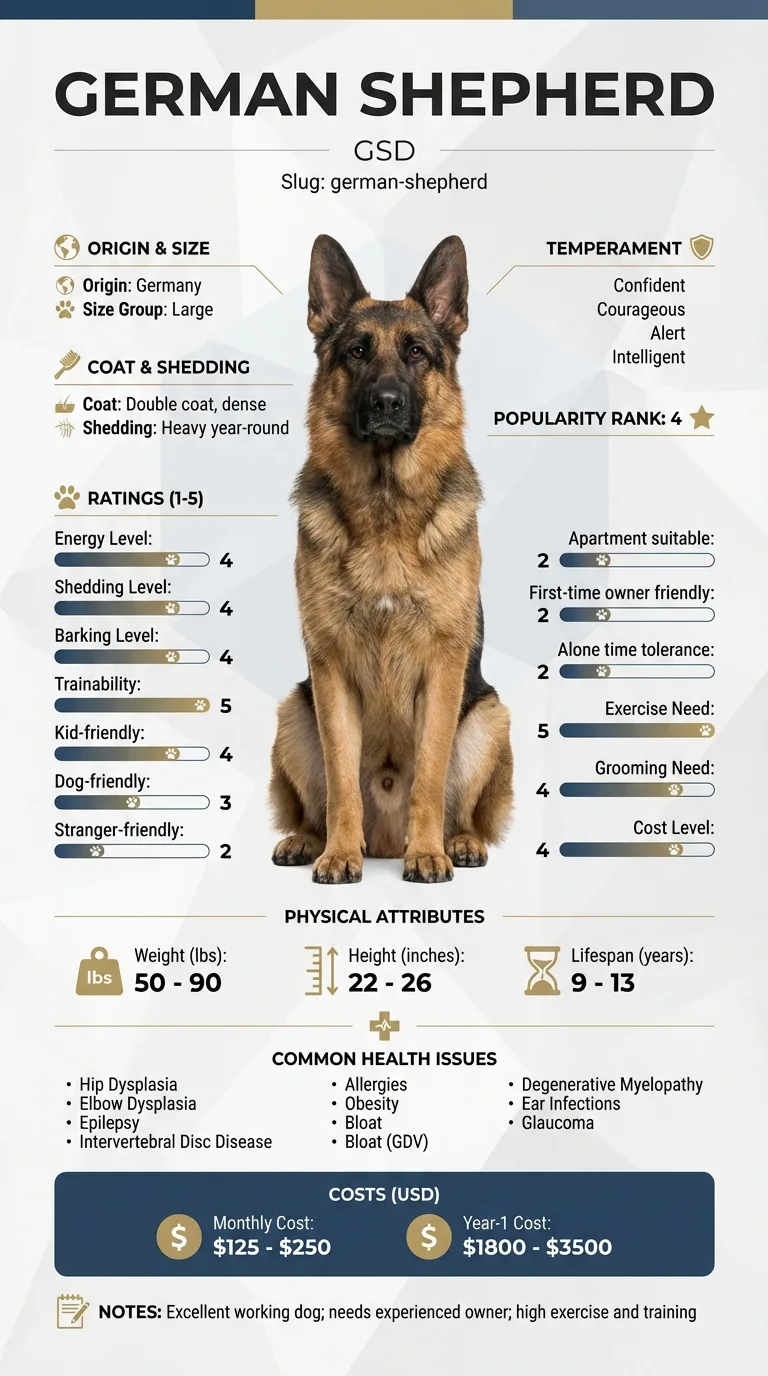
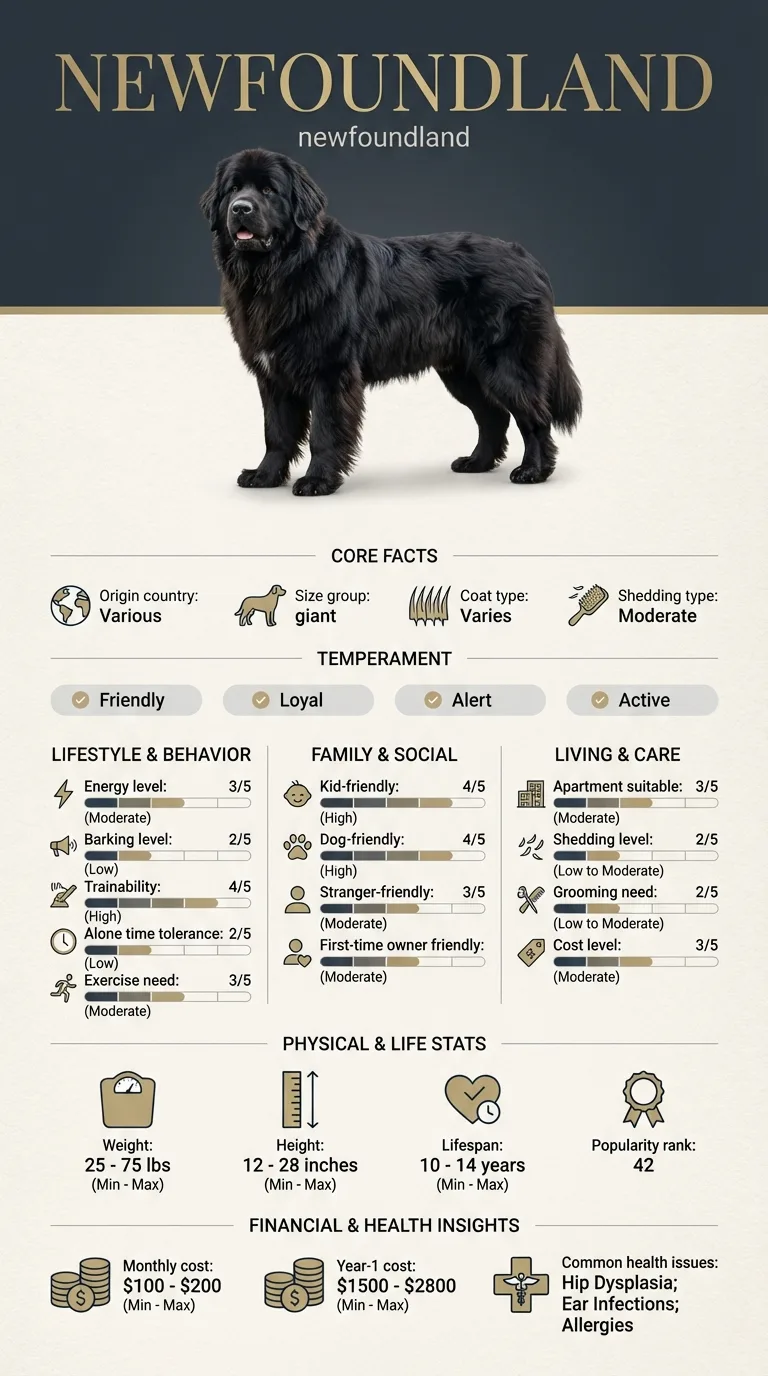
This is for someone already down to German Shepherd and Newfoundland and deciding between them. For this pair the decision usually turns on exercise need and energy level, so those are covered first and in most detail. Anyone choosing from a flat has a clear answer here: German Shepherd rates 2/5 against 1/5. Breed history is left out; what follows is what you will actually live with.
Between German Shepherd and Newfoundland, exercise need is what separates them, and Newfoundland is the lower-effort dog of the two to keep.
Choose German Shepherd if shedding is a problem in your house, you want a dog that picks up training quickly and a smaller dog suits your car, your home or your back.
Choose Newfoundland if this is your first dog, your walking routine is modest and the dog will be alone during the working day.
| Feature | german shepherd | newfoundland | Winner |
|---|---|---|---|
| Size class | large | giant | Equal |
| Weight | 50–90 lbs | 100–150 lbs | Equal |
| Height | 22–26 in | 26–28 in | Equal |
| Lifespan | 9–13 years | 9–10 years | german shepherd |
| Exercise need | Very high (5/5) | Moderate (3/5) | newfoundland |
| Grooming need | High (4/5) | High (4/5) | Equal |
| Shedding | High (4/5) | Very high (5/5) | german shepherd |
| Energy level | High (4/5) | Low (2/5) | Equal |
| Barking | High (4/5) | Low (2/5) | newfoundland |
| Apartment suitability | Low (2/5) | Very low (1/5) | german shepherd |
| Good for first-time owners | Low (2/5) | Moderate (3/5) | newfoundland |
| Tolerates being alone | Low (2/5) | Moderate (3/5) | newfoundland |
| Trainability | Very high (5/5) | High (4/5) | german shepherd |
| Good with kids | High (4/5) | Very high (5/5) | newfoundland |
| Good with other dogs | Moderate (3/5) | High (4/5) | newfoundland |
| Friendly to strangers | Low (2/5) | High (4/5) | newfoundland |
| Cost level | High (4/5) | Very high (5/5) | german shepherd |
| Coat | Double coat, dense | Heavy water-resistant double coat | Equal |
| Origin | Germany | Various | Equal |
| Typical monthly cost | $125–$250 | $150–$310 | Equal |
| Typical first-year cost | $1,800–$3,500 | $2,200–$4,200 | Equal |
Step up from a German Shepherd to a Newfoundland and you're adding 50 to 60 lbs of dog, the Newf runs 100-150 lbs against the Shepherd's 50-90, moving from the large category into giant territory. Height gains are smaller, 26-28 inches versus 22-26, so most of that extra weight is bulk and bone density, not just a taller dog.
This is one of the bigger reversals in the whole comparison: the Shepherd needs 5/5 exercise, the Newfoundland just 3/5, and energy level tells the same story even more starkly, 4/5 against a genuinely low 2/5. A Newfoundland is a giant breed content with a moderate walk and some water play; a Shepherd wants a job.
Grooming ties at 4/5, but shedding actually favors the Shepherd here, 4/5 versus the Newfoundland's 5/5. The Newf's heavy, water-resistant double coat sheds more heavily and mats more readily around the legs and britches, so despite being the calmer dog day to day, it's the messier one to keep looking presentable.
Neither breed suits small spaces, but the Newfoundland is worse off, 1/5 for apartment suitability against the Shepherd's already-poor 2/5. The compensation is noise: the Newf barks at just 2/5 versus the Shepherd's 4/5, and it tolerates being alone somewhat better too, 3/5 against 2/5. A Newfoundland needs square footage more than constant company.
Trainability favors the Shepherd, 5/5 to 4/5, but first-time-owner suitability tips slightly toward the Newfoundland, 3/5 against 2/5. Neither is really a beginner's dog given their size and exercise demands, but the Newf's naturally gentler temperament makes early handling mistakes less likely to escalate into a real training problem.
The Newfoundland outperforms the Shepherd across the board here: 5/5 with kids against 4/5, 4/5 with other dogs against 3/5, and 4/5 with strangers against a wary 2/5. Newfoundlands were bred as calm working companions around people, and it shows, this is the more naturally sociable of the two breeds by a clear margin.
The Shepherd actually wins on lifespan here, 9-13 years against the Newfoundland's shorter 9-10, a reminder that giant breeds tend to have compressed lifespans regardless of temperament. Health overlap is limited to hip dysplasia and bloat. The Newfoundland's remaining risks are cardiac, subaortic stenosis and dilated cardiomyopathy, which a cardiac screening before purchase can help rule out.
Cost level rates 4/5 for the Shepherd and a higher 5/5 for the Newfoundland, and the dollar figures confirm it: $125-$250 monthly against $150-$310, and first-year costs of $1,800-$3,500 versus $2,200-$4,200. Feeding 100-150 lbs of dog, plus larger doses of any medication, adds up fast even over a shortened lifespan.
German Shepherd weighs 50–90 lbs and lives 9–13 years; Newfoundland weighs 100–150 lbs and lives 9–10 years. The two diverge most on exercise need, energy level and barking and 1 other rated axes. Almost every rated axis separates them at least slightly. The comparison marks an easier option only where one exists. Facts like weight and country of origin are not scored. Both dogs are rated from the same dataset, which is what makes the numbers comparable with each other even though any individual dog sits somewhere inside its breed's range.

Substantially, 100-150 lbs against 50-90, which moves the Newfoundland into the giant-breed category while the Shepherd stays large. The height difference is smaller, just a few inches.
The Newfoundland, by a wide margin, 3/5 exercise need and a low 2/5 energy level, against the Shepherd's 5/5 and 4/5. Despite the size, this is the calmer dog day to day.
The German Shepherd, at 9-13 years against the Newfoundland's 9-10. Giant breeds generally trade size for lifespan, and that holds here.
Very, it rates 5/5 with kids, the top score in this table, against the Shepherd's still-good 4/5. Newfoundlands have a long-standing reputation as gentle family dogs.
The Newfoundland, at $150-$310 monthly and $2,200-$4,200 in the first year, against the Shepherd's $125-$250 and $1,800-$3,500. Sheer body mass drives most of that gap.
Only hip dysplasia and bloat overlap. The Newfoundland's other major risks are cardiac conditions, subaortic stenosis and dilated cardiomyopathy, that aren't on the Shepherd's list.
The Newfoundland, rated 2/5 against the Shepherd's 4/5. It's a quieter breed overall despite its size.
If you have the space and want a calmer giant that's genuinely gentle with kids and strangers, Newfoundland. If you want a smaller, more alert working dog and can meet its exercise needs, Shepherd.
$125-$250 for the Shepherd versus $150-$310 for the Newfoundland, the Newf runs higher.
The Shepherd rates 5/5 versus the Newfoundland's 3/5, the Shepherd needs notably more.
The Shepherd, at 9-13 years versus the Newfoundland's 9-10, slightly longer despite being the smaller-bodied dog here.
Secure checkout on Stripe. We never see your card.
7-day money-back guarantee. Instant access.
Health information here is general and is not veterinary advice. If your dog shows pain, sudden behaviour change, or worsening symptoms, consult a licensed veterinarian.
Some links on this site are affiliate links. We may earn a commission at no extra cost to you, and we only suggest products we believe are helpful for dog owners.
We research and check what we publish, but we do not warrant that any figure, date, price, or statement is accurate, complete, or current, and we accept no liability for any loss, cost, injury, or other harm arising from the use of this site. Use it as one reference among several. You remain responsible for your own decisions and for your dog's care - confirm anything that matters with a licensed veterinarian or another qualified professional before you act on it. Full disclaimer.
Match your lifestyle to the right dog.
Take quizNot sure which breed is right for you? Take our 2-minute quiz to find out.
Take the quiz