Living
Which fits a smaller home?
The Cavalier, clearly — 5/5 apartment suitability against the Newfoundland's 1/5, plus a fraction of the size.

Quick answer
Which fits a smaller home?
The Cavalier, clearly — 5/5 apartment suitability against the Newfoundland's 1/5, plus a fraction of the size.
Cavalier King Charles Spaniel or Newfoundland? On paper they differ most on apartment suitability, and on the scales Newfoundland is the heavier at 100–150 lbs. Here is how the two compare on everything that shapes an ordinary week.
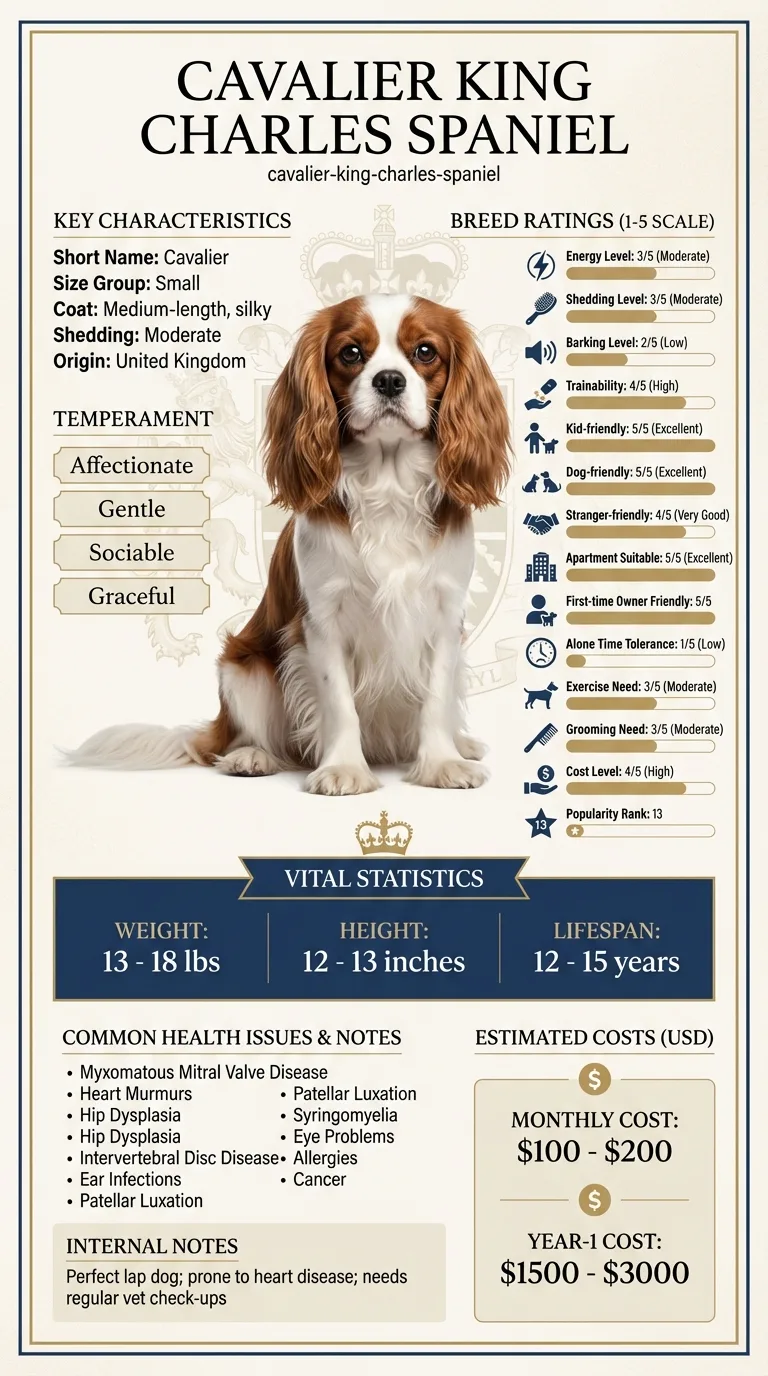
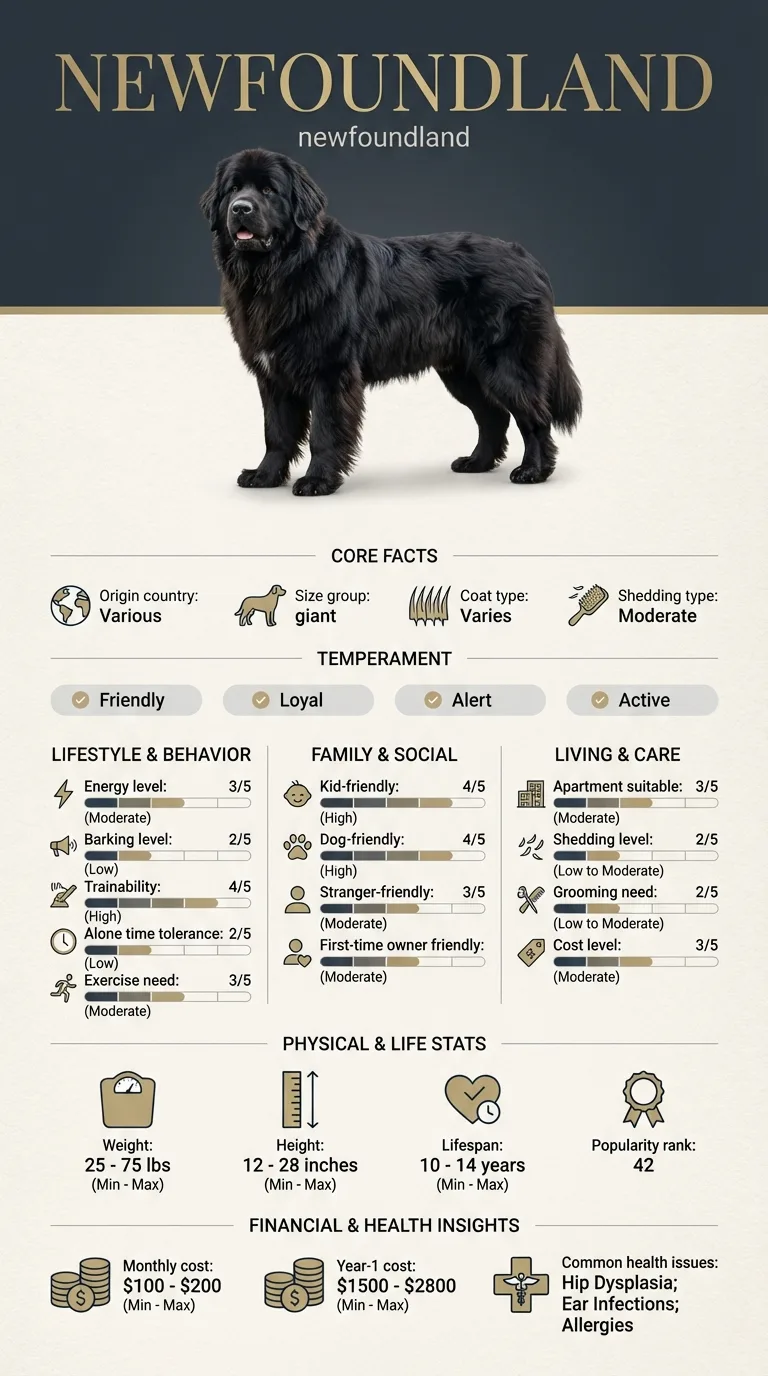
This is for someone already down to Cavalier King Charles Spaniel and Newfoundland and deciding between them. For this pair the decision usually turns on apartment suitability and shedding, so those are covered first and in most detail. Anyone choosing from a flat has a clear answer here: Cavalier King Charles Spaniel rates 5/5 against 1/5. The focus throughout is on daily consequences rather than breed background.
Between Cavalier King Charles Spaniel and Newfoundland, apartment suitability is what separates them, and Cavalier King Charles Spaniel is the lower-effort dog of the two to keep.
Choose Cavalier King Charles Spaniel if you are in a flat or a smaller home, this is your first dog and you do not want a standing grooming appointment.
Choose Newfoundland if the dog will be alone during the working day.
| Feature | cavalier king charles spaniel | newfoundland | Winner |
|---|---|---|---|
| Size class | small | giant | Equal |
| Weight | 13–18 lbs | 100–150 lbs | Equal |
| Height | 12–13 in | 26–28 in | Equal |
| Lifespan | 12–15 years | 9–10 years | cavalier king charles spaniel |
| Exercise need | Moderate (3/5) | Moderate (3/5) | Equal |
| Grooming need | Moderate (3/5) | High (4/5) | cavalier king charles spaniel |
| Shedding | Moderate (3/5) | Very high (5/5) | cavalier king charles spaniel |
| Energy level | Moderate (3/5) | Low (2/5) | Equal |
| Barking | Low (2/5) | Low (2/5) | Equal |
| Apartment suitability | Very high (5/5) | Very low (1/5) | cavalier king charles spaniel |
| Good for first-time owners | Very high (5/5) | Moderate (3/5) | cavalier king charles spaniel |
| Tolerates being alone | Very low (1/5) | Moderate (3/5) | newfoundland |
| Trainability | High (4/5) | High (4/5) | Equal |
| Good with kids | Very high (5/5) | Very high (5/5) | Equal |
| Good with other dogs | Very high (5/5) | High (4/5) | cavalier king charles spaniel |
| Friendly to strangers | High (4/5) | High (4/5) | Equal |
| Cost level | High (4/5) | Very high (5/5) | cavalier king charles spaniel |
| Coat | Medium-length, silky | Heavy water-resistant double coat | Equal |
| Origin | United Kingdom | Various | Equal |
| Typical monthly cost | $100–$200 | $150–$310 | Equal |
| Typical first-year cost | $1,500–$3,000 | $2,200–$4,200 | Equal |
The Newfoundland is a giant in every sense — 100-150 lbs and 26-28 inches, against the Cavalier's 13-18 lbs and 12-13 inches. That's roughly eight times the weight packed into a frame more than double the height. Both are calm-natured dogs, but only one of them can rest its head on a kitchen counter without standing on hind legs.
Exercise need actually ties at moderate (3/5) for both breeds, which surprises people expecting a giant dog to demand marathon walks. The Newfoundland's energy level even rates lower, low (2/5) against the Cavalier's moderate (3/5) — it's a famously laid-back breed once past puppyhood, content with a swim or a steady walk rather than constant activity.
This is where the Newfoundland's size shows up: grooming rates high (4/5) against the Cavalier's moderate (3/5), and shedding jumps to very high (5/5) versus moderate (3/5). That heavy, water-resistant double coat sheds seasonally in volume — expect to vacuum often and invest in a good de-shedding brush if you go this route.
Barking is low for both (2/5), so neither will annoy the neighbors. Apartment suitability is a different story: Cavalier scores very high (5/5), Newfoundland scores very low (1/5) — a 100+ lb dog with a heavy coat needs real space to be comfortable. The Newfoundland does handle alone time better, moderate (3/5) against the Cavalier's very low (1/5).
Trainability ties at high (4/5) for both breeds, so neither is a struggle to teach. First-time-owner suitability favors the Cavalier though, very high (5/5) against the Newfoundland's moderate (3/5) — again, a size and strength issue more than an intelligence one. A Newfoundland puppy that grows into 150 lbs needs consistent handling from day one.
Both score very high (5/5) with kids, and the Newfoundland's sweet, patient temperament has earned it a reputation as a gentle giant around children. Cavaliers edge ahead with other dogs, very high (5/5) against high (4/5), while both are equally friendly to strangers at high (4/5) — sociable dogs on both sides of this comparison.
Lifespan favors the Cavalier substantially, 12-15 years against just 9-10 for the Newfoundland — typical for a giant breed carrying that much body weight. The Newfoundland's health list is shorter but serious: subaortic stenosis, dilated cardiomyopathy, bloat, and cystinuria, plus hip dysplasia. The Cavalier's cardiac risk (mitral valve disease, heart murmurs) runs alongside its own longer list of joint and neurological concerns.
Cost level rates high (4/5) for the Cavalier and very high (5/5) for the Newfoundland, and the dollar ranges follow: $100-200 monthly for the Cavalier against $150-310 for the Newfoundland, $1,500-3,000 versus $2,200-4,200 in year one. Food volume and that heavy coat's grooming needs are the two obvious cost drivers for the bigger dog.
Cavalier King Charles Spaniel weighs 13–18 lbs and lives 12–15 years; Newfoundland weighs 100–150 lbs and lives 9–10 years. The two diverge most on apartment suitability, shedding and good for first-time owners and 1 other rated axes. They are level on barking, exercise need and good with kids, so those cannot decide it. The table below marks a winner only where one breed is genuinely easier for a typical owner; size and origin are facts rather than merits and stay level. Ratings come from one source applied to both breeds, so they are meaningful against each other rather than as absolute scores.

A lot more — 100-150 lbs against the Cavalier's 13-18 lbs, so a full-grown Newfoundland can outweigh a Cavalier by eight times or more. Height runs 26-28 inches versus 12-13.
The Newfoundland, considerably — very high (5/5) shedding against the Cavalier's moderate (3/5), driven by that heavy water-resistant double coat. Expect seasonal blowouts that need real management.
Workable but not ideal — it rates moderate (3/5) against the Cavalier's very high (5/5). The Newfoundland's calm temperament helps, but its eventual size means a first-timer needs to commit to early, consistent training.
The Cavalier, decisively — very high (5/5) apartment suitability against the Newfoundland's very low (1/5). A dog that can reach 150 lbs with a thick coat needs space this pairing's numbers make clear the Cavalier alone can offer.
The Newfoundland runs higher across the board: $150-310 a month versus $100-200 for the Cavalier, and $2,200-4,200 versus $1,500-3,000 in the first year. Larger food bills and coat care account for most of the gap.
Hip dysplasia and heart-related conditions show up for both, though the specifics differ — mitral valve disease for the Cavalier versus subaortic stenosis and dilated cardiomyopathy for the Newfoundland. Bloat is a Newfoundland-specific risk not listed for the Cavalier.
The Newfoundland, moderate (3/5) against the Cavalier's very low (1/5). The Cavalier was bred as a close companion dog and tends to struggle more with solitude than most breeds, the Newfoundland included.
The Cavalier, clearly — 5/5 apartment suitability against the Newfoundland's 1/5, plus a fraction of the size.
About $700-1,200 more in year one: $2,200-4,200 versus $1,500-3,000 for the Cavalier.
Neither, really — both rate moderate (3/5); the Newfoundland's size doesn't translate into a higher activity demand.
The Cavalier, 12-15 years against 9-10 for the Newfoundland — a gap typical of giant breeds.
Secure checkout on Stripe. We never see your card.
7-day money-back guarantee. Instant access.
Health information here is general and is not veterinary advice. If your dog shows pain, sudden behaviour change, or worsening symptoms, consult a licensed veterinarian.
Some links on this site are affiliate links. We may earn a commission at no extra cost to you, and we only suggest products we believe are helpful for dog owners.
We research and check what we publish, but we do not warrant that any figure, date, price, or statement is accurate, complete, or current, and we accept no liability for any loss, cost, injury, or other harm arising from the use of this site. Use it as one reference among several. You remain responsible for your own decisions and for your dog's care - confirm anything that matters with a licensed veterinarian or another qualified professional before you act on it. Full disclaimer.
Match your lifestyle to the right dog.
Take quizNot sure which breed is right for you? Take our 2-minute quiz to find out.
Take the quiz