Living
Which fits a small living space better?
The Bulldog, decisively — very high apartment suitability versus the Newfoundland's very low rating.

Quick answer
Which fits a small living space better?
The Bulldog, decisively — very high apartment suitability versus the Newfoundland's very low rating.
Bulldog (English) or Newfoundland? On paper they differ most on apartment suitability, and on the scales Newfoundland is the heavier at 100–150 lbs. Here is how the two compare on everything that shapes an ordinary week.
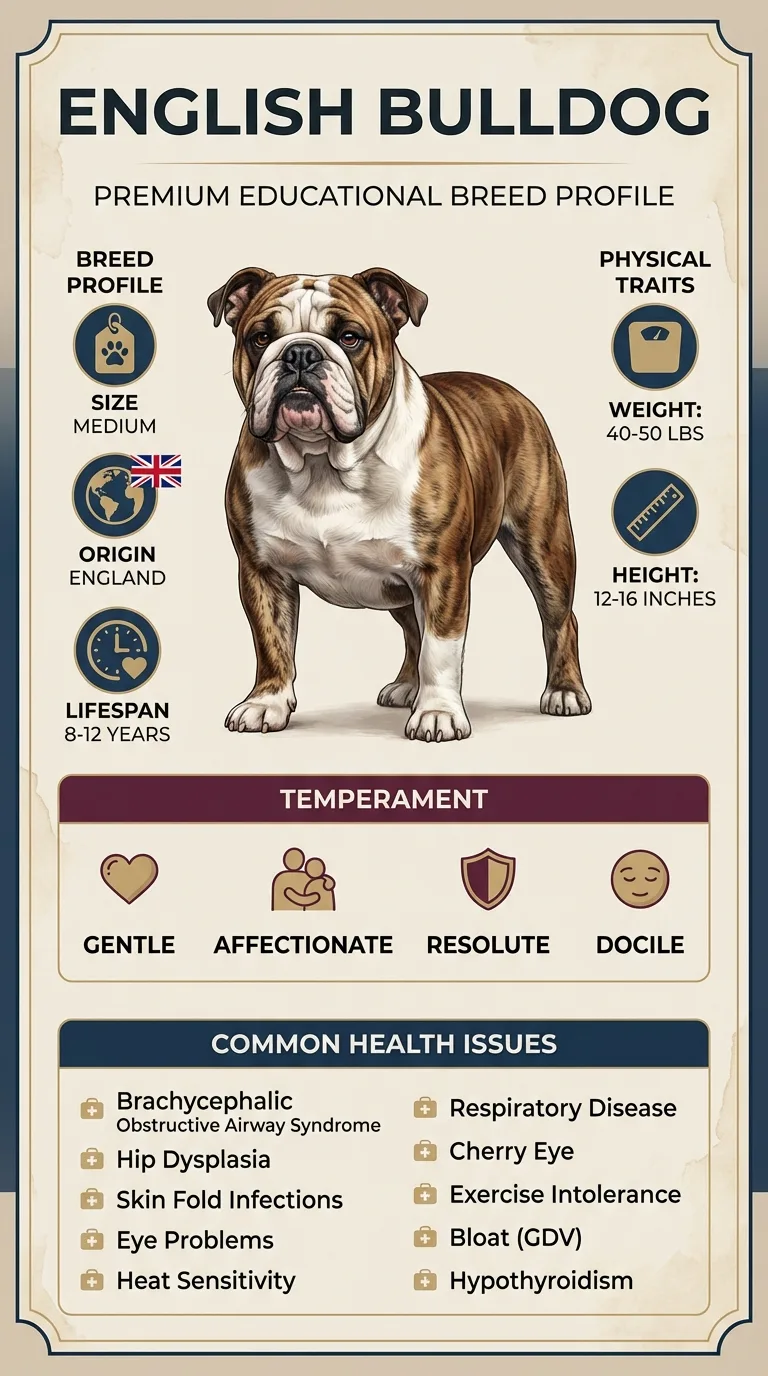
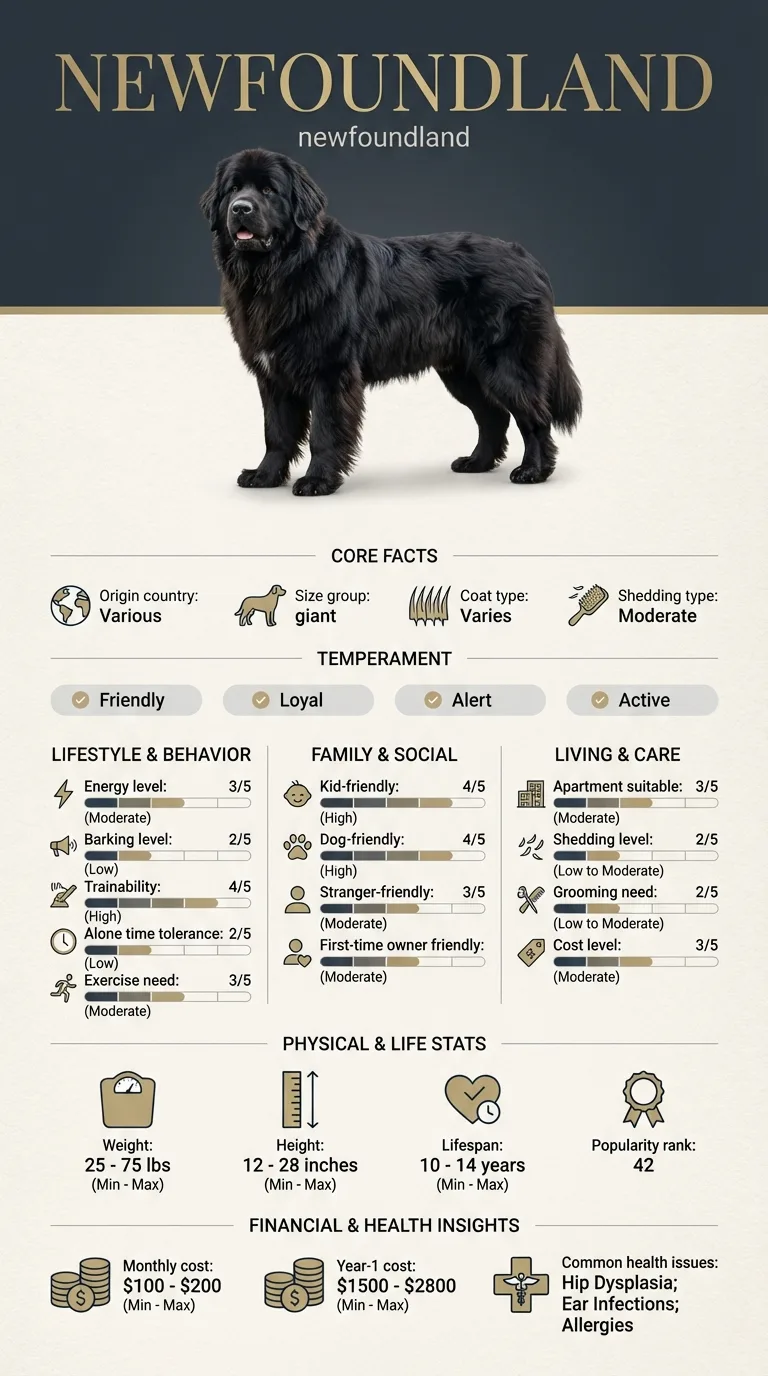
This is for someone already down to Bulldog (English) and Newfoundland and deciding between them. For this pair the decision usually turns on apartment suitability and shedding, so those are covered first and in most detail. Anyone choosing from a flat has a clear answer here: Bulldog (English) rates 5/5 against 1/5. The focus throughout is on daily consequences rather than breed background.
Between Bulldog (English) and Newfoundland, apartment suitability is what separates them, and Bulldog (English) is the lower-effort dog of the two to keep.
Choose Bulldog (English) if you are in a flat or a smaller home, you do not want a standing grooming appointment and shedding is a problem in your house.
Choose Newfoundland if you want a dog that picks up training quickly and you want a dog that can keep up with an active routine.
| Feature | bulldog | newfoundland | Winner |
|---|---|---|---|
| Size class | medium | giant | Equal |
| Weight | 40–50 lbs | 100–150 lbs | Equal |
| Height | 12–16 in | 26–28 in | Equal |
| Lifespan | 8–12 years | 9–10 years | bulldog |
| Exercise need | Low (2/5) | Moderate (3/5) | bulldog |
| Grooming need | Moderate (3/5) | High (4/5) | bulldog |
| Shedding | Moderate (3/5) | Very high (5/5) | bulldog |
| Energy level | Low (2/5) | Low (2/5) | Equal |
| Barking | Low (2/5) | Low (2/5) | Equal |
| Apartment suitability | Very high (5/5) | Very low (1/5) | bulldog |
| Good for first-time owners | Moderate (3/5) | Moderate (3/5) | Equal |
| Tolerates being alone | Moderate (3/5) | Moderate (3/5) | Equal |
| Trainability | Moderate (3/5) | High (4/5) | newfoundland |
| Good with kids | Very high (5/5) | Very high (5/5) | Equal |
| Good with other dogs | High (4/5) | High (4/5) | Equal |
| Friendly to strangers | High (4/5) | High (4/5) | Equal |
| Cost level | Very high (5/5) | Very high (5/5) | Equal |
| Coat | Short, smooth | Heavy water-resistant double coat | Equal |
| Origin | England | Various | Equal |
| Typical monthly cost | $150–$350 | $150–$310 | Equal |
| Typical first-year cost | $2,500–$5,000 | $2,200–$4,200 | Equal |
Forget the size-class label for a second — 'giant' undersells it. A Newfoundland can weigh 100 to 150 pounds and stand 26 to 28 inches at the shoulder, three to four times the mass of a Bulldog's 40 to 50 pounds and 12 to 16 inches. This is not a case of picking a slightly bigger dog; it's picking between a compact, low-slung breed and one that can rest its head on a kitchen counter.
Exercise needs favor the Bulldog on paper, low (2/5) against the Newfoundland's moderate (3/5), though both are calm dogs by temperament. The Newfoundland's extra exercise requirement is not about intensity, it's about a big-bodied breed needing enough movement to stay in shape and avoid joint strain. A short daily walk suffices for the Bulldog; the Newfoundland does better with more consistent activity.
The Newfoundland asks for real commitment here. Its heavy, water-resistant double coat rates high (4/5) for grooming and very high (5/5) for shedding — expect fur in volume, especially during seasonal blowouts. The Bulldog sits lower on both counts, moderate (3/5) grooming and moderate (3/5) shedding. The size difference between these two breeds actually understates how much more hair the Newfoundland produces.
This is the sharpest split in the whole comparison: the Bulldog rates very high (5/5) for apartment suitability, the Newfoundland very low (1/5). A 120-plus pound dog with a thick coat needs space to move and stay cool. Barking and time-alone tolerance are rated the same for both, so it's specifically square footage that separates them, not noise or independence.
Both breeds rate moderate (3/5) for first-time owners, so neither is a bad starter breed on that front. Trainability tips toward the Newfoundland, high (4/5) against the Bulldog's moderate (3/5) — it's a breed bred to work alongside people and takes direction more readily. The Bulldog isn't resistant to training, it just needs more patience and shorter, more motivating sessions.
Both breeds rate very high (5/5) with kids, and both rate high (4/5) with other dogs and with strangers — on paper this is a wash. The practical difference is proportion: a Newfoundland's size means supervising toddler interactions is about controlling a much larger body, even a gentle one, while a Bulldog's smaller frame is easier to manage in a crowded living room.
The data gives the Bulldog a slight edge on lifespan, 8 to 12 years against the Newfoundland's tighter 9 to 10. Both carry breed-specific structural risk: the Bulldog's list runs to airway and skin issues, while the Newfoundland's centers on the heart and joints — subaortic stenosis, dilated cardiomyopathy, hip dysplasia. Bloat (GDV) appears on both lists, a shared reason to feed either breed smaller, slower meals.
Cost lands close to even. The Bulldog runs $150 to $350 a month and $2,500 to $5,000 in year one; the Newfoundland runs $150 to $310 a month and $2,200 to $4,200, both rated very high (5/5) overall. Don't let the size difference fool you into assuming the giant breed costs dramatically more day to day — food volume is higher, but vet costs track breed health risk more than body weight.
Bulldog (English) weighs 40–50 lbs and lives 8–12 years; Newfoundland weighs 100–150 lbs and lives 9–10 years. The two diverge most on apartment suitability and shedding. They are level on tolerates being alone, barking and cost level, so those cannot decide it. The table below marks a winner only where one breed is genuinely easier for a typical owner; size and origin are facts rather than merits and stay level. Ratings come from one source applied to both breeds, so they are meaningful against each other rather than as absolute scores.

Substantially — 100 to 150 pounds and 26 to 28 inches versus the Bulldog's 40 to 50 pounds and 12 to 16 inches. Expect two to three times the weight and roughly double the height.
No, not according to the ratings — very low (1/5) against the Bulldog's very high (5/5). A breed this large needs room to move.
The Newfoundland, by a clear margin — very high (5/5) versus the Bulldog's moderate (3/5). Its double coat blows out seasonally.
Yes — rated very high (5/5), tied with the Bulldog. Its gentle, patient temperament is well documented, though its size still means supervising play.
Close, yes. The Bulldog runs $150–$350 a month, the Newfoundland $150–$310 — both rated very high (5/5) on overall cost.
Bloat (GDV) and hip dysplasia appear on both lists. Beyond that they diverge — the Bulldog's risks are airway and skin related, the Newfoundland's are cardiac.
The Newfoundland rates higher, high (4/5) versus the Bulldog's moderate (3/5), reflecting its working-breed background.
The Bulldog, decisively — very high apartment suitability versus the Newfoundland's very low rating.
Not really — $150–$350 a month for the Bulldog versus $150–$310 for the Newfoundland, roughly the same range.
The Newfoundland, moderate (3/5) versus the Bulldog's low (2/5), though neither is a high-energy breed.
The Bulldog's range runs slightly longer, 8–12 years against the Newfoundland's 9–10.
Secure checkout on Stripe. We never see your card.
7-day money-back guarantee. Instant access.

Health information here is general and is not veterinary advice. If your dog shows pain, sudden behaviour change, or worsening symptoms, consult a licensed veterinarian.
Some links on this site are affiliate links. We may earn a commission at no extra cost to you, and we only suggest products we believe are helpful for dog owners.
We research and check what we publish, but we do not warrant that any figure, date, price, or statement is accurate, complete, or current, and we accept no liability for any loss, cost, injury, or other harm arising from the use of this site. Use it as one reference among several. You remain responsible for your own decisions and for your dog's care - confirm anything that matters with a licensed veterinarian or another qualified professional before you act on it. Full disclaimer.
Match your lifestyle to the right dog.
Take quizNot sure which breed is right for you? Take our 2-minute quiz to find out.
Take the quiz