Living
Which is easier to fit in a small apartment?
The Miniature Schnauzer, rated Very high (5/5) for apartment suitability.

Quick answer
Which is easier to fit in a small apartment?
The Miniature Schnauzer, rated Very high (5/5) for apartment suitability.
Miniature Schnauzer or Newfoundland? On paper they differ most on apartment suitability, and on the scales Newfoundland is the heavier at 100–150 lbs. Here is how the two compare on everything that shapes an ordinary week.
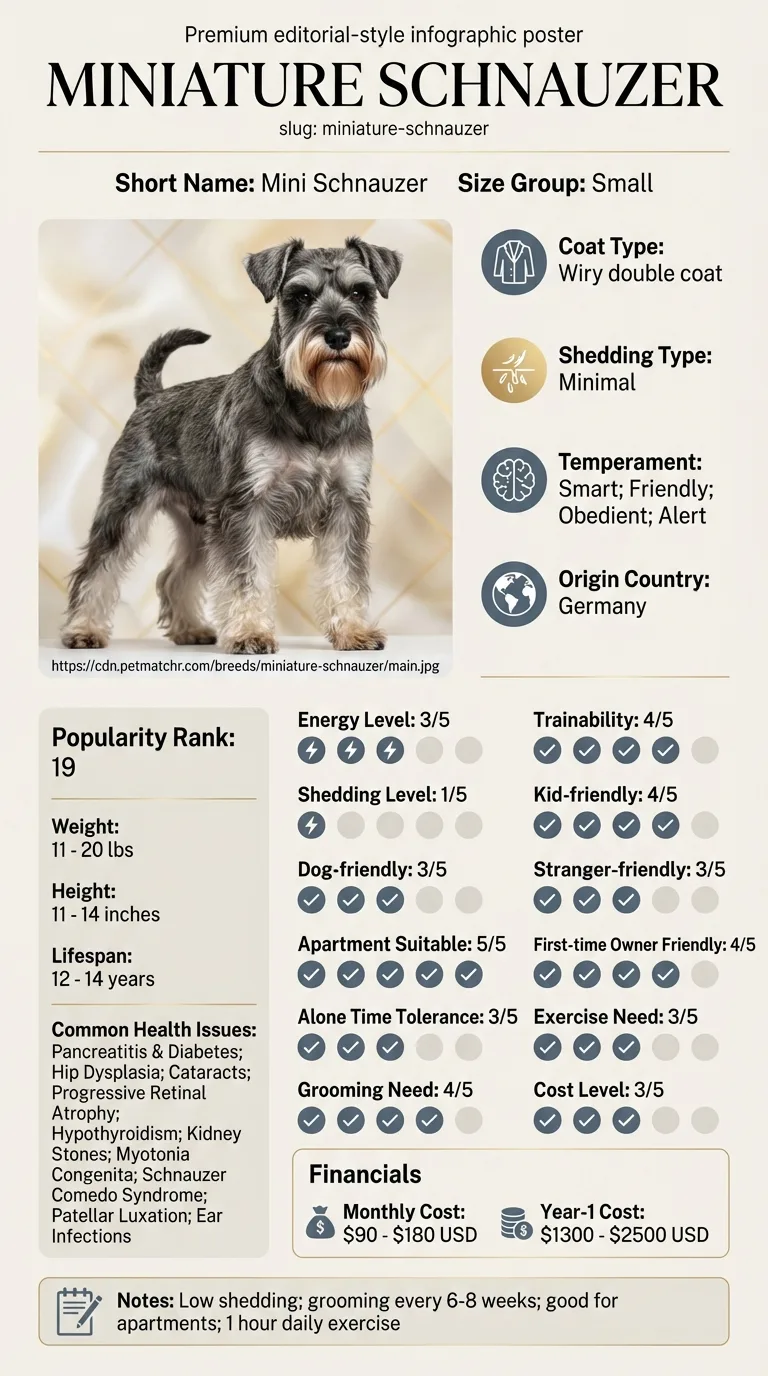
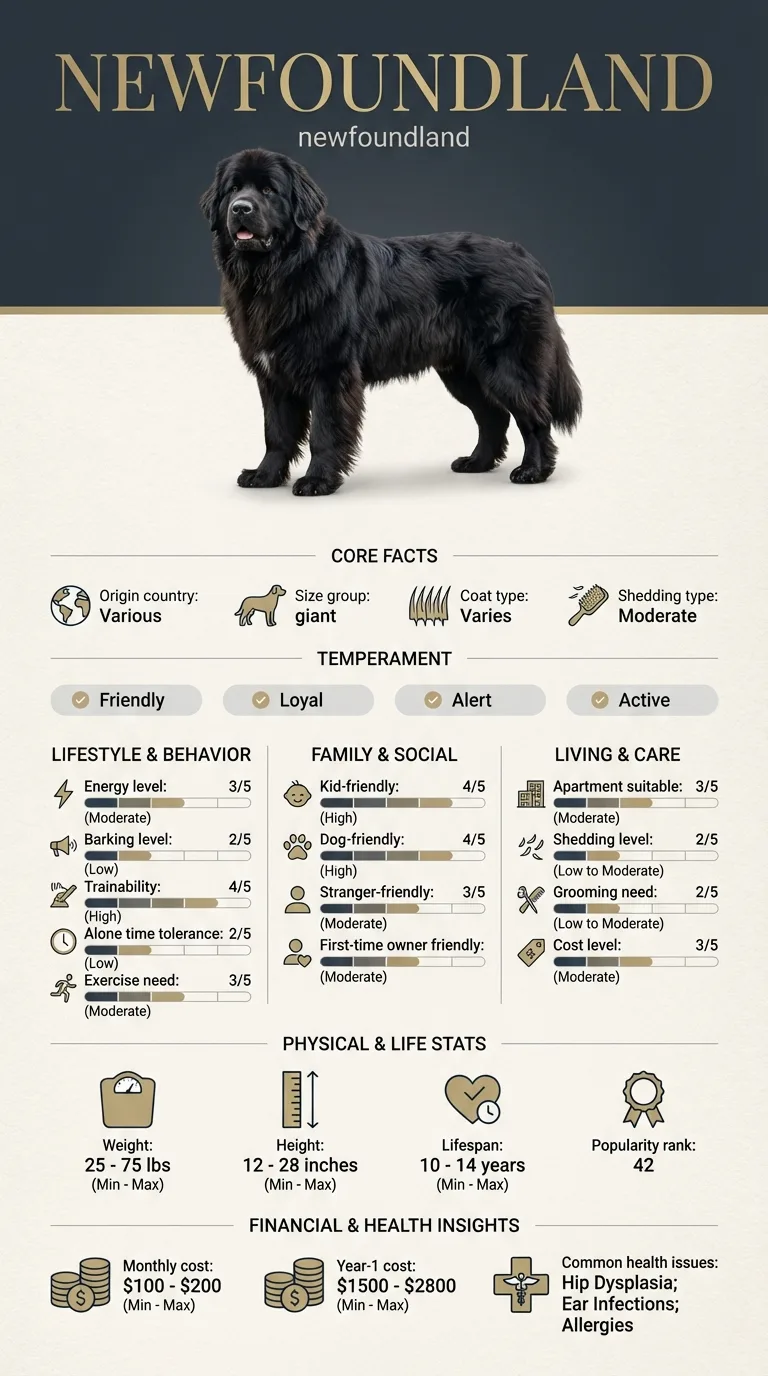
This is for someone already down to Miniature Schnauzer and Newfoundland and deciding between them. For this pair the decision usually turns on apartment suitability and shedding, so those are covered first and in most detail. Anyone choosing from a flat has a clear answer here: Miniature Schnauzer rates 5/5 against 1/5. Breed history is left out; what follows is what you will actually live with.
Between Miniature Schnauzer and Newfoundland, apartment suitability is what separates them, and Miniature Schnauzer is the lower-effort dog of the two to keep.
Choose Miniature Schnauzer if you are in a flat or a smaller home, this is your first dog and shedding is a problem in your house.
Choose Newfoundland if there are young children at home and you already have another dog.
| Feature | miniature schnauzer | newfoundland | Winner |
|---|---|---|---|
| Size class | small | giant | Equal |
| Weight | 11–20 lbs | 100–150 lbs | Equal |
| Height | 11–14 in | 26–28 in | Equal |
| Lifespan | 12–14 years | 9–10 years | miniature schnauzer |
| Exercise need | Moderate (3/5) | Moderate (3/5) | Equal |
| Grooming need | High (4/5) | High (4/5) | Equal |
| Shedding | Very low (1/5) | Very high (5/5) | miniature schnauzer |
| Energy level | Moderate (3/5) | Low (2/5) | Equal |
| Barking | High (4/5) | Low (2/5) | newfoundland |
| Apartment suitability | Very high (5/5) | Very low (1/5) | miniature schnauzer |
| Good for first-time owners | High (4/5) | Moderate (3/5) | miniature schnauzer |
| Tolerates being alone | Moderate (3/5) | Moderate (3/5) | Equal |
| Trainability | High (4/5) | High (4/5) | Equal |
| Good with kids | High (4/5) | Very high (5/5) | newfoundland |
| Good with other dogs | Moderate (3/5) | High (4/5) | newfoundland |
| Friendly to strangers | Moderate (3/5) | High (4/5) | newfoundland |
| Cost level | Moderate (3/5) | Very high (5/5) | miniature schnauzer |
| Coat | Wiry double coat | Heavy water-resistant double coat | Equal |
| Origin | Germany | Various | Equal |
| Typical monthly cost | $90–$180 | $150–$310 | Equal |
| Typical first-year cost | $1,300–$2,500 | $2,200–$4,200 | Equal |
An 11-to-20-pound Miniature Schnauzer standing 11 to 14 inches sits at the opposite end of the size chart from a 100-to-150-pound Newfoundland that reaches 26 to 28 inches at the shoulder — both are officially small versus giant size classes, and the numbers justify the label difference. The Schnauzer's wiry double coat and compact frame make it easy to lift, crate, and transport, while the Newfoundland's heavy, water-resistant double coat and sheer mass mean furniture, vehicles, and doorways all need to accommodate a dog that can weigh as much as an adult person. Anyone torn between these two is choosing between a portable dog and a room-filling one.
Exercise need actually ties at Moderate (3/5) for both breeds, which surprises people expecting the giant Newfoundland to need more activity — in practice its Low (2/5) energy level and calm, patient nature keep daily requirements modest, more about swimming and short walks than sustained running. The Schnauzer's Moderate (3/5) energy shows up as alert, active bursts rather than endurance, fitting its Smart, Alert temperament. Neither breed demands the multi-hour exercise regimen some working breeds need, but the Newfoundland's size still means each walk takes more physical effort to manage than the Schnauzer's does.
Grooming need ties at High (4/5) for both, but shedding diverges sharply: the Schnauzer sheds at Very low (1/5) thanks to its wiry coat, while the Newfoundland sheds at Very high (5/5) from its heavy double coat built for cold water work. That means similar time commitments at the grooming table — brushing, trimming, coat maintenance — but very different amounts of hair left on furniture and floors between sessions. A household sensitive to loose hair but willing to put in grooming time should lean Schnauzer; one that doesn't mind vacuuming often can handle the Newfoundland's shedding more easily.
Apartment suitability splits about as far as two breeds can: Miniature Schnauzer Very high (5/5) against Newfoundland Very low (1/5), and barking runs the other direction — Schnauzer High (4/5), Newfoundland Low (2/5). That combination means a small unit with thin walls fits the Schnauzer's size but not its vocal habits, while the Newfoundland is the quieter housemate but needs the square footage a giant breed requires to be comfortable. Both tolerate being alone at a tied Moderate (3/5), so neither is an obvious pick for long solo workdays, but the space question alone usually decides this one before noise even enters the conversation.
Trainability ties at High (4/5), and both are genuinely solid choices for first-time owners, though the Schnauzer edges ahead at High (4/5) versus the Newfoundland's Moderate (3/5) — mostly a function of size rather than intelligence, since a giant breed that pulls on leash is harder to physically correct. The Schnauzer's Obedient streak and the Newfoundland's famously Sweet, Patient disposition both train well with consistent positive reinforcement. The real experience gap shows up in strength management: a poorly leash-trained Newfoundland can drag an adult, while a poorly trained Schnauzer is, at worst, a stubborn nuisance.
The Newfoundland pulls ahead with kids at Very high (5/5) against the Schnauzer's already-strong High (4/5), living up to its reputation as a gentle giant, and it also edges out the Schnauzer with other dogs (High 4/5 versus Moderate 3/5) and with strangers (High 4/5 versus Moderate 3/5). The Schnauzer's Friendly, Alert nature makes it a good family dog too, just a notch more reserved and more prone to sounding an alarm at visitors. For a busy household with kids, guests, and other pets constantly cycling through, the Newfoundland's easygoing social profile has a slight edge on paper.
Lifespan favors the Schnauzer clearly, 12 to 14 years against the Newfoundland's 9 to 10 — a gap consistent with the size-versus-longevity pattern seen across breeds. The Schnauzer's ten-item health list leans metabolic and small-breed structural, including Pancreatitis & Diabetes, Kidney Stones, and the breed-specific Schnauzer Comedo Syndrome and Myotonia Congenita, alongside Hip Dysplasia and Progressive Retinal Atrophy. The Newfoundland's shorter five-item list is dominated by cardiac and structural giant-breed risks: Subaortic Stenosis, Dilated Cardiomyopathy, Hip Dysplasia, and Bloat (GDV), plus the rarer Cystinuria. A cardiac screening is worth prioritizing for the Newfoundland specifically.
Cost level runs Moderate (3/5) for the Schnauzer against Very high (5/5) for the Newfoundland, and the dollar ranges track that gap closely: $90–$180 monthly and $1,300–$2,500 in year one for the Schnauzer versus $150–$310 monthly and $2,200–$4,200 for the Newfoundland. A giant breed simply eats, medicates, and boards at a higher price point across the board, and the Very high (5/5) grooming demand on that heavy double coat adds recurring cost on top of food. Anyone budgeting for the Newfoundland should plan for roughly double the Schnauzer's typical spend.
Miniature Schnauzer weighs 11–20 lbs and lives 12–14 years; Newfoundland weighs 100–150 lbs and lives 9–10 years. The two diverge most on apartment suitability, shedding and barking and 1 other rated axes. They are level on tolerates being alone, exercise need and grooming need, so those cannot decide it. The comparison marks an easier option only where one exists. Facts like weight and country of origin are not scored. Both dogs are rated from the same dataset, which is what makes the numbers comparable with each other even though any individual dog sits somewhere inside its breed's range.

The Newfoundland, rated Low (2/5) for barking against the Schnauzer's High (4/5) — a notable reversal given the size difference.
Its Very low (1/5) apartment suitability rating suggests yes; the Schnauzer's Very high (5/5) rating makes it the far better fit for small spaces.
The Newfoundland, rated Very high (5/5), though the Schnauzer's High (4/5) rating still makes it a strong family dog.
Roughly 60–70% more in year one — $2,200–$4,200 versus the Schnauzer's $1,300–$2,500 — mostly from food volume and grooming.
The Miniature Schnauzer, at Very low (1/5) shedding compared to the Newfoundland's Very high (5/5).
Yes, both rate High (4/5) for trainability, though the Schnauzer's smaller size makes early mistakes easier to manage physically.
The Miniature Schnauzer, typically 12–14 years, versus the Newfoundland's 9–10 years.
The Miniature Schnauzer, rated Very high (5/5) for apartment suitability.
The Miniature Schnauzer, rated High (4/5) versus the Newfoundland's Low (2/5).
The Newfoundland, at $150–$310 versus the Schnauzer's $90–$180.
The Newfoundland, rated High (4/5) versus the Schnauzer's Moderate (3/5).
Secure checkout on Stripe. We never see your card.
7-day money-back guarantee. Instant access.
Health information here is general and is not veterinary advice. If your dog shows pain, sudden behaviour change, or worsening symptoms, consult a licensed veterinarian.
Some links on this site are affiliate links. We may earn a commission at no extra cost to you, and we only suggest products we believe are helpful for dog owners.
We research and check what we publish, but we do not warrant that any figure, date, price, or statement is accurate, complete, or current, and we accept no liability for any loss, cost, injury, or other harm arising from the use of this site. Use it as one reference among several. You remain responsible for your own decisions and for your dog's care - confirm anything that matters with a licensed veterinarian or another qualified professional before you act on it. Full disclaimer.
Match your lifestyle to the right dog.
Take quizNot sure which breed is right for you? Take our 2-minute quiz to find out.
Take the quiz