Health
What does an early luxating patella look like in a dog?
A brief skip or hop in a back leg that resolves within a step or two on its own, often during play or sharp turns, is the classic early sign of a lower-grade luxating patella.

Quick answer
What does an early luxating patella look like in a dog?
A brief skip or hop in a back leg that resolves within a step or two on its own, often during play or sharp turns, is the classic early sign of a lower-grade luxating patella.
A kneecap that slips and pops back into place on its own can look, for months, like nothing more than a playful little hop.
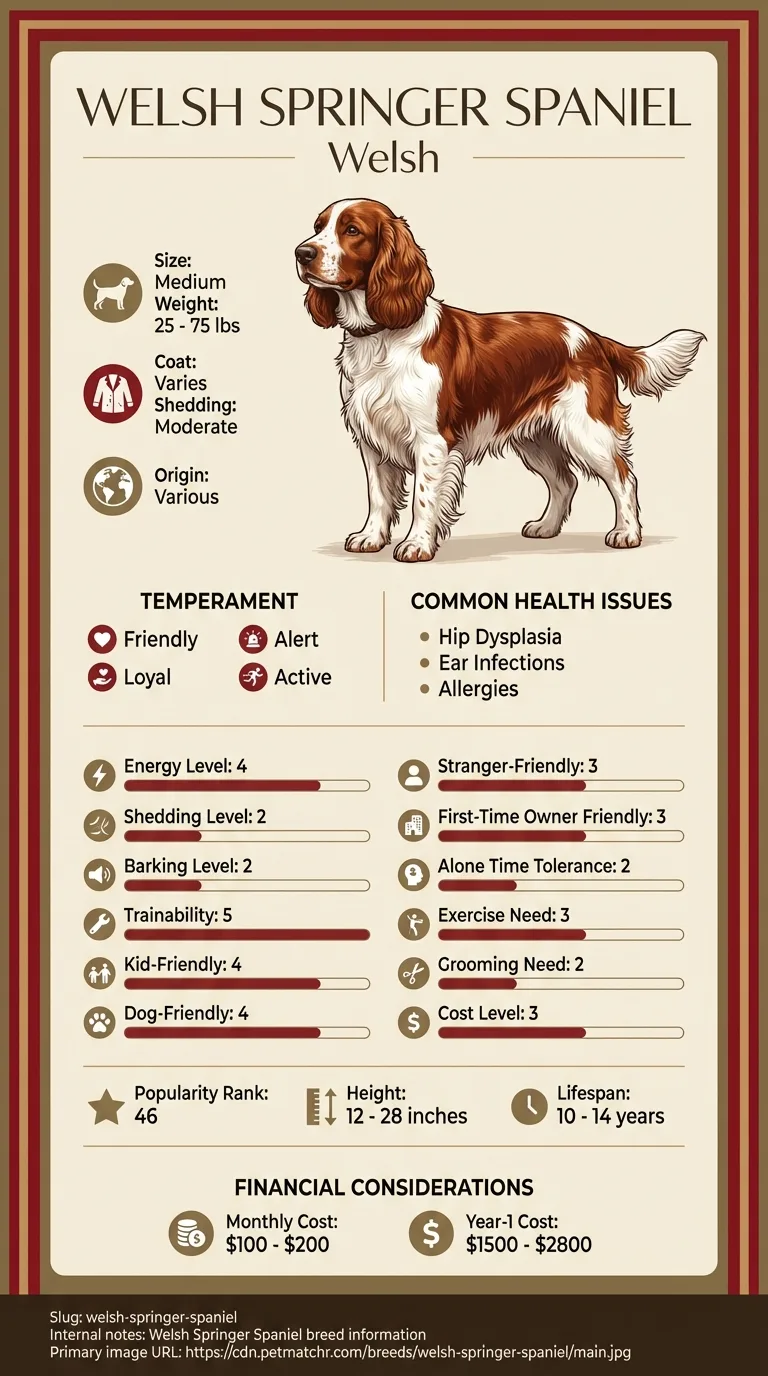
Owners of young to middle-aged Welsh Springer Spaniels who notice an occasional odd skip during play or on walks, but see their dog otherwise acting completely normal, are the ones most likely to be dealing with this early on.
This guide is not medical advice. If your dog shows pain, sudden behavior change, or worsening symptoms, consult a licensed veterinarian.
Some links may be affiliate links. We may earn a commission at no extra cost to you. We only suggest products we believe are helpful for dog owners.
A luxating patella is a kneecap that slips out of its normal groove, and in its earliest, mildest grades it often looks like nothing more than an occasional playful skip rather than a medical issue. Recognizing the pattern, a brief hop that self-corrects, is the key skill for Welsh Springer Spaniel owners, since lower grades are easy to overlook for months.
Luxating patellas occur across many small and medium breeds, and while it is not singled out as this breed's most documented condition, it is common enough across dogs generally that any owner noticing an occasional skip should have it checked rather than assumed harmless.
In a medium, athletic breed like the Welsh Springer Spaniel, an inherited variation in the depth or alignment of the groove that guides the kneecap can allow it to slip sideways during normal movement, particularly during the sharp turns and quick direction changes this breed's active lifestyle regularly involves.
Excess body weight, hard landings from jumping, and repeated sharp turns during play or fieldwork all add sideways stress to the kneecap, and this everyday physical activity is what turns an inherited structural tendency into a visible, intermittent skip.
Talk to your vet about any occasional skip or hop you notice, even if your dog seems otherwise fine, so a manual exam can confirm the grade. If the skip becomes constant, your dog stops using the leg normally, or shows sudden pain, this warrants a prompt, though not necessarily emergency, vet visit.
See all Welsh Springer Spaniel health problems, which breeds are prone to luxating patellas, or the full Welsh Springer Spaniel breed guide for temperament, exercise needs and ownership costs.
Lower-grade cases can remain stable for years with monitoring alone, while progression, when it happens, typically unfolds gradually over months to years rather than suddenly.
Success looks like catching a lower-grade case early, keeping your dog lean and active within reasonable limits, and having a clear plan with your vet for what to watch for if the grade changes over time.
Luxating patellas are graded on a scale from one to four, and understanding where a dog falls on that scale changes what the skip actually means. Grade one is a kneecap that can be manually pushed out of place during a vet exam but pops right back and rarely causes visible symptoms; many dogs at this grade are never even diagnosed because they show no outward sign at all.
Grade two is where that intermittent skip usually shows up: the kneecap slips out during normal movement, causing the dog to briefly hold the leg up, then slides back into place on its own, often within a step or two. This is the grade most often mistaken for a quirky gait, since the dog seems completely fine between episodes and shows no ongoing pain.
Grade three and four describe a kneecap that stays out of place most or all of the time, or that cannot be manually returned to position at all. At these grades, the abnormal gait becomes constant rather than occasional, and arthritis develops faster because the joint is working in an abnormal position continuously rather than intermittently. Catching a dog at grade one or two, while the skip still looks occasional, gives far more room for conservative management before the joint reaches that constant-luxation stage.

Because early-grade luxating patellas can look so much like normal quirky movement, the main skill for owners is simply noticing the pattern and mentioning it, rather than treating anything themselves.
If you think your Welsh has luxating patellas, the plan is three steps: write down what you have seen and when it started, book a veterinary appointment rather than waiting for the next flare, and take video of the behaviour or symptom before you go — the thing you are worried about rarely happens in the consulting room. Screening in the parents covers hip dysplasia, ear infections, epilepsy.
What the vet visit should produce is a diagnosis and a written plan, not just reassurance: what is being ruled out, what the monitoring interval is, and which signs mean you come back sooner. Ask what the treatment costs across a year rather than per visit, because that is the number that decides whether you are managing this condition or reacting to it.
Between appointments, keep a short log — dates, what you saw, what changed. It is the single most useful thing an owner brings to a follow-up, and for luxating patellas it is often what separates a clear pattern from a guess.
Nina had always thought her Welsh Springer, Pippa, had a funny little hop she did during fetch, holding one back leg up mid-stride before setting it back down and continuing on as if nothing happened. Friends joked it was just Pippa being Pippa, and Nina genuinely believed that for almost a year. At a routine annual exam, Nina mentioned the hop almost as an afterthought, and her vet's manual knee exam confirmed a grade two luxating patella in the affected leg. Because Pippa showed no pain and the grade was stable, her vet recommended weight monitoring and activity modification rather than surgery for now, with a plan to recheck in six months. A year later, Pippa's grade has remained stable, and Nina now tracks the frequency of the hop in a simple note on her phone after every walk.
Key takeaway: A skip that looks like personality can be a genuine grade of luxating patella, and the only way to tell the difference is a vet exam, not months of watching and wondering.
Grade one is a kneecap that can be manually displaced but returns on its own with no visible symptoms. Grade two slips during normal movement and self-corrects, often looking like an occasional skip. Grades three and four involve a kneecap that stays out of place most or all of the time.
A brief skip or hop where your dog holds one back leg up for a step or two before walking normally again, especially during play or sharp turns, is the classic early sign that often gets mistaken for a quirky gait.
Not necessarily. Many grade one cases never progress and cause no lasting issues. Grade two cases are more variable, and some do progress over time, which is why monitoring rather than ignoring an early sign matters.
Lower grades are typically confirmed and monitored during a routine vet exam through gentle manual manipulation of the kneecap, sometimes alongside x-rays to assess the joint more fully.
Not always. Lower grade cases are sometimes managed conservatively with weight control and activity modification, while progressive or higher grade cases are more likely to need surgical correction, which is covered separately in more detail.
Because the joint is only briefly out of position and self-corrects quickly, many dogs show no obvious pain at this stage, which is exactly why it is so easy to mistake for a harmless quirk rather than a joint issue.
The early signs are set out in the sections above, and they are the reason to book a veterinary appointment rather than wait. Luxating Patellas in Welshs is diagnosed by a vet, not from a symptom list, and the sooner it is on record the more options remain open.
The early signs are set out in the sections above, and they are the reason to book a veterinary appointment rather than wait. Luxating Patellas in Welsh Springer Spaniels is diagnosed by a vet, not from a symptom list, and the sooner it is on record the more options remain open.
A brief skip or hop in a back leg that resolves within a step or two on its own, often during play or sharp turns, is the classic early sign of a lower-grade luxating patella.
Grades range from one, a kneecap that pops back on its own with no symptoms, to four, a kneecap that stays out of place and cannot be manually repositioned.
No, not always. Lower grades sometimes remain stable for a dog's whole life, but they should still be monitored since some cases do progress over time.
Mention any occasional skip or hop to your vet at a routine visit, since a gentle manual exam can usually confirm the grade even if your dog shows no other symptoms.
Keeping your dog lean reduces sideways stress on the kneecap, which can help lower-grade cases stay stable longer.
A one-page prep sheet for this condition: the signs, the questions to ask, what to get priced. Unlocks here.
You get: Vet visit prep sheet
No spam. One-click unsubscribe. See our privacy policy.
Preview page 1 before you decide.