Living
Which breed is bigger?
The Golden Retriever, at 55-75 lbs versus the Welsh Springer's 35-55 lbs.

Quick answer
Which breed is bigger?
The Golden Retriever, at 55-75 lbs versus the Welsh Springer's 35-55 lbs.
Golden Retriever or Welsh Springer Spaniel? On paper they differ most on shedding, and on the scales Golden Retriever is the heavier at 55–75 lbs. Here is how the two compare on everything that shapes an ordinary week.
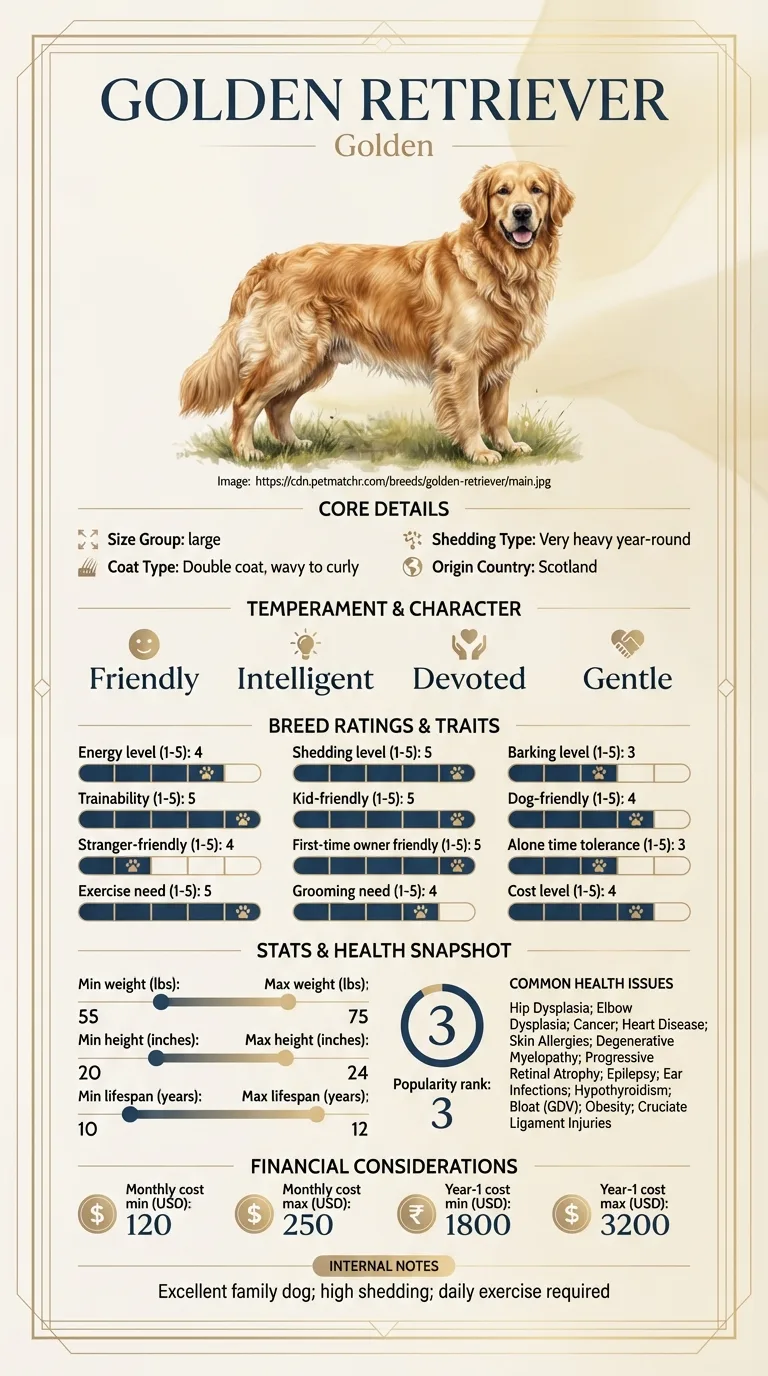
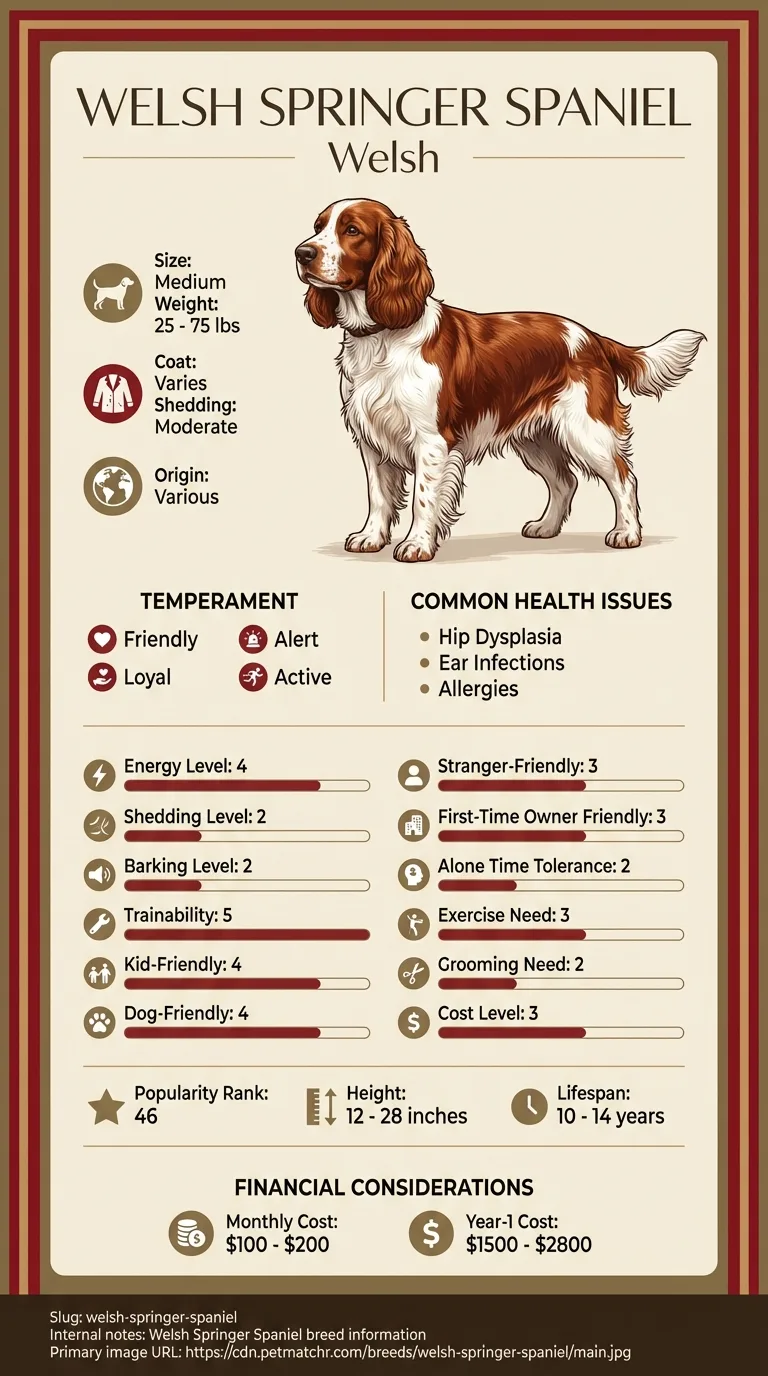
This is for someone already down to Golden Retriever and Welsh Springer Spaniel and deciding between them. For this pair the decision usually turns on shedding and good for first-time owners, so those are covered first and in most detail. Both rate 2/5 for flats, so housing does not settle this one. It is written for the decision rather than the breed history.
Between Golden Retriever and Welsh Springer Spaniel, shedding is what separates them, and Golden Retriever is the lower-effort dog of the two to keep.
Choose Golden Retriever if this is your first dog, the dog will be alone during the working day and there are young children at home.
Choose Welsh Springer Spaniel if you do not want a standing grooming appointment, shedding is a problem in your house and your walking routine is modest.
| Feature | golden retriever | welsh springer spaniel | Winner |
|---|---|---|---|
| Size class | large | medium | Equal |
| Weight | 55–75 lbs | 35–55 lbs | Equal |
| Height | 20–24 in | 17–19 in | Equal |
| Lifespan | 10–12 years | 12–15 years | welsh springer spaniel |
| Exercise need | Very high (5/5) | High (4/5) | welsh springer spaniel |
| Grooming need | High (4/5) | Moderate (3/5) | welsh springer spaniel |
| Shedding | Very high (5/5) | Moderate (3/5) | welsh springer spaniel |
| Energy level | High (4/5) | High (4/5) | Equal |
| Barking | Moderate (3/5) | Moderate (3/5) | Equal |
| Apartment suitability | Low (2/5) | Low (2/5) | Equal |
| Good for first-time owners | Very high (5/5) | Moderate (3/5) | golden retriever |
| Tolerates being alone | Moderate (3/5) | Low (2/5) | golden retriever |
| Trainability | Very high (5/5) | High (4/5) | golden retriever |
| Good with kids | Very high (5/5) | High (4/5) | golden retriever |
| Good with other dogs | High (4/5) | High (4/5) | Equal |
| Friendly to strangers | High (4/5) | Moderate (3/5) | golden retriever |
| Cost level | High (4/5) | Moderate (3/5) | welsh springer spaniel |
| Coat | Double coat, wavy to curly | Medium, straight and water-resistant | Equal |
| Origin | Scotland | Various | Equal |
| Typical monthly cost | $120–$250 | $100–$200 | Equal |
| Typical first-year cost | $1,800–$3,200 | $1,400–$2,900 | Equal |
At 55 to 75 pounds and 20 to 24 inches, the Golden Retriever outweighs the medium-sized Welsh Springer Spaniel by 20 pounds or more at comparable ends of each range — the Springer tops out at 55 pounds and 19 inches. Both breeds carry a sturdy, athletic sporting-dog build suited to fieldwork, but the Springer's more compact frame makes it easier to lift, crate, and transport, while still being substantial enough to hold its own on long walks or in water. Anyone choosing between a full-size retriever and a mid-size spaniel is really deciding how much physical dog they want managing around a home with limited space.
Exercise need favors the Golden at very high (5/5) against the Welsh Springer's still-demanding high (4/5), while both land at high (4/5) for general energy level. In practice the gap is modest — the Springer, an original working gundog, wants daily off-leash time, retrieving games, or long hikes almost as much as the Golden does. Neither breed thrives on a single short walk per day. The real distinction shows up more in intensity and duration than in category: the Golden's exercise ceiling runs a bit higher, so owners planning multi-mile runs or all-day outdoor activity will find the Golden the marginally more tireless partner of the two.
The Golden requires more upkeep on both fronts — grooming rated high (4/5) versus the Springer's moderate (3/5), and shedding very high (5/5) versus the Springer's moderate (3/5). The Golden's dense, wavy-to-curly double coat needs frequent brushing and produces heavier, more constant fur around the house. The Welsh Springer's medium, straight, water-resistant coat sheds noticeably less and needs regular but less intensive brushing, along with attention to its feathered ears and legs after outdoor time. For an owner who wants the retrieving, water-loving personality of a sporting breed without quite as much coat maintenance, the Springer represents a real step down in grooming demand.
Both breeds share the same low (2/5) apartment suitability rating and the same moderate (3/5) barking level, so neither offers a clear edge on that front — both simply need more space and outdoor access than a typical apartment provides. The difference shows up in solitude: the Golden tolerates being alone moderately (3/5) while the Welsh Springer rates lower at 2/5, consistent with its loyal, even-tempered but people-focused nature. A Springer left alone too often in cramped quarters is more likely to develop anxious or destructive habits than a Golden facing the same situation. Either breed does best with a yard and a household that's rarely gone all day.
The Golden rates very high (5/5) for trainability and first-time owners, while the Welsh Springer sits a notch below at high (4/5) trainability and moderate (3/5) for first-time suitability. Part of that gap traces to temperament: the Springer is described as reserved with strangers, which can translate into a dog that needs more patient, gradual socialization before it settles confidently into new training environments. It remains a highly capable working gundog once established, just less immediately biddable for a total beginner than the more universally friendly Golden. Owners with some prior dog experience, or willingness to invest extra time in early socialization, will find the Springer very trainable.
With kids, the Golden's very high (5/5) rating edges the Springer's high (4/5), and both breeds match at high (4/5) for getting along with other dogs. The clearer gap is with strangers — Golden high (4/5), Springer moderate (3/5) — which lines up directly with the Springer's documented reserved-with-strangers temperament, versus the outwardly friendly, devoted Golden. In a busy household with constant visitors, the Golden's warmth toward new people will likely feel easier to manage; in a quieter home where the dog mainly interacts with a stable family circle, the Springer's loyal, even-tempered nature is just as rewarding, if a bit more one-household-focused.
The Welsh Springer Spaniel's 12-15 year lifespan comfortably beats the Golden's 10-12 years, and its health list is notably shorter at five conditions — hip dysplasia, ear infections, epilepsy, glaucoma, and hypothyroidism — versus the Golden's thirteen, which adds cancer, heart disease, bloat, degenerative myelopathy, and several more serious entries. Ear infections are worth flagging specifically for the Springer given its long, hanging ears, which need regular checking and cleaning, especially after swimming. The Golden's broader list, including cancer as a leading cause of death in the breed, makes preventive veterinary care and pet insurance a more pressing consideration for Golden owners than for Springer owners.
Cost level rates high (4/5) for the Golden against moderate (3/5) for the Springer, and the dollar figures track that gap — $120-$250 monthly and $1,800-$3,200 in year one for the Golden, versus $100-$200 monthly and $1,400-$2,900 for the Springer. Food volume tied to the Golden's larger size accounts for much of the difference, alongside its heavier grooming needs. Both breeds' health lists warrant a look at pet insurance, though the Springer's shorter list of milder conditions may mean lower premiums over a dog's lifetime. Overall the Welsh Springer is the more budget-friendly of the two sporting breeds to raise and maintain.
Golden Retriever weighs 55–75 lbs and lives 10–12 years; Welsh Springer Spaniel weighs 35–55 lbs and lives 12–15 years. The two diverge most on shedding and good for first-time owners. They are level on apartment suitability, barking and good with other dogs, so those cannot decide it. In the table, a "winner" means easier for an ordinary household — not better. Size, coat and origin are recorded without a verdict. Because both breeds are scored the same way, the gaps are reliable even where the absolute numbers are rough.

Less so than the Golden — it's described as reserved with strangers and rates moderate (3/5) for stranger-friendliness, compared to the Golden's high (4/5). Early, consistent socialization helps a Springer warm up faster.
The Welsh Springer Spaniel, typically 12-15 years versus the Golden Retriever's 10-12 years, with a notably shorter list of associated health conditions as well.
Nearly — it rates high (4/5) for exercise need against the Golden's very high (5/5). Both are working sporting breeds that need daily vigorous activity, not just short walks.
The Welsh Springer Spaniel, rated moderate (3/5) versus the Golden's very high (5/5), thanks to its straight, water-resistant coat compared to the Golden's dense double coat.
It can work, rated moderate (3/5) for first-time owners, but it takes more patience with socialization than a Golden (rated very high, 5/5) due to its reserved nature around strangers.
The Welsh Springer Spaniel, at roughly $1,400-$2,900 in year one versus the Golden's $1,800-$3,200, largely due to lower food and grooming costs at its smaller size.
Ear infections are on their health list, a common issue for long-eared spaniels, especially after swimming. Regular ear checks and cleaning are an important part of routine care.
The Golden Retriever, at 55-75 lbs versus the Welsh Springer's 35-55 lbs.
The Welsh Springer Spaniel, at 12-15 years versus the Golden's 10-12 years.
The Golden Retriever, rated high (4/5) versus the Springer's moderate (3/5).
The Golden Retriever, rated very high (5/5) versus the Springer's moderate (3/5).
Secure checkout on Stripe. We never see your card.
7-day money-back guarantee. Instant access.


Health information here is general and is not veterinary advice. If your dog shows pain, sudden behaviour change, or worsening symptoms, consult a licensed veterinarian.
Some links on this site are affiliate links. We may earn a commission at no extra cost to you, and we only suggest products we believe are helpful for dog owners.
We research and check what we publish, but we do not warrant that any figure, date, price, or statement is accurate, complete, or current, and we accept no liability for any loss, cost, injury, or other harm arising from the use of this site. Use it as one reference among several. You remain responsible for your own decisions and for your dog's care - confirm anything that matters with a licensed veterinarian or another qualified professional before you act on it. Full disclaimer.
Match your lifestyle to the right dog.
Take quizNot sure which breed is right for you? Take our 2-minute quiz to find out.
Take the quiz