Health
Is rapid-growth bone disease a real risk for Welsh Springer Spaniels?
No — it's documented in giant and large fast-growing breeds, not in this medium-sized breed.

Quick answer
Is rapid-growth bone disease a real risk for Welsh Springer Spaniels?
No — it's documented in giant and large fast-growing breeds, not in this medium-sized breed.
The bone and growth problems tied to explosive giant-breed growth spurts are a real veterinary category — they just aren't the Welsh Springer Spaniel's category.
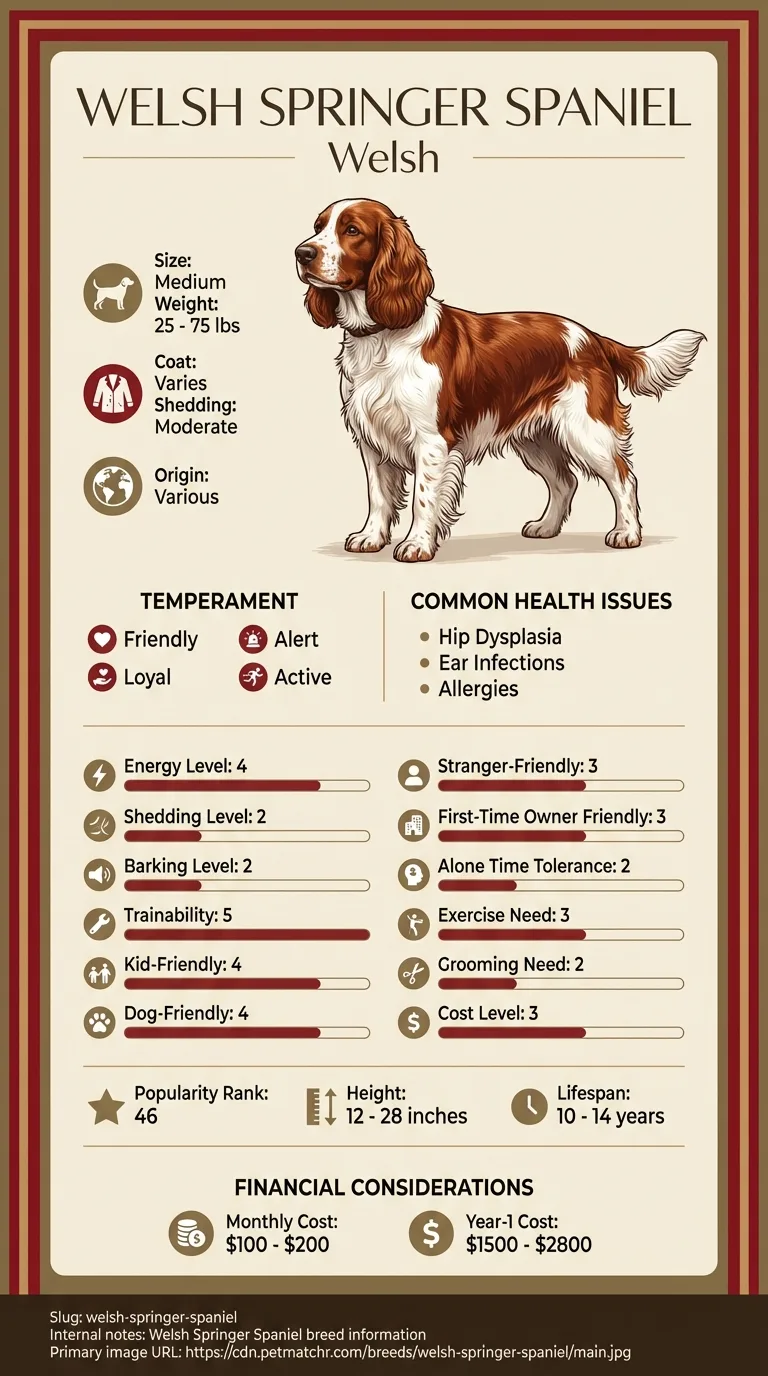
Owners who've read general large-breed puppy growth warnings and want to know whether they apply to their Welsh Springer Spaniel, especially during the gangly 4-8 month growth phase, are the audience for this page.
This guide is not medical advice. If your dog shows pain, sudden behavior change, or worsening symptoms, consult a licensed veterinarian.
Some links may be affiliate links. We may earn a commission at no extra cost to you. We only suggest products we believe are helpful for dog owners.
We research and check what we publish, but we do not warrant that any figure, date, price, or statement is accurate, complete, or current, and we accept no liability for any loss, cost, injury, or other harm arising from the use of this site. Use it as one reference among several. You remain responsible for your own decisions and for your dog's care - confirm anything that matters with a licensed veterinarian or another qualified professional before you act on it. Full disclaimer.
Hypertrophic osteodystrophy, panosteitis, and related rapid-growth bone disorders are well characterized in giant and large fast-growing breeds, but they aren't established as a Welsh Springer Spaniel concern. This breed's genuinely documented skeletal issue is hip dysplasia, which stems from joint conformation rather than growth rate.
Rapid-growth bone disorders are uncommon even within the giant breeds where they're documented, and they aren't recognized as occurring in Welsh Springer Spaniels at all. Hip dysplasia, by contrast, is a genuinely tracked condition in this breed through health screening programs like OFA and PennHIP.
The giant and large fast-growing breeds where HOD and panosteitis appear share a trait Welsh Springer Spaniels don't: packing on tremendous weight in a short window during puppyhood. Without that explosive growth trajectory, the mechanical and metabolic stress believed to trigger these bone disorders doesn't apply to this breed in the same way.
For breeds actually at risk, overfeeding or excess calcium supplementation during rapid growth phases is a recognized aggravating factor. Since this specific growth-disorder pathway isn't relevant to Welsh Springer Spaniels, there's no meaningful environmental trigger to manage for it in this breed — standard, breed-appropriate puppy nutrition is the relevant guidance instead.
See a vet for any limping, stiffness, or reluctance to bear weight that lasts more than a day or two, regardless of which condition is suspected. In a Welsh Springer Spaniel, the workup is more likely to focus on minor injury or hip development than a giant-breed growth disorder.
See all Welsh Springer Spaniel health problems, which breeds are prone to bone growth issues, or the full Welsh Springer Spaniel breed guide for temperament, exercise needs and ownership costs.
Because rapid-growth bone disorders aren't a relevant concern for this breed, there's no disease timeline to track for them here. Hip dysplasia, the real skeletal issue in this breed, is typically monitored through puppy growth and confirmed via X-ray screening around 1-2 years of age.
Success here means redirecting attention from a giant-breed growth syndrome that doesn't apply, toward the routine puppy-growth care and hip-health screening that genuinely matter for a Welsh Springer Spaniel. A puppy growing steadily, moving comfortably, and screened appropriately as an adult is the realistic marker of a healthy outcome.
Rapid-growth bone disorders are driven by extreme growth rates that simply don't occur in a 35-55 lb breed. These are the mismatches worth understanding before assuming any of this applies to your dog.
Hypertrophic osteodystrophy (HOD) and panosteitis are painful inflammatory bone conditions that show up almost exclusively in large and giant breeds during the fastest stretch of puppy growth, typically 3 to 8 months old. They're strongly linked to breeds that pack on 60-100+ lb in their first year, like Great Danes, Saint Bernards, Mastiffs, and Irish Wolfhounds.
A Welsh Springer Spaniel puppy reaches its adult weight of 35-55 lb on a much gentler curve, without the explosive growth spurts that appear to trigger these disorders. That difference in growth trajectory is exactly why HOD and panosteitis aren't recognized as a Welsh Springer Spaniel concern in veterinary literature.
A Welsh Springer puppy that's limping, reluctant to play, or seems stiff after rest still needs veterinary evaluation — the more likely explanations in this breed include minor sprains, growth-plate strain from an awkward fall, or early signs of hip dysplasia rather than a giant-breed growth disorder.

Hip dysplasia is the genuinely documented orthopedic condition in Welsh Springer Spaniels, and it's worth your attention instead of a giant-breed growth syndrome. It develops from a poor fit between the ball and socket of the hip joint and can show up as early as puppyhood or gradually over years.
Unlike HOD or panosteitis, hip dysplasia in this breed is manageable with weight control, appropriate exercise during growth, and, when needed, orthopedic evaluation via OFA or PennHIP screening. Breeders who health-test for hip scores are a meaningful safeguard, and that's the screening question worth asking instead of giant-breed growth-rate questions.

After reading a large-breed puppy forum full of warnings about hypertrophic osteodystrophy, Marisol in Boise started weighing her 5-month-old Welsh Springer Spaniel every week, convinced a growth spurt would trigger it. Her vet pointed out that the condition is documented in giant breeds gaining several pounds a week, while her puppy was tracking a steady, unremarkable curve toward a normal 40-something-pound adult weight. Instead, they talked through hip screening timing and shifted her focus to the actual documented risk in the breed. Marisol still weighs her dog occasionally out of habit, but she's stopped scanning for a giant-breed disease that was never going to apply to a spaniel.
Key takeaway: A bone disorder documented in giant, fast-growing breeds isn't a realistic concern for a Welsh Springer Spaniel's more moderate growth curve — hip dysplasia screening is the genuinely useful focus for this breed's skeletal health.
These rapid-growth bone disorders aren't established as occurring in Welsh Springer Spaniels; they're documented mainly in giant and large fast-growing breeds like Great Danes and Mastiffs. A limping Welsh Springer puppy is more likely dealing with a minor sprain, an awkward fall, or early hip dysplasia.
Welsh Springer Spaniels grow to their adult weight of 35-55 lb over a comparatively gradual curve, without the explosive weekly weight gain seen in giant breeds. That slower growth trajectory is thought to be why these specific inflammatory bone conditions aren't recognized in this breed.
A standard medium-breed puppy food is generally appropriate for a Welsh Springer Spaniel rather than a giant-breed slow-growth formula designed for breeds gaining far more weight, far faster. Ask your vet to confirm the right formula and feeding schedule for your individual puppy.
Hip dysplasia is the orthopedic condition genuinely documented in Welsh Springer Spaniels, and it's the one worth screening for through OFA or PennHIP evaluation. It's a different mechanism from rapid-growth bone disorders — a joint-fit issue rather than a growth-rate issue.
Any limping in a growing puppy deserves veterinary evaluation, regardless of whether a giant-breed-specific diagnosis applies. In this breed, the more likely causes are minor soft-tissue injury, an awkward landing, or in some cases early hip dysplasia.
No breed's puppyhood is entirely risk-free, but the specific rapid-growth bone syndromes tied to giant breeds don't appear to be one of this breed's documented risks. Hip dysplasia, which is documented, is the more relevant growth-and-development concern to monitor.
It's most often reported in giant and large fast-growing breeds such as Great Danes, Saint Bernards, Mastiffs, Weimaraners, and Irish Wolfhounds. Welsh Springer Spaniels, at 35-55 lb with a steadier growth pattern, fall outside the group where this condition is typically documented.
No — it's documented in giant and large fast-growing breeds, not in this medium-sized breed.
Hip dysplasia is the real, documented skeletal concern for Welsh Springer Spaniels.
No — a standard medium-breed puppy formula fits this breed's growth rate better.
They reach their 35-55 lb adult weight gradually, without the explosive spurts seen in giant breeds.
Yes — any persistent limp warrants a veterinary check regardless of which condition turns out to be the cause.
A one-page prep sheet for this condition: the signs, the questions to ask, what to get priced. Unlocks here.
You get: Vet visit prep sheet
No spam. One-click unsubscribe. See our privacy policy.
Preview page 1 before you decide.