DogBreedCompass
← Back to breed profileEvery breed’s cost in Philadelphia

Welsh Springer Spaniel Cost in Philadelphia

See Welsh Springer Spaniel price across all cities →

Quick answer

Welsh Springer Spaniel cost in Philadelphia

About $105 to $210 a month and $1,470 to $3,045 in year one, modestly above average. The Philadelphia-specific advantage is early hip screening: the laxity-based method developed at Penn can be run from sixteen weeks, which is early enough to change the plan.

A Welsh Springer Spaniel in Philadelphia costs about $105 to $210 a month, with year one between $1,470 and $3,045 — modestly above the national average, which is where a dense Northeastern city with limited yards tends to sit. The genuinely Philadelphia-specific opportunity for this breed concerns hips, and it is available months earlier here than most owners realise it is available at all.

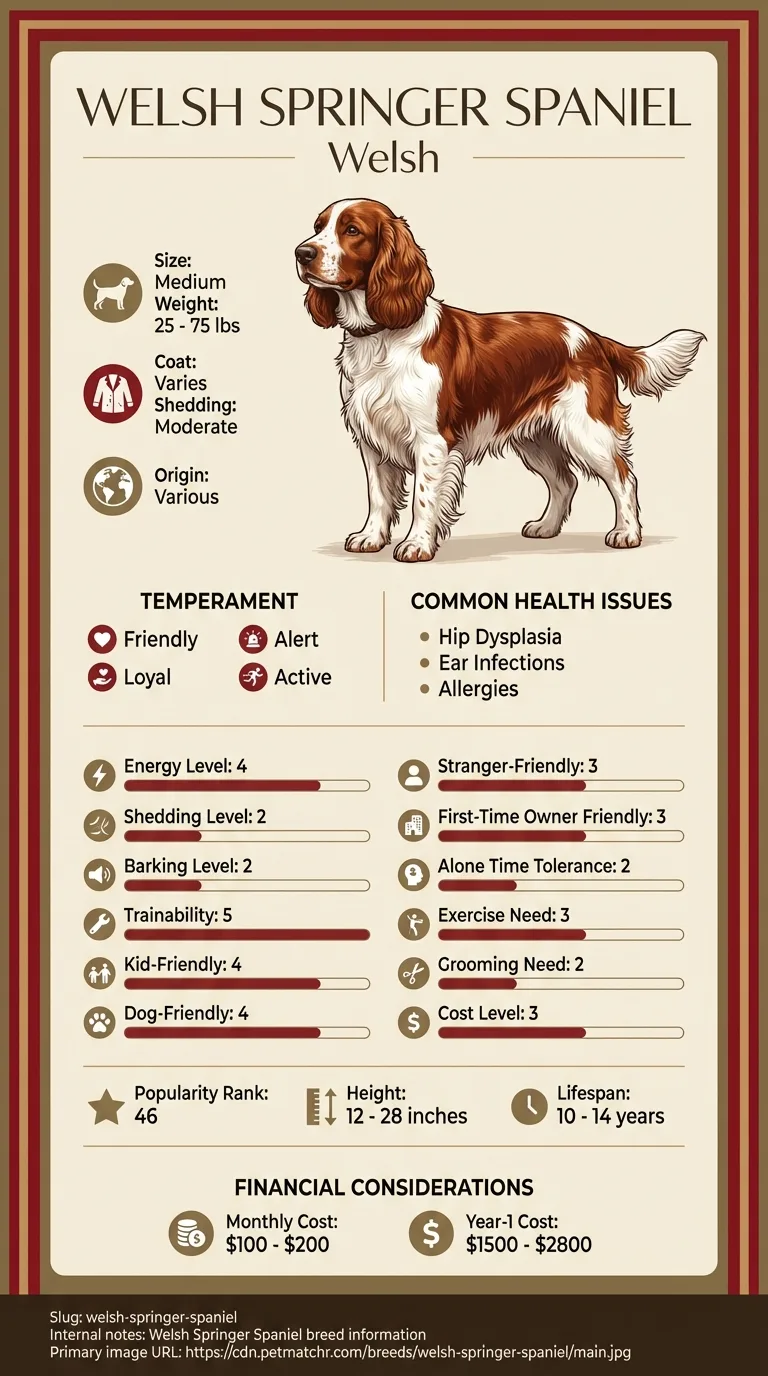
Welsh Springer Spaniel Cost in Philadelphia infographic

Why costs vary

The orthopaedic end of this breed's documented list carries the highest lifetime ceiling of the five. It is also the only one where information obtained early genuinely changes what an owner can do about it.

Cost summary

Modestly above-average Philadelphia pricing driven largely by yard-less housing, with an eight-month prevention window and an optional early screening line in the puppy year.

Estimate · source: estimation · confidence: medium · updated 2026-09-06 · not a quote

First year
$1470 - $3045
Ongoing monthly
$105 - $210

First-year expenses

ItemCost range
Early hip screening under sedation, puppy year
Optional, requires a certified veterinarian, and gives a measured laxity figure from around sixteen weeks.
$200 - $450

Monthly expenses

ItemCost range
Food for a 35-to-55-pound growing or active dog
Portioned to keep a young dog lean, which matters most where laxity is on the looser side.
$50 - $85
Dog walking without a private yard
A structural cost of rowhouse living rather than an optional extra for this breed.
$140 - $340

Is pet insurance worth it?

Early screening creates a small timing problem worth understanding: a recorded finding, however useful clinically, is also information an insurer can act on.

When insurance makes sense

Take the quote first and screen second. Doing it in that order preserves coverage while still giving you the information you wanted.

When you might skip it

An owner with a reserve large enough to fund a surgical year outright can reasonably self-insure at this market's pricing.

Ways to save without cutting essentials

The Philadelphia saving is a decade of comfort bought with one early test and a lot of free wooded trail.

  • Take an insurance quote before any hip screening is recorded, then screen.
  • Ask your practice whether they can perform or refer for early laxity-based hip evaluation.
  • Use Forbidden Drive and the Wissahickon's soft surfaces for a growing dog's mileage.
  • Keep the dog genuinely lean; it is the cheapest and most effective joint intervention there is.
  • Set prevention to the local eight-month season rather than defaulting to twelve.

Philadelphia Cost Factors: A Number at Sixteen Weeks Instead of a Verdict at Two

The Penn method measures joint laxity — how much the hip can be distracted from the socket — and expresses it as a number rather than a subjective grade. Because laxity is measurable in a young dog, it can be performed from around sixteen weeks of age, and the result is comparable against a breed-wide distribution rather than being a pass or a fail.

What that buys an owner is time. A puppy whose laxity sits at the tighter end of the range can be treated as an ordinary athletic dog. A puppy whose laxity sits at the looser end is a dog whose weight should be managed tightly from the start, whose long descents and repetitive high-impact work should be deferred, and whose owner should have an orthopaedic conversation at four rather than at eight. None of that reverses genetics. All of it affects when a marginal joint starts hurting.

There are honest caveats. It requires sedation or general anaesthesia and has to be done by a veterinarian certified in the method, so it is not something a general practice can necessarily offer on request. It costs more than a routine visit. And a favourable number is not a guarantee any more than an unfavourable one is a sentence.

But Philadelphia is the one city where the method's home institution is local, the practitioners are comparatively easy to find, and an owner can reasonably expect the conversation to be a familiar one rather than an unusual request. For a breed with hip dysplasia on its documented list, that is a real and specific local advantage.

Dense Housing, an Eight-Month Season, and Fairmount Park

The running costs here are moderately above average, and the biggest structural driver is housing. Rowhouse and apartment living without a private yard is common enough that dog-walking or daycare turns up in a great many Philadelphia budgets — and for a breed rated 2 out of 5 on tolerance for being left alone, that is a need rather than a convenience. Genuine winters do at least keep flea and tick prevention to about eight months.

Exercise is one of this city's quiet strengths. The Fairmount Park system is among the largest urban park networks in the country, and the Wissahickon Valley section covers roughly eighteen hundred acres of wooded gorge with Forbidden Drive running along the creek — several miles of soft, level, shaded surface that is close to ideal for a growing dog whose joints you would rather not load heavily.

That pairing is the point. If early screening suggests keeping a young dog off hard, repetitive, high-impact work, Philadelphia happens to provide a large amount of exactly the right kind of ground to substitute, at no cost, inside the city limits.

Welsh Springer Spaniel Cost in Philadelphia - Dense Housing, an Eight-Month Season, and Fairmount Park

The Number That Changed the Puppy Year

A family in Mount Airy had their four-month-old Welsh Springer screened on their veterinarian's suggestion, mostly out of curiosity. The laxity figure came back on the looser side of the breed distribution — not alarming, but not the number they had hoped for. What changed was ordinary and undramatic. They kept him a little leaner than they otherwise would have, they skipped the long hill descents everyone else's dogs were doing, and they put his mileage on the flat creek path instead. He is seven now and entirely comfortable. Whether that is the plan or simply luck, nobody can say — but the plan cost them one appointment and a change of route.

Key takeaway: In Philadelphia the useful hip information arrives early enough to act on, and the city's own soft-surface trail network is what you act with.

Frequently asked questions

How much does a Welsh Springer Spaniel cost per month in Philadelphia?

About $105 to $210, modestly above the national average, with dog-walking costs in yard-less housing accounting for much of the difference.

What is the first-year cost?

Roughly $1,470 to $3,045, including the initial exam, vaccinations, spay or neuter if needed, and gear alongside monthly running costs.

Can hips really be screened before two years old?

Yes, by the laxity-based method developed at Penn's veterinary school, which can be performed from around sixteen weeks and gives a measured number rather than a grade.

What would I actually do with that information?

Manage weight tightly, defer long descents and repetitive high-impact work, and start orthopaedic conversations earlier. It does not change the genetics; it changes the timeline you are working against.

What are the drawbacks?

It requires sedation or anaesthesia and a certified veterinarian, and it costs more than a routine visit. A good result is also not a guarantee, just as a poor one is not a verdict.

What emergency fund makes sense in Philadelphia?

Around $735 for a serious unplanned visit at local pricing, which is a reasonable floor given how high the orthopaedic ceiling runs in this breed.

Quick answers

View more answers
Costs

Welsh Springer Spaniel cost in Philadelphia

About $105 to $210 a month and $1,470 to $3,045 in year one, modestly above average. The Philadelphia-specific advantage is early hip screening: the laxity-based method developed at Penn can be run from sixteen weeks, which is early enough to change the plan.

Related DogBreedCompass guides

Important reminder

This guide is not medical advice. If your dog shows pain, sudden behavior change, or worsening symptoms, consult a licensed veterinarian.

Some links may be affiliate links. We may earn a commission at no extra cost to you. We only suggest products we believe are helpful for dog owners.

Get the 12-month budget for this breed in your city

One sheet with every line item, the emergency fund and when insurance pays off - unlocks on this page.

You get: 12-month budget sheet

No spam. One-click unsubscribe. See our privacy policy.

Preview page 1 before you decide.

Related guides