Health
Are Welsh Springer Spaniels prone to heart disease?
No, cardiac disease is not among this breed's most documented conditions, but it can still occur in any individual dog, as with any breed.

Quick answer
Are Welsh Springer Spaniels prone to heart disease?
No, cardiac disease is not among this breed's most documented conditions, but it can still occur in any individual dog, as with any breed.
A breed without a cardiac reputation still has a heart, and routine listening at the vet's office is what catches the rare cases before they become a problem.
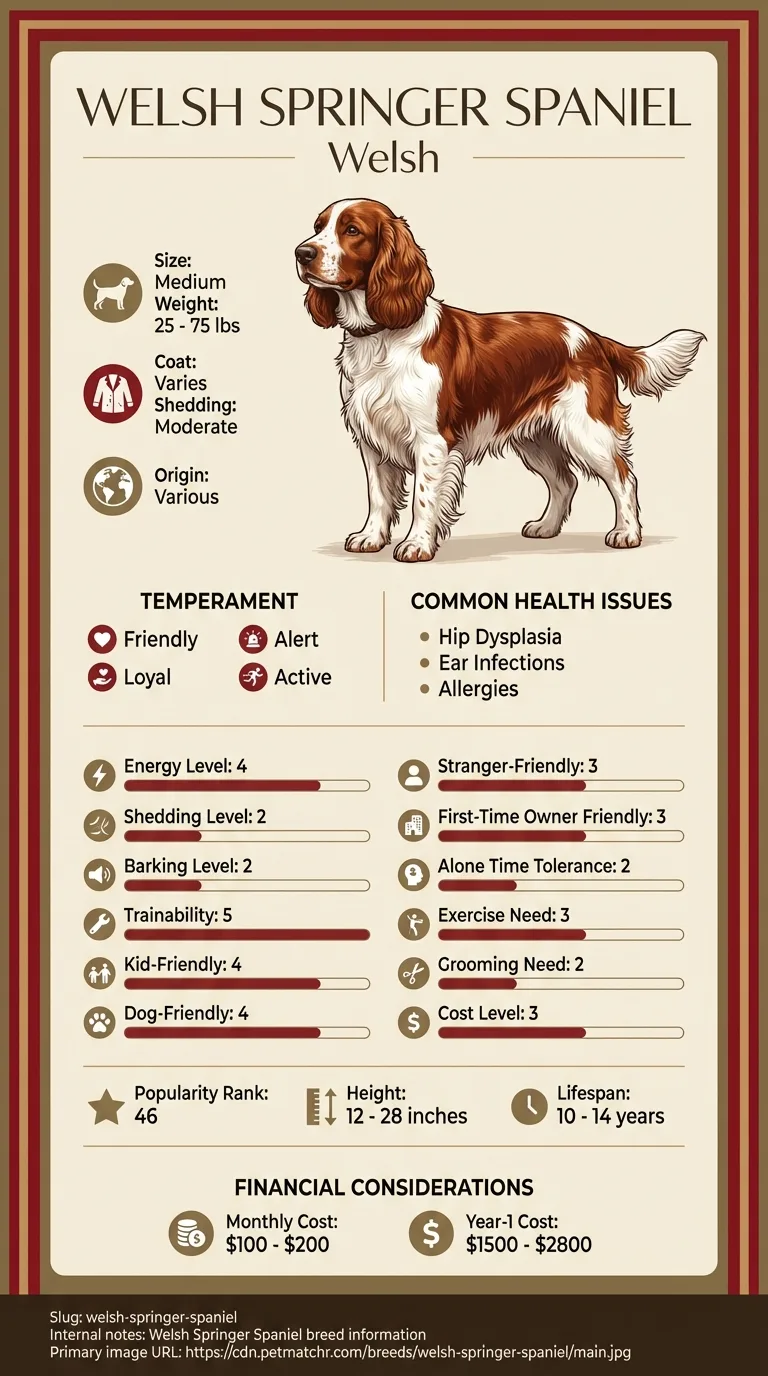
Owners of middle-aged and senior Welsh Springer Spaniels, and anyone who has heard about heart conditions in other breeds and wants an honest sense of how much it matters here, are the main audience for this overview.
This guide is not medical advice. If your dog shows pain, sudden behavior change, or worsening symptoms, consult a licensed veterinarian.
Some links may be affiliate links. We may earn a commission at no extra cost to you. We only suggest products we believe are helpful for dog owners.
We research and check what we publish, but we do not warrant that any figure, date, price, or statement is accurate, complete, or current, and we accept no liability for any loss, cost, injury, or other harm arising from the use of this site. Use it as one reference among several. You remain responsible for your own decisions and for your dog's care - confirm anything that matters with a licensed veterinarian or another qualified professional before you act on it. Full disclaimer.
Cardiac disease is not among the documented health issues most associated with Welsh Springer Spaniels, whose known concerns center on hip dysplasia, ear infections, epilepsy, glaucoma, and hypothyroidism. Heart conditions can still occur in any individual dog, and most are caught incidentally through routine wellness exams rather than through a specific breed-linked screening protocol.
Cardiac disease is not flagged as a leading documented condition for this breed, making it a comparatively low-priority but not impossible concern; most owners will never encounter a significant cardiac diagnosis, but consistent screening remains good general practice.
Welsh Springer Spaniels do not carry a documented breed-specific predisposition to cardiac disease, so any heart condition that does occur is more likely tied to normal individual aging or incidental factors rather than an inherited breed trait, unlike the orthopedic and thyroid conditions genuinely documented for this breed.
General health maintenance, consistent wellness exams, and a healthy weight all support cardiac health broadly in any dog, and their absence can allow age-related cardiac changes to go unnoticed for longer than they should.
Talk to your vet if you notice reduced exercise tolerance, a new cough, fainting, or general lethargy that doesn't have an obvious explanation. Sudden collapse, extreme difficulty breathing, or blue-tinged gums are signs of a true cardiac or respiratory emergency and require immediate veterinary care.
See all Welsh Springer Spaniel health problems, which breeds are prone to heart conditions, or the full Welsh Springer Spaniel breed guide for temperament, exercise needs and ownership costs.
Since this breed carries no elevated cardiac risk, most owners will go their dog's entire life without a significant cardiac finding; when something is caught, it is typically incidental and identified during routine annual screening.
Success looks like maintaining consistent wellness exams throughout your dog's life so that if a cardiac issue ever does arise, it is caught early and incidentally rather than only after symptoms become obvious.
Some breeds carry well-established, high cardiac risk, with specific conditions expected in a meaningful share of the population. The Welsh Springer Spaniel is not one of them. Its documented health list centers on hip dysplasia, ear infections, epilepsy, glaucoma, and hypothyroidism, none of which are cardiac. That context matters because it changes the right level of concern from active worry to routine good practice.
That said, any dog can develop a heart murmur, an arrhythmia, or valve changes with age, cardiac disease is simply a possibility across all of dogdom, not a Welsh Springer-specific one. The most common way an owner encounters this is incidentally: a vet listening to the heart during an annual exam notices something worth a second look, often in a dog that shows no symptoms at all at home.
Because this breed is genuinely active, with an exercise need most sources rate a 4 out of 5, a useful practical signal for owners is exercise tolerance. A dog that starts tiring noticeably faster than it used to, coughs after lying down, or seems less willing to keep pace on a familiar walk is worth a vet visit, less because this breed is cardiac-prone and more because those are the general warning signs worth acting on in any dog.

Because this breed isn't in a documented high-cardiac-risk category, the right approach is steady, routine awareness rather than specialized breed-specific cardiac screening.
Rachel's Welsh Springer, Ozzy, had never shown a single symptom that worried her, no cough, no tiring on walks, nothing. At his eight-year wellness exam, her vet paused during the routine stethoscope check and mentioned a soft, previously undetected heart murmur. Rachel was surprised, having assumed this breed simply wasn't a cardiac concern. Her vet explained that murmurs can appear in any dog with age and recommended a baseline echocardiogram, which showed very mild, early valve changes not yet requiring treatment, just monitoring at future annual visits. Ozzy has shown no symptoms in the two years since, and Rachel now understands her role as simply keeping those annual exams consistent rather than worrying about a breed-specific cardiac threat that was never really there.
Key takeaway: A breed with no cardiac reputation can still turn up an incidental finding, which is exactly why routine wellness exams matter regardless of a dog's documented health list.
No. Cardiac disease is not among the conditions most consistently documented for this breed, which is better known for orthopedic and thyroid issues. Heart conditions can still occur, as in any dog, but this breed carries no special elevated cardiac risk.
Most often, a vet notices a heart murmur or irregular rhythm incidentally during a routine annual wellness exam, in a dog showing no symptoms at home at all.
Reduced exercise tolerance, a new cough especially after resting, and general lethargy are the broad warning signs worth mentioning to a vet in any dog, including this one.
Annual wellness exams that include a stethoscope check are generally sufficient for a breed without elevated cardiac risk; more specialized screening is typically reserved for dogs showing symptoms or those in genuinely high-risk breeds.
Yes, this is normal and expected. Cardiac disease can occur in any dog regardless of breed, and a documented health list simply reflects which conditions are most statistically notable for that breed, not an exhaustive list of possible issues.
Yes. As with any breed, cardiac risk generally increases somewhat with age, which is part of why consistent annual exams matter more, not less, as your Welsh Springer gets older.
No, cardiac disease is not among this breed's most documented conditions, but it can still occur in any individual dog, as with any breed.
Most cardiac findings are incidental, caught during a routine stethoscope check at an annual wellness exam in a dog with no symptoms at home.
Reduced exercise tolerance, a new cough especially after resting, and unusual lethargy are the general signs worth mentioning to a vet.
Keeping annual wellness exams consistent through adulthood is generally sufficient for a breed without elevated cardiac risk.
Routine annual exams cost relatively little; more specialized cardiac workups, if ever needed, cost more but are typically reserved for dogs showing actual symptoms.
A one-page prep sheet for this condition: the signs, the questions to ask, what to get priced. Unlocks here.
You get: Vet visit prep sheet
No spam. One-click unsubscribe. See our privacy policy.
Preview page 1 before you decide.