Health
Is ARVC documented in Welsh Springer Spaniels?
No — it's characterized in Boxers and Doberman Pinschers, not established in this breed.

Quick answer
Is ARVC documented in Welsh Springer Spaniels?
No — it's characterized in Boxers and Doberman Pinschers, not established in this breed.
ARVC sounds like exactly the kind of silent heart condition every owner should worry about — but the genetic mutations behind it have been mapped in Boxers and Dobermans, not in Welsh Springer Spaniels.
Owners who've read about ARVC in general canine cardiology content or breed-comparison articles, and now wonder whether their Welsh Springer Spaniel needs cardiac screening for it, are the audience for this page.
This guide is not medical advice. If your dog shows pain, sudden behavior change, or worsening symptoms, consult a licensed veterinarian.
Some links may be affiliate links. We may earn a commission at no extra cost to you. We only suggest products we believe are helpful for dog owners.
We research and check what we publish, but we do not warrant that any figure, date, price, or statement is accurate, complete, or current, and we accept no liability for any loss, cost, injury, or other harm arising from the use of this site. Use it as one reference among several. You remain responsible for your own decisions and for your dog's care - confirm anything that matters with a licensed veterinarian or another qualified professional before you act on it. Full disclaimer.
Check this first
Fainting, sudden collapse, extreme exercise intolerance, or an irregular heartbeat felt through the chest wall are never something to watch and wait on, in any breed. A Welsh Springer Spaniel showing these signs needs a same-day veterinary exam, likely including a physical exam, chest X-rays, and possibly an ECG or echocardiogram.
In this breed, though, a vet is far more likely to find a benign arrhythmia, an unrelated systemic illness, or — if seizure-like activity is involved — a link to the epilepsy that is genuinely documented in Welsh Springer Spaniels. Hypothyroidism, also on this breed's real health list, can independently cause lethargy and reduced exercise tolerance that owners sometimes mistake for a heart problem.
The practical takeaway is the same one that applies to any breed-mismatched worry: don't ignore a real symptom, but don't let a rare condition from a different breed set your expectations for what the workup will find.
If any of these apply, call your vet or an emergency clinic now. The rest of this page is for the cases that are not an emergency.
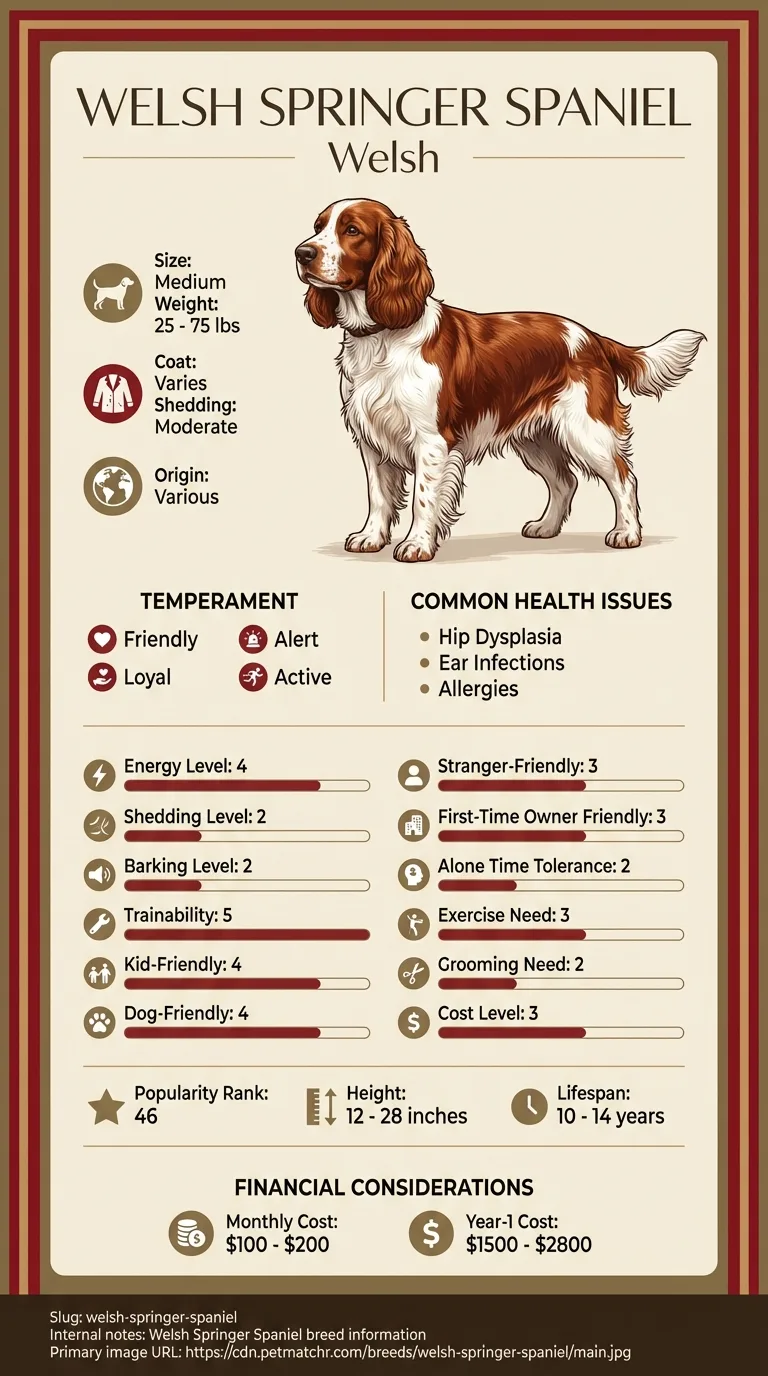
Arrhythmogenic right ventricular cardiomyopathy is a serious inherited heart rhythm disorder well characterized in Boxers and Doberman Pinschers, with validated genetic tests and screening protocols specific to those breeds. It is not established as occurring in Welsh Springer Spaniels, whose documented health risks — hip dysplasia, ear infections, epilepsy, glaucoma, and hypothyroidism — deserve the screening attention instead.
ARVC is common enough within Boxer and Doberman Pinscher populations to warrant routine breed-specific screening protocols in those breeds, but it has no recognized prevalence in Welsh Springer Spaniels at all. For this breed, the far more common and relevant health concerns are hip dysplasia, ear infections, epilepsy, glaucoma, and hypothyroidism.
The genetic mutations linked to ARVC have been mapped specifically within Boxer and Doberman Pinscher bloodlines through targeted cardiology research. No comparable study has identified an ARVC-linked mutation in Welsh Springer Spaniel lines, and this breed's known heritable conditions run in a different direction entirely — orthopedic, ocular, endocrine, and neurological.
Because ARVC isn't established in this breed's genetics, there are no meaningful environmental triggers to manage for it in a Welsh Springer Spaniel. Environmental factors that are actually relevant to this breed's real risks include drying ears after swimming, controlling weight to ease joint stress from hip dysplasia, and identifying seizure triggers if epilepsy runs in the line.
Talk to your vet promptly about any fainting, collapse, sustained exercise intolerance, or irregular heartbeat, since these deserve a real workup regardless of breed. In a Welsh Springer Spaniel, that workup is more likely to point toward epilepsy, hypothyroidism, or another documented breed condition than toward ARVC.
ARVC is a serious diagnosis when it's real, and that seriousness can bleed into research about breeds it doesn't affect. These are the missteps worth avoiding.
See all Welsh Springer Spaniel health problems, which breeds are prone to arrhythmogenic right ventricular cardiomyopathy arvc, or the full Welsh Springer Spaniel breed guide for temperament, exercise needs and ownership costs.
There's no meaningful ARVC monitoring timeline to set for this breed, since the condition isn't established here. A more useful timeline is the standard one: annual wellness exams, periodic thyroid panels starting in early adulthood, and hip and eye screening before any breeding decision.
Success here looks like redirecting the energy spent worrying about a Boxer- or Doberman-specific heart condition toward the screening and care Welsh Springer Spaniels actually benefit from. An owner who tracks ear health, joint condition, thyroid function, eye health, and seizure history is covering this breed's real risk profile.
Screening protocols exist because specific breeds carry specific documented risks, and a Welsh Springer Spaniel's priorities look different from a Boxer's or a Doberman's.

After reading a general canine cardiology article that named ARVC as a leading cause of sudden death in dogs, Priya in Sacramento asked her vet to run a full cardiac workup on her four-year-old Welsh Springer Spaniel, Baxter, who had no symptoms at all. Her vet explained that ARVC's genetic markers have only been identified in Boxers and Doberman Pinschers, and that Baxter's breed carries a completely different set of documented risks. Instead, they used the appointment to check Baxter's ears (clean, but due after a summer of lake swimming), add a thyroid panel to his upcoming senior bloodwork, and confirm his hip and eye screening results were current. Priya left with a plan built around Welsh Springer Spaniel-specific risks instead of a Boxer-specific one.
Key takeaway: A serious-sounding heart condition documented in other breeds isn't a meaningful risk for a Welsh Springer Spaniel — the real return on a vet visit comes from screening this breed's actual documented conditions: hips, ears, thyroid, eyes, and seizure history.
No — ARVC is a genetic heart condition extensively characterized in Boxers and Doberman Pinschers, and it isn't documented as occurring in Welsh Springer Spaniels. Routine cardiac auscultation at annual vet visits is a more relevant baseline for this breed than ARVC-specific screening.
It's a disease in which normal heart muscle in the right ventricle is gradually replaced by fatty and fibrous tissue, disrupting the heart's electrical signals and causing dangerous arrhythmias. In Boxers it can also involve the left ventricle, and it's a recognized cause of sudden cardiac death in both Boxers and Doberman Pinschers.
There's no genetic marker for ARVC validated in this breed, so a general-purpose panel wouldn't give you meaningful information. It's more useful to spend that visit on the conditions genuinely documented in Welsh Springer Spaniels — hips, ears, thyroid, eyes, and seizure history.
It's far more likely related to epilepsy, a documented condition in this breed, or a benign cause like overheating or overexertion, than to a heart condition never established in Welsh Springer Spaniels. Any fainting or collapse episode still deserves a prompt veterinary workup to rule out the more likely explanations.
There isn't a heart condition on this breed's documented common health issue list — the established risks are hip dysplasia, ear infections, epilepsy, glaucoma, and hypothyroidism. A general cardiac check at annual exams is still reasonable, just not because of any known breed-specific arrhythmia risk.
Breed-specific screening protocols exist because researchers identified and validated specific genetic mutations and clinical patterns within those breeds' populations. No equivalent research has found ARVC in Welsh Springer Spaniel bloodlines, so there's no validated test or protocol to apply here.
It's possible in theory for any dog, but in this breed hypothyroidism is a documented and far more likely cause of reduced stamina and lethargy. A vet visit with bloodwork is the right first step rather than assuming a cardiac cause tied to a different breed's genetics.
No — it's characterized in Boxers and Doberman Pinschers, not established in this breed.
A routine cardiac auscultation at annual vet visits is reasonable, without breed-specific ARVC testing.
Hip dysplasia, ear infections, epilepsy, glaucoma, and hypothyroidism are the breed's genuinely documented risks.
Not in this breed — epilepsy is a documented cause of collapse-like episodes in Welsh Springer Spaniels.
No — exercise planning for this breed should follow its real energy level and joint health, not an undocumented cardiac risk.
A one-page prep sheet for this condition: the signs, the questions to ask, what to get priced. Unlocks here.
You get: Vet visit prep sheet
No spam. One-click unsubscribe. See our privacy policy.
Preview page 1 before you decide.