Health
What are the early signs of hip dysplasia in a Welsh Springer Spaniel?
A bunny-hop gait, reluctance to jump, stiffness after rest, and a narrower hind stance are the earliest visible signs of hip dysplasia in this breed.

Quick answer
What are the early signs of hip dysplasia in a Welsh Springer Spaniel?
A bunny-hop gait, reluctance to jump, stiffness after rest, and a narrower hind stance are the earliest visible signs of hip dysplasia in this breed.
A dog built for a lifetime of retrieving needs hips that fit together properly, and this breed's most documented condition is exactly the joint that can let it down.
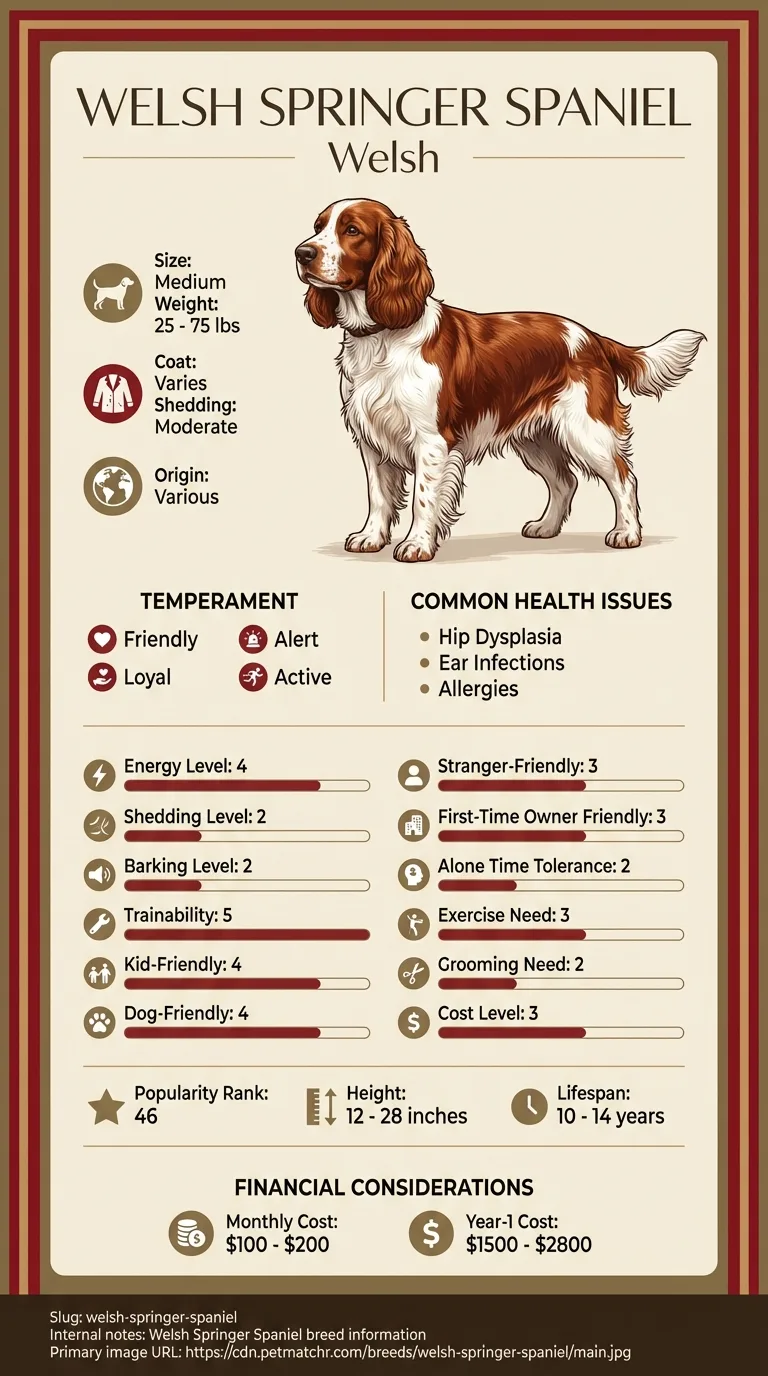
Owners of active, growing Welsh Springer puppies and those with adult dogs entering their senior years, when early laxity finally turns into visible arthritis, are the two groups who see this most.
This guide is not medical advice. If your dog shows pain, sudden behavior change, or worsening symptoms, consult a licensed veterinarian.
Some links may be affiliate links. We may earn a commission at no extra cost to you. We only suggest products we believe are helpful for dog owners.
We research and check what we publish, but we do not warrant that any figure, date, price, or statement is accurate, complete, or current, and we accept no liability for any loss, cost, injury, or other harm arising from the use of this site. Use it as one reference among several. You remain responsible for your own decisions and for your dog's care - confirm anything that matters with a licensed veterinarian or another qualified professional before you act on it. Full disclaimer.
Hip dysplasia is one of the most consistently documented conditions in Welsh Springer Spaniels. It begins as joint laxity that often causes no visible symptoms in puppyhood, then gradually wears into arthritis over months and years, especially in a breed with real drive to run and jump.
Hip dysplasia appears on the short list of documented health issues for this breed, meaning it shows up often enough in health records and veterinary literature to be considered a genuine, well-established concern rather than a rare finding.
Welsh Springer Spaniels carry a documented genetic predisposition to hip joint laxity, and their medium build combined with a real drive to run, jump, and retrieve means that predisposition gets exercised hard from puppyhood onward, which can accelerate how quickly arthritis develops in a loosely formed joint.
Rapid weight gain during growth, repetitive jumping onto furniture or in and out of vehicles before the skeleton matures, and carrying extra weight as an adult all add mechanical stress that turns genetic laxity into faster, more painful arthritis.
Talk to your vet if you notice a bunny-hop gait, reluctance to jump, stiffness after rest, or a narrower hind stance, so hip laxity or early arthritis can be assessed before it progresses further. A dog that suddenly cannot bear weight, cries out, or cannot rise needs urgent same-day veterinary attention.
See all Welsh Springer Spaniel health problems, which breeds are prone to hip dysplasia, or the full Welsh Springer Spaniel breed guide for temperament, exercise needs and ownership costs.
Laxity is often present from puppyhood, but visible symptoms typically appear gradually over one to several years, with many dogs not showing an obvious gait change until middle age or later.
Success looks like a dog that stays lean, active, and comfortable through careful weight and exercise management, even if x-rays show measurable arthritis, rather than a joint that is perfectly normal on a scan.
Hip dysplasia starts as laxity: the ball of the femur does not sit snugly in the hip socket, so it moves more than it should during normal activity. In a puppy, this laxity alone often causes no visible pain, which is part of why the condition is so easy to miss early.
Over months and years, that repeated abnormal movement wears down cartilage and reshapes the socket edge, and this is when arthritis sets in. For a medium, energetic breed with a genuine drive to run, jump, and retrieve, that repeated wear accumulates faster than it would in a sedentary dog, which is why exercise management during growth matters as much as genetics.
By the time an owner notices a bunny-hop gait, where both back legs move together like a rabbit rather than alternating, or reluctance to jump into a car, the joint has usually already developed measurable arthritic change. Catching the laxity stage earlier, through a vet exam or hip scoring, gives far more room to slow that progression.

Because dysplasia is a lifelong joint condition rather than a one-time event, management changes at each life stage rather than stopping once a diagnosis is made.
Dana's Welsh Springer, Cardigan, had always moved a little oddly on stairs, but she chalked it up to personality rather than a health issue. It wasn't until Cardigan started refusing to jump into the back seat of the car, something he had done eagerly for years, that Dana brought it up at a routine checkup. A physical exam revealed hip laxity consistent with dysplasia, confirmed later with x-rays. Rather than surgery, Dana's vet recommended a structured weight-and-exercise plan: shorter, more frequent walks instead of long runs, a ramp for the car, and careful portion control to keep Cardigan lean. Eighteen months later, Cardigan's gait has stabilized and he is back to short bursts of retrieving, just without the marathon sessions he used to do.
Key takeaway: The visible signs of hip dysplasia often show up long after the joint laxity itself began, which is why a subtle gait change is worth a vet visit rather than a shrug.
Hip dysplasia is a malformation where the ball and socket of the hip joint do not fit together tightly, allowing abnormal movement that gradually wears down cartilage and leads to arthritis over time.
It is genetic, but growth rate, weight, and exercise during puppyhood all influence how much arthritis eventually develops from that genetic looseness. Two dogs with similar hip conformation can have very different outcomes based on management.
A bunny-hop gait where both back legs move together, reluctance to jump into a car or onto furniture, stiffness after rest that eases with movement, and a narrower hind stance are the classic signs.
A vet exam with manipulation tests can suggest laxity, but a formal hip score requires x-rays, usually through OFA or PennHIP evaluation, done under sedation at the appropriate age.
Most dogs are managed rather than cured, through weight control, moderate low-impact exercise, and vet-guided pain management as needed. Surgery is reserved for more severe cases where quality of life is significantly affected.
Keeping a growing puppy lean, avoiding repetitive high-impact jumping before the growth plates close, and choosing steady rather than explosive exercise all reduce how much arthritis eventually develops.
Yes, and often significantly so. Extra weight adds direct mechanical load to an already compromised joint, so weight control is one of the single most effective things an owner can do.
A bunny-hop gait, reluctance to jump, stiffness after rest, and a narrower hind stance are the earliest visible signs of hip dysplasia in this breed.
No, but its impact can be greatly reduced through lifelong weight control, moderate exercise, and vet-guided management, especially when caught early.
Mild cases can often be managed for years with weight control and exercise adjustments alone; costs rise significantly if joint supplements, physical therapy, or surgery become necessary.
Keeping puppies lean, limiting repetitive jumping before eighteen months, and choosing steady over explosive exercise all support healthier hip development.
A dog suddenly unable to bear weight, crying out, or completely unable to rise needs urgent veterinary attention, since this can signal a more acute injury layered on top of existing joint disease.
A one-page prep sheet for this condition: the signs, the questions to ask, what to get priced. Unlocks here.
You get: Vet visit prep sheet
No spam. One-click unsubscribe. See our privacy policy.
Preview page 1 before you decide.