Living
Bigger dog: Chihuahua or Welsh Springer Spaniel?
The Welsh Springer Spaniel is dramatically bigger, weighing 35-55 lbs versus the Chihuahua's 2-6 lbs.

Quick answer
Bigger dog: Chihuahua or Welsh Springer Spaniel?
The Welsh Springer Spaniel is dramatically bigger, weighing 35-55 lbs versus the Chihuahua's 2-6 lbs.
Chihuahua or Welsh Springer Spaniel? On paper they differ most on apartment suitability, and on the scales Welsh Springer Spaniel is the heavier at 35–55 lbs. Here is how the two compare on everything that shapes an ordinary week.
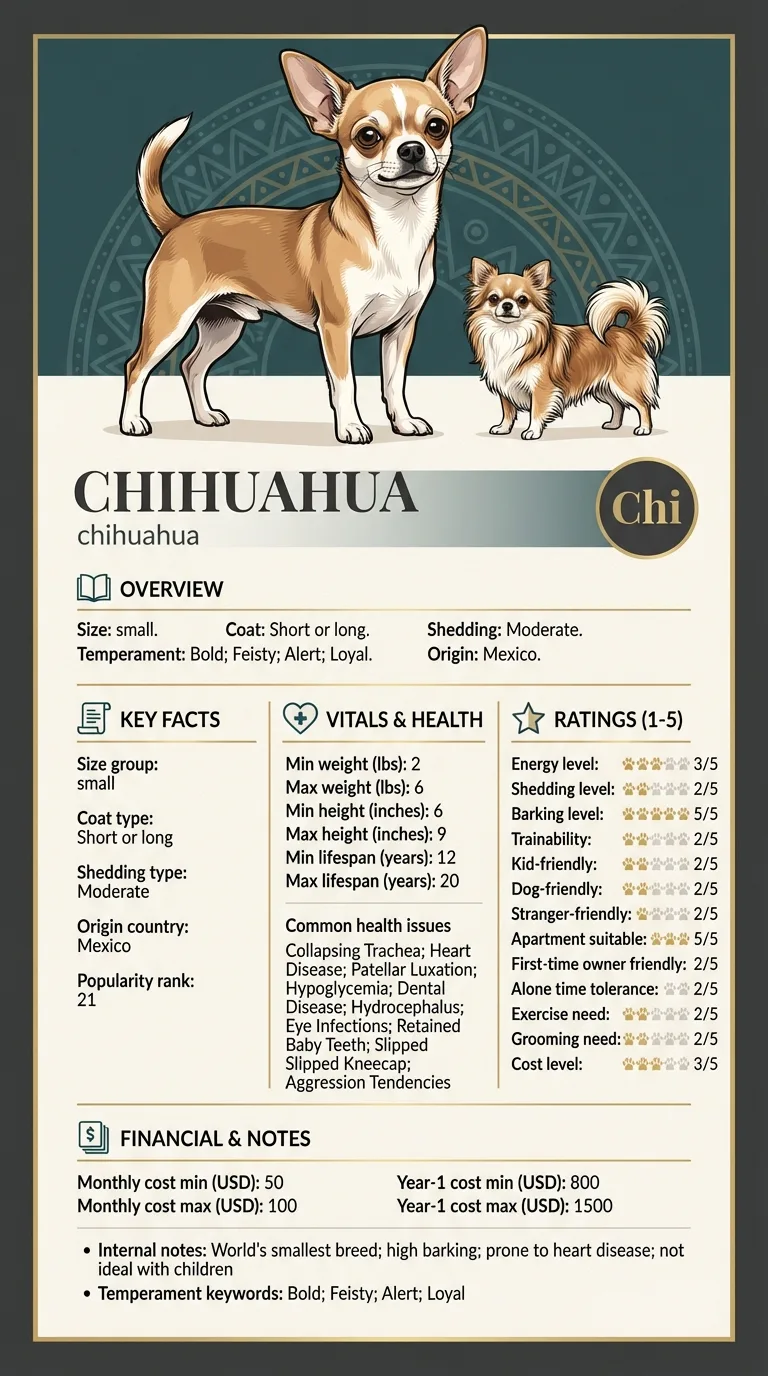
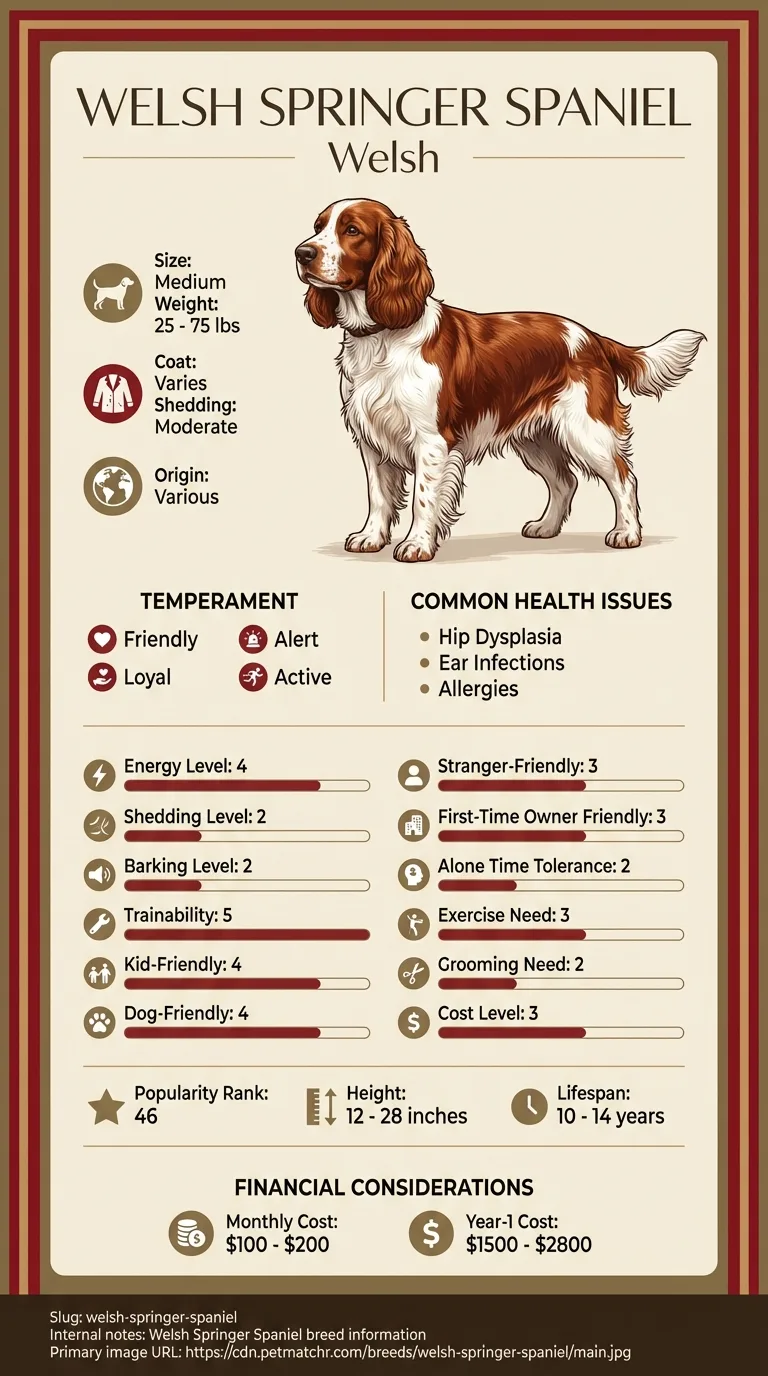
This is for someone already down to Chihuahua and Welsh Springer Spaniel and deciding between them. For this pair the decision usually turns on apartment suitability and exercise need, so those are covered first and in most detail. Anyone choosing from a flat has a clear answer here: Chihuahua rates 5/5 against 2/5. Breed history is left out; what follows is what you will actually live with.
Between Chihuahua and Welsh Springer Spaniel, apartment suitability is what separates them, and Chihuahua is the lower-effort dog of the two to keep.
Choose Chihuahua if you are in a flat or a smaller home, you do not want a standing grooming appointment and shedding is a problem in your house.
Choose Welsh Springer Spaniel if this is your first dog, there are young children at home and you already have another dog.
| Feature | chihuahua | welsh springer spaniel | Winner |
|---|---|---|---|
| Size class | small | medium | Equal |
| Weight | 2–6 lbs | 35–55 lbs | Equal |
| Height | 6–9 in | 17–19 in | Equal |
| Lifespan | 12–20 years | 12–15 years | chihuahua |
| Exercise need | Low (2/5) | High (4/5) | chihuahua |
| Grooming need | Low (2/5) | Moderate (3/5) | chihuahua |
| Shedding | Low (2/5) | Moderate (3/5) | chihuahua |
| Energy level | Moderate (3/5) | High (4/5) | Equal |
| Barking | Very high (5/5) | Moderate (3/5) | welsh springer spaniel |
| Apartment suitability | Very high (5/5) | Low (2/5) | chihuahua |
| Good for first-time owners | Low (2/5) | Moderate (3/5) | welsh springer spaniel |
| Tolerates being alone | Low (2/5) | Low (2/5) | Equal |
| Trainability | Low (2/5) | High (4/5) | welsh springer spaniel |
| Good with kids | Low (2/5) | High (4/5) | welsh springer spaniel |
| Good with other dogs | Low (2/5) | High (4/5) | welsh springer spaniel |
| Friendly to strangers | Low (2/5) | Moderate (3/5) | welsh springer spaniel |
| Cost level | Moderate (3/5) | Moderate (3/5) | Equal |
| Coat | Short or long | Medium, straight and water-resistant | Equal |
| Origin | Mexico | Various | Equal |
| Typical monthly cost | $50–$100 | $100–$200 | Equal |
| Typical first-year cost | $800–$1,500 | $1,400–$2,900 | Equal |
Put a 2-to-6-pound Chihuahua next to a 35-to-55-pound Welsh Springer Spaniel and the difference is almost comic: the springer can outweigh its counterpart by nearly tenfold, standing 17 to 19 inches at the shoulder against the Chihuahua's 6 to 9 inches. That gap shapes nearly everything else on this page. The Chihuahua's tiny frame is built for lap space and travel bags, while the Welsh Springer Spaniel carries the sturdier, sporting-dog build of a gundog bred to work fields for hours. Owners choosing between them are really choosing between two different categories of dog, not two dogs of similar scale with different coats.
The Welsh Springer Spaniel rates high (4/5) on exercise need and high (4/5) on energy level, reflecting its roots as a working gundog that expects daily fieldwork or long runs. The Chihuahua sits at low (2/5) exercise need but moderate (3/5) energy, meaning it can be surprisingly zippy indoors in short bursts without needing a real workout. A Welsh Springer left under-exercised tends to become restless and destructive, while a Chihuahua's energy can mostly be burned off with a couple of short walks and some living-room play. Anyone drawn to hiking or field sports has a natural partner in the springer; anyone wanting minimal exercise obligations leans Chihuahua.
Both breeds score low to moderate on coat care, but the details differ. The Chihuahua's grooming need sits at low (2/5) with low (2/5) shedding, whether it carries the short or the long coat variety — an occasional brush covers most weeks. The Welsh Springer Spaniel's medium, straight, water-resistant coat pushes both grooming and shedding to moderate (3/5), and its feathering around the ears and legs needs regular brushing to avoid matting, plus more frequent baths after muddy walks given its field-dog habits. Neither breed demands professional grooming on the level of a heavily coated show breed, but the springer asks for noticeably more brush time than the Chihuahua.
On paper the Chihuahua looks like the apartment-dweller's dream, scoring very high (5/5) for apartment suitability against the Welsh Springer Spaniel's low (2/5). But there's a catch: the Chihuahua also rates very high (5/5) for barking, so thin walls and close neighbors can become an issue despite its small footprint. The springer's moderate (3/5) barking is easier to live with, but its high exercise needs make small spaces frustrating for the dog itself. Neither breed tolerates being left alone well, both rated low (2/5) on that measure, so long solo workdays are a poor fit for either the vocal Chihuahua or the physically pent-up springer.
New dog owners often assume small equals easy, but the numbers say otherwise here. The Chihuahua rates low (2/5) on both trainability and suitability for first-time owners, and its bold, feisty temperament can translate into stubbornness during training sessions if handled inconsistently. The Welsh Springer Spaniel rates high (4/5) on trainability and moderate (3/5) for first-timers, benefiting from its even-tempered, loyal nature and gundog heritage that makes it responsive to structured work. A first-time owner willing to put in patient, consistent training will likely find the springer more cooperative, while the Chihuahua rewards owners who understand toy-breed psychology and don't mistake small size for an easy temperament.
This category shows one of the widest gaps on the comparison table. The Chihuahua scores low (2/5) for good with kids, low (2/5) for good with other dogs, and low (2/5) for friendliness to strangers — consistent with a breed described as bold and feisty that can be wary of rough handling or unfamiliar faces. The Welsh Springer Spaniel scores high (4/5) on both kids and other dogs and moderate (3/5) with strangers, reflecting its even-tempered, loyal disposition bred for cooperative work alongside handlers and other gundogs. Families with young children or multi-dog households have a much smoother path with the springer; the Chihuahua tends to do best as a one-on-one companion for calmer households.
The Chihuahua actually wins on longevity, with a lifespan of 12 to 20 years compared to the Welsh Springer Spaniel's 12 to 15 — but that extra potential lifespan comes with a longer list of watch-outs, including collapsing trachea, heart disease, patellar luxation, hypoglycemia, hydrocephalus, and retained baby teeth that sometimes need extraction. The Welsh Springer Spaniel's five flagged conditions — hip dysplasia, ear infections, epilepsy, glaucoma, and hypothyroidism — are fewer in number but include hip dysplasia, a concern worth screening for in a larger, more athletic breed. Prospective owners of the Chihuahua should budget for dental care and knee monitoring, while springer owners should watch ears after wet outdoor activity and ask breeders about hip and eye clearances.
Both breeds carry a moderate (3/5) overall cost rating, but the actual dollar figures diverge sharply because of size. The Chihuahua runs $50 to $100 a month and roughly $800 to $1,500 in the first year, reflecting smaller food portions and lower-dose medications. The Welsh Springer Spaniel costs $100 to $200 monthly and $1,400 to $2,900 in year one — close to double across the board, driven by a larger body to feed, more coat to maintain, and higher-volume flea, tick, and heartworm preventives. Owners on a tight budget who still want a dog with real presence will find the Chihuahua meaningfully cheaper to keep, while the springer's costs align with a mid-size sporting breed.
Chihuahua weighs 2–6 lbs and lives 12–20 years; Welsh Springer Spaniel weighs 35–55 lbs and lives 12–15 years. The two diverge most on apartment suitability, exercise need and barking and 3 other rated axes. They are level on tolerates being alone and cost level, so those cannot decide it. The comparison marks an easier option only where one exists. Facts like weight and country of origin are not scored. Both dogs are rated from the same dataset, which is what makes the numbers comparable with each other even though any individual dog sits somewhere inside its breed's range.

The Chihuahua is the far better apartment fit, rating very high (5/5) for apartment suitability versus the Welsh Springer Spaniel's low (2/5), though the Chihuahua's very high (5/5) barking score means noise, not space, becomes the real apartment challenge.
The Chihuahua typically lives longer, with a lifespan of 12 to 20 years compared to the Welsh Springer Spaniel's 12 to 15 years.
Yes — the Welsh Springer Spaniel rates high (4/5) on trainability against the Chihuahua's low (2/5), thanks to its even-tempered, gundog-bred responsiveness to structured work.
The Welsh Springer Spaniel is considerably better with children, scoring high (4/5) versus the Chihuahua's low (2/5), consistent with its loyal, even-tempered nature compared to the Chihuahua's bolder, more defensive personality.
Roughly double — first-year costs run about $1,400-$2,900 for the springer versus $800-$1,500 for the Chihuahua, mainly due to food volume and coat care.
Neither breed tolerates being alone well, both rated low (2/5), so long solitary days are a poor fit for either the Chihuahua or the Welsh Springer Spaniel.
The Chihuahua sheds less, rated low (2/5) versus the Welsh Springer Spaniel's moderate (3/5) shedding from its water-resistant double coat.
The Welsh Springer Spaniel is dramatically bigger, weighing 35-55 lbs versus the Chihuahua's 2-6 lbs.
The Welsh Springer Spaniel barks less, rated moderate (3/5) versus the Chihuahua's very high (5/5).
The Chihuahua, with low (2/5) grooming needs versus the springer's moderate (3/5).
The Welsh Springer Spaniel edges it, rated moderate (3/5) for first-time owners versus the Chihuahua's low (2/5).
Secure checkout on Stripe. We never see your card.
7-day money-back guarantee. Instant access.
Health information here is general and is not veterinary advice. If your dog shows pain, sudden behaviour change, or worsening symptoms, consult a licensed veterinarian.
Some links on this site are affiliate links. We may earn a commission at no extra cost to you, and we only suggest products we believe are helpful for dog owners.
We research and check what we publish, but we do not warrant that any figure, date, price, or statement is accurate, complete, or current, and we accept no liability for any loss, cost, injury, or other harm arising from the use of this site. Use it as one reference among several. You remain responsible for your own decisions and for your dog's care - confirm anything that matters with a licensed veterinarian or another qualified professional before you act on it. Full disclaimer.
Match your lifestyle to the right dog.
Take quizNot sure which breed is right for you? Take our 2-minute quiz to find out.
Take the quiz