Health
Does this breed have a documented cardiomyopathy risk?
No, there's no documented predisposition for this breed; risk here is more tied to general aging than any known breed-specific genetic pattern.

Quick answer
Does this breed have a documented cardiomyopathy risk?
No, there's no documented predisposition for this breed; risk here is more tied to general aging than any known breed-specific genetic pattern.
A cough after lying down, a bit less stamina on the usual walk, these are easy to write off as normal aging, but they're also how early heart muscle changes can first show themselves.
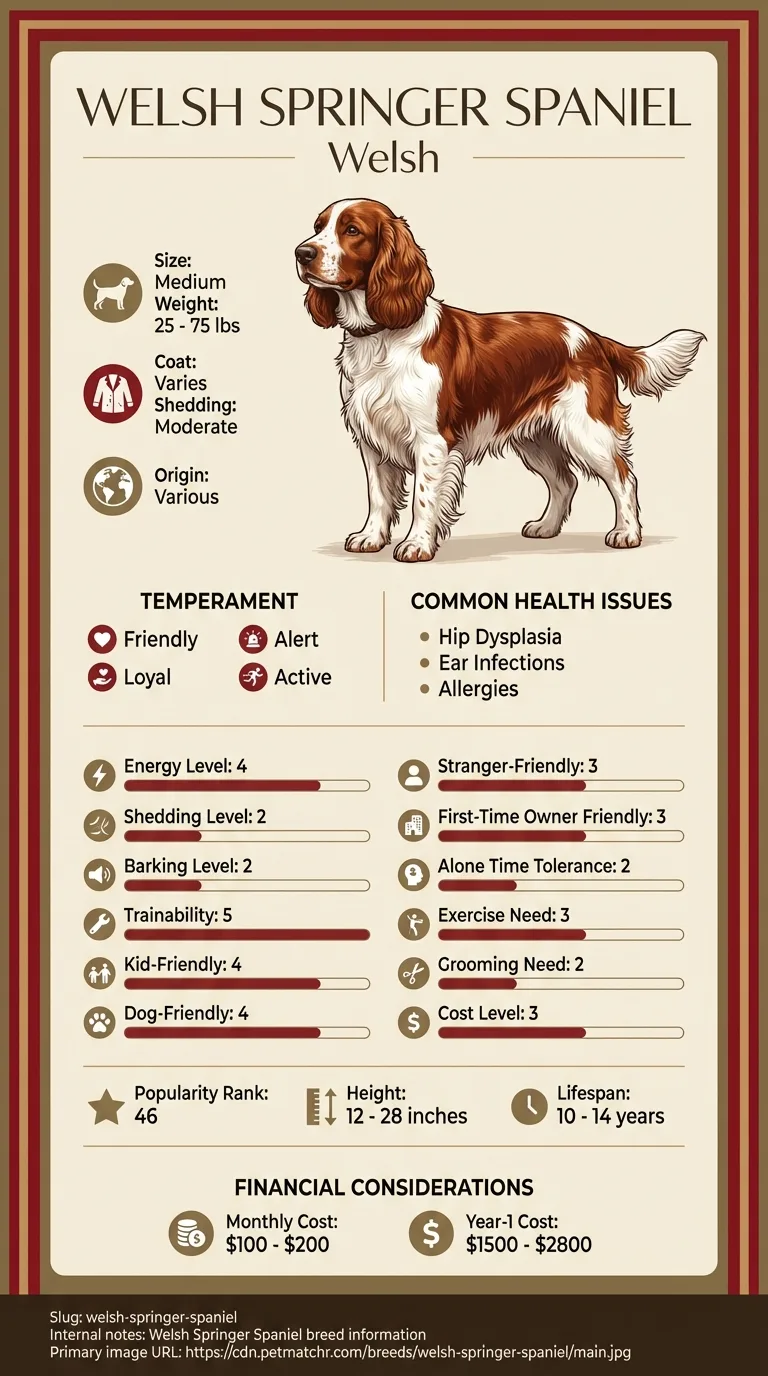
Owners of senior Welsh Springer Spaniels, particularly those whose dogs were highly active in their younger years, are the ones most likely to notice a gradual drop in exercise tolerance worth mentioning to a vet.
This guide is not medical advice. If your dog shows pain, sudden behavior change, or worsening symptoms, consult a licensed veterinarian.
Some links may be affiliate links. We may earn a commission at no extra cost to you. We only suggest products we believe are helpful for dog owners.
We research and check what we publish, but we do not warrant that any figure, date, price, or statement is accurate, complete, or current, and we accept no liability for any loss, cost, injury, or other harm arising from the use of this site. Use it as one reference among several. You remain responsible for your own decisions and for your dog's care - confirm anything that matters with a licensed veterinarian or another qualified professional before you act on it. Full disclaimer.
Cardiomyopathy refers to disease of the heart muscle itself, most often involving thinning and stretching of the heart chambers that weakens the heart's pumping ability over time. It isn't a documented breed-specific risk for the Welsh Springer Spaniel, but heart muscle changes can develop with age in any dog, and this breed's 12 to 15 year lifespan provides more time for that possibility.
Cardiomyopathy isn't among the Welsh Springer Spaniel's documented health issues. It's included here because heart muscle disease is a general aging-related risk across dog breeds, and this breed's comparatively long lifespan means more dogs live into the years where such changes are more likely to be diagnosed.
There's no documented genetic predisposition to cardiomyopathy for this breed in breeds.json. The relevant breed factor is simply longevity, a 12 to 15 year lifespan gives more opportunity for age-related heart muscle changes to develop and eventually become noticeable.
Diet is one of the more actionable environmental factors, since certain non-traditional diet formulations have been associated with heart muscle changes in dogs generally. General cardiovascular health, maintained through appropriate exercise and a healthy weight, also plays a supporting role.
Talk to your vet if you notice a persistent cough, reduced exercise tolerance, episodes of rapid or labored breathing, fainting, or a swollen abdomen. Fainting or collapse during exertion should be treated as urgent and evaluated the same day.
See all Welsh Springer Spaniel health problems, which breeds are prone to cardiomyopathy, or the full Welsh Springer Spaniel breed guide for temperament, exercise needs and ownership costs.
Cardiomyopathy typically develops gradually over months to years rather than appearing suddenly. Once diagnosed, most dogs are managed with medication over the remainder of their life rather than treated toward a full recovery.
Success looks like stable heart function and maintained quality of life for as long as possible, with regular monitoring to catch and adjust treatment as the condition progresses, rather than a cure.
Cardiomyopathy is an umbrella term for disease affecting the structure or function of the heart muscle itself, as opposed to problems with the valves or the electrical rhythm. The most commonly discussed form is dilated cardiomyopathy, where the heart chambers stretch and the muscle thins, becoming a weaker pump over time.
This breed isn't documented as having an elevated risk for any specific form of cardiomyopathy, unlike breeds where a genetic predisposition has been well studied and confirmed. What matters more here is that cardiomyopathy in general tends to be an age-related or, in some cases, nutritionally influenced condition, and a breed with a 12 to 15 year lifespan has more years for age-related heart changes to potentially develop.
Because early cardiomyopathy often produces no obvious symptoms at all, it's frequently first detected incidentally, during a routine exam when a vet hears an unusual heart sound, rather than because an owner noticed something wrong at home.
Early cardiomyopathy is often silent, but these signs, especially in combination, are worth raising at your dog's next appointment rather than waiting for the annual exam.

Dylan brought his eleven-year-old Welsh Springer Spaniel, Seren, in for a routine dental cleaning consultation, expecting nothing more than a teeth conversation. During the pre-procedure exam, the vet heard a new, faint heart murmur and recommended an echocardiogram before proceeding with anesthesia. The scan showed early changes consistent with mild cardiomyopathy, not yet causing any symptoms Dylan had noticed at home. The vet adjusted the anesthesia plan for safety and started Seren on monitoring with plans to reassess in six months. Dylan now schedules a heart check as part of every annual senior exam, grateful the dental visit caught something he wouldn't have thought to look for otherwise.
Key takeaway: Early cardiomyopathy is often silent, which is exactly why routine senior exams, not just symptom-driven vet visits, matter as a dog ages into its later years.
No, this isn't among the breed's documented health issues. It's discussed here because heart muscle disease can develop in any dog with age, and this breed's typical 12 to 15 year lifespan gives more time for that to occur.
An echocardiogram, an ultrasound of the heart, is the standard way to assess heart muscle thickness, chamber size, and pumping function. A vet may also use chest X-rays and bloodwork to build a fuller picture.
Diet has been linked to some cases of dilated cardiomyopathy in dogs generally, which is why feeding a complete, well-formulated diet and discussing any grain-free or boutique diet choices with your vet is a reasonable precaution.
Dilated cardiomyopathy is one specific form of cardiomyopathy, involving a stretched, thinned heart muscle. Cardiomyopathy is the broader category that also includes other, less common structural heart muscle changes.
It's generally managed rather than cured, often with medication to support heart function and reduce symptoms. Early detection through routine vet exams gives the most treatment options.
Yes, a stethoscope exam is a standard, low-cost part of any senior wellness visit, and it can catch subtle changes, like a new murmur or irregular rhythm, well before obvious symptoms appear.
No, there's no documented predisposition for this breed; risk here is more tied to general aging than any known breed-specific genetic pattern.
Reduced stamina on a normally easy walk or a new cough at rest are the most common early signs owners notice at home.
An echocardiogram is the standard diagnostic tool, often supplemented with chest X-rays and bloodwork.
A veterinary echocardiogram typically runs $300 to $600, sometimes more if performed by a cardiology specialist.
Yes, routine senior wellness exams with a stethoscope check can catch subtle heart changes before obvious symptoms develop.
A one-page prep sheet for this condition: the signs, the questions to ask, what to get priced. Unlocks here.
You get: Vet visit prep sheet
No spam. One-click unsubscribe. See our privacy policy.
See a sample page before you decide.
Early access list
The free prep sheet covers the same-day warning signs, a symptom log and the questions to ask. We are considering a fuller kit that adds a cost worksheet for the usual tests and treatments (US price ranges with their sources) and a plain-English guide to ways of covering the bill. It is not built yet; this list tells us whether it is worth building.
One email, no spam, unsubscribe anytime. Information only, not veterinary advice.