Health
What is the first sign of kidney disease in dogs?
Increased thirst and urination are usually the earliest noticeable signs, often appearing before bloodwork shows a clear abnormality.

Quick answer
What is the first sign of kidney disease in dogs?
Increased thirst and urination are usually the earliest noticeable signs, often appearing before bloodwork shows a clear abnormality.
By the time a dog's kidneys make themselves obvious, they have usually been struggling quietly for a long time already.
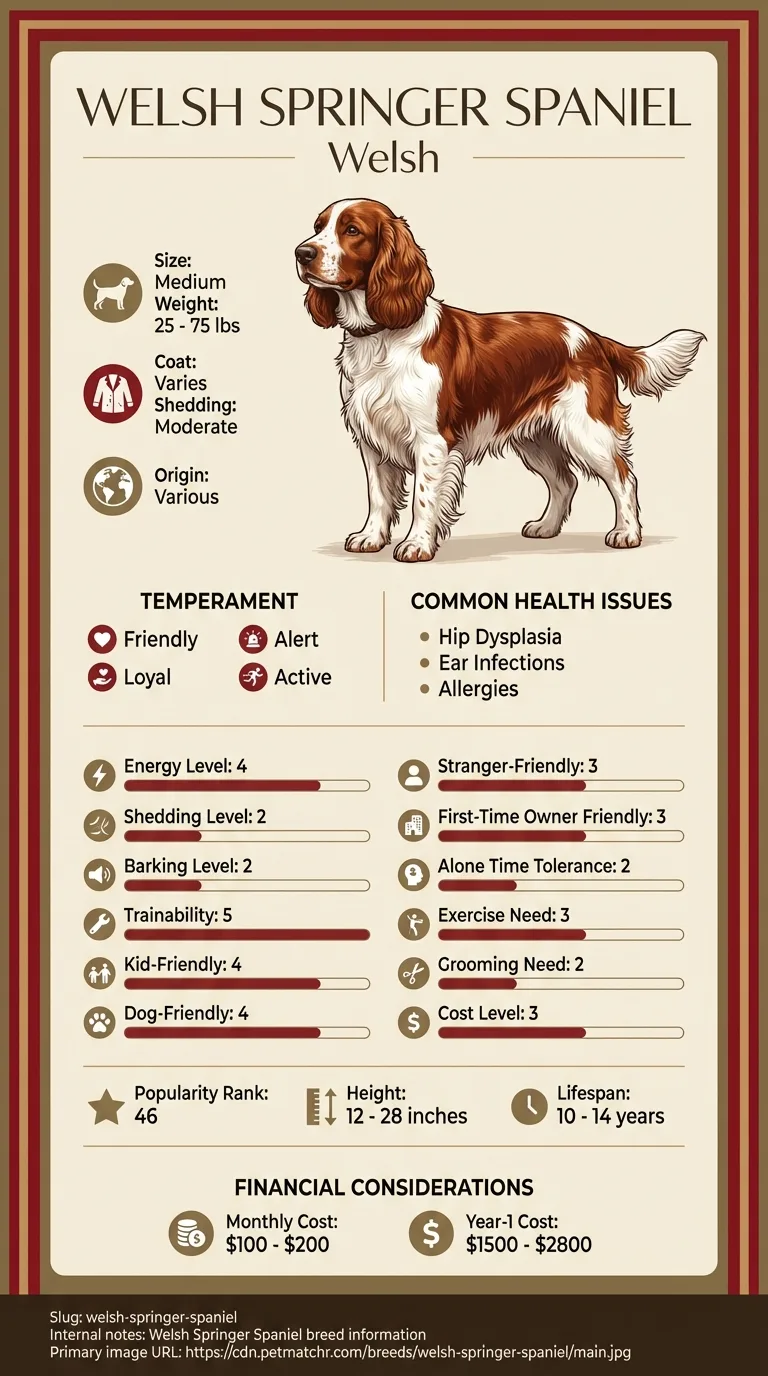
Owners of senior Welsh Springer Spaniels are most likely to encounter this, since chronic kidney disease is overwhelmingly a condition of aging rather than something that typically appears in young dogs.
This guide is not medical advice. If your dog shows pain, sudden behavior change, or worsening symptoms, consult a licensed veterinarian.
Some links may be affiliate links. We may earn a commission at no extra cost to you. We only suggest products we believe are helpful for dog owners.
We research and check what we publish, but we do not warrant that any figure, date, price, or statement is accurate, complete, or current, and we accept no liability for any loss, cost, injury, or other harm arising from the use of this site. Use it as one reference among several. You remain responsible for your own decisions and for your dog's care - confirm anything that matters with a licensed veterinarian or another qualified professional before you act on it. Full disclaimer.
Chronic kidney disease is a progressive, largely age-related condition that can affect Welsh Springer Spaniels as they enter their senior years. Because the kidneys have significant reserve capacity, a dog can lose much of its kidney function before bloodwork clearly reflects it, making regular senior screening more valuable than waiting for obvious symptoms.
Chronic kidney disease becomes increasingly common with age across virtually all dog breeds, and given this breed's typical twelve to fifteen year lifespan, most Welsh Springer Spaniels that reach advanced seniority have some meaningful chance of encountering it.
Kidney disease in Welsh Springer Spaniels is driven primarily by the normal aging process rather than a specific breed-linked genetic vulnerability, though this breed's twelve to fifteen year lifespan means more dogs live long enough to encounter age-related kidney decline than in shorter-lived breeds.
Consistent hydration, dental health, and routine veterinary monitoring throughout life all influence how much cumulative strain the kidneys experience, while inconsistent water access or unmanaged infections can accelerate decline.
Talk to your vet if you notice increased thirst or urination, appetite decline, weight loss, or a duller coat, especially in a senior dog, so bloodwork and a urine test can assess kidney function. Sudden collapse, repeated vomiting, or a complete stop in urination are signs of acute kidney crisis and require emergency veterinary care immediately.
See all Welsh Springer Spaniel health problems, which breeds are prone to kidney disease, or the full Welsh Springer Spaniel breed guide for temperament, exercise needs and ownership costs.
Chronic kidney disease typically progresses over months to years once diagnosed, with the pace varying significantly based on how early it is caught and how consistently management is followed.
Success looks like catching the disease at an early stage through routine senior screening, then maintaining stable bloodwork values and good quality of life for as long as possible through diet and monitoring.
Kidneys have enormous reserve capacity, built with far more filtering tissue than a dog needs day to day. This is generally a good thing, but it means the organ can lose a large share of its function while still managing to keep waste products in a normal range on standard bloodwork, masking the problem during its earliest and most treatable stage.
The first visible sign in many dogs is a change in thirst and urination: drinking more water than usual and needing to urinate more frequently, sometimes producing noticeably diluted urine. This happens because failing kidneys lose their ability to concentrate urine efficiently, so the body compensates by processing more fluid through the system. Owners often notice this change well before any bloodwork abnormality appears, especially if they pay attention to how often the water bowl needs refilling.
As the disease progresses further, appetite decline, weight loss, occasional vomiting, and a duller coat can follow, since the buildup of waste products the kidneys can no longer filter efficiently starts to affect the whole body. Regular senior bloodwork, ideally including a urine test, remains the most reliable way to catch this disease while there is still meaningful kidney function left to protect.

Chronic kidney disease cannot be reversed, but it can often be slowed meaningfully with consistent monitoring and management, giving many dogs comfortable additional years.
Grace noticed her ten-year-old Welsh Springer, Hollis, seemed to be drinking more than usual, needing his water bowl refilled twice a day instead of once. He seemed otherwise normal, so she almost didn't mention it at his next checkup, but decided to bring it up anyway. Her vet recommended bloodwork and a urine test, which revealed early-stage chronic kidney disease, still well within a manageable range. Rather than waiting for more obvious symptoms, Grace started Hollis on a prescription kidney-support diet and committed to bloodwork every six months. Two years later, Hollis's kidney values have stayed remarkably stable, and Grace credits noticing that one small, easy-to-dismiss change in his water bowl habits.
Key takeaway: Kidney disease gives its clearest early warning through thirst and urination changes long before bloodwork would otherwise catch it, which is why a seemingly minor habit change is worth mentioning at the vet rather than shrugging off.
Increased thirst and urination are usually the first noticeable signs, since failing kidneys lose the ability to concentrate urine efficiently. Appetite decline and weight loss tend to follow as the disease progresses further.
A dog can lose roughly two thirds of kidney function before standard bloodwork clearly reflects it, since kidneys have significant reserve capacity built in. This is why regular senior screening matters more than waiting for obvious symptoms.
No, chronic kidney disease cannot be reversed, but it can often be slowed significantly with diet changes, hydration support, and monitoring, giving many dogs good quality of life for a meaningful additional stretch of time.
Twice-yearly bloodwork and urine testing starting in the senior years is generally recommended, since this disease is largely age-related and catching it early meaningfully improves management options.
No. Increased drinking is the body's way of compensating for kidneys that can no longer concentrate urine efficiently. Restricting water can actually cause dangerous dehydration and should never be done.
A prescription kidney-support diet, typically lower in phosphorus and adjusted in protein quality, is one of the most effective tools for slowing disease progression once a diagnosis is confirmed.
Increased thirst and urination are usually the earliest noticeable signs, often appearing before bloodwork shows a clear abnormality.
No, but progression can often be slowed significantly with diet changes and monitoring, giving many dogs comfortable additional years.
Twice-yearly bloodwork and urine testing for senior dogs is the standard recommendation, since this disease is largely age related.
A prescription kidney-support diet plus ongoing bloodwork monitoring are the main ongoing costs, and they can add up meaningfully over a dog's remaining years.
No, never restrict water. Increased drinking is the kidneys' compensation mechanism, and restricting water can cause dangerous dehydration.
A one-page prep sheet for this condition: the signs, the questions to ask, what to get priced. Unlocks here.
You get: Vet visit prep sheet
No spam. One-click unsubscribe. See our privacy policy.
Preview page 1 before you decide.