Health
Is OCD a Sheltie problem?
No. It is a large and giant breed condition driven by rapid growth and heavy joint loading, and it is not on this breed's documented health list.

Quick answer
Is OCD a Sheltie problem?
No. It is a large and giant breed condition driven by rapid growth and heavy joint loading, and it is not on this breed's documented health list.
It is a disease of big, fast-growing dogs. A Shetland Sheepdog reaches its adult twenty pounds without ever putting the kind of load through a shoulder that this condition requires.
Owners of a Sheltie puppy or adolescent limping on a front leg who have gone looking for causes and hit a wall of Labrador and Great Dane material that does not seem to apply.
This guide is not medical advice. If your dog shows pain, sudden behavior change, or worsening symptoms, consult a licensed veterinarian.
Some links may be affiliate links. We may earn a commission at no extra cost to you. We only suggest products we believe are helpful for dog owners.
We research and check what we publish, but we do not warrant that any figure, date, price, or statement is accurate, complete, or current, and we accept no liability for any loss, cost, injury, or other harm arising from the use of this site. Use it as one reference among several. You remain responsible for your own decisions and for your dog's care - confirm anything that matters with a licensed veterinarian or another qualified professional before you act on it. Full disclaimer.
Osteochondritis dissecans is a developmental joint disease in which a piece of cartilage fails to convert to bone, dies, and lifts away as a flap inside the joint. It causes persistent one-sided lameness in a growing dog, usually between five and twelve months, most often in the shoulder. It is a large-breed condition and is rare in a Shetland Sheepdog, so the practical value of this page is in redirecting the investigation of a limping Sheltie adolescent.
Rare in this breed and common in giant and large breeds. Among growing Shetland Sheepdogs presenting with a limp, the overwhelming majority turn out to have a soft tissue strain, a foot problem or a stifle issue rather than osteochondritis dissecans.
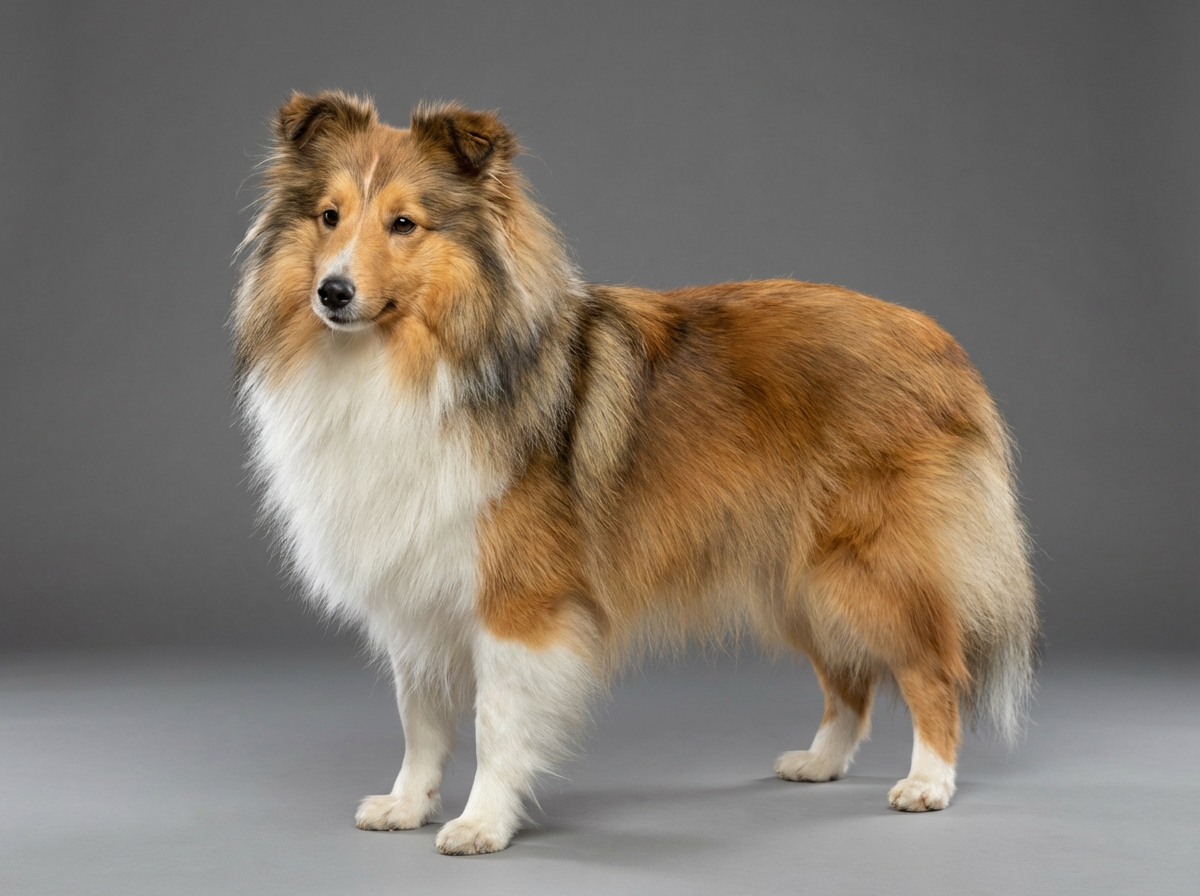
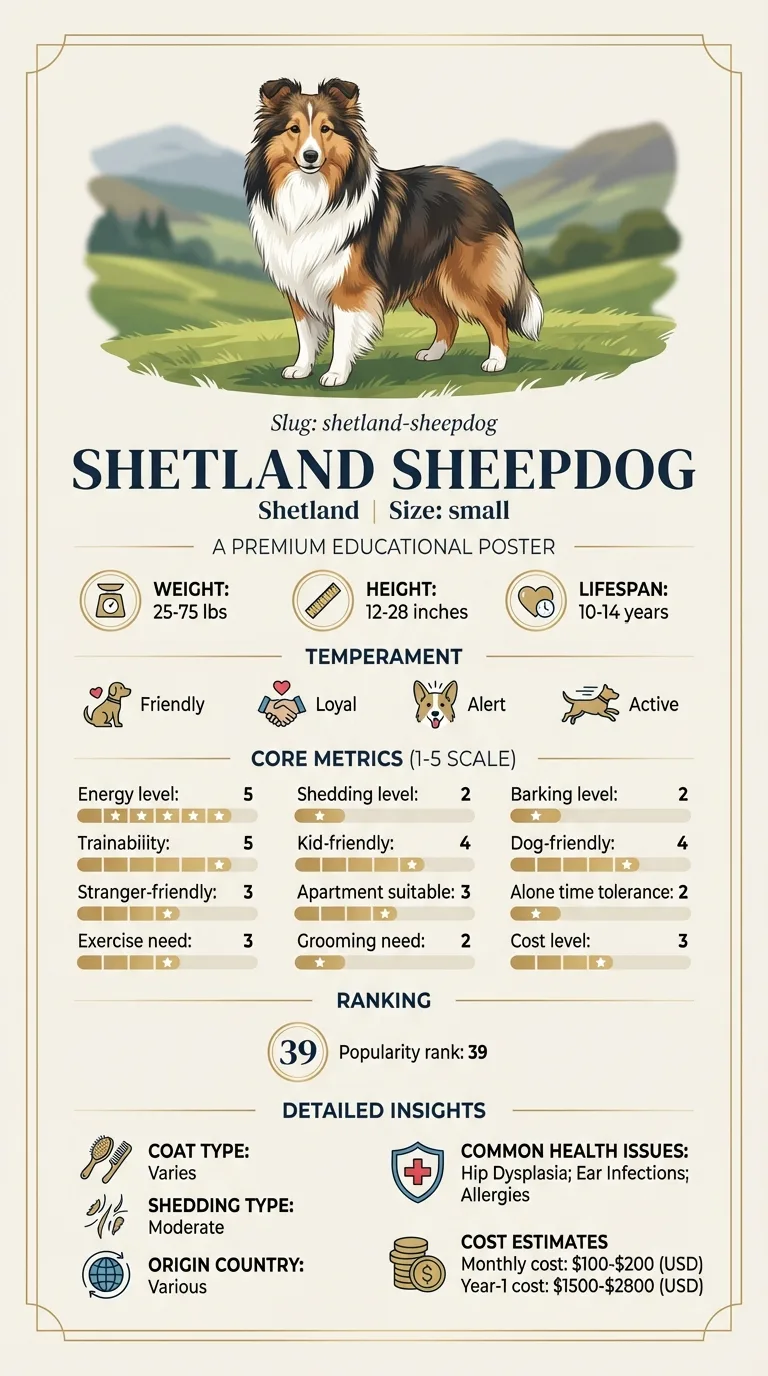
The relevant breed fact is a protective one. At thirteen to sixteen inches and fifteen to twenty five pounds, the Shetland Sheepdog reaches maturity without ever loading its developing joints the way a fast-growing large breed does, and the condition is absent from its documented health list. The genuine breed contribution is elsewhere: patellar luxation is documented in Shelties and frequently causes the gait changes and compensatory soreness that prompt an owner to start investigating lameness in the first place.
Growth-period management matters even in a breed at low risk. Overfeeding a puppy so that it grows heavier than its skeleton can comfortably carry is unhelpful in any size of dog. So is repetitive forced exercise, long runs alongside a bicycle, or endless ball throwing on hard ground before the skeleton has matured. Slippery flooring adds another kind of load, since a puppy whose feet slide is repeatedly wrenching joints that are still forming.
Go the same day if a young dog will not bear weight on a leg at all, if the limb is swollen or hot, if there is obvious pain on handling a joint, or if the lameness followed a significant fall. Non-weight-bearing lameness in a puppy can mean a fracture and should not wait. Book within a week or two for any limp in a five to twelve month old dog that has not resolved after a fortnight of genuine restriction, or for a lameness that keeps returning each time activity resumes. Ask for a full orthopaedic examination including both hind limbs, since compensation from a stifle problem is a common source of confusion.
See all Shetland Sheepdog health problems, which breeds are prone to osteochondritis dissecans ocd, or the full Shetland Sheepdog breed guide for temperament, exercise needs and ownership costs.
A soft tissue strain in a young dog usually resolves within two weeks of restriction and stays resolved. A limp that survives that fortnight should be imaged within days rather than rested again. If osteochondritis dissecans is confirmed, surgical removal of the flap is generally followed by six to twelve weeks of controlled rehabilitation, and arthritic change in the affected joint is a lifelong consequence to be managed rather than avoided.
For most Sheltie owners success is finding the boring answer: a grass seed, a strained shoulder, a sore knee on the other side. A young dog that returns to full soundness after appropriate rest and is still sound six months later has had a good outcome. What should not be accepted is a puppy that has limped intermittently for three months with no examination beyond an instruction to rest it.
Joint cartilage in a growing dog is fed by diffusion, not by its own blood vessels, and it is at its most vulnerable exactly when the dog is growing fastest. If the cartilage layer becomes too thick, the deepest part of it is too far from its nutrient supply and dies.
What makes it thick is load and speed of growth. A Great Dane puppy gains enormous mass across a few months and drives it through joints that have not finished forming. Labradors, Rottweilers, Bernese and German Shepherds sit in the same category, and the shoulder, elbow, hock and stifle are the usual sites.
A Shetland Sheepdog does none of that. It grows from a small puppy to a fifteen to twenty five pound adult over the same months, and the forces going through its shoulder are a fraction of what a giant breed generates. Osteochondritis dissecans is correspondingly rare in dogs of this size and does not appear on the breed's documented health list, which covers Collie Eye Anomaly, MDR1 drug sensitivity, dermatomyositis, hypothyroidism and patellar luxation.
That is not the same as impossible, and any adolescent Sheltie with a persistent front limb lameness deserves radiographs rather than reassurance. But the odds strongly favour something else.
In practice, a limping Sheltie adolescent has a short list of much more likely explanations.

Yusuf's Sheltie puppy, Nessa, started limping on a front leg at seven months. His practice advised rest. She improved, then limped again a week after returning to normal walks, and he rested her again. On the third cycle he asked for a proper examination rather than more rest. The vet went carefully through the foot, spreading the toes and parting the feathering, and found a grass awn buried between two toes with a small tract of infection around it. Under a brief sedation it came out. What Yusuf reflected on afterwards was that he had spent three weeks reading about shoulder cartilage in Labradors while the problem was in a place he could have looked at with a torch. He now checks Nessa's feet every time she comes in from a field in summer, which takes about twenty seconds and has found two more awns since.
Key takeaway: In a small herding breed, front limb lameness is far more often the foot or a soft tissue strain than a developmental cartilage disease of giant dogs. Look at the foot first, restrict properly once, and if it comes back, ask for imaging rather than a third round of rest.
It is rare and is not among the breed's documented health conditions. Osteochondritis dissecans is concentrated in large and giant breeds where rapid growth loads immature joints heavily. A twenty pound herding dog simply does not generate those forces, though the condition is not formally impossible.
The shoulder is the classic site, followed by the elbow, the hock and the stifle. Lameness is typically on one side, worse after rest and after exercise, and persists rather than resolving. The dog is usually between five and twelve months old when it appears.
Two weeks of genuinely restricted activity, meaning short lead walks only, no stairs, no furniture and no play with other dogs. If the limp has not clearly resolved by the end of that, it needs imaging rather than another two weeks. Repeated cycles of rest and relapse waste months.
No. Large-breed growth formulas are designed for a growth pattern a Sheltie does not have, and feeding a small breed inappropriately is its own risk. Feed an appropriate diet for the size and keep the puppy lean, which is the genuinely protective intervention.
A careful orthopaedic examination first, checking every joint and both hind limbs, followed by radiographs of the suspicious area. Positioning a puppy correctly requires sedation, which in a Shetland Sheepdog means the MDR1 result should already be on file before the appointment.
Repetitive high-impact activity before the growth plates close is worth avoiding in any breed: long forced runs, repeated jumping, and hard turning on slick surfaces. Free play at the puppy's own pace on good footing is a different matter and is beneficial rather than risky.
No. It is a large and giant breed condition driven by rapid growth and heavy joint loading, and it is not on this breed's documented health list.
Typically between five and twelve months, during the growth period. Lameness starting in an adult dog is not this condition.
When two weeks of genuine restriction has not resolved it, or immediately if the dog will not bear weight on the leg at all.
No. Keeping the puppy lean and avoiding repetitive high-impact activity does more than any supplement, and neither costs anything.
Yes. Free play on grass at the puppy's own pace is good for developing joints. It is forced repetitive activity that carries risk.
A one-page prep sheet for this condition: the signs, the questions to ask, what to get priced. Unlocks here.
You get: Vet visit prep sheet
No spam. One-click unsubscribe. See our privacy policy.
Preview page 1 before you decide.