Behavior
Which is quieter?
The Shiba Inu, rated Moderate (3/5) for barking versus the Sheltie's Very High (5/5).

Quick answer
Which is quieter?
The Shiba Inu, rated Moderate (3/5) for barking versus the Sheltie's Very High (5/5).
Shetland Sheepdog or Shiba Inu? On paper they differ most on trainability, and on the scales Shetland Sheepdog is the heavier at 15–25 lbs. Here is how the two compare on everything that shapes an ordinary week.
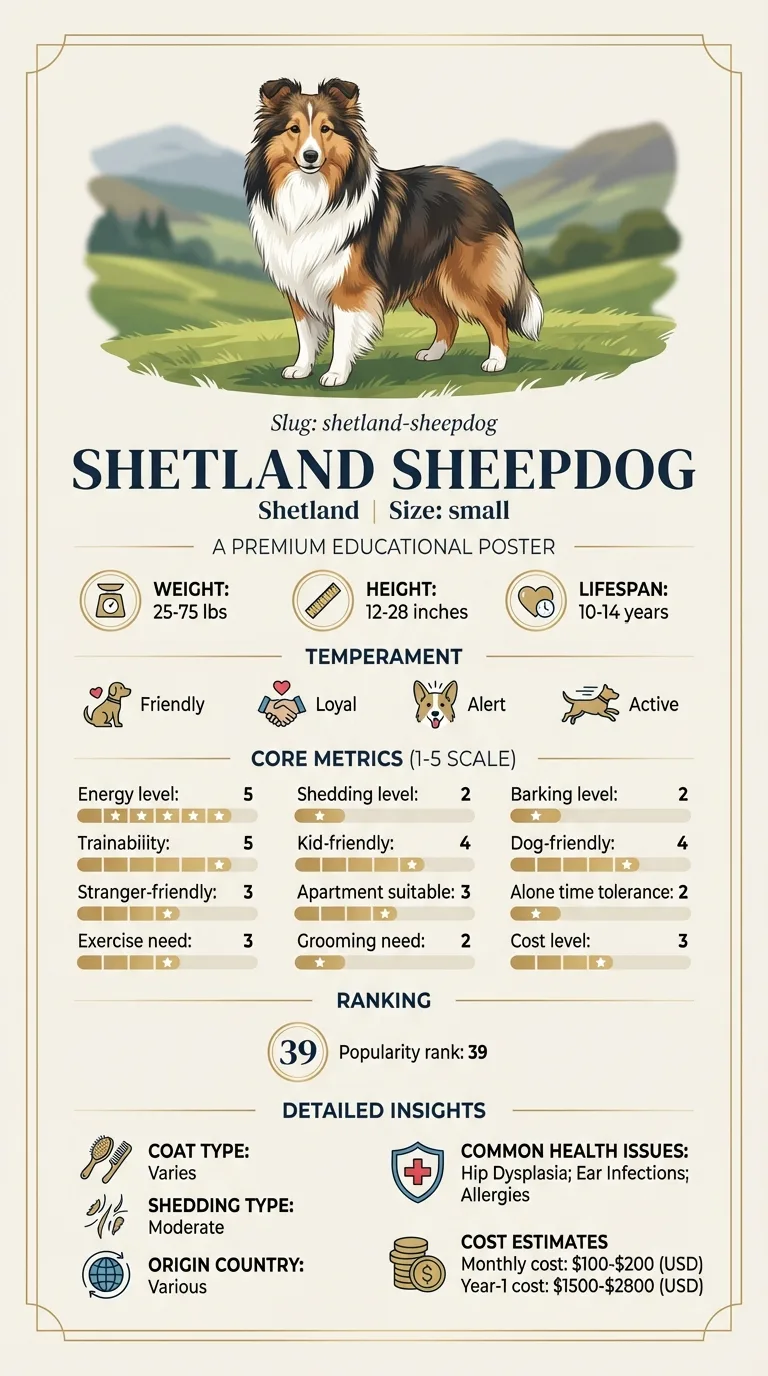
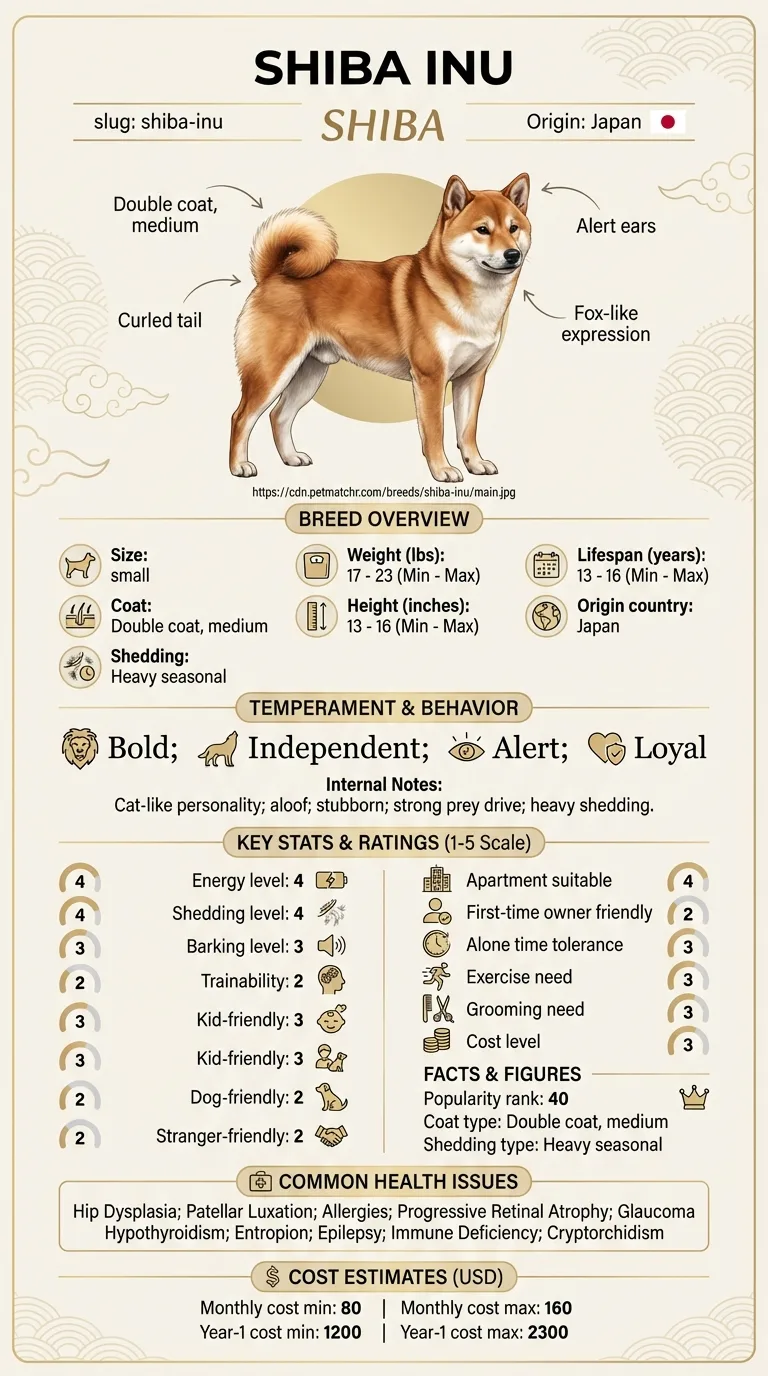
This is for someone already down to Shetland Sheepdog and Shiba Inu and deciding between them. For this pair the decision usually turns on trainability and good for first-time owners, so those are covered first and in most detail. Anyone choosing from a flat has a clear answer here: Shiba Inu rates 4/5 against 3/5. It is written for the decision rather than the breed history.
Between Shetland Sheepdog and Shiba Inu, trainability is what separates them, and Shiba Inu is the lower-effort dog of the two to keep.
Choose Shetland Sheepdog if this is your first dog, there are young children at home and you already have another dog.
Choose Shiba Inu if you are in a flat or a smaller home, you do not want a standing grooming appointment and your walking routine is modest.
| Feature | shetland sheepdog | shiba inu | Winner |
|---|---|---|---|
| Size class | small | small | Equal |
| Weight | 15–25 lbs | 17–23 lbs | Equal |
| Height | 13–16 in | 13–16 in | Equal |
| Lifespan | 12–14 years | 13–16 years | shiba inu |
| Exercise need | High (4/5) | Moderate (3/5) | shiba inu |
| Grooming need | High (4/5) | Moderate (3/5) | shiba inu |
| Shedding | High (4/5) | High (4/5) | Equal |
| Energy level | High (4/5) | High (4/5) | Equal |
| Barking | Very high (5/5) | Moderate (3/5) | shiba inu |
| Apartment suitability | Moderate (3/5) | High (4/5) | shiba inu |
| Good for first-time owners | High (4/5) | Low (2/5) | shetland sheepdog |
| Tolerates being alone | Low (2/5) | Moderate (3/5) | shiba inu |
| Trainability | Very high (5/5) | Low (2/5) | shetland sheepdog |
| Good with kids | High (4/5) | Moderate (3/5) | shetland sheepdog |
| Good with other dogs | High (4/5) | Low (2/5) | shetland sheepdog |
| Friendly to strangers | Low (2/5) | Low (2/5) | Equal |
| Cost level | Moderate (3/5) | Moderate (3/5) | Equal |
| Coat | Long, dense double coat | Double coat, medium | Equal |
| Origin | Various | Japan | Equal |
| Typical monthly cost | $80–$150 | $80–$160 | Equal |
| Typical first-year cost | $1,100–$2,300 | $1,200–$2,300 | Equal |
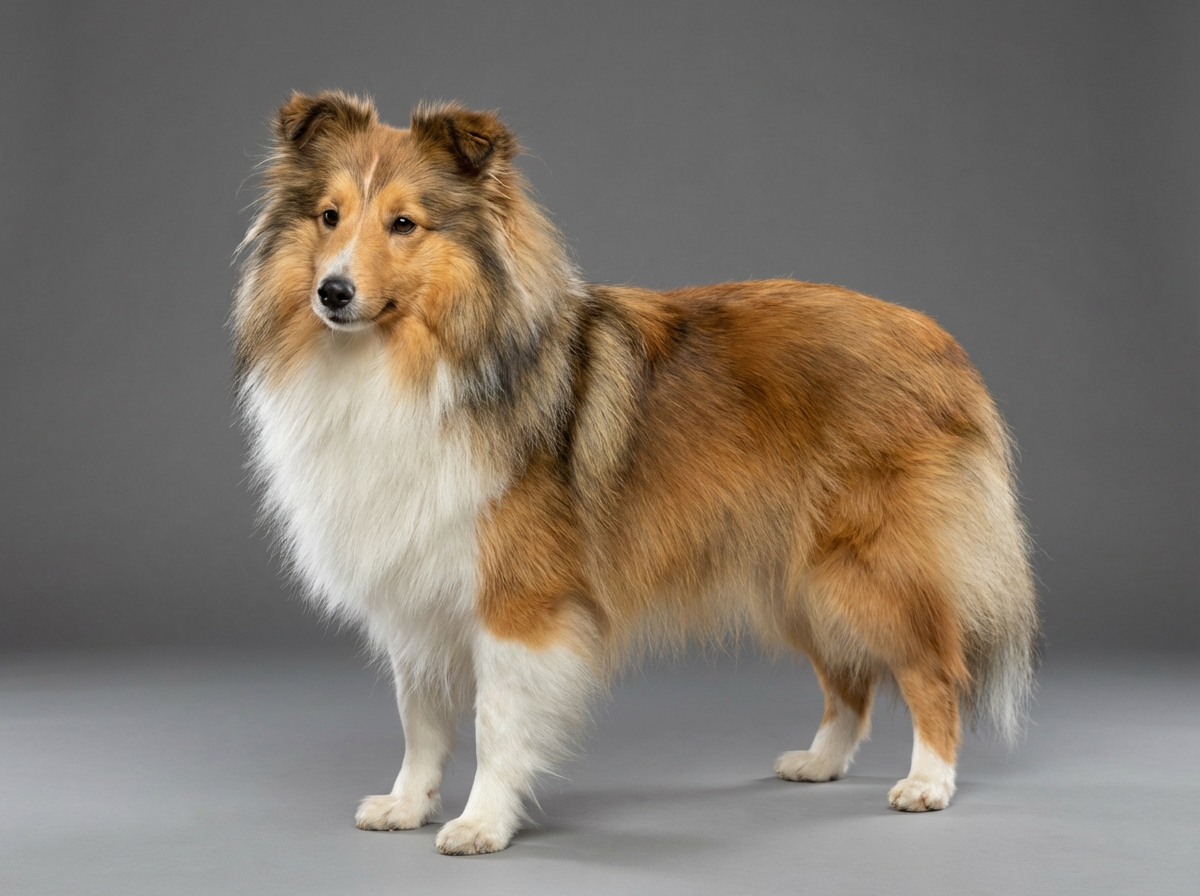
The Shetland Sheepdog and Shiba Inu are close in stature — 15–25 lbs and 13–16 inches for the Sheltie, 17–23 lbs and 13–16 inches for the Shiba — but their builds read differently in person. The Sheltie's long, dense double coat and herding-dog proportions give it a fuller, more elegant silhouette, while the Shiba's compact, muscular frame and famously fox-like face project a sturdier, more compact presence at a similar height. Both are genuinely small dogs suited to modest living spaces, so build and coat volume, more than raw numbers, will likely drive a visual preference between them.
The Sheltie rates High (4/5) for exercise need against the Shiba's Moderate (3/5), even though both share a High (4/5) energy-level rating — a reminder that energy and exercise need aren't quite the same thing. Shelties were bred to herd livestock across Scottish terrain all day and often channel that drive into agility or herding-style games even without sheep nearby. The Shiba, more Independent and self-contained, is content with moderate daily walks and doesn't demand the same structured outlet. Owners drawn to dog sports will likely find the Sheltie the more natural partner.
Both breeds shed heavily, rating High (4/5) each, so a lint roller is a daily tool with either dog. Grooming effort tilts toward the Sheltie, though, at High (4/5) versus the Shiba's Moderate (3/5) — the Sheltie's long, dense double coat needs more frequent brushing to prevent matting than the Shiba's shorter double coat. Neither breed is a good match for an owner hoping to avoid brushing altogether, but the Shiba asks for somewhat less time at it despite the comparable amount of loose fur both breeds produce, especially during seasonal coat blows.
The Shiba edges out the Sheltie for apartment suitability, High (4/5) versus Moderate (3/5), and it also barks less — Moderate (3/5) against the Sheltie's Very High (5/5), the top tier on this scale. Shelties are famously Vocal, a trait listed directly in their temperament profile, and that alert-barking habit is a real consideration for anyone in close-quarters housing. The Shiba does edge ahead on alone-tolerance too, Moderate (3/5) versus the Sheltie's Low (2/5), making it somewhat better suited to longer solo stretches despite its more Independent, less overtly needy temperament.
This is one of the widest trainability gaps in any comparison: the Sheltie rates Very High (5/5) while the Shiba rates Low (2/5), and the difference shows up again in first-time-owner suitability, High (4/5) for the Sheltie versus Low (2/5) for the Shiba. The Shiba's Bold, Independent, cat-like temperament means it often works on its own terms rather than eagerly pleasing a handler, a trait many Shiba owners come to love but that frustrates anyone expecting quick obedience. The Sheltie's Bright, Devoted nature makes it one of the more naturally biddable herding breeds.
The Sheltie outperforms the Shiba in every social category here: High (4/5) with kids against Moderate (3/5), and High (4/5) with other dogs against a notably low Low (2/5) for the Shiba. Both rate Low (2/5) with strangers, so neither breed greets new people with open arms — the Sheltie tends toward reserved watchfulness, while the Shiba's Independent streak reads more as aloof indifference. Multi-dog households in particular should note the Shiba's Low other-dogs score, since Shibas can be prone to same-sex aggression without careful early socialization.
The Shiba's 13–16 year lifespan edges out the Sheltie's 12–14 years. The Sheltie's shorter five-item health list includes two conditions worth flagging specifically: MDR1 Drug Sensitivity, which affects how the dog metabolizes certain medications, and Dermatomyositis, an inherited inflammatory skin and muscle disease relatively unique to herding breeds. The Shiba's longer ten-item list includes Immune Deficiency, Entropion and Cryptorchidism alongside shared concerns like Patellar Luxation and Hypothyroidism. Sheltie owners should specifically alert any vet to MDR1 status before administering common drugs like ivermectin, since a sensitive dog can react severely.
Both breeds rate Moderate (3/5) for overall cost and land in a similar, relatively affordable range — $80–$150 monthly for the Sheltie versus $80–$160 for the Shiba, with first-year totals of $1,100–$2,300 for the Sheltie against $1,200–$2,300 for the Shiba. These are among the more budget-friendly small breeds compared to some of the higher-maintenance toy breeds on this site. The main cost differentiator is likely grooming frequency, where the Sheltie's High rating versus the Shiba's Moderate rating means more brushing time, if not necessarily more money, over the dog's lifetime.
Shetland Sheepdog weighs 15–25 lbs and lives 12–14 years; Shiba Inu weighs 17–23 lbs and lives 13–16 years. The two diverge most on trainability, good for first-time owners and barking and 1 other rated axes. They are level on cost level, energy level and shedding, so those cannot decide it. In the table, a "winner" means easier for an ordinary household — not better. Size, coat and origin are recorded without a verdict. Because both breeds are scored the same way, the gaps are reliable even where the absolute numbers are rough.

The Shetland Sheepdog by a wide margin — it rates Very High (5/5) for trainability versus the Shiba's Low (2/5).
Yes, it rates Very High (5/5) for barking and Vocal is listed directly among its temperament traits, the highest barking score in this comparison.
The Sheltie, rated High (4/5) versus the Shiba's Low (2/5) — Shibas can be prone to same-sex aggression without careful socialization.
The Shiba Inu, with a 13–16 year lifespan versus the Sheltie's 12–14 years.
Not especially — it rates Low (2/5) for first-time-owner suitability due to its independent, strong-willed nature, versus the Sheltie's High (4/5).
Yes — both rate High (4/5) for shedding, so regular brushing and vacuuming are needed either way.
It's a genetic condition listed on the Sheltie's health profile that affects how the dog processes certain medications, meaning some common drugs can cause severe reactions.
The Shiba Inu, rated Moderate (3/5) for barking versus the Sheltie's Very High (5/5).
The Shiba Inu, rated High (4/5) versus the Sheltie's Moderate (3/5).
The Shetland Sheepdog, rated High (4/5) versus the Shiba's Moderate (3/5).
The Shetland Sheepdog, rated High (4/5) versus the Shiba's Moderate (3/5).
Secure checkout on Stripe. We never see your card.
7-day money-back guarantee. Instant access.
Health information here is general and is not veterinary advice. If your dog shows pain, sudden behaviour change, or worsening symptoms, consult a licensed veterinarian.
Some links on this site are affiliate links. We may earn a commission at no extra cost to you, and we only suggest products we believe are helpful for dog owners.
We research and check what we publish, but we do not warrant that any figure, date, price, or statement is accurate, complete, or current, and we accept no liability for any loss, cost, injury, or other harm arising from the use of this site. Use it as one reference among several. You remain responsible for your own decisions and for your dog's care - confirm anything that matters with a licensed veterinarian or another qualified professional before you act on it. Full disclaimer.
Match your lifestyle to the right dog.
Take quizNot sure which breed is right for you? Take our 2-minute quiz to find out.
Take the quiz