Doberman Pinscher vs Shetland Sheepdog: Which Suits Your Home?
Quick answer
Which breed fits better overall?
The Sheltie suits a smaller household that can tolerate real vocal activity and wants an easier first dog. The Doberman suits someone with the space and experience for a larger, quieter, more protective breed.
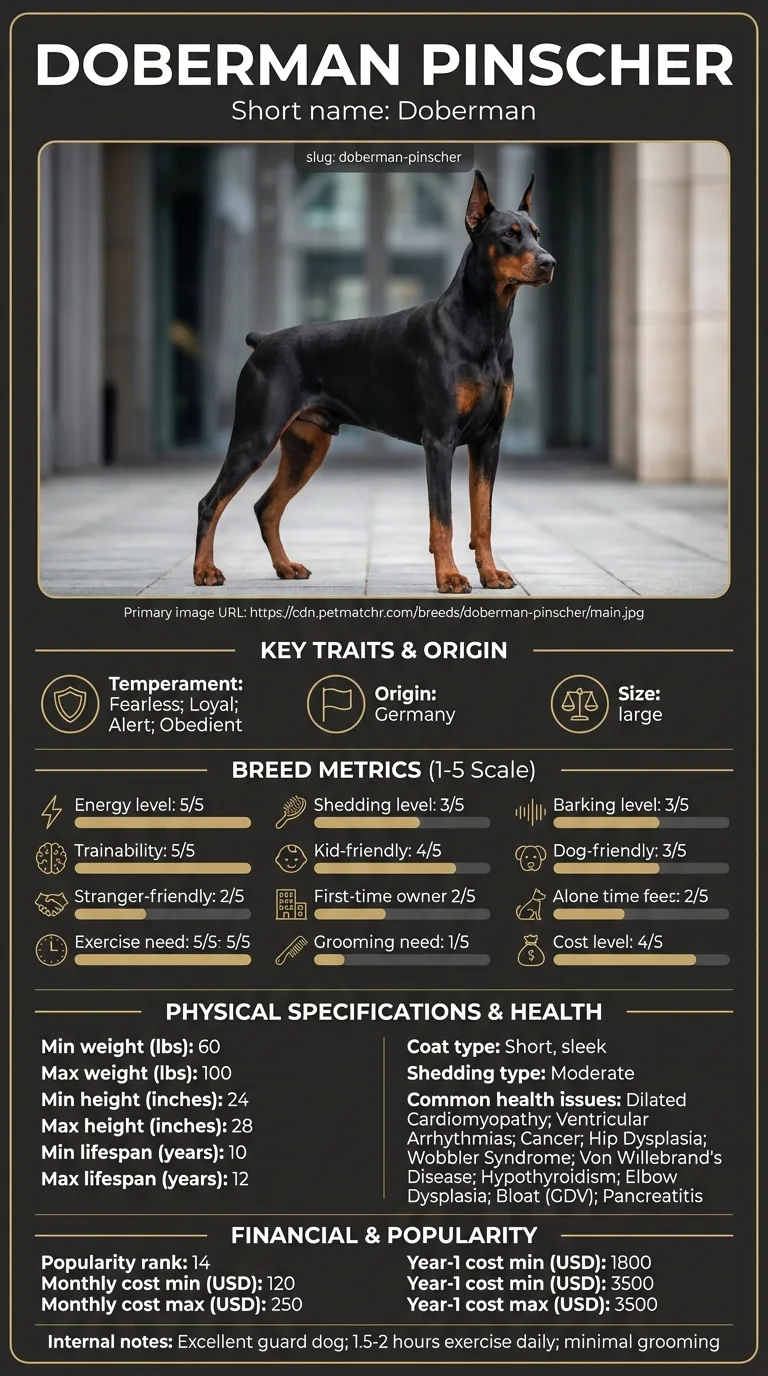
Doberman Pinscher or Shetland Sheepdog? On paper they differ most on grooming need, and on the scales Doberman Pinscher is the heavier at 60–100 lbs. Here is how the two compare on everything that shapes an ordinary week.
This is for someone already down to Doberman Pinscher and Shetland Sheepdog and deciding between them. For this pair the decision usually turns on grooming need and good for first-time owners, so those are covered first and in most detail. Anyone choosing from a flat has a clear answer here: Shetland Sheepdog rates 3/5 against 2/5. The focus throughout is on daily consequences rather than breed background.
Quick verdict
Between Doberman Pinscher and Shetland Sheepdog, grooming need is what separates them, and Shetland Sheepdog is the lower-effort dog of the two to keep.
Choose doberman pinscher if...
Choose Doberman Pinscher if you do not want a standing grooming appointment, shedding is a problem in your house and you want a dog that can keep up with an active routine.
Choose shetland sheepdog if...
Choose Shetland Sheepdog if you are in a flat or a smaller home, this is your first dog and your walking routine is modest.
Head-to-head comparison
Feature
doberman pinscher
shetland sheepdog
Winner
Size class
large
small
Equal
Weight
60–100 lbs
15–25 lbs
Equal
Height
24–28 in
13–16 in
Equal
Lifespan
10–12 years
12–14 years
shetland sheepdog
Exercise need
Very high (5/5)
High (4/5)
shetland sheepdog
Grooming need
Very low (1/5)
High (4/5)
doberman pinscher
Shedding
Moderate (3/5)
High (4/5)
doberman pinscher
Energy level
Very high (5/5)
High (4/5)
Equal
Barking
Moderate (3/5)
Very high (5/5)
doberman pinscher
Apartment suitability
Low (2/5)
Moderate (3/5)
shetland sheepdog
Good for first-time owners
Low (2/5)
High (4/5)
shetland sheepdog
Tolerates being alone
Low (2/5)
Low (2/5)
Equal
Trainability
Very high (5/5)
Very high (5/5)
Equal
Good with kids
High (4/5)
High (4/5)
Equal
Good with other dogs
Moderate (3/5)
High (4/5)
shetland sheepdog
Friendly to strangers
Low (2/5)
Low (2/5)
Equal
Cost level
High (4/5)
Moderate (3/5)
shetland sheepdog
Coat
Short, sleek
Long, dense double coat
Equal
Origin
Germany
Various
Equal
Typical monthly cost
$120–$250
$80–$150
Equal
Typical first-year cost
$1,800–$3,500
$1,100–$2,300
Equal
Deep dive
Size and build
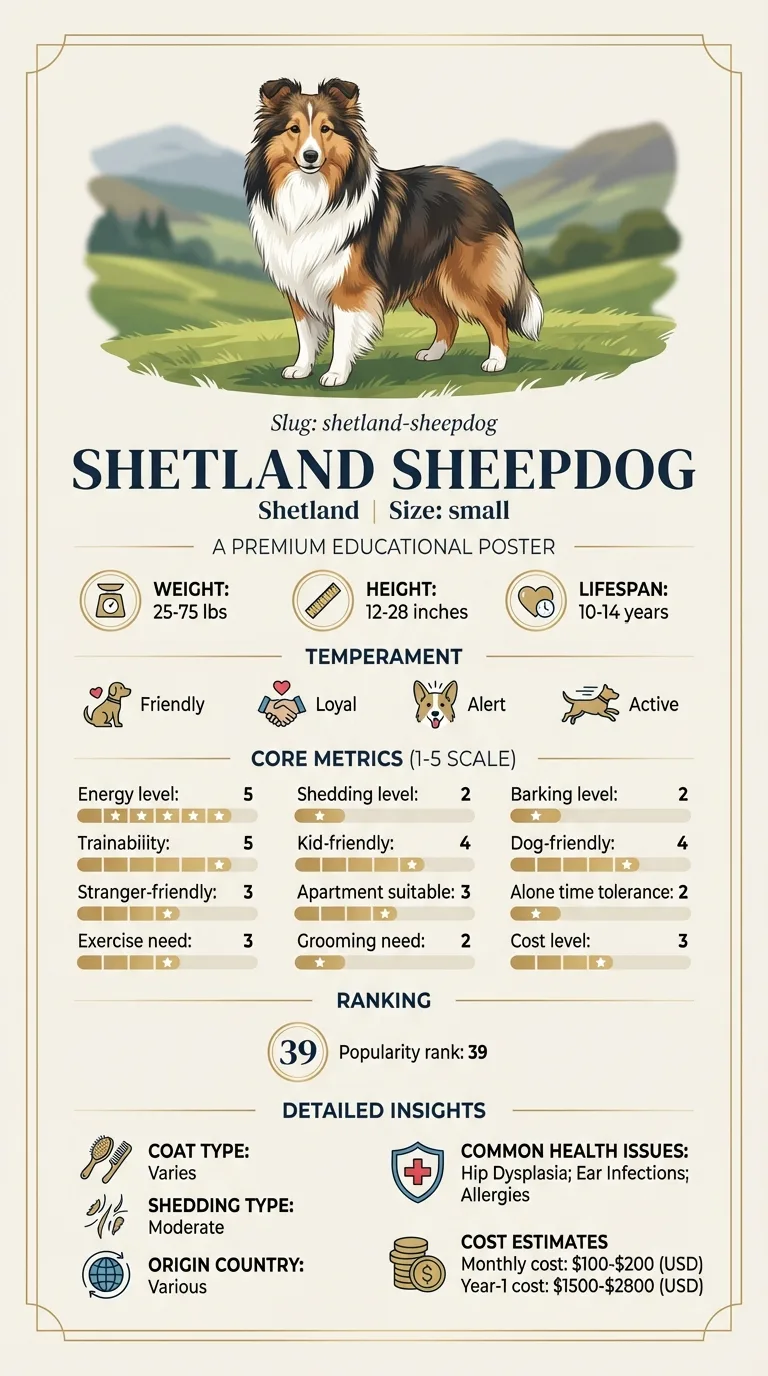
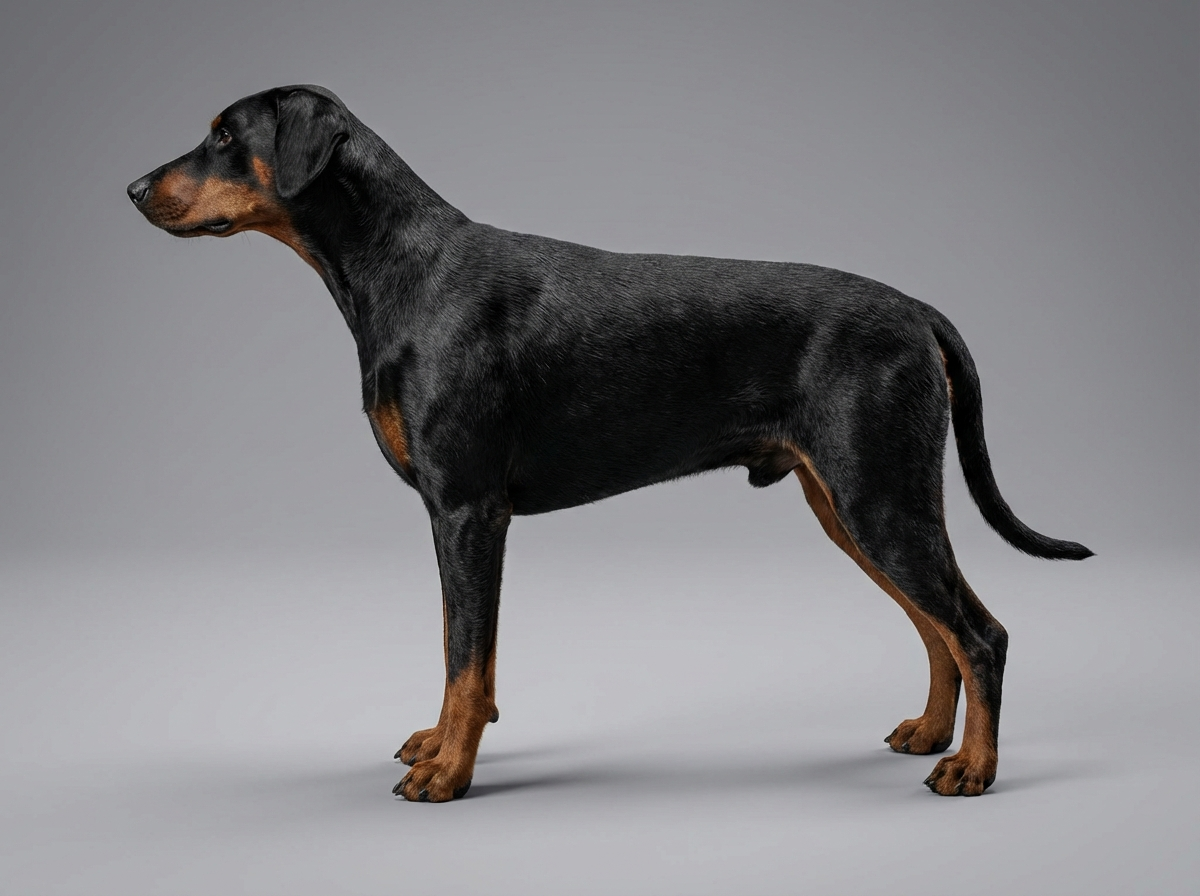
The size gap here is substantial — a Doberman runs 60 to 100 pounds and up to 28 inches, while a Shetland Sheepdog tops out around 25 pounds and 16 inches, roughly a quarter of the Doberman's mass at the high end. The Sheltie's long, dense coat and fine-boned herding build make it look even smaller next to the Doberman's lean, muscled frame.
Energy and exercise
Both breeds need real daily activity, but the Doberman needs more — a full 5 out of 5 against the Sheltie's still-high 4 out of 5. The Sheltie's herding background means its energy tends to come out in bursts of movement and mental engagement rather than sheer mileage, but don't mistake its small size for a low-exercise breed.
Grooming and shedding
The Sheltie's long double coat demands real upkeep — a high 4 out of 5 for grooming and the same 4 out of 5 for shedding, meaning regular brushing and a house that needs frequent vacuuming. The Doberman sits at the opposite end on both counts, 1 out of 5 for grooming and a moderate 3 out of 5 for shedding. This is one of the clearer breed trade-offs in this comparison: coat maintenance versus almost none.
Apartment living, noise and time alone
Barking is the number to watch here — the Sheltie rates a very high 5 out of 5, among the loudest ratings you'll see in these comparisons, against the Doberman's moderate 3 out of 5. That vocal tendency is bred in; Shelties were used to alert on approaching sheep and predators, and the instinct carries into apartment living. Apartment suitability itself favors the Sheltie regardless, 3 out of 5 against the Doberman's 2, but thin walls and a barky dog don't always mix.
Training and owner experience
Both breeds train exceptionally well, tied at the maximum 5 out of 5. The Sheltie is notably friendlier to first-time owners, though — 4 out of 5 against the Doberman's 2 out of 5. That's a meaningful gap; a Sheltie's herding intelligence is generally easier for a newer owner to channel than a Doberman's size and protective drive.
Kids, other dogs and visitors
The two tie with kids (4 out of 5 each) and, more surprisingly, with strangers — both score a wary 2 out of 5, meaning the Sheltie's reputation as a gentle family dog doesn't extend automatically to warmth with unfamiliar people. The Sheltie does edge ahead with other dogs, 4 out of 5 against the Doberman's 3.
Health and lifespan
The Sheltie lives somewhat longer, 12 to 14 years against the Doberman's 10 to 12, and its health list looks entirely different — Collie Eye Anomaly, MDR1 drug sensitivity, and dermatomyositis are all specific to herding-breed genetics. The only condition the two lists share is hypothyroidism. If you go with the Sheltie, ask a breeder specifically about MDR1 testing, since it affects how the dog metabolizes certain common medications.
Cost to keep
The Sheltie costs less overall — a moderate 3 out of 5 rating against the Doberman's high 4 out of 5, $80 to $150 a month against $120 to $250, and $1,100 to $2,300 in the first year against $1,800 to $3,500. Its smaller size keeps food costs down, though the grooming time investment is real even if it doesn't always show up as a dollar figure.
Doberman Pinscher vs Shetland Sheepdog at a glance
Doberman Pinscher weighs 60–100 lbs and lives 10–12 years; Shetland Sheepdog weighs 15–25 lbs and lives 12–14 years. The two diverge most on grooming need, good for first-time owners and barking. They are level on tolerates being alone, good with kids and friendly to strangers, so those cannot decide it. The table below marks a winner only where one breed is genuinely easier for a typical owner; size and origin are facts rather than merits and stay level. Ratings come from one source applied to both breeds, so they are meaningful against each other rather than as absolute scores.
Doberman Pinscher vs Shetland Sheepdog: Which Suits Your Home? - Doberman Pinscher vs Shetland Sheepdog at a glance
Frequently asked questions
How much smaller is a Shetland Sheepdog than a Doberman?
Considerably — a Sheltie weighs 15 to 25 pounds against a Doberman's 60 to 100, and stands well under half the height. It's a genuinely small dog next to a large one.
Is a Shetland Sheepdog a loud breed?
Yes, notably so — it rates a very high 5 out of 5 for barking, among the loudest ratings in these comparisons, against the Doberman's moderate 3 out of 5. That's worth weighing seriously if you have close neighbors.
Which is easier for a first-time owner?
The Shetland Sheepdog, by a wide margin — 4 out of 5 against the Doberman's 2 out of 5. Both breeds train equally well (5 out of 5 each), but the Sheltie is much more forgiving of beginner handling.
Is the Sheltie friendly with strangers?
Not especially — it rates a wary 2 out of 5, the same as the Doberman. Despite its gentle reputation with family, the Sheltie doesn't automatically warm to people it doesn't know.
Which costs less to keep?
The Shetland Sheepdog — $80 to $150 a month and $1,100 to $2,300 in year one, against $120 to $250 and $1,800 to $3,500 for the Doberman. Its smaller size keeps food and general care costs down.
Do these breeds share health risks?
Barely — hypothyroidism is the only condition on both lists. The Sheltie's other risks, like Collie Eye Anomaly and MDR1 drug sensitivity, are specific to herding-breed genetics and don't appear in the Doberman's profile.
Which breed lives longer?
The Shetland Sheepdog, typically 12 to 14 years against the Doberman's 10 to 12.
The Sheltie suits a smaller household that can tolerate real vocal activity and wants an easier first dog. The Doberman suits someone with the space and experience for a larger, quieter, more protective breed.
Costs
What's the monthly cost?
The Sheltie runs $80 to $150; the Doberman runs $120 to $250 — the size difference drives most of that gap.
Living
How much exercise is needed?
Both need daily activity. The Doberman rates 5 out of 5, the Sheltie close behind at 4 out of 5 despite its small size.
Health
Which lives longer?
The Shetland Sheepdog, typically 12 to 14 years against the Doberman's 10 to 12.
Related DogBreedCompass guides
Doberman Pinscher breed guide – Readers comparing the two usually want the full profile of Doberman Pinscher before deciding.
Shetland Sheepdog breed guide – The same for Shetland Sheepdog, so the comparison can be checked against the detail.
Doberman Pinscher vs Weimaraner – Weimaraner is the closest breed to Doberman Pinscher on the measured axes, so it is the natural next comparison.
Health information here is general and is not veterinary advice. If your dog shows pain, sudden behaviour change, or worsening symptoms, consult a licensed veterinarian.
Some links on this site are affiliate links. We may earn a commission at no extra cost to you, and we only suggest products we believe are helpful for dog owners.
We research and check what we publish, but we do not warrant that any figure, date, price, or statement is accurate, complete, or current, and we accept no liability for any loss, cost, injury, or other harm arising from the use of this site. Use it as one reference among several. You remain responsible for your own decisions and for your dog's care - confirm anything that matters with a licensed veterinarian or another qualified professional before you act on it. Full disclaimer.