Behavior
Bigger shedder?
Tied — both rate high (4/5) for shedding.

Quick answer
Bigger shedder?
Tied — both rate high (4/5) for shedding.
Saint Bernard or Shetland Sheepdog? On paper they differ most on barking, and on the scales Saint Bernard is the heavier at 120–180 lbs. Here is how the two compare on everything that shapes an ordinary week.
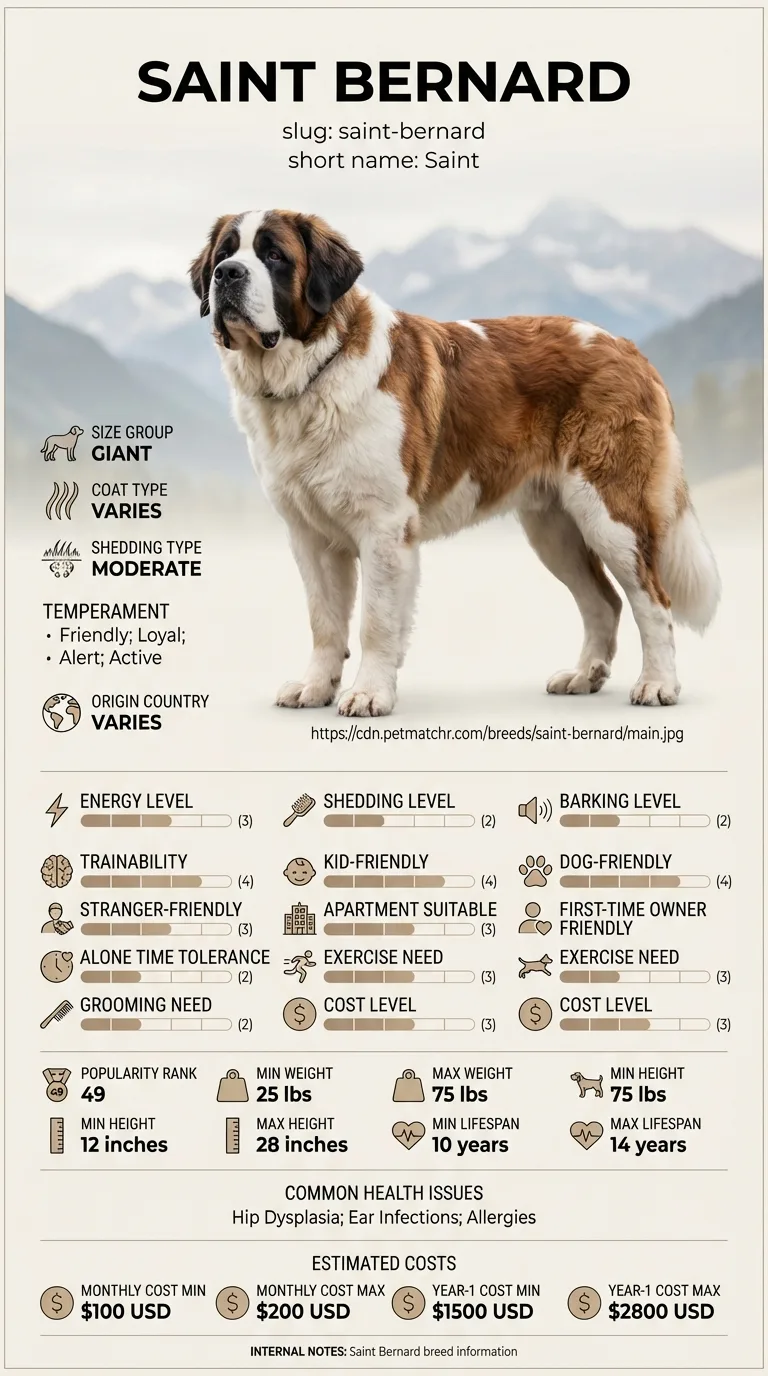
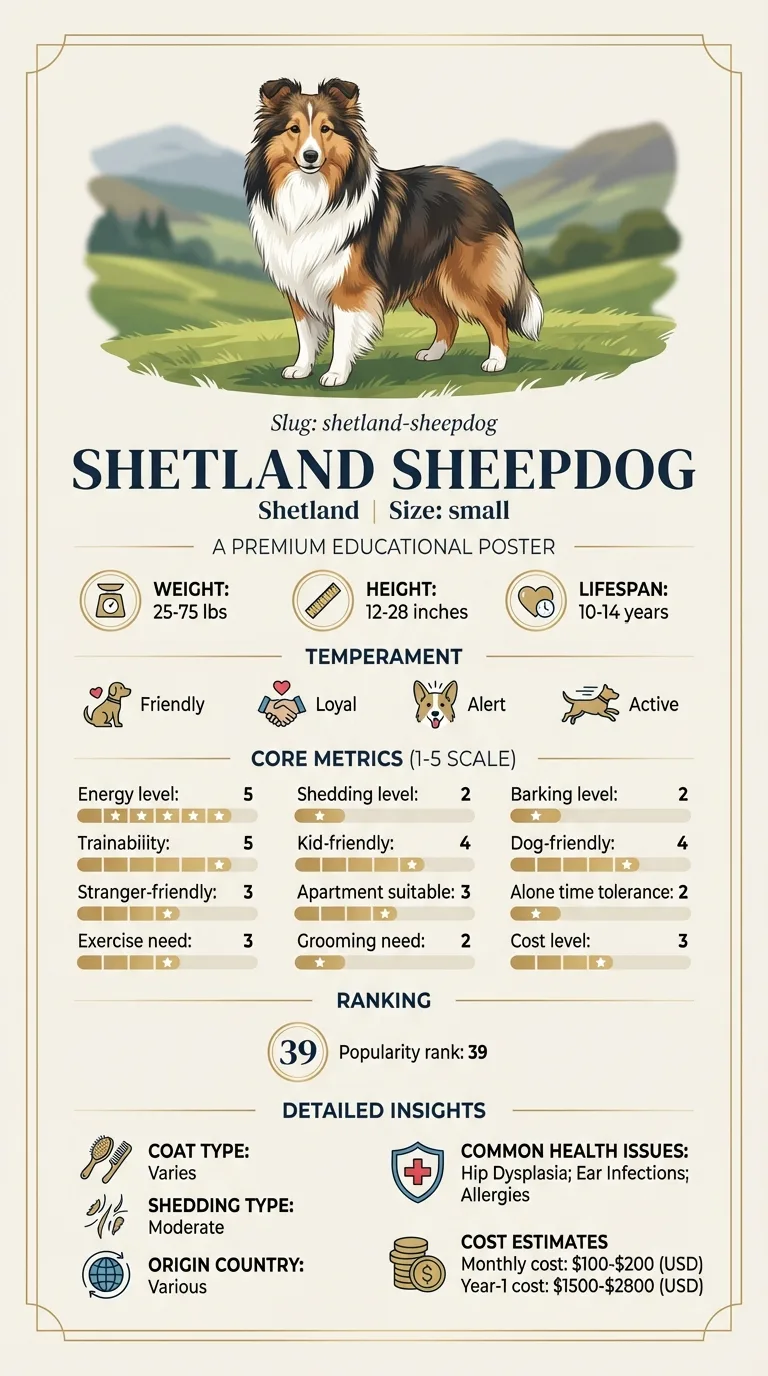
This is for someone already down to Saint Bernard and Shetland Sheepdog and deciding between them. For this pair the decision usually turns on barking and exercise need, so those are covered first and in most detail. Anyone choosing from a flat has a clear answer here: Shetland Sheepdog rates 3/5 against 1/5. It is written for the decision rather than the breed history.
Between Saint Bernard and Shetland Sheepdog, barking is what separates them, and Saint Bernard is the lower-effort dog of the two to keep.
Choose Saint Bernard if you do not want a standing grooming appointment, your walking routine is modest and the dog will be alone during the working day.
Choose Shetland Sheepdog if you are in a flat or a smaller home, this is your first dog and you want a dog that picks up training quickly.
| Feature | saint bernard | shetland sheepdog | Winner |
|---|---|---|---|
| Size class | giant | small | Equal |
| Weight | 120–180 lbs | 15–25 lbs | Equal |
| Height | 26–30 in | 13–16 in | Equal |
| Lifespan | 8–10 years | 12–14 years | shetland sheepdog |
| Exercise need | Low (2/5) | High (4/5) | saint bernard |
| Grooming need | Moderate (3/5) | High (4/5) | saint bernard |
| Shedding | High (4/5) | High (4/5) | Equal |
| Energy level | Low (2/5) | High (4/5) | Equal |
| Barking | Low (2/5) | Very high (5/5) | saint bernard |
| Apartment suitability | Very low (1/5) | Moderate (3/5) | shetland sheepdog |
| Good for first-time owners | Moderate (3/5) | High (4/5) | shetland sheepdog |
| Tolerates being alone | Moderate (3/5) | Low (2/5) | saint bernard |
| Trainability | Moderate (3/5) | Very high (5/5) | shetland sheepdog |
| Good with kids | Very high (5/5) | High (4/5) | saint bernard |
| Good with other dogs | High (4/5) | High (4/5) | Equal |
| Friendly to strangers | High (4/5) | Low (2/5) | saint bernard |
| Cost level | Very high (5/5) | Moderate (3/5) | shetland sheepdog |
| Coat | Short or long double coat | Long, dense double coat | Equal |
| Origin | Various | Various | Equal |
| Typical monthly cost | $150–$310 | $80–$150 | Equal |
| Typical first-year cost | $2,200–$4,200 | $1,100–$2,300 | Equal |
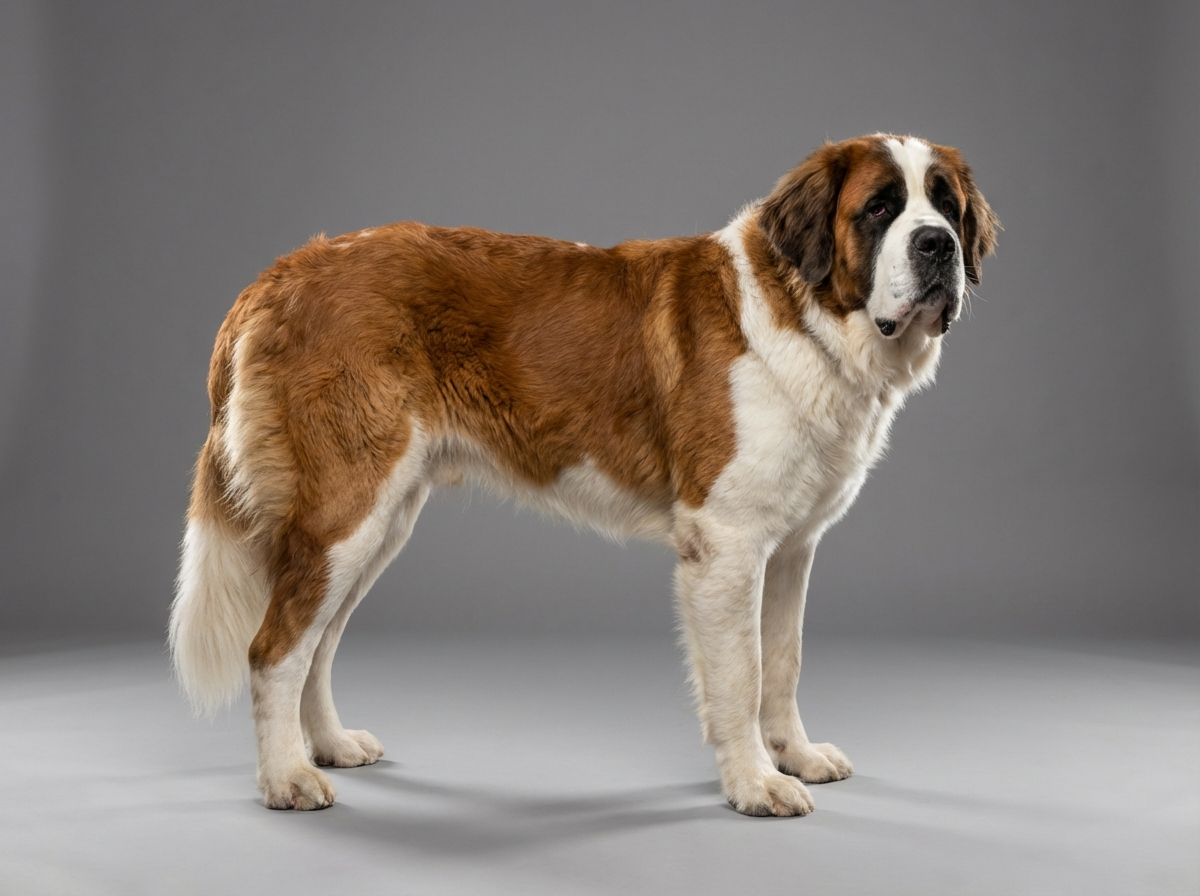
At 120–180 pounds and 26–30 inches tall, the Saint Bernard is a giant that can weigh eight times more than a 15–25 lb, 13–16 inch Shetland Sheepdog. That gap changes daily logistics: a Saint Bernard needs a reinforced crate, a wide-bodied vehicle, and enough floor space to stretch out and turn around, while a Sheltie fits neatly into a standard crate or even a large lap. Vet bills, medication dosing, and even the size of a suitable dog bed scale with the numbers above. Anyone comparing these two should picture both dogs standing in their actual living room — the size difference is the single biggest factor separating this pairing from almost any other on this site.
The Saint Bernard scores low (2/5) on both exercise need and energy level, content with a couple of short walks and long naps between them. The Shetland Sheepdog rates high (4/5) on exercise need and energy, and its "Bright" and "Vocal" temperament tags reflect a dog that wants a job — herding trials, agility, or at minimum a daily run — not just a stroll. Pairing a low-drive giant with a high-drive herder means very different exercise budgets: the Saint Bernard owner can get by with modest activity, while the Sheltie owner should plan for 45–60 minutes of structured movement most days to avoid boredom-driven barking or nipping at heels.
Both breeds shed heavily (4/5), so neither is a low-hair-on-the-couch choice, but grooming effort diverges: the Saint Bernard's short-or-long double coat needs moderate (3/5) upkeep, while the Shetland Sheepdog's long, dense double coat demands high (4/5) attention, including regular brushing to prevent matting behind the ears and along the ruff. Saint Bernards drool more than they shed-brush, so towel duty matters as much as grooming tools. Shelties need a slicker brush and a comb worked through the undercoat weekly, more during seasonal blowouts. Expect a fur-management routine either way — this is not a pairing where either dog spares you the vacuum.
Apartment suitability splits sharply here: the Saint Bernard rates very low (1/5), simply too large for most compact spaces, while the Shetland Sheepdog rates moderate (3/5) and can adapt to smaller quarters if exercised enough. Noise cuts the other way — the Saint Bernard barks rarely (2/5), but the Sheltie is rated very high (5/5) for barking, a trait tied to its herding instincts and "Vocal" temperament tag. A Sheltie left alone in a thin-walled apartment building can become a noise complaint; a Saint Bernard in a house with a yard is the more realistic setup. Alone-time tolerance also favors the Saint Bernard (moderate, 3/5) over the Sheltie (low, 2/5), a dog bred to work alongside people.
Trainability favors the Shetland Sheepdog decisively — rated very high (5/5) versus the Saint Bernard's moderate (3/5) — and Shelties consistently rank among the more biddable herding breeds, quick to pick up commands and agility sequences. The Saint Bernard isn't difficult, but its size means basic obedience (loose-leash walking, not jumping up) has outsized consequences if skipped; a 150-pound dog that pulls is a real problem in a way a 20-pound dog that pulls is not. The Saint Bernard rates moderate (3/5) for first-time owners and the Sheltie rates high (4/5), suggesting the Sheltie is the gentler on-ramp for someone new to dog ownership, provided its vocal tendencies are managed early.
With kids, the Saint Bernard edges out the Sheltie (very high 5/5 versus high 4/5), and its "Gentle" and "Patient" temperament tags back that up — this is a breed literally shaped by generations of tolerant, watchful behavior around people. Both breeds score high (4/5) with other dogs. Strangers are where they differ most: the Saint Bernard is rated high (4/5) friendly to strangers, while the Sheltie rates low (2/5), consistent with its "Sensitive" and watchful-herder instincts that can produce wariness or reactive barking toward unfamiliar visitors. A household that hosts frequently may find the Saint Bernard the more relaxed greeter, while the Sheltie may need structured introductions to new people.
The Shetland Sheepdog's 12–14 year lifespan runs well past the Saint Bernard's 8–10 years, a gap largely explained by giant-breed biology. Saint Bernards face Hip Dysplasia, Elbow Dysplasia, Dilated Cardiomyopathy, Entropion, and Bloat (GDV) — the last a genuine emergency risk in deep-chested giants that owners should learn to recognize. Shelties carry their own list: Collie Eye Anomaly, MDR1 Drug Sensitivity (which affects how the breed metabolizes certain medications, including some common flea and heartworm drugs), Dermatomyositis, Hypothyroidism, and Patellar Luxation. Prospective owners of either breed should ask breeders for hip, elbow, cardiac, or eye clearances specific to these conditions, and Sheltie owners in particular should flag MDR1 status with their vet before prescribing.
Cost level rates very high (5/5) for the Saint Bernard against moderate (3/5) for the Sheltie, and the ranges bear that out: $150–310 a month and $2,200–4,200 in year one for the Saint Bernard versus $80–150 a month and $1,100–2,300 for the Sheltie. Food alone is the biggest driver — a 150-pound dog eats several times what a 20-pound dog does — and giant-breed veterinary care, larger-dose medications, and bigger-ticket items like crates and orthopedic beds add up fast. The Sheltie's grooming needs (high, 4/5) partly offset its smaller food bill, but even with regular professional brushing sessions factored in, it remains the notably cheaper breed to keep long-term.
Saint Bernard weighs 120–180 lbs and lives 8–10 years; Shetland Sheepdog weighs 15–25 lbs and lives 12–14 years. The two diverge most on barking, exercise need and energy level and 4 other rated axes. They are level on good with other dogs and shedding, so those cannot decide it. In the table, a "winner" means easier for an ordinary household — not better. Size, coat and origin are recorded without a verdict. Because both breeds are scored the same way, the gaps are reliable even where the absolute numbers are rough.

The Shetland Sheepdog, rated very high (5/5) for barking against the Saint Bernard's low (2/5) — Shelties are natural alert-barkers bred to vocalize at anything unusual, so expect more noise from the smaller dog, not the giant.
Yes on paper — the Saint Bernard rates low (2/5) on both energy and exercise need, while the Sheltie rates high (4/5) on both. In practice this means the Sheltie needs real daily exercise to stay settled, while the Saint Bernard is naturally more of a couch companion.
The Shetland Sheepdog is rated higher for first-time owners (4/5) than the Saint Bernard (3/5), largely thanks to its very high trainability (5/5). The Saint Bernard isn't hard to train, but its sheer size raises the stakes of any training gaps.
Yes — both are rated high (4/5) for shedding, so neither is a good fit for someone trying to avoid dog hair on furniture and clothing.
The Sheltie's 12–14 year lifespan is meaningfully longer than the Saint Bernard's 8–10 years, though it carries its own risks like MDR1 drug sensitivity and Collie Eye Anomaly that need breed-specific screening.
Roughly double at minimum — the Saint Bernard's monthly cost of $150–310 and first-year cost of $2,200–4,200 run well above the Sheltie's $80–150 monthly and $1,100–2,300 first-year figures, mostly driven by food volume and giant-breed vet care.
The Saint Bernard, rated high (4/5) for friendliness to strangers versus the Sheltie's low (2/5). The Sheltie's watchful, sensitive nature makes it more likely to bark or hang back around unfamiliar visitors.
Tied — both rate high (4/5) for shedding.
The Saint Bernard, rated very high (5/5) versus the Sheltie's high (4/5).
The Shetland Sheepdog, by a wide margin on both monthly and first-year cost.
The Shetland Sheepdog, at 12–14 years versus the Saint Bernard's 8–10.
Secure checkout on Stripe. We never see your card.
7-day money-back guarantee. Instant access.
Health information here is general and is not veterinary advice. If your dog shows pain, sudden behaviour change, or worsening symptoms, consult a licensed veterinarian.
Some links on this site are affiliate links. We may earn a commission at no extra cost to you, and we only suggest products we believe are helpful for dog owners.
We research and check what we publish, but we do not warrant that any figure, date, price, or statement is accurate, complete, or current, and we accept no liability for any loss, cost, injury, or other harm arising from the use of this site. Use it as one reference among several. You remain responsible for your own decisions and for your dog's care - confirm anything that matters with a licensed veterinarian or another qualified professional before you act on it. Full disclaimer.
Match your lifestyle to the right dog.
Take quizNot sure which breed is right for you? Take our 2-minute quiz to find out.
Take the quiz