Health
Do giant breed growth rules apply to Shelties?
No. Most puppy growth advice online targets breeds ending at eighty pounds or more and does not transfer to a 20 pound herding dog.

Quick answer
Do giant breed growth rules apply to Shelties?
No. Most puppy growth advice online targets breeds ending at eighty pounds or more and does not transfer to a 20 pound herding dog.
Nearly all the growth advice on the internet was written for dogs that will end up weighing a hundred pounds. A Shetland Sheepdog finishes at 15 to 25 pounds, and following giant breed rules can do genuine harm.
New owners of a Sheltie puppy who have been handed a large breed growth chart. People whose puppy has started skipping on a hind leg. Anyone standing in a shop deciding whether a calcium supplement is a good idea.
This guide is not medical advice. If your dog shows pain, sudden behavior change, or worsening symptoms, consult a licensed veterinarian.
Some links may be affiliate links. We may earn a commission at no extra cost to you. We only suggest products we believe are helpful for dog owners.
Developmental skeletal problems occur when bone and cartilage form abnormally during growth. In giant breeds the driver is the sheer speed and scale of construction. In a small herding breed the relevant issues are more local: whether the groove holding the kneecap forms deep enough, whether growth plates are injured by impact before they close, and whether the puppy is carrying more weight than a developing skeleton should support. The good news is that most of these levers are in the owner's hands.
The classic large breed growth diseases are rare in Shetland Sheepdogs and do not appear on the breed's documented health profile. Patellar luxation, however, is documented, and it is fundamentally a developmental problem of how the knee forms. That makes the knee, rather than the long bones, the growth issue Sheltie owners are most likely to actually encounter during the first year.
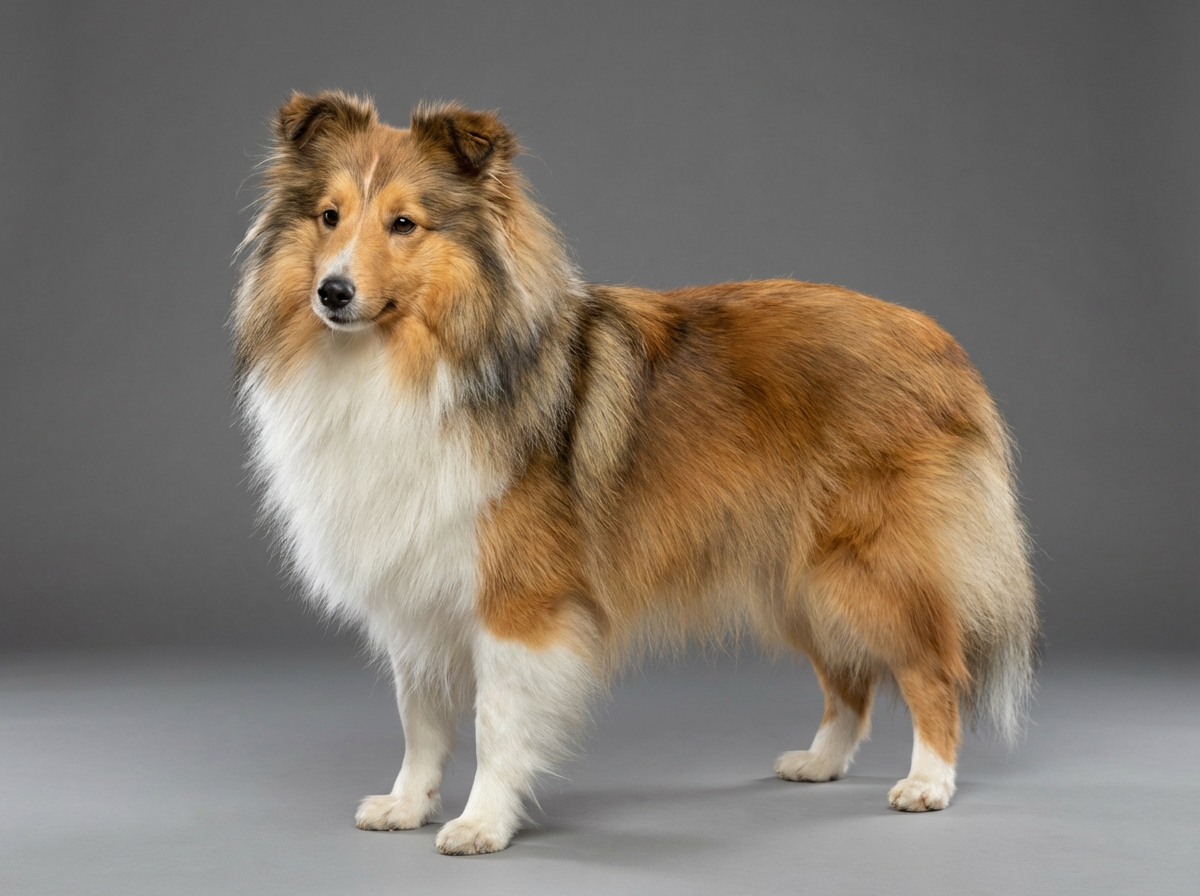
The Shetland Sheepdog's small adult size, 15 to 25 pounds and 13 to 16 inches tall, means the skeleton is built quickly but on a small scale, which avoids most of the mechanisms behind giant breed growth disease. The genuine breed factor is the knee. Patellar luxation is documented here and reflects how the femoral groove and the alignment of the thigh muscles develop during the first months of life. Coat is a complicating factor rather than a cause: the developing double coat conceals body condition from about four months onward, which is when overfeeding usually begins without anyone noticing.
Flooring and furniture shape the mechanical environment a puppy grows in. Laminate and tile allow the hind legs to slide apart during excited play, and a puppy who launches off the sofa several times a day is delivering repeated shocks through cartilage that is still converting to bone. Feeding practice matters as much: free access to a full bowl, generous training treats and family members supplementing meals produce a heavy puppy far more often than any deficiency does. Well-meaning supplementation, usually bought without veterinary advice, is the other common environmental harm.
Ask for a kneecap assessment at every puppy vaccination visit and get the grade written in the record, because that baseline is what future comparisons rest on. Book promptly for any persistent limp lasting more than a day or two, for a puppy who cries when a leg is handled, for swelling around a joint, or for reluctance to bear weight. Seek same-day help for a puppy who is suddenly non-weight-bearing after a fall or a jump, since growth plate fractures are genuine injuries that need imaging rather than rest. Also raise any brief hopping or skipping gait even if it lasts seconds and resolves, because that is the signature of a slipping kneecap and it is worth documenting early.
See all Shetland Sheepdog health problems, which breeds are prone to bone growth issues, or the full Shetland Sheepdog breed guide for temperament, exercise needs and ownership costs.
Most growth in this breed is complete by around eight to twelve months, with the knee joint continuing to firm up somewhat beyond that. Body condition responds to feeding changes within three to four weeks. A luxating kneecap identified in puppyhood is monitored across years rather than resolved in weeks.
A yearling who reaches the breed's normal 15 to 25 pound range without ever having been chubby, moves symmetrically at a trot, and has a kneecap grade recorded in her notes. Not every developmental issue is preventable, but a lean, well-managed first year gives the joints the best start available.
Strip out the giant breed material and a short, practical list remains. Each of these is something an owner controls directly during the first year.
The instinct to help bones grow by adding calcium is understandable and it is backwards. A complete commercial puppy food already contains calcium and phosphorus in a deliberately balanced ratio, because the ratio matters more than the absolute quantity. Adding a calcium supplement on top skews that ratio, and in growing dogs excess dietary calcium has been shown to interfere with normal skeletal development rather than support it. The same applies to bone meal and to well-intentioned home-prepared additions.
The honest position is that the best thing you can do for a Sheltie puppy's bones is feed a complete puppy diet at the amount that keeps her lean, and add nothing. If you want to change something, change the quantity rather than the composition, and do it against how the dog feels under your hands rather than against a number on the bag.
Coat makes that harder than it sounds. A Sheltie puppy is developing the long, dense double coat the breed is known for, and by six months there is enough of it to disguise a genuinely chubby dog. Weigh her fortnightly and assess by touch: fingers flat along the ribcage should find ribs with gentle pressure, and there should be a visible waist when you look down from above with the coat parted.
The joint to watch specifically is the knee. Patellar luxation is one of the five documented conditions in this breed, and puppies who skip a step or two, hold a hind leg up briefly and then carry on as normal are showing exactly the classic sign. Report it even if it lasts three seconds, because a grade recorded at six months is what lets your vet judge whether anything is changing at three years.

Teasel came home at nine weeks and her owner Fraser, who had previously owned a Rottweiler, did what he had done before: bought a joint and calcium supplement and a large breed growth chart. At the sixteen week vaccination the vet weighed her, felt for her ribs through an already thickening coat, and told him she was noticeably heavy for her frame. The supplements were stopped, the daily ration reduced and measured, and training treats subtracted from meals. The vet also graded a mild kneecap looseness on the right and wrote it down. Fraser put runners across the hall and taught Teasel to use a set of steps to the sofa. At three she is 21 pounds, sound, and her knee grade has not changed since the puppy examination.
Key takeaway: Advice that worked for a large breed can actively harm a small one. Feed complete food, keep the puppy lean, and add nothing.
These are conditions of rapidly growing large and giant breeds and are uncommon in a dog that finishes at 15 to 25 pounds. Neither appears on the Shetland Sheepdog's documented health list. Growing pain complaints in a Sheltie puppy warrant examination rather than assumption.
Frequent short sessions rather than long forced walks. Free play on grass, training games and exploration build coordination and muscle. What growing joints do not need is sustained running alongside a bike or repeated jumping.
In a small breed, typically somewhere between eight and twelve months, earlier than in large breeds. Ask your own vet, because it determines when higher-impact activities such as agility jumping become reasonable.
A complete diet formulated for puppies, fed to the point where the dog stays lean. Small breed puppy formulations exist and are appropriate. Switch to adult food on your vet's timing rather than at a fixed date.
No. A brief hop where the leg is carried and then dropped back into use is the textbook description of a kneecap slipping. It is not painful enough to worry a puppy and it is absolutely worth a veterinary examination.
For a growing puppy, yes. Legs splaying outward repeatedly puts abnormal force through hips and knees that have not finished forming. Rugs and runners are a cheap, genuinely useful intervention during the first year.
No. Most puppy growth advice online targets breeds ending at eighty pounds or more and does not transfer to a 20 pound herding dog.
No. A complete puppy food is already balanced, and added calcium disrupts that balance and can harm skeletal development.
Feel rather than look. Ribs should be findable with light flat pressure, and a waist should be visible when the coat is parted.
After the growth plates close, typically somewhere past eight to twelve months, and only on your vet's confirmation. Groundwork can start much earlier.
A complete small breed puppy diet sits comfortably within the breed's usual eighty to a hundred and fifty dollar monthly range, and costs far less than supplements you do not need.
A one-page prep sheet for this condition: the signs, the questions to ask, what to get priced. Unlocks here.
You get: Vet visit prep sheet
No spam. One-click unsubscribe. See our privacy policy.
Preview page 1 before you decide.