Living
Goldendoodle or Shetland Sheepdog overall?
If barking and shedding are dealbreakers, the Goldendoodle wins clearly. If you want a smaller, cheaper, longer-lived dog and can handle the vocals, the Sheltie holds its own.

Quick answer
Goldendoodle or Shetland Sheepdog overall?
If barking and shedding are dealbreakers, the Goldendoodle wins clearly. If you want a smaller, cheaper, longer-lived dog and can handle the vocals, the Sheltie holds its own.
Goldendoodle or Shetland Sheepdog? On paper they differ most on shedding, and on the scales Goldendoodle is the heavier at 15–90 lbs. Here is how the two compare on everything that shapes an ordinary week.
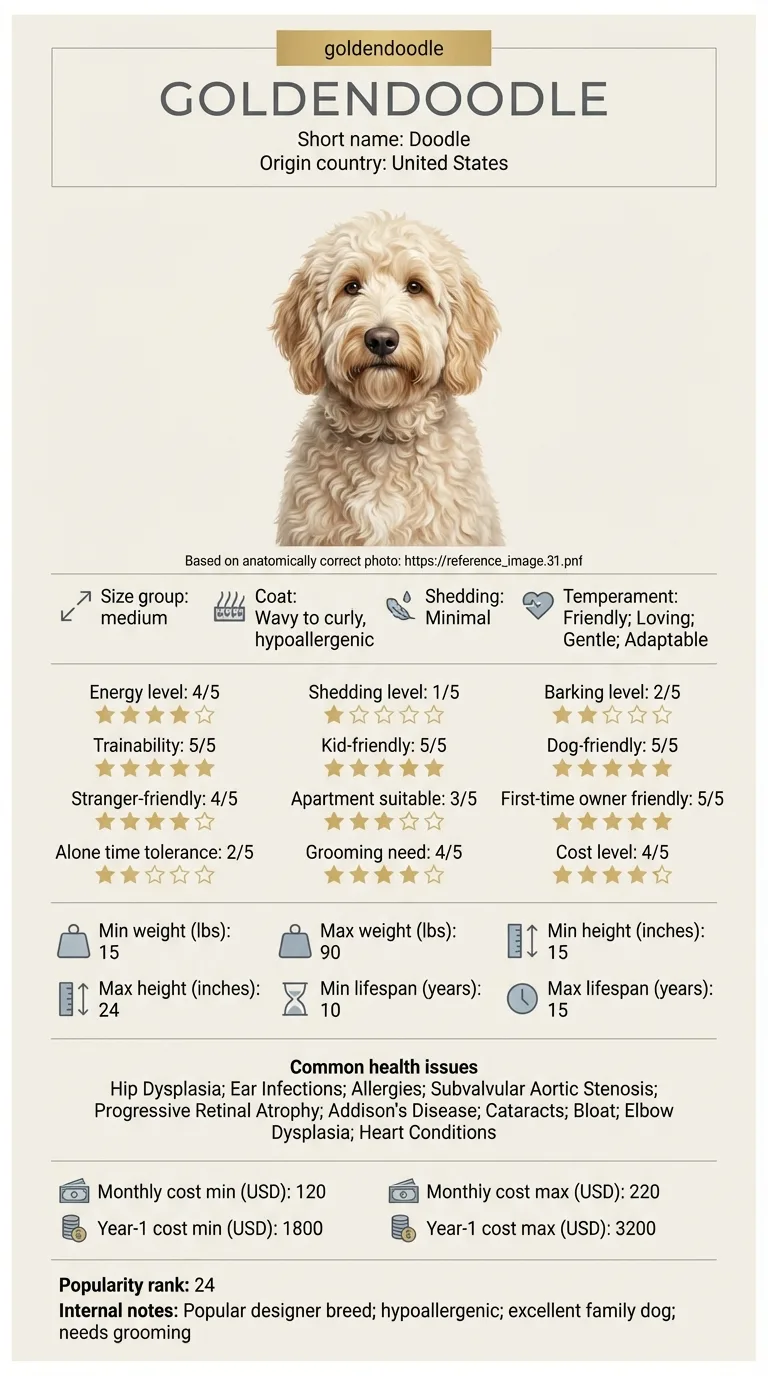
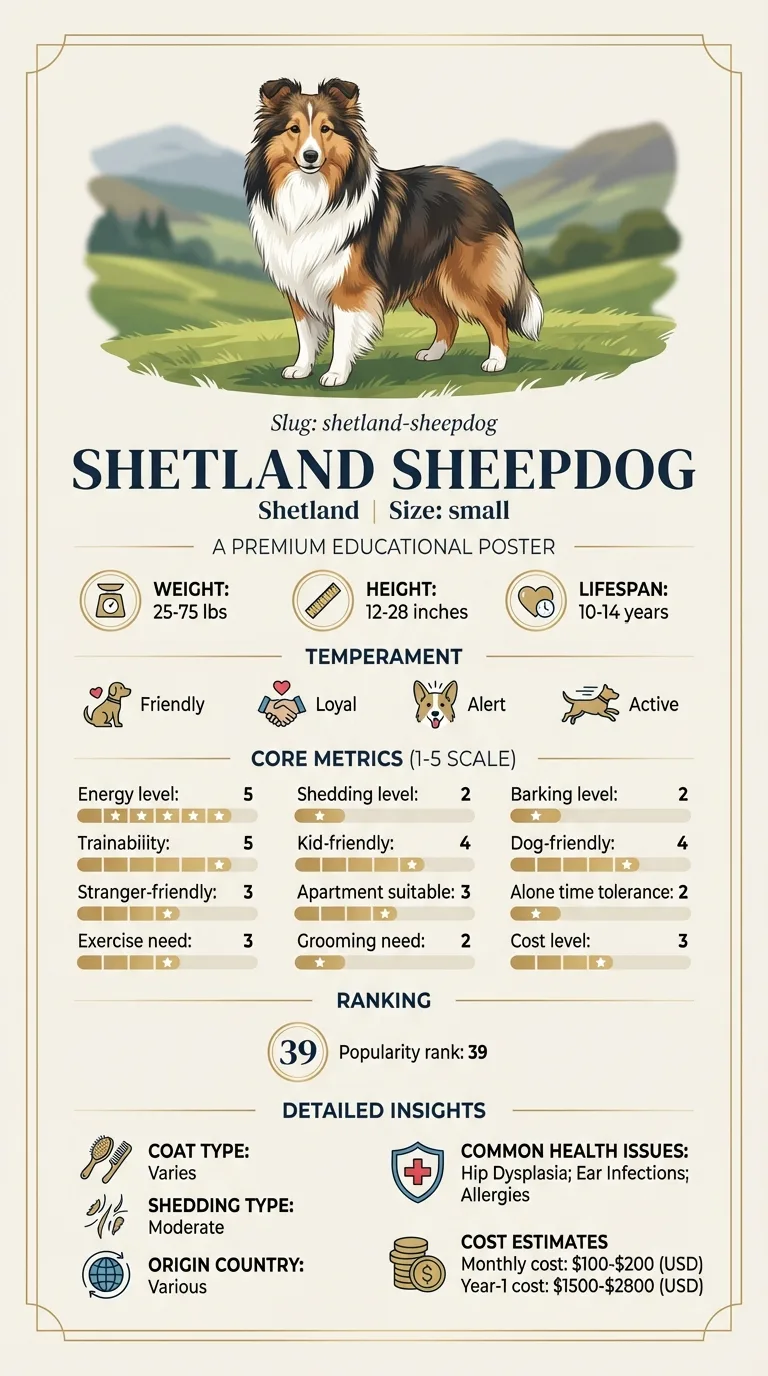
This is for someone already down to Goldendoodle and Shetland Sheepdog and deciding between them. For this pair the decision usually turns on shedding and barking, so those are covered first and in most detail. Both rate 3/5 for flats, so housing does not settle this one. It is written for the decision rather than the breed history.
Between Goldendoodle and Shetland Sheepdog, shedding is what separates them, and Goldendoodle is the lower-effort dog of the two to keep.
Choose Goldendoodle if this is your first dog, shedding is a problem in your house and there are young children at home.
Choose Shetland Sheepdog if a smaller dog suits your car, your home or your back and you want a dog that is more watchful with visitors.
| Feature | goldendoodle | shetland sheepdog | Winner |
|---|---|---|---|
| Size class | medium | small | Equal |
| Weight | 15–90 lbs | 15–25 lbs | Equal |
| Height | 15–24 in | 13–16 in | Equal |
| Lifespan | 10–15 years | 12–14 years | shetland sheepdog |
| Exercise need | High (4/5) | High (4/5) | Equal |
| Grooming need | High (4/5) | High (4/5) | Equal |
| Shedding | Very low (1/5) | High (4/5) | goldendoodle |
| Energy level | High (4/5) | High (4/5) | Equal |
| Barking | Low (2/5) | Very high (5/5) | goldendoodle |
| Apartment suitability | Moderate (3/5) | Moderate (3/5) | Equal |
| Good for first-time owners | Very high (5/5) | High (4/5) | goldendoodle |
| Tolerates being alone | Low (2/5) | Low (2/5) | Equal |
| Trainability | Very high (5/5) | Very high (5/5) | Equal |
| Good with kids | Very high (5/5) | High (4/5) | goldendoodle |
| Good with other dogs | Very high (5/5) | High (4/5) | goldendoodle |
| Friendly to strangers | High (4/5) | Low (2/5) | goldendoodle |
| Cost level | High (4/5) | Moderate (3/5) | shetland sheepdog |
| Coat | Wavy to curly, hypoallergenic | Long, dense double coat | Equal |
| Origin | United States | Various | Equal |
| Typical monthly cost | $120–$220 | $80–$150 | Equal |
| Typical first-year cost | $1,800–$3,200 | $1,100–$2,300 | Equal |
A Shetland Sheepdog is a small dog, 15-25 lbs and 13-16 inches, while a Goldendoodle is classed medium and can run anywhere from 15 lbs up to 90. At the low end of the Goldendoodle range the two overlap; at the high end there's no comparison at all. If you've pictured a specific Goldendoodle size, check where it falls on that 15-90 spread before assuming it'll be Sheltie-sized.
Both breeds rate 4/5 for exercise need and energy level — this isn't a comparison where one dog is obviously more laid-back. Shelties were bred to herd, and that instinct shows up as a need for structured activity, not just a lap around the yard. Expect to give either dog real daily exercise, ideally with some mental work mixed in, herding games for the Sheltie, retrieving for the Goldendoodle.
Grooming need is tied at 4/5, but shedding is not: Goldendoodle 1/5, Sheltie 4/5. That long, dense double coat blows out twice a year and sheds steadily in between, which is the opposite of what the Goldendoodle's curly coat does. If shedding-free floors matter more to you than brushing time, the Goldendoodle is the clearer pick despite the similar overall grooming rating.
Barking is the number that should stop you here: Shetland Sheepdogs rate 5/5, Goldendoodles 2/5. That's not a small gap — Shelties are famously vocal, bred to herd partly with their voice, and it doesn't switch off indoors. Apartment suitability ties at 3/5 moderate for both, but a 5/5 barker in a shared building is a different practical problem than the apartment rating alone suggests.
Trainability ties at 5/5 for both — Shelties are famously quick learners, right up there with the Goldendoodle. First-time-owner suitability tilts slightly to the Goldendoodle, 5/5 against 4/5, mostly because the Sheltie's sensitive, bright temperament responds poorly to harsh handling and needs a gentler, more consistent approach than a beginner might default to.
The Goldendoodle rates slightly higher with kids (5/5 vs 4/5) and other dogs (5/5 vs 4/5), both close calls. The bigger gap is with strangers: Goldendoodle 4/5, Sheltie 2/5. Shelties are devoted to their own family but genuinely reserved with new people, which tracks with their watchful, sensitive temperament — don't expect one to greet visitors the way a Goldendoodle will.
The Sheltie lives a bit longer, 12-14 years against the Goldendoodle's 10-15 — close enough that individual dogs vary more than the breed average. Their health lists don't overlap at all: the Sheltie's five conditions include MDR1 drug sensitivity and dermatomyositis, neither of which appears on the Goldendoodle's ten-item list. Ask specifically about MDR1 testing if you're considering a Sheltie, since it affects how the dog metabolizes certain medications.
The Sheltie is meaningfully cheaper to keep: $80-150 a month against the Goldendoodle's $120-220, and its cost rating sits at 3/5 moderate versus 4/5 high. First-year costs show the same gap, up to $2,300 for the Sheltie against $3,200 for the doodle. Smaller size generally means smaller food and medication bills, and that shows up clearly here.
Goldendoodle weighs 15–90 lbs and lives 10–15 years; Shetland Sheepdog weighs 15–25 lbs and lives 12–14 years. The two diverge most on shedding, barking and friendly to strangers. They are level on tolerates being alone, apartment suitability and energy level, so those cannot decide it. In the table, a "winner" means easier for an ordinary household — not better. Size, coat and origin are recorded without a verdict. Because both breeds are scored the same way, the gaps are reliable even where the absolute numbers are rough.

Usually, yes. Shelties are a small breed at 15-25 lbs; Goldendoodles are medium and can range from 15 up to 90 lbs, so only the smallest Goldendoodles overlap with Sheltie size.
The Shetland Sheepdog, by a wide margin — 5/5 versus the Goldendoodle's 2/5. This is probably the single biggest factor to weigh if you have close neighbors or thin walls.
The Sheltie, rated 4/5 against the Goldendoodle's 1/5. Its long double coat sheds steadily and blows out seasonally, while the doodle's curly coat holds onto loose hair instead of releasing it everywhere.
The Goldendoodle is, rated 4/5. The Sheltie rates just 2/5 — it's a watchful, sensitive breed that bonds tightly with its own family but tends to hold back around new people.
The Shetland Sheepdog, at $80-150 a month versus $120-220 for the Goldendoodle. First-year costs follow the same pattern, roughly $900 less for the Sheltie.
No overlap at all between the two lists. The Sheltie's risks include Collie Eye Anomaly and MDR1 drug sensitivity; the Goldendoodle's include Addison's disease and subvalvular aortic stenosis. Ask breeders about testing specific to each.
Both are rated 5/5 for trainability — a genuine tie. The difference is temperament: the Sheltie needs a gentler hand given its sensitivity, while the Goldendoodle is more forgiving of a beginner's mistakes.
If barking and shedding are dealbreakers, the Goldendoodle wins clearly. If you want a smaller, cheaper, longer-lived dog and can handle the vocals, the Sheltie holds its own.
The Shetland Sheepdog, at $80-150 versus $120-220 for the Goldendoodle.
Neither — both rate 4/5 on exercise need, a tie.
The Shetland Sheepdog, at 12-14 years versus 10-15 for the Goldendoodle — close, with real overlap at the top end.
Secure checkout on Stripe. We never see your card.
7-day money-back guarantee. Instant access.
Health information here is general and is not veterinary advice. If your dog shows pain, sudden behaviour change, or worsening symptoms, consult a licensed veterinarian.
Some links on this site are affiliate links. We may earn a commission at no extra cost to you, and we only suggest products we believe are helpful for dog owners.
We research and check what we publish, but we do not warrant that any figure, date, price, or statement is accurate, complete, or current, and we accept no liability for any loss, cost, injury, or other harm arising from the use of this site. Use it as one reference among several. You remain responsible for your own decisions and for your dog's care - confirm anything that matters with a licensed veterinarian or another qualified professional before you act on it. Full disclaimer.
Match your lifestyle to the right dog.
Take quizNot sure which breed is right for you? Take our 2-minute quiz to find out.
Take the quiz