Health
What is PRA in dogs?
An inherited, progressive degeneration of the retina's light-sensing cells leading to gradual vision loss.

Quick answer
What is PRA in dogs?
An inherited, progressive degeneration of the retina's light-sensing cells leading to gradual vision loss.
Because the loss happens gradually, often starting with reduced night vision that's easy to miss, many owners don't realize anything is wrong until the dog is already struggling considerably in low light.
This mostly affects owners who notice their dog bumping into furniture at dusk, hesitating on stairs in dim light, or seeming reluctant to go outside after dark, all classic early signs that are easy to attribute to clumsiness or aging.
This guide is not medical advice. If your dog shows pain, sudden behavior change, or worsening symptoms, consult a licensed veterinarian.
Some links may be affiliate links. We may earn a commission at no extra cost to you. We only suggest products we believe are helpful for dog owners.
We research and check what we publish, but we do not warrant that any figure, date, price, or statement is accurate, complete, or current, and we accept no liability for any loss, cost, injury, or other harm arising from the use of this site. Use it as one reference among several. You remain responsible for your own decisions and for your dog's care - confirm anything that matters with a licensed veterinarian or another qualified professional before you act on it. Full disclaimer.
Check this first
PRA itself is a slow, chronic process rather than an emergency, so vision loss developing gradually over months to years doesn't require urgent care in the way an acute injury would. However, any sudden vision loss, one or both eyes going cloudy or losing sight abruptly rather than gradually, is different and needs a same-day vet visit, since sudden blindness can indicate a completely different, sometimes treatable emergency condition rather than PRA.
Gradual night-vision difficulty, hesitation in dim lighting, or bumping into unfamiliar objects while daytime vision still seems intact are consistent with typical PRA progression and warrant a scheduled eye exam rather than urgent care.
The distinguishing factor is speed. PRA's hallmark is a slow, progressive decline typically starting with night vision and advancing over months to years. Sudden, complete vision loss happening over hours or days points toward a different, sometimes urgent cause and should prompt an immediate vet visit rather than being assumed to be PRA progressing unusually fast.
If any of these apply, call your vet or an emergency clinic now. The rest of this page is for the cases that are not an emergency.
Progressive retinal atrophy is an inherited degeneration of the retina's light-sensing cells that causes gradual, ultimately permanent vision loss, typically beginning with reduced night vision that's easy for owners to miss at first. It isn't painful, and dogs generally adapt well to the gradual decline, but there's currently no treatment to reverse or stop it once it starts, making early recognition mostly valuable for adapting the home environment rather than for altering the disease course.
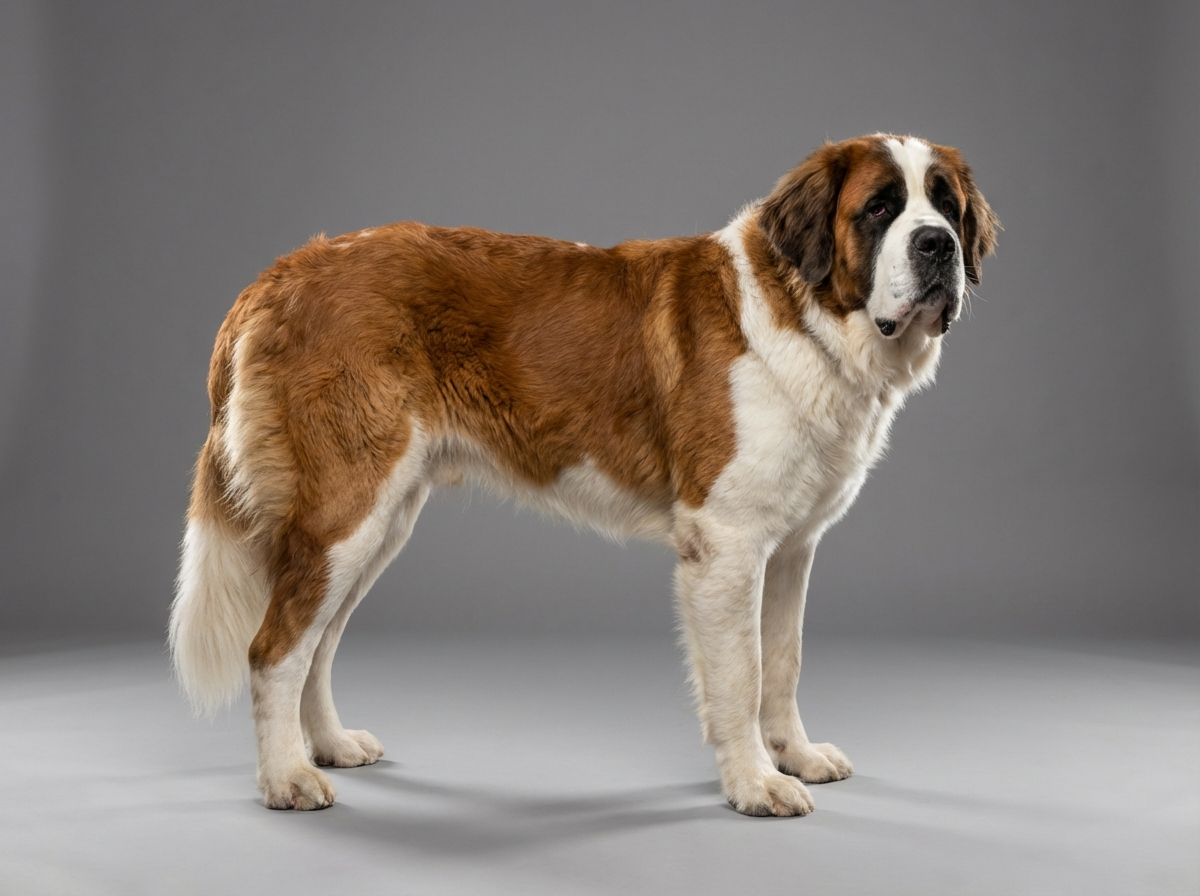
PRA is a well-documented inherited condition across many breeds, and while it's not among the most frequently cited health issues in Saint Bernards specifically, it remains a real, genetically-driven risk worth screening for in breeding programs.
PRA is caused by inherited genetic mutations affecting the retina's photoreceptor cells, passed down from parent to offspring, and different specific mutations are documented across various breeds, meaning a Saint Bernard's individual risk depends heavily on whether the specific genetic variant is present in its particular bloodline.
There are no known environmental triggers for PRA, since it's a purely inherited condition; the disease's progression follows the underlying genetic predisposition rather than being influenced by diet, exercise, or other lifestyle factors.
Talk to your vet about any hesitation or clumsiness in dim lighting or after dark, since this is the classic early sign of PRA worth a formal eye exam. Sudden vision loss, either eye going cloudy or unseeing abruptly rather than gradually, needs a same-day vet visit.
Because PRA develops gradually and dogs compensate well early on, a few common assumptions delay diagnosis and adaptation.
See all Saint Bernard health problems, which breeds are prone to progressive retinal atrophy pra, or the full Saint Bernard breed guide for temperament, exercise needs and ownership costs.
PRA typically progresses over months to a few years from the first signs of reduced night vision to more significant vision loss, though the exact pace varies by the specific genetic variant and individual dog.
Success means a dog that remains confident and well-adjusted despite vision loss, through consistent environmental layout, verbal cues, and patience, rather than expecting any treatment to slow or reverse the underlying retinal degeneration.
Colleen noticed her Saint Bernard, Jasper, had started hesitating at the bottom of the stairs after dark, though he moved normally during the day. A veterinary ophthalmologist diagnosed early PRA after a specialized eye exam. Rather than waiting for vision to decline further, Colleen began using consistent verbal cues for stairs and doorways right away and added textured mats near key hazards. Two years later, with Jasper's vision now significantly reduced even in daylight, he still navigates his home confidently using the cues and layout he learned well before he needed them.
Key takeaway: Starting the adaptation process early, while Jasper still had some vision, meant he had already learned the cues and layout he'd eventually need to rely on completely, rather than trying to learn them after vision loss was already severe.
It's an inherited group of conditions where the retina's light-sensing photoreceptor cells gradually degenerate over time, causing progressive, ultimately permanent vision loss that typically starts with reduced night vision.
Reduced night vision is usually the first sign, showing up as hesitation or clumsiness in dim lighting or after dark, while daytime vision often remains relatively normal in the earlier stages.
A veterinary ophthalmologist can identify characteristic retinal changes through a specialized eye exam, and an electroretinogram can measure retinal function directly. Genetic testing is also available for certain known PRA variants.
There is currently no cure or treatment that reverses or stops PRA's progression in most forms. Management focuses on supporting the dog's quality of life as vision declines, through environmental adaptations and training.
Dogs generally adapt remarkably well to gradual vision loss, relying heavily on scent, hearing, and memorized environments, especially when owners keep furniture layout consistent and introduce verbal cues early.
No, PRA itself is not painful; it's a degeneration of the retina's light-sensing cells rather than a source of physical discomfort, which is part of why quality of life often remains good even as vision declines.
No, since PRA is inherited, affected dogs and often their close relatives should not be used for breeding, and genetic testing can help identify carriers before breeding decisions are made.
An inherited, progressive degeneration of the retina's light-sensing cells leading to gradual vision loss.
Reduced night vision, showing up as hesitation or clumsiness in dim lighting, is usually the earliest sign.
No, there's currently no cure, and management focuses on supporting quality of life as vision declines.
No, it's not a painful condition, just a gradual loss of vision.
Yes, genetic testing exists for certain known PRA variants and is recommended for breeding dogs in affected lines.
A one-page prep sheet for this condition: the signs, the questions to ask, what to get priced. Unlocks here.
You get: Vet visit prep sheet
No spam. One-click unsubscribe. See our privacy policy.
Preview page 1 before you decide.