Health
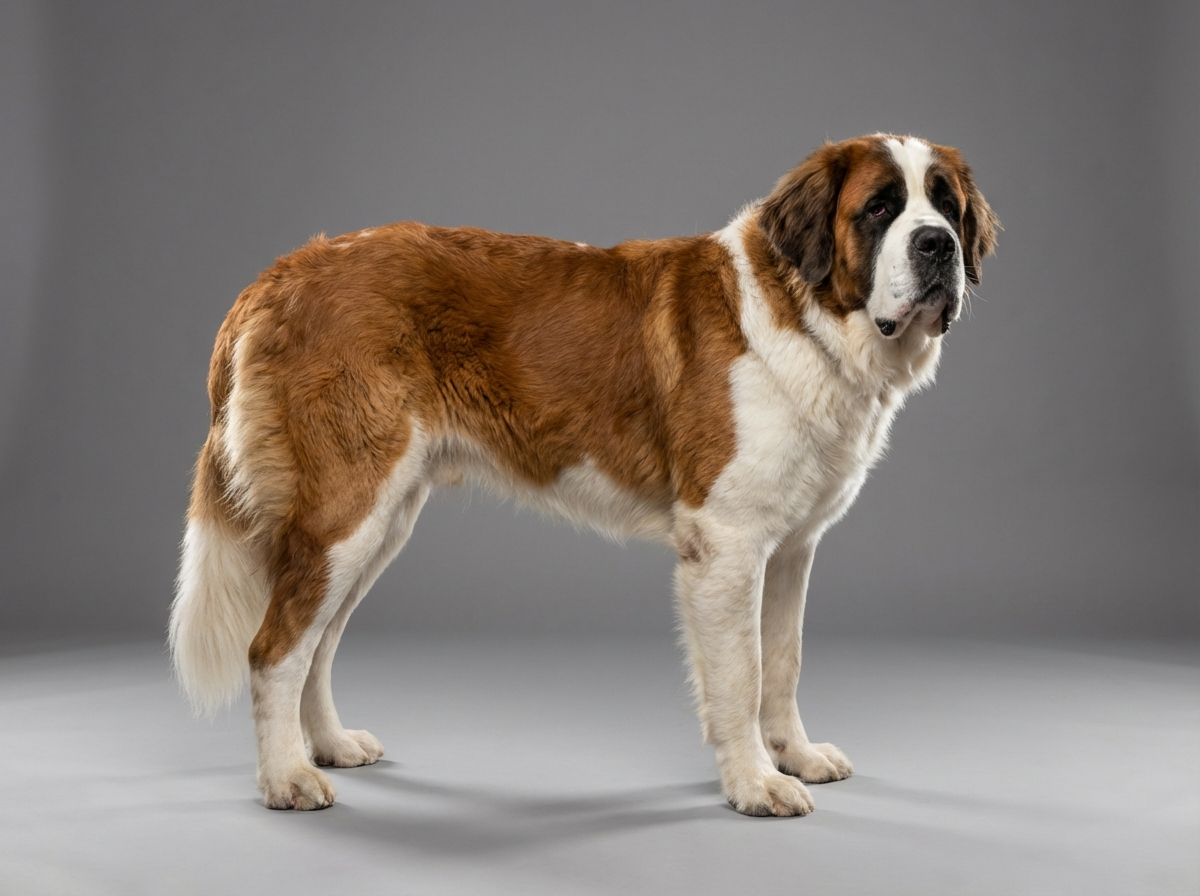
Why does arthritis start early in Saint Bernards?
Because hip and elbow dysplasia, both documented in the breed, cause uneven joint wear from a young age, accelerating arthritic changes.

Quick answer
Why does arthritis start early in Saint Bernards?
Because hip and elbow dysplasia, both documented in the breed, cause uneven joint wear from a young age, accelerating arthritic changes.
A Saint Bernard's arthritis story often does not start in old age. It starts in a joint that was already imperfectly formed at eight months old, and the stiffness an owner notices at age five is often the accumulated wear of years, not a sudden new problem.
Owners who assume slowing down is simply a young-to-middle-age dog 'mellowing out,' rather than recognizing it as an early sign of joint pain in a breed already carrying documented dysplasia risk.
This guide is not medical advice. If your dog shows pain, sudden behavior change, or worsening symptoms, consult a licensed veterinarian.
Some links may be affiliate links. We may earn a commission at no extra cost to you. We only suggest products we believe are helpful for dog owners.
We research and check what we publish, but we do not warrant that any figure, date, price, or statement is accurate, complete, or current, and we accept no liability for any loss, cost, injury, or other harm arising from the use of this site. Use it as one reference among several. You remain responsible for your own decisions and for your dog's care - confirm anything that matters with a licensed veterinarian or another qualified professional before you act on it. Full disclaimer.
Arthritis in a Saint Bernard is degenerative joint disease that develops when uneven wear — most often caused by the breed's documented hip or elbow dysplasia — gradually damages cartilage and prompts new bone growth around the joint. It frequently begins earlier than typical 'old age' arthritis because the underlying joint malformation has often been present since puppyhood.
Given how frequently hip and elbow dysplasia are documented in this breed, arthritic changes are a common long-term outcome rather than an unusual complication, and most Saint Bernards will show at least some degree of joint change by mid-to-late life.
The breed's rapid growth to a large adult size, combined with a documented tendency toward hip and elbow dysplasia, means many joints are asked to bear substantial weight before they have finished developing correctly. That structural mismatch is the direct mechanical cause of accelerated cartilage wear.
Excess weight, hard flooring, repeated jumping on and off furniture or vehicles, and high-impact exercise in puppyhood before growth plates close all add extra stress to joints that may already be structurally vulnerable.
See a vet for any persistent stiffness, reluctance to jump or climb, or a noticeable limp, even if it seems mild or intermittent. Treat as urgent a sudden inability to bear weight on a leg, visible swelling around a joint, or an abrupt change from mild stiffness to obvious pain, since this can indicate an acute injury layered on top of chronic joint disease.
None of these signs on their own proves arthritis, but together, and especially in a dog with known dysplasia, they are worth a vet visit rather than being written off as normal aging or laziness.

See all Saint Bernard health problems, which breeds are prone to arthritis, or the full Saint Bernard breed guide for temperament, exercise needs and ownership costs.
Arthritis is a progressive, lifelong condition rather than one that resolves. Most dogs show meaningful comfort improvement within 4 to 6 weeks of starting a weight, exercise and pain-management plan, though the underlying joint changes remain permanent.
Success is a dog that moves comfortably through daily life — willing to walk, rising without obvious struggle, and showing good quality of life — not a return to puppy-level joint function, which is not realistic once arthritis is present.
Hip and elbow dysplasia are both documented health issues in this breed and describe a joint that does not fit together as precisely as it should — the ball and socket in the hip, or the three bones that must align in the elbow. A slightly loose or misaligned joint bears weight unevenly every single time the dog stands, walks or climbs stairs. Over months and years, that uneven loading wears cartilage down faster than it would in a properly formed joint, and the body responds by laying down extra bone around the joint margins — the process that shows up on an X-ray as arthritis.
This means a Saint Bernard's arthritis is very often not a separate, unrelated condition that arrives in old age, but the long-term consequence of a joint issue the dog may have carried since it was a puppy. A dog diagnosed with dysplasia young is, statistically, more likely to show arthritic changes earlier than a dog with well-formed joints.
Bruno, a five-year-old Saint Bernard diagnosed with mild hip dysplasia as a puppy, had always jumped eagerly into the back of his owner's truck for weekend trips. One spring his owner noticed Bruno hesitating at the tailgate, sometimes needing two attempts to get in. A vet exam and X-rays showed early arthritic changes in both hips, consistent with the dysplasia noted years earlier. Bruno's owner added a truck ramp, switched his diet to manage a few extra pounds he had put on, and started a vet-recommended joint supplement alongside shorter, more frequent walks instead of one long one. Within six weeks Bruno was moving more freely and using the ramp without any fuss.
Key takeaway: The hesitation at the tailgate was Bruno's earliest visible sign of arthritis, years after his original dysplasia diagnosis — catching it there, rather than waiting for an obvious limp, gave his owner a real head start on managing it.
Given the breed's dysplasia risk, some dogs show early arthritic changes by four to six years old, well before what most owners think of as 'old age' for a dog with an 8 to 10 year lifespan.
No. Dysplasia is the structural joint malformation present from a young age; arthritis is the degenerative joint disease that often develops afterward as a consequence of that malformation.
Not entirely if dysplasia is already present, but keeping the dog lean, providing joint-safe exercise, and treating any lameness early can meaningfully slow how quickly arthritis progresses.
A physical exam assessing joint range of motion and pain response, often combined with X-rays to see the extent of joint changes and confirm the diagnosis.
Extremely important. Every extra pound adds compressive force to already compromised joints, and weight management is one of the few factors entirely within an owner's control.
Not necessarily — many dogs are managed successfully with weight control, joint-supportive exercise and vet-guided pain management. Surgery is considered case by case, usually for more severe dysplasia or when conservative management is not enough.
Persistent stiffness that does not improve with rest, reluctance to do previously normal activities, or any limping are signs worth a vet exam rather than assuming it is simply age or personality.
Because hip and elbow dysplasia, both documented in the breed, cause uneven joint wear from a young age, accelerating arthritic changes.
Slower rising after rest and reluctance to jump or climb stairs are typically the first noticeable signs.
Yes — excess weight directly increases joint load, and weight management is one of the most effective, fully controllable interventions.
Controlled leash walks and swimming are generally easier on joints than jumping, running on hard surfaces, or repetitive stair use.
Many vets recommend them as part of a broader plan, but they work best alongside weight management and appropriate exercise, not as a standalone fix.
A one-page prep sheet for this condition: the signs, the questions to ask, what to get priced. Unlocks here.
You get: Vet visit prep sheet
No spam. One-click unsubscribe. See our privacy policy.
Preview page 1 before you decide.