Living
Bloodhound or Saint Bernard - which fits a family better?
The Saint Bernard scores higher with kids (5/5 vs 4/5) and is more trainable and forgiving for a first-time owner, but it costs noticeably more to keep and needs more space.

Quick answer
Bloodhound or Saint Bernard - which fits a family better?
The Saint Bernard scores higher with kids (5/5 vs 4/5) and is more trainable and forgiving for a first-time owner, but it costs noticeably more to keep and needs more space.
Bloodhound or Saint Bernard? On paper they differ most on cost level, and on the scales Saint Bernard is the heavier at 120–180 lbs. Here is how the two compare on everything that shapes an ordinary week.
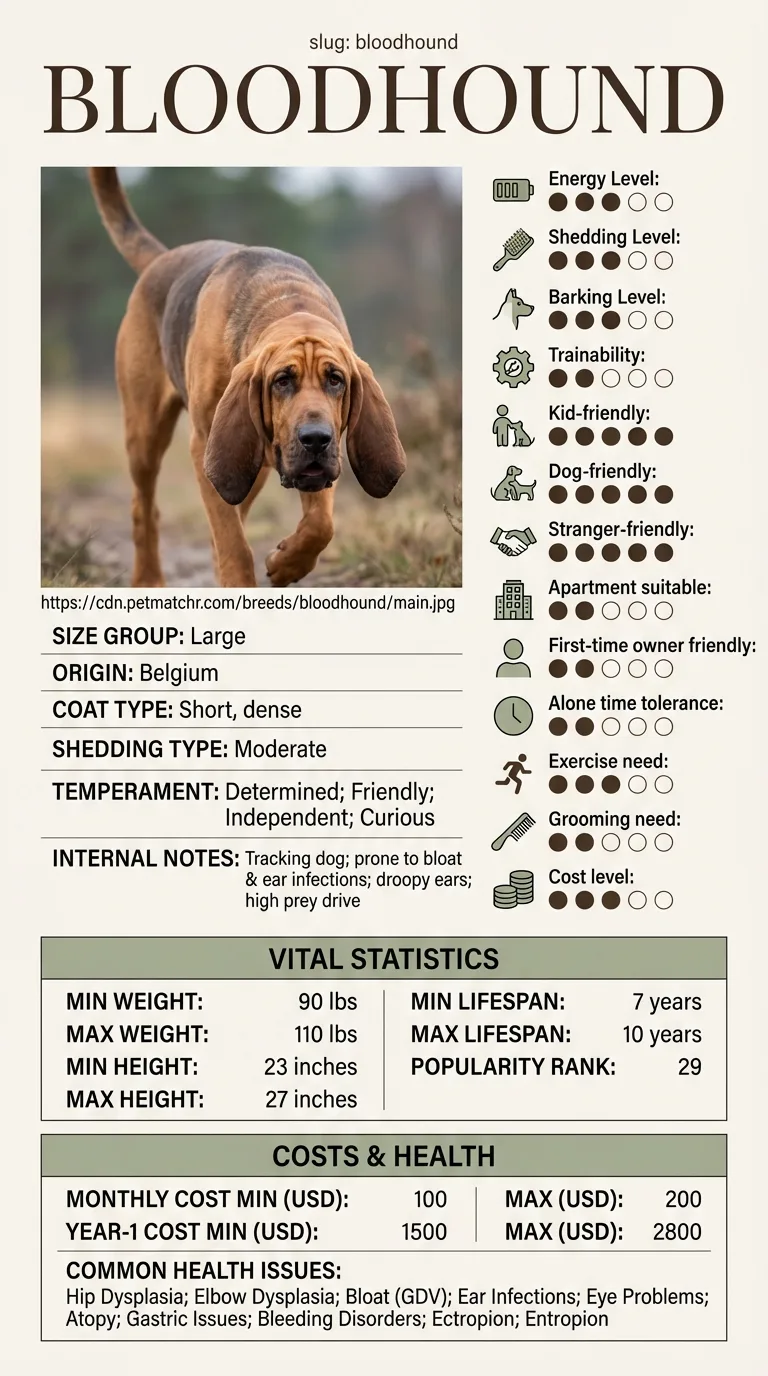
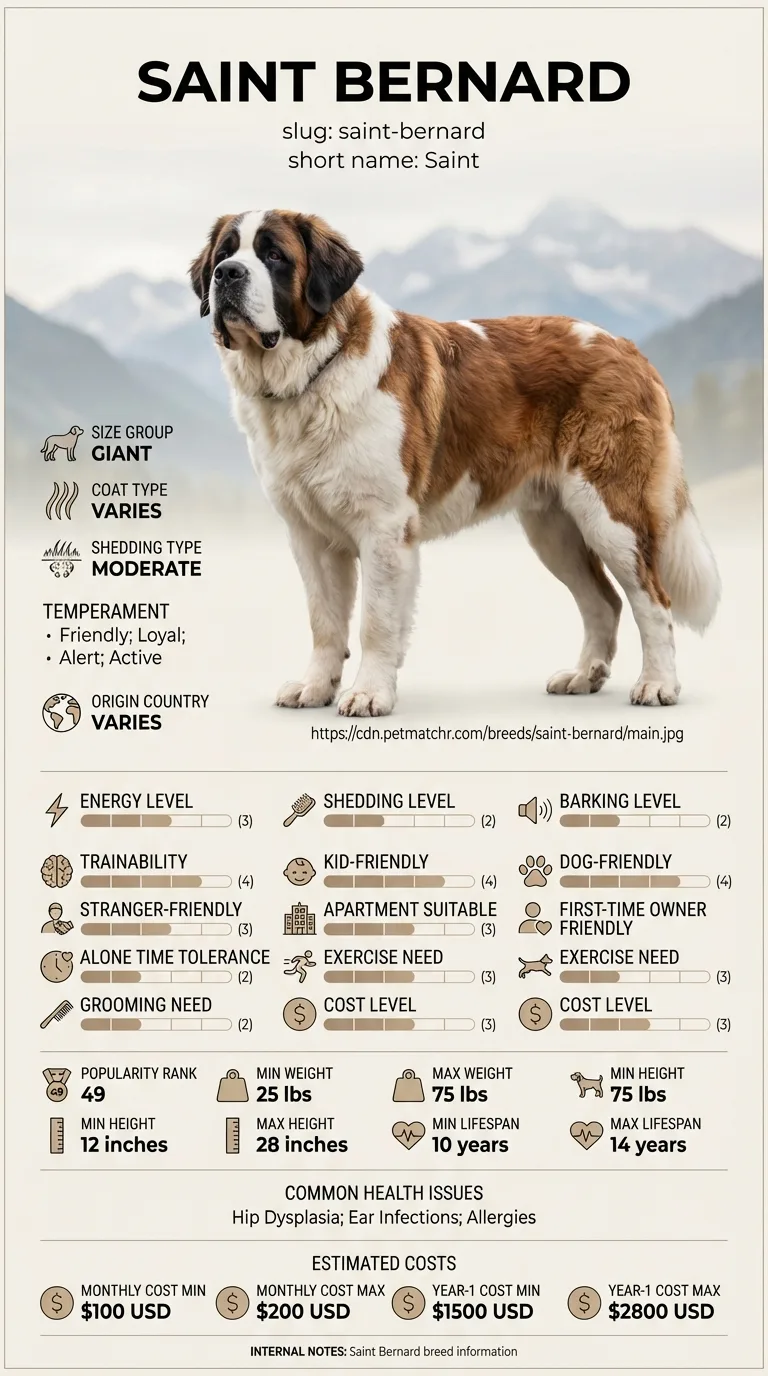
This is for someone already down to Bloodhound and Saint Bernard and deciding between them. For this pair the decision usually turns on cost level, so those are covered first and in most detail. Anyone choosing from a flat has a clear answer here: Bloodhound rates 2/5 against 1/5. The focus throughout is on daily consequences rather than breed background.
Between Bloodhound and Saint Bernard, cost level is what separates them, and Saint Bernard is the lower-effort dog of the two to keep.
Choose Bloodhound if you do not want a standing grooming appointment, shedding is a problem in your house and a smaller dog suits your car, your home or your back.
Choose Saint Bernard if this is your first dog, your walking routine is modest and the dog will be alone during the working day.
| Feature | bloodhound | saint bernard | Winner |
|---|---|---|---|
| Size class | large | giant | Equal |
| Weight | 90–110 lbs | 120–180 lbs | Equal |
| Height | 23–27 in | 26–30 in | Equal |
| Lifespan | 7–10 years | 8–10 years | saint bernard |
| Exercise need | Moderate (3/5) | Low (2/5) | saint bernard |
| Grooming need | Low (2/5) | Moderate (3/5) | bloodhound |
| Shedding | Moderate (3/5) | High (4/5) | bloodhound |
| Energy level | Moderate (3/5) | Low (2/5) | Equal |
| Barking | Moderate (3/5) | Low (2/5) | saint bernard |
| Apartment suitability | Low (2/5) | Very low (1/5) | bloodhound |
| Good for first-time owners | Low (2/5) | Moderate (3/5) | saint bernard |
| Tolerates being alone | Low (2/5) | Moderate (3/5) | saint bernard |
| Trainability | Low (2/5) | Moderate (3/5) | saint bernard |
| Good with kids | High (4/5) | Very high (5/5) | saint bernard |
| Good with other dogs | High (4/5) | High (4/5) | Equal |
| Friendly to strangers | High (4/5) | High (4/5) | Equal |
| Cost level | Moderate (3/5) | Very high (5/5) | bloodhound |
| Coat | Short, dense | Short or long double coat | Equal |
| Origin | Belgium | Various | Equal |
| Typical monthly cost | $100–$200 | $150–$310 | Equal |
| Typical first-year cost | $1,500–$2,800 | $2,200–$4,200 | Equal |
Step up from the Bloodhound to the Saint Bernard and you're moving into genuinely giant territory - 120-180 lbs and up to 30 inches at the shoulder, dwarfing the Bloodhound's already substantial 90-110 lbs. Both are large dogs by any normal measure, but only one of them is classified giant, and it shows in everything from doorway clearance to crate size.
These are two of the more sedentary large breeds you'll find, though not equally so. The Saint Bernard rates just 2/5 on exercise need and low energy overall, while the Bloodhound sits a notch higher at 3/5. Neither wants to run marathons, but the Bloodhound will happily follow a scent trail for far longer than it would ever chase a ball in the yard.
The Bloodhound is the lower-maintenance coat here - 2/5 grooming and 3/5 shedding versus the Saint Bernard's 3/5 and 4/5. Saint Bernards can carry either a short or long double coat, and the long-coated version in particular means more brushing to keep mats and loose fur under control. Budget more time with a brush if you're going Saint Bernard.
Both breeds score poorly for apartment life, but the Saint Bernard is worse still - a 1/5 next to the Bloodhound's 2/5, reflecting sheer size as much as anything. On barking, though, the Bloodhound is louder at 3/5 versus the Saint Bernard's 2/5. If noise complaints from neighbors are your concern, the Saint Bernard is quieter; if floor space is your concern, neither is a great fit.
Both breeds are stubborn enough to test a first-time owner, but the Saint Bernard is the more forgiving of the two - 3/5 on both trainability and first-time-owner suitability, against the Bloodhound's 2/5 on each. The Saint Bernard also tolerates being left alone better (3/5 vs 2/5). None of this makes either breed easy, but the Saint Bernard gives you more room for error.
With kids the Saint Bernard rates a near-perfect 5/5 against the Bloodhound's already strong 4/5 - both are good family dogs, but the Saint Bernard edges ahead. They're evenly matched with other dogs and strangers, both scoring 4/5 on each, so social temperament isn't really a deciding factor between them.
The overlap in health risk is substantial - both breeds are prone to hip dysplasia, elbow dysplasia, bloat, and entropion. The Saint Bernard adds dilated cardiomyopathy, a heart condition, to that list, while the Bloodhound carries a longer tail of additional issues including bleeding disorders and atopy. Lifespans are close but the Saint Bernard edges longer at 8-10 years versus 7-10.
This is where the gap widens the most. The Saint Bernard's overall cost level rates 5/5, the highest tier, against the Bloodhound's 3/5 - and the numbers back it up, with monthly costs of $150-310 versus $100-200 and first-year costs of $2,200-4,200 versus $1,500-2,800. Feeding and vet bills scale with size, and the Saint Bernard is simply the bigger dog.
Bloodhound weighs 90–110 lbs and lives 7–10 years; Saint Bernard weighs 120–180 lbs and lives 8–10 years. The two diverge most on cost level. They are level on good with other dogs and friendly to strangers, so those cannot decide it. The table below marks a winner only where one breed is genuinely easier for a typical owner; size and origin are facts rather than merits and stay level. Ratings come from one source applied to both breeds, so they are meaningful against each other rather than as absolute scores.

Yes - the Saint Bernard is classified as giant, running 120-180 lbs, while the Bloodhound tops out around 110 lbs. Even the tallest Bloodhound at 27 inches is shorter than the shortest typical Saint Bernard at 26 inches.
The Saint Bernard, rated 4/5 on shedding against the Bloodhound's 3/5, with correspondingly higher grooming needs (3/5 vs 2/5) - especially if you get the long-coated variety.
The Saint Bernard is the better of the two at 3/5, versus the Bloodhound's 2/5. Neither is a beginner breed outright, but the Saint Bernard's more even temperament and higher trainability make it the gentler learning curve.
Not comfortably. The Saint Bernard scores just 1/5 on apartment suitability and the Bloodhound 2/5 - both need real space, not a one-bedroom floor plan.
A lot more for the Saint Bernard. Monthly costs run $150-310 versus $100-200 for the Bloodhound, and first-year costs are $2,200-4,200 versus $1,500-2,800.
Yes, significantly - both are prone to hip dysplasia, elbow dysplasia, bloat, and entropion. The Saint Bernard's additional risk is dilated cardiomyopathy, a heart condition worth discussing with a vet and breeder.
The Saint Bernard, rated 2/5 on barking against the Bloodhound's 3/5 - somewhat surprising given its size, but it tracks with its generally low-energy, watchful temperament.
The Saint Bernard scores higher with kids (5/5 vs 4/5) and is more trainable and forgiving for a first-time owner, but it costs noticeably more to keep and needs more space.
Saint Bernards run $150-310 a month against the Bloodhound's $100-200 - budget for the bigger dog's bigger appetite and vet bills.
Neither needs much - the Bloodhound rates 3/5 and the Saint Bernard just 2/5, making both relatively low-energy for large breeds.
The Saint Bernard, typically 8-10 years against the Bloodhound's 7-10 years, though both are on the shorter end for large dogs.
Secure checkout on Stripe. We never see your card.
7-day money-back guarantee. Instant access.
Health information here is general and is not veterinary advice. If your dog shows pain, sudden behaviour change, or worsening symptoms, consult a licensed veterinarian.
Some links on this site are affiliate links. We may earn a commission at no extra cost to you, and we only suggest products we believe are helpful for dog owners.
We research and check what we publish, but we do not warrant that any figure, date, price, or statement is accurate, complete, or current, and we accept no liability for any loss, cost, injury, or other harm arising from the use of this site. Use it as one reference among several. You remain responsible for your own decisions and for your dog's care - confirm anything that matters with a licensed veterinarian or another qualified professional before you act on it. Full disclaimer.
Match your lifestyle to the right dog.
Take quizNot sure which breed is right for you? Take our 2-minute quiz to find out.
Take the quiz