Health
What is the main sign of von Willebrand's disease?
Bleeding from an ordinary small injury or procedure that continues well past the normal stopping time.

Quick answer
What is the main sign of von Willebrand's disease?
Bleeding from an ordinary small injury or procedure that continues well past the normal stopping time.
A dog with von Willebrand's disease can look completely healthy for years, until an ordinary small bleed refuses to stop on schedule.
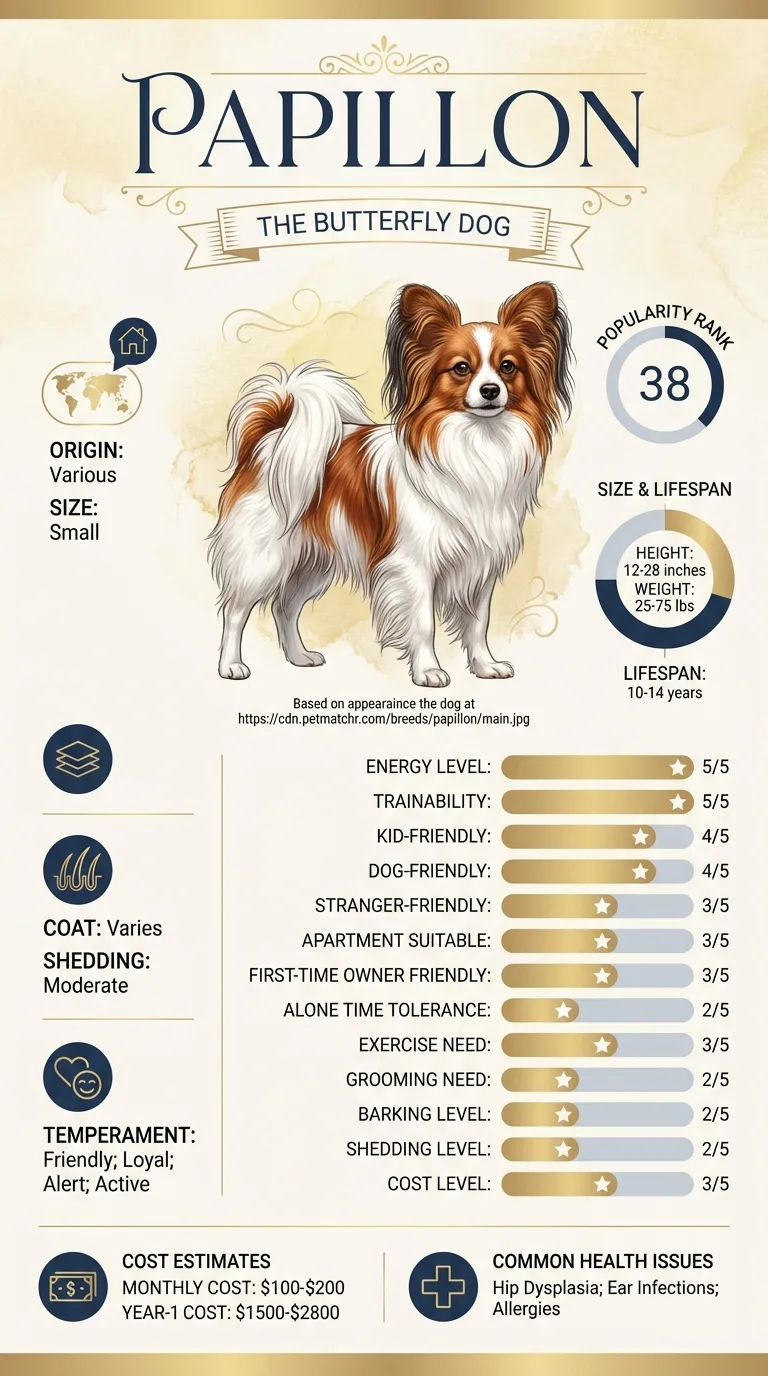
This affects owners who are blindsided by unusually prolonged bleeding after a routine procedure or minor injury, with no prior warning that their Papillon had any bleeding tendency at all.
This guide is not medical advice. If your dog shows pain, sudden behavior change, or worsening symptoms, consult a licensed veterinarian.
Some links may be affiliate links. We may earn a commission at no extra cost to you. We only suggest products we believe are helpful for dog owners.
We research and check what we publish, but we do not warrant that any figure, date, price, or statement is accurate, complete, or current, and we accept no liability for any loss, cost, injury, or other harm arising from the use of this site. Use it as one reference among several. You remain responsible for your own decisions and for your dog's care - confirm anything that matters with a licensed veterinarian or another qualified professional before you act on it. Full disclaimer.
Von Willebrand's disease is an inherited deficiency or malfunction of a protein needed for the earliest step of blood clotting. It produces no visible symptom in daily life, and most affected dogs are only identified when a real bleeding event, most commonly a spay, neuter, or dental procedure, causes bleeding that continues well past the normal stopping point. It is not among the Papillon's most prominently documented health issues, but it is a recognized condition genetic health panels for many small and toy breeds commonly screen for.
This condition is not listed among the Papillon's most prominently documented health issues, so breed-specific prevalence data is limited. It is recognized broadly enough across small and toy breeds that genetic screening panels commonly test for it, and any individual result should be discussed with a vet rather than assumed from breed reputation alone.
Von Willebrand's disease is inherited, tied to a specific gene variant affecting production or function of von Willebrand factor. It is not confirmed as a widely documented issue specifically in Papillons the way patellar luxation or progressive retinal atrophy are, but it is recognized broadly enough in small and toy breeds that it remains worth screening for individually.
The underlying clotting deficiency is not influenced by environment. What environment and circumstance determine is simply when the condition becomes visible, since it only shows itself through an actual injury or procedure serious enough to test the body's clotting ability.
Talk to a vet promptly about any bleeding, from a cut, a nail trim, or after a procedure, that continues well past what seems like a normal stopping time. If a procedure is already underway and bleeding will not stop, this becomes an urgent, same-visit conversation rather than something to monitor from home.
See all Papillon health problems, which breeds are prone to von willebrands disease, or the full Papillon breed guide for temperament, exercise needs and ownership costs.
A screening test result is typically available within days. Managing an actual bleeding event during surgery is handled in the moment by the surgical team, often adding time and cost to the procedure but rarely changing the overall outcome when caught and managed appropriately.
Success looks like a diagnosis known in advance of any planned procedure, so precautions can be taken proactively, rather than a surprise discovered mid-surgery.
Von Willebrand's disease is a deficiency or malfunction of von Willebrand factor, a protein the blood needs to help platelets stick together and start plugging a damaged blood vessel. Without enough functional factor, the earliest step of clot formation is weaker than it should be, so bleeding that would normally stop within a couple of minutes continues well past that.
This is different from a low platelet count, which affects the number of platelets available, and different from a broader clotting-factor deficiency affecting the later stages of clot formation. Von Willebrand's disease specifically slows the initial step where platelets stick to an injury site, which is why the classic sign is prolonged bleeding from a small, ordinary wound rather than large spontaneous bruising or internal bleeding without any obvious cause.
A dog can carry this condition for its entire life without ever showing a symptom, because ordinary daily life rarely produces the kind of injury that reveals it. The condition typically comes to light around a genuinely bleeding event: a nail trimmed slightly too short, a baby tooth falling out, and most commonly, a routine spay or neuter, where surgical bleeding that should stop within a normal window instead continues and prompts the surgical team to investigate.
Severity varies considerably between individual dogs, from a mild tendency that only shows up under real surgical stress to a more significant deficiency that causes visible problems from relatively minor injuries. This variability is part of why the condition is often discovered rather than anticipated: without a specific reason to test for it in advance, most owners and even many vets have no signal that a particular dog carries it until an actual bleeding event forces the question.
Because the condition hides until a real bleeding event exposes it, the most useful precaution is proactive screening before any planned procedure rather than waiting to discover it during one.

If you think your Papillon has von willebrand's disease, the plan is three steps: write down what you have seen and when it started, book a veterinary appointment rather than waiting for the next flare, and take video of the behaviour or symptom before you go — the thing you are worried about rarely happens in the consulting room. Screening in the parents covers patellar luxation, progressive retinal atrophy, dental disease.
What the vet visit should produce is a diagnosis and a written plan, not just reassurance: what is being ruled out, what the monitoring interval is, and which signs mean you come back sooner. Ask what the treatment costs across a year rather than per visit, because that is the number that decides whether you are managing this condition or reacting to it.
Between appointments, keep a short log — dates, what you saw, what changed. It is the single most useful thing an owner brings to a follow-up, and for von willebrand's disease it is often what separates a clear pattern from a guess.
Amara scheduled a routine spay for her young Papillon, Juno, expecting the same straightforward recovery she remembered from a previous dog. The surgery itself went as planned, but the incision site continued oozing well past the point the vet team expected it to have sealed, prompting them to run additional bloodwork mid-recovery. The results showed Juno had von Willebrand's disease, something no prior sign in her life had ever suggested. She had never had so much as a slow-healing scrape before this. The surgical team managed the bleeding with additional supportive care, and Juno recovered fully, though the extra day of monitoring and the additional testing added meaningfully to the cost and the stress of what Amara had expected to be a routine procedure. Looking back, Amara realized there had been no way to anticipate this without specifically screening for it in advance, since Juno had shown absolutely no symptoms in her first two years of life. She now keeps Juno's diagnosis prominently noted with every vet she sees and mentions it before any future procedure, however minor.
Key takeaway: Von Willebrand's disease frequently shows no sign at all until a real bleeding event exposes it, which is why proactive screening before a planned surgery is worth asking about even in a dog with no prior history of any bleeding problem.
A deficiency or malfunction of von Willebrand factor, a protein needed for platelets to stick together at the start of clot formation. It causes prolonged bleeding from injuries or procedures rather than spontaneous large bruising.
Most dogs show no signs at all until an actual bleeding event, commonly a spay, neuter, dental procedure, or a minor injury, causes bleeding that continues well past the normal window. A specific bleeding-time test or genetic test can confirm it in advance if there is any reason for concern.
It is not listed among this breed's most prominently documented health issues, but it is a recognized bleeding disorder that genetic health panels for many small and toy breeds, Papillons included, commonly screen for. An individual result should be discussed with your vet rather than assumed from breed reputation alone.
Through a specific blood test measuring von Willebrand factor activity, or through a genetic DNA test that identifies the associated variant, either before a planned procedure as a precaution or after an unexplained prolonged bleeding event.
No, it is a lifelong condition, but it is manageable. Dogs with a known diagnosis can be given special precautions before any surgery, and severe bleeding events can be treated with plasma products or specific medications when needed.
It is a reasonable precaution to ask your vet about, particularly if there is any family history of bleeding problems or if you simply want to rule it out before an elective surgery.
A screening test is a modest added cost to a routine vet visit. Managing an actual bleeding event, particularly one requiring plasma products during surgery, is considerably more, which is part of why proactive screening before a planned procedure is worth considering.
Bleeding from an ordinary small injury or procedure that continues well past the normal stopping time.
No, it causes no symptoms in daily life and only becomes apparent during an actual bleeding event.
Yes, a bleeding-time test or genetic test can screen for it proactively before any planned procedure.
No, it is lifelong, but it is manageable with precautions before surgery and treatment during a bleeding event if needed.
Considerably more than a proactive screening test, particularly if plasma products are needed during surgery, which is why testing beforehand is worth considering.
A one-page prep sheet for this condition: the signs, the questions to ask, what to get priced. Unlocks here.
You get: Vet visit prep sheet
No spam. One-click unsubscribe. See our privacy policy.
Preview page 1 before you decide.