Health
Why do Papillons overheat if they are not flat faced?
Because a five to ten pound body has almost no thermal mass, and at eight to eleven inches tall the dog is breathing the hot air radiating off pavement.

Quick answer
Why do Papillons overheat if they are not flat faced?
Because a five to ten pound body has almost no thermal mass, and at eight to eleven inches tall the dog is breathing the hot air radiating off pavement.
A five to ten pound dog has almost no thermal buffer. It heats up faster than you do and it does it closer to the ground.
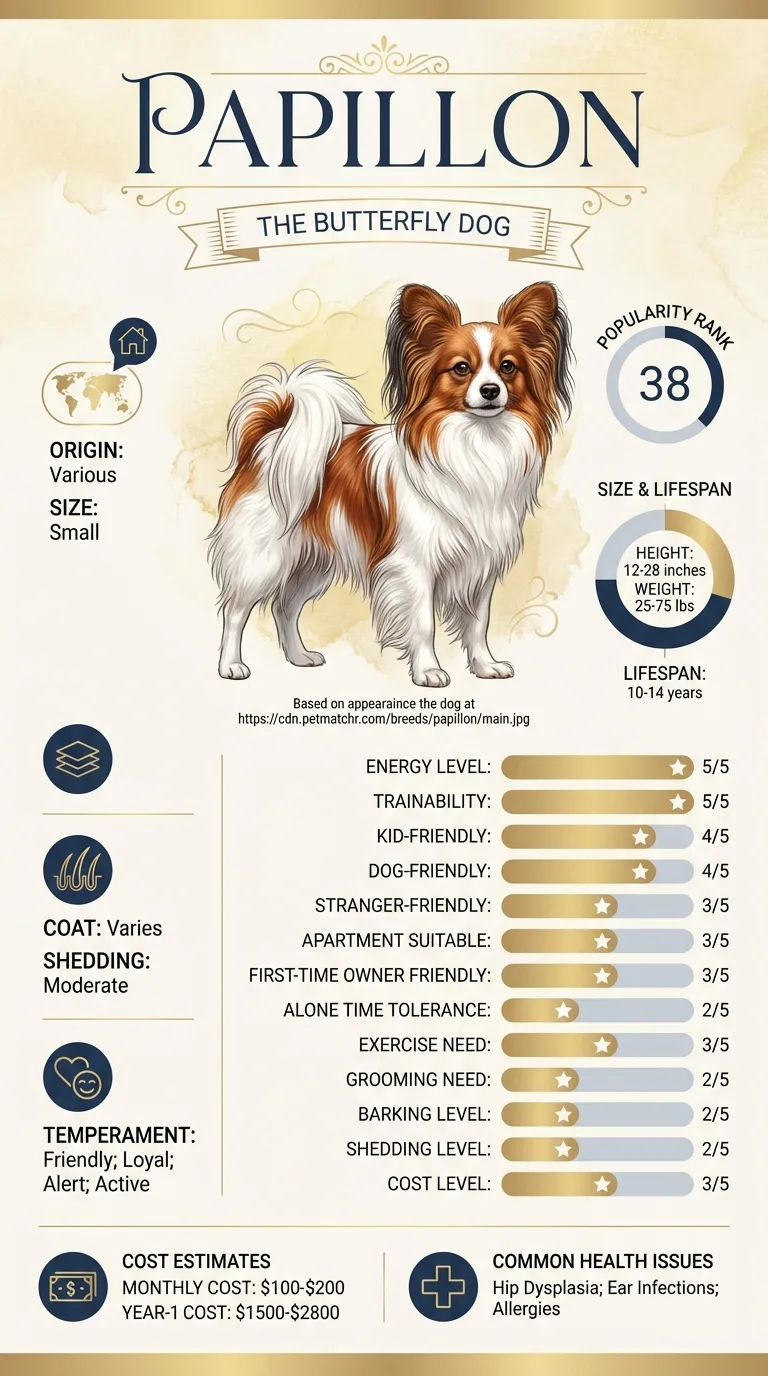
Owners in hot regions who cannot understand why a lively, sound breed struggles on summer afternoons, and anyone who has watched their Papillon quit halfway through a walk it managed easily in April.
This guide is not medical advice. If your dog shows pain, sudden behavior change, or worsening symptoms, consult a licensed veterinarian.
Some links may be affiliate links. We may earn a commission at no extra cost to you. We only suggest products we believe are helpful for dog owners.
We research and check what we publish, but we do not warrant that any figure, date, price, or statement is accurate, complete, or current, and we accept no liability for any loss, cost, injury, or other harm arising from the use of this site. Use it as one reference among several. You remain responsible for your own decisions and for your dog's care - confirm anything that matters with a licensed veterinarian or another qualified professional before you act on it. Full disclaimer.
Heat sensitivity in Papillons is a problem of scale rather than anatomy. The breed has a well proportioned muzzle and pants efficiently, but at five to ten pounds it holds almost no heat reserve, and at eight to eleven inches tall it lives inside the hottest layer of summer air. Owners typically notice it as a dog that suddenly refuses a familiar route, sits down in shade, or wants to be carried home.
Nearly every Papillon owner in a warm climate runs into this by the first proper summer. It is not a disease, it is a design constraint of a very small dog, and it is manageable with scheduling rather than medicine. What varies between individuals is mostly weight, age and whether the dog has any airway or cardiac issue on top.
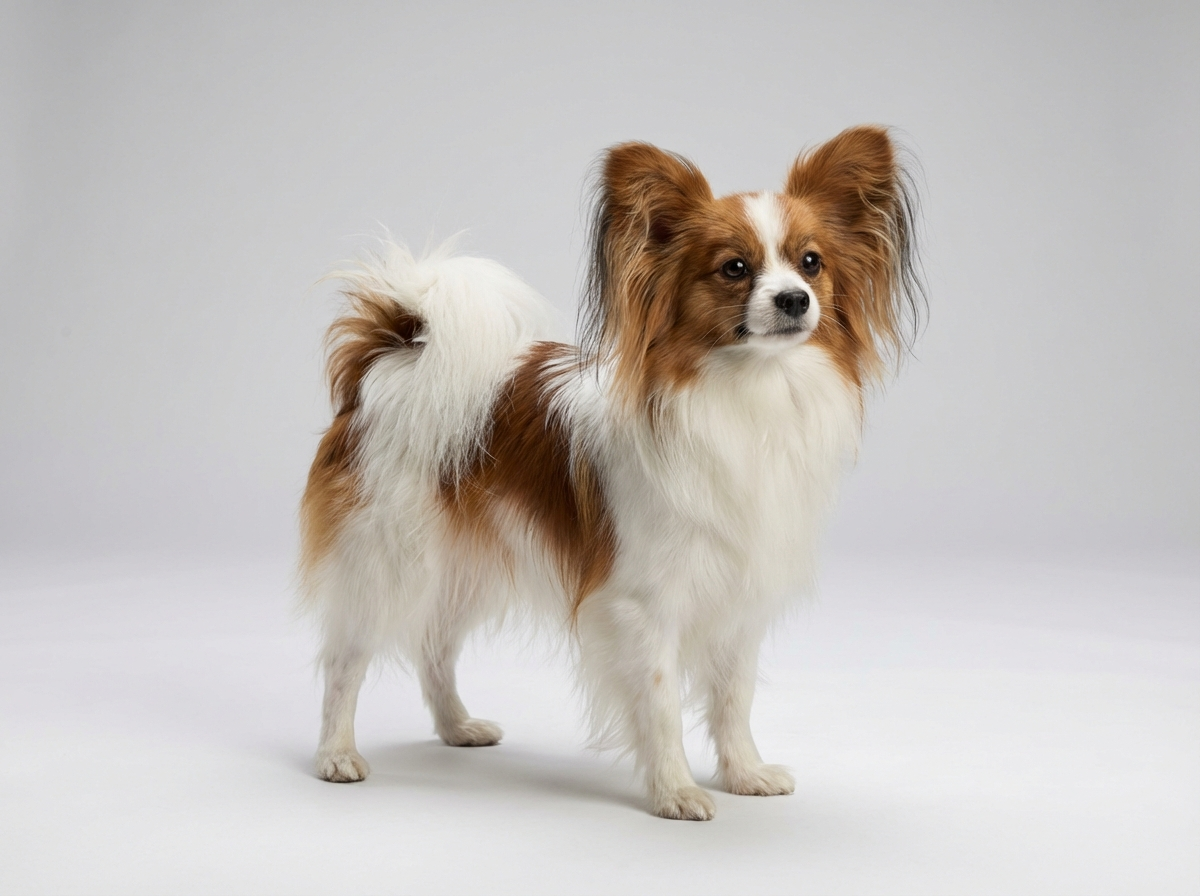
Papillons are among the smallest of the alert companion breeds, and small bodies exchange heat with the environment much faster than large ones because they carry more surface per unit of mass. The breed's low stature keeps it in the radiant heat layer above hard ground. Its long silky single coat lacks the dense undercoat that insulates in both directions, so heat reaches thin skin more directly, and the energy rating of four out of five means these dogs rarely stop themselves in time.
Urban surfaces are the biggest variable. Dark asphalt absorbs sunlight all day and re-radiates it into the evening, so a seven o'clock walk on a city street can be hotter at Papillon height than a four o'clock walk across grass. Humidity matters just as much as temperature, because evaporative cooling from panting stalls in damp air. Cars, balconies and glass fronted rooms create trapped heat far above the outdoor reading.
Contact a vet the same day if your Papillon has been out in the heat and is now weak, vomiting, unsteady, or has diarrhoea, even if it has cooled down and seems better. Heat injury can develop over the following hours. Treat frantic panting that does not settle in shade, bright red or very pale gums, drooling thick saliva, staggering or collapse as an emergency: begin cooling and get to a clinic immediately rather than waiting to see whether the dog improves.
None of these are careless. They are reasonable habits built around a human sized experience of the same weather.
See all Papillon health problems, which breeds are prone to heat sensitivity, or the full Papillon breed guide for temperament, exercise needs and ownership costs.
Heat sensitivity is permanent, because body size is permanent. What changes within one summer is your scheduling. Most owners find that after two or three weeks of shifted walk times and surface checking, the dog stops refusing walks entirely and the problem effectively disappears until the following June.
Success is a Papillon that finishes its walks happily all year, has never needed a heat related vet visit, and has a shaded, cool spot it takes itself to without being told.
The first is surface area relative to volume. A small animal has proportionally far more skin per unit of body mass than a large one. In cold weather that costs heat, which is why little dogs shiver first. In hot weather it works the other way: heat pours in across a large relative surface into a body that has very little mass to absorb it. A Labrador warming by one degree has to soak up several times the energy that a seven pound Papillon does. There is simply less dog to buffer the change.
The second is height. A Papillon stands eight to eleven inches at the shoulder, so its whole body sits inside the layer of superheated air that radiates off asphalt, concrete and sand. Air temperature at head height for you, on a summer afternoon, can be twenty degrees cooler than the air your dog is breathing. Dark paving on a clear day gets hot enough to hurt paw pads well before it feels alarming underfoot in shoes.
The long silky single coat is a mixed factor. It has no dense undercoat, so it traps less warm air than a double coated breed, but it also provides less of a sun barrier over thin skin, particularly along a light coloured back and the bridge of the nose.
Put those together and the practical rule is that a Papillon's summer walk is a different event from yours, happening in hotter air, over hotter ground, in a body with no reserve.

If you think your Papillon has heat sensitivity, the plan is three steps: write down what you have seen and when it started, book a veterinary appointment rather than waiting for the next flare, and take video of the behaviour or symptom before you go — the thing you are worried about rarely happens in the consulting room. Screening in the parents covers patellar luxation, progressive retinal atrophy, dental disease.
What the vet visit should produce is a diagnosis and a written plan, not just reassurance: what is being ruled out, what the monitoring interval is, and which signs mean you come back sooner. Ask what the treatment costs across a year rather than per visit, because that is the number that decides whether you are managing this condition or reacting to it.
Between appointments, keep a short log — dates, what you saw, what changed. It is the single most useful thing an owner brings to a follow-up, and for heat sensitivity it is often what separates a clear pattern from a guess.
Rafe walked his Papillon Nell the same eight hundred metre loop twice a day for two years without incident. In late June she began stopping dead at the corner shop, roughly a third of the way round, and refusing to go further. Rafe assumed she had hurt something. His vet found nothing on examination and asked what time he walked. Half past five, on a treeless street of dark paving that had been in direct sun since nine that morning. Rafe put his hand on the pavement outside the shop the next afternoon and could not hold it there. He moved the evening walk to nine o'clock and rerouted the morning one through a park. Nell has completed every walk since. The only equipment he bought was a folding water bowl.
Key takeaway: When a Papillon starts refusing a familiar summer route, check the ground before you check the dog. At eight to eleven inches tall, the walk you are taking and the walk it is taking are not the same walk.
Yes, but not for the reason usually given. They are not brachycephalic and their airway is well built for panting. Their sensitivity comes from very low body mass, a low standing height that puts them inside radiant heat off paving, and thin skin under a single layer coat. They cope worse than a mid sized dog in the same conditions.
There is no single number, because humidity, sun, wind and ground surface change the answer completely. A more useful test is the surface check and the shade check: if paving is uncomfortable on your palm, or if the whole route is in full sun, the walk should wait. Grass at dusk is a different world from midday concrete.
The breed sits at a moderate exercise requirement, and that requirement does not vanish in July, it relocates. Split walks into shorter early morning and post sunset outings, and move the mental work indoors. A Papillon is highly trainable, and fifteen minutes of trick work in air conditioning drains more energy than a hot slog.
Light coloured dogs, thin coated bellies and the bridge of the nose can burn. If your dog sunbathes on a patio, provide shade rather than relying on the coat, and ask your vet before applying any product to the skin. Many human sunscreens contain ingredients that are unsafe if a dog licks them off.
Cooling mats are useful and low risk. Wetted cooling vests can help but must be re-wetted, because a dry vest on a small dog becomes insulation. Watch that any garment does not press on the throat, since this breed already carries a tendency toward tracheal weakness.
Considerably. In a breed that lives fourteen to sixteen years, a lot of dogs face summers at twelve or thirteen with reduced cardiac reserve, stiffer joints and less efficient temperature regulation. Older Papillons need shorter, cooler outings and closer supervision than the same dog needed at four.
Because a five to ten pound body has almost no thermal mass, and at eight to eleven inches tall the dog is breathing the hot air radiating off pavement.
Early morning and after sunset, on grass or shaded routes. Test the ground with the back of your hand before you set off.
No. The single silky coat offers sun protection over thin skin, and shaving it can create sunburn without meaningfully improving cooling.
Not at all. This is a breed rated highly for apartment living, and a well air conditioned home with early and late outings suits it perfectly well.
A one-page prep sheet for this condition: the signs, the questions to ask, what to get priced. Unlocks here.
You get: Vet visit prep sheet
No spam. One-click unsubscribe. See our privacy policy.
Preview page 1 before you decide.