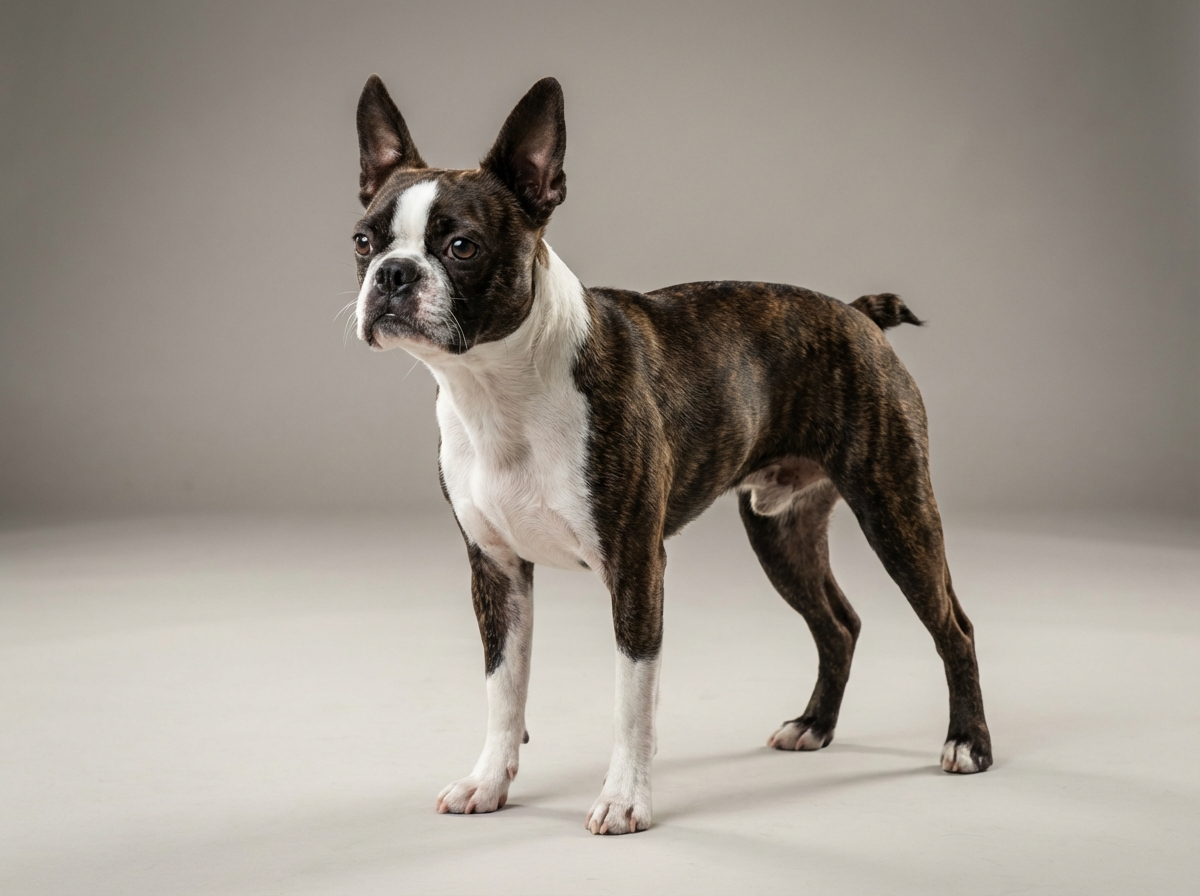
Living
Can Boston Terriers live in a hot climate?
Yes, with air conditioning and a schedule built around dawn and dusk. Without reliable indoor cooling, a hot humid climate is a poor match for this breed.

Quick answer
Can Boston Terriers live in a hot climate?
Yes, with air conditioning and a schedule built around dawn and dusk. Without reliable indoor cooling, a hot humid climate is a poor match for this breed.
A Boston can be in trouble on a day a Labrador finds pleasant. The margin is not small, and it closes fastest in humidity rather than in raw temperature.
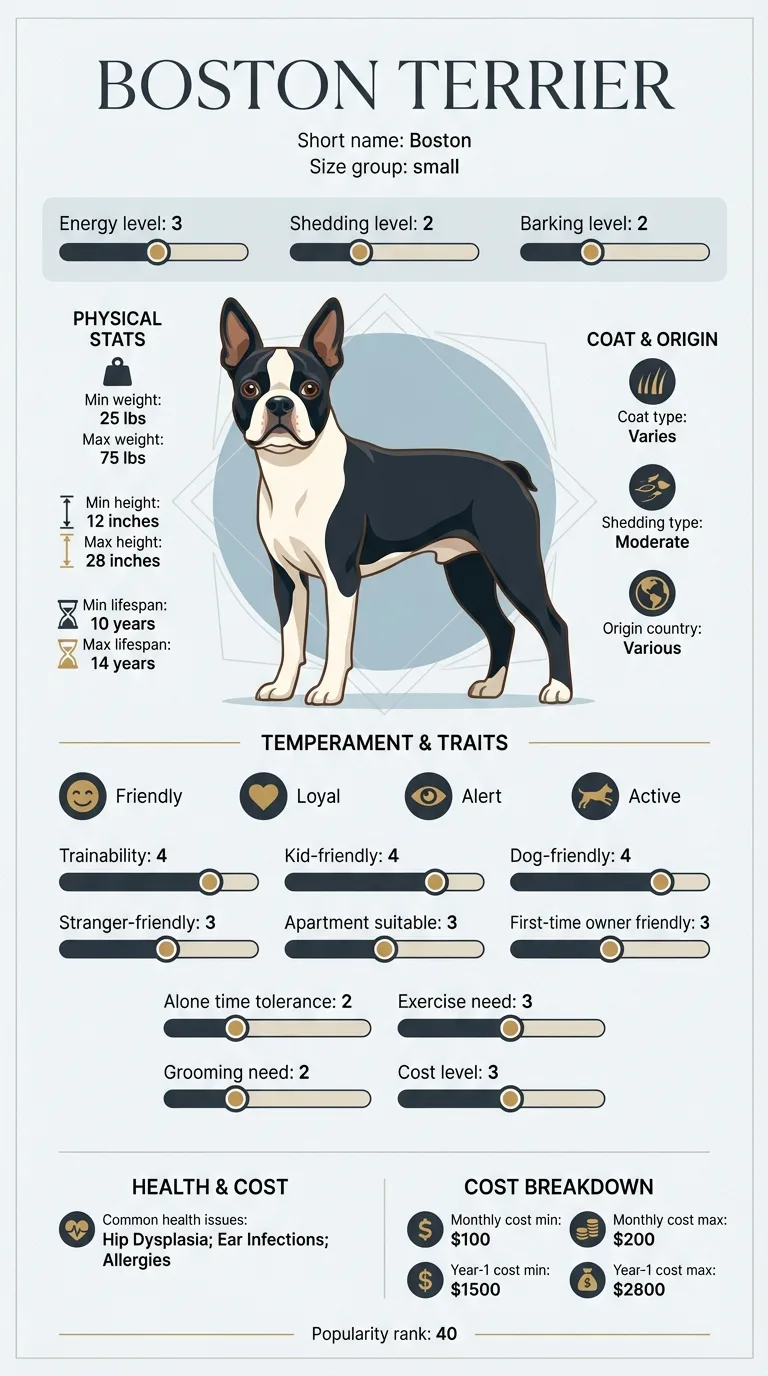
First-time Boston owners heading into their first summer, and anyone who has moved from a longer-muzzled breed and is still using their old rules about what counts as a hot day.
This guide is not medical advice. If your dog shows pain, sudden behavior change, or worsening symptoms, consult a licensed veterinarian.
Some links may be affiliate links. We may earn a commission at no extra cost to you. We only suggest products we believe are helpful for dog owners.
We research and check what we publish, but we do not warrant that any figure, date, price, or statement is accurate, complete, or current, and we accept no liability for any loss, cost, injury, or other harm arising from the use of this site. Use it as one reference among several. You remain responsible for your own decisions and for your dog's care - confirm anything that matters with a licensed veterinarian or another qualified professional before you act on it. Full disclaimer.
Heat sensitivity in a Boston Terrier is not a preference or a personality quirk. It is a structural limit on how fast the dog can shed heat, set by the shape of its head. Managing it is mostly a scheduling problem: deciding in advance which hours of a summer day are outdoor hours and holding that line even when the dog is asking to go.
Universal in the breed to some degree. Brachycephalic airway syndrome sits at the top of the Boston Terrier's documented health issues, and even dogs with no diagnosis and no surgery have less thermal headroom than a longer-muzzled dog of the same 12 to 25 pound size. Individual variation is wide, so two Bostons in the same household can have noticeably different limits.
Selective breeding shortened the Boston's facial bones without shortening the soft tissue inside proportionally. The result is a crowded nasal passage, often narrow nostrils, and a soft palate that can sit long relative to the space available. Air moving through that arrangement is turbulent and slow, which cuts evaporative cooling exactly when it is needed most. The breed's compact 12 to 25 pound body also has a modest surface area to shed heat passively.
Humidity is the biggest environmental multiplier, followed by radiant heat from hard surfaces and by still air with no breeze. Enclosed spaces without ventilation remove the only mechanism that helps. Excess body weight adds insulation and increases the muscular work of breathing. Excitement, unfamiliar dogs and travel stress all raise heat production before any exercise happens.
Go immediately, without calling ahead, if your Boston is panting frantically and cannot settle, has a bright red or bluish tongue, is drooling thick saliva, is unsteady on its feet, vomits after heat exposure, or collapses. Those are heatstroke signs and every minute counts. Book a routine appointment if your dog pants loudly at rest in a cool room, cannot complete a short cool-weather walk, snores heavily enough to disturb sleep, or seems to be losing heat tolerance year on year, since airway surgery is most useful when it is done before things become severe.
See all Boston Terrier health problems, which breeds are prone to heat sensitivity, or the full Boston Terrier breed guide for temperament, exercise needs and ownership costs.
A new summer routine takes about two weeks for a dog to accept without protest, and roughly one season for the owner to internalise. Improvements from weight loss show up within four to eight weeks. Nothing in husbandry changes the underlying anatomy, so expectations should be set around better management rather than better tolerance.
A summer with no emergency, no episode of frantic panting that would not settle, and a dog whose exercise happens at hours that keep it comfortable. If your Boston has severe anatomical obstruction, success may also include a surgical consultation rather than another season of careful avoidance.
Panting works by evaporation. Air drawn across moist surfaces carries water away, and that phase change takes heat with it. The drier the incoming air, the more water it can absorb and the more heat leaves with each breath.
When humidity is high, the incoming air is already close to saturated. Each pant now removes far less heat, so the dog pants faster and harder to compensate. In a Boston Terrier, panting harder means forcing more air through a passage that already resists flow, and the muscular work of doing that generates heat of its own. Past a certain point the effort produces more heat than the panting removes, and the dog is climbing rather than holding steady.
This is why 26 degrees Celsius on a dry day can be manageable while 24 degrees at 85 percent humidity is genuinely dangerous. Owners who go by temperature alone get caught out by exactly this.
Two other multipliers deserve naming. Ground radiation from asphalt and concrete can put the air at a small dog's nose height ten degrees above the reading on your phone. And excitement raises heat production before the walk has even started, which is why a Boston who spins at the door on a July morning begins the outing already behind.

None of this is complicated. It is a set of defaults that stop you making case-by-case judgements on a hot afternoon.
If you think your Boston has heat sensitivity, the plan is three steps: write down what you have seen and when it started, book a veterinary appointment rather than waiting for the next flare, and take video of the behaviour or symptom before you go — the thing you are worried about rarely happens in the consulting room. Screening in the parents covers brachycephalic airway syndrome (boas), patellar luxation, cataracts.
What the vet visit should produce is a diagnosis and a written plan, not just reassurance: what is being ruled out, what the monitoring interval is, and which signs mean you come back sooner. Ask what the treatment costs across a year rather than per visit, because that is the number that decides whether you are managing this condition or reacting to it.
Between appointments, keep a short log — dates, what you saw, what changed. It is the single most useful thing an owner brings to a follow-up, and for heat sensitivity it is often what separates a clear pattern from a guess.
Nell was three and had always been noisy in the heat, but the summer her family moved from a coastal town to an inland city was different. The temperatures were similar; the humidity was not. She began coming back from her usual half-past-eight walk unable to settle for forty minutes. Her owner Rachel did three things over one weekend. She moved the morning walk to twenty past five, which she hated for about a fortnight. She bought a Y-front harness and put the collar in a drawer. And she moved Nell's bed onto the kitchen tiles with a floor fan pointed at it. The evening walk became a nine o'clock walk. Afternoons became a snuffle mat and five minutes of trick training. Nell lost a pound over the season without a diet change, simply because the frantic recovery panting stopped. Rachel still gets up at five every July.
Key takeaway: Heat management in this breed is a schedule, not a product. The owners who cope best are the ones who decided the rules in June rather than negotiating them at two in the afternoon.
There is no single number, because humidity, sun and pavement all shift it. As a working default, plan around the low twenties Celsius in dry air and treat anything above that with humidity as an indoor day. Watch the dog rather than the forecast: loud, open-mouthed panting with a wide tongue is your ceiling, wherever the thermometer sits.
They can help, but only if used correctly. A wet vest cools by evaporation, so it works in dry air and does very little in humid air, where it can act as insulation instead. Shade, airflow and simply not going out in the heat outperform any garment.
No, and it is not necessary. The breed's coat is short and smooth with low shedding, and it provides some protection from direct sun on the skin. Heat leaves a dog through the airway, not through the coat, so clipping removes protection without improving cooling.
Swimming carries real risk in this breed. A short muzzle sits low in the water, the body is dense and not naturally buoyant, and a tiring Boston can get into difficulty fast. Shallow paddling pools with the dog standing, supervised, are a much better option than open water.
Panting is normal thermoregulation and also a stress response, so some is expected. What is not normal is loud, effortful panting at rest in a cool room, and that pattern points at the airway itself rather than the environment. It is worth a veterinary assessment.
Often, yes. Airway soft tissue can thicken over years of turbulent airflow, and older dogs tend to carry more weight and have less cardiac reserve. Many owners notice that the summer routine that worked at three needs to be stricter at eight.
Yes, with air conditioning and a schedule built around dawn and dusk. Without reliable indoor cooling, a hot humid climate is a poor match for this breed.
In genuinely hot weather, minutes rather than half hours, and only for toileting. Judge by the dog's breathing on return, not by a stopwatch.
Cool water is fine and encourages drinking. The old warning about ice causing bloat is not supported, though a very hot dog gulping large volumes at once is worth slowing down.
They can, in a closed room, a conservatory, a crate in direct sun, or a car. Never leave one in a parked vehicle even briefly, whatever the outside temperature reads.
A one-page prep sheet for this condition: the signs, the questions to ask, what to get priced. Unlocks here.
You get: Vet visit prep sheet
No spam. One-click unsubscribe. See our privacy policy.
Preview page 1 before you decide.