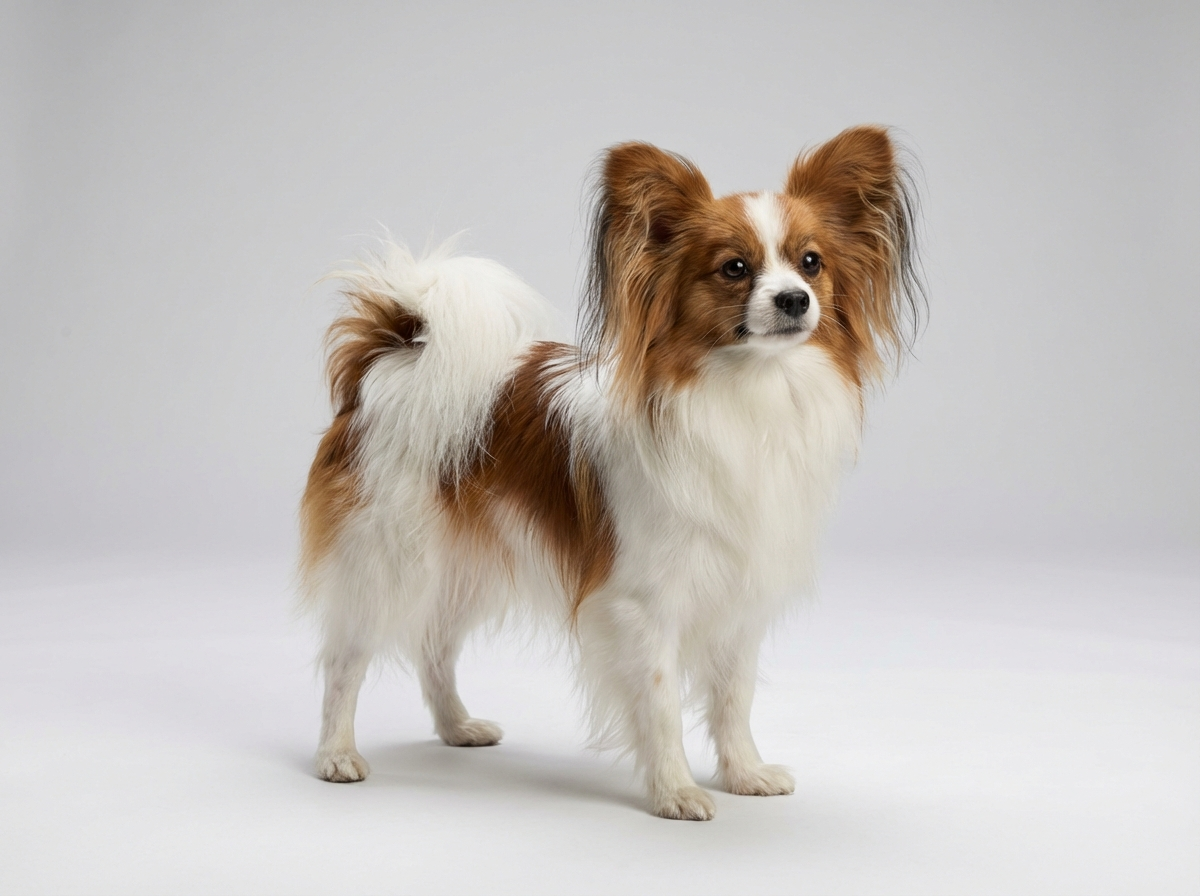
Health
What is the biggest bone risk to a Papillon puppy?
A forearm fracture from a fall or a jump out of someone's arms. The radius and ulna of a toy puppy are slender with a marginal blood supply, and these breaks are slow and difficult to heal.

Quick answer
What is the biggest bone risk to a Papillon puppy?
A forearm fracture from a fall or a jump out of someone's arms. The radius and ulna of a toy puppy are slender with a marginal blood supply, and these breaks are slow and difficult to heal.
A toy puppy's forearm bones are about the thickness of a pencil. The developmental risks that follow from that are nothing like a Great Dane's.
New owners of a Papillon puppy who have read large-breed growth advice and are trying to work out what applies, and anyone who has felt a soft spot on top of their puppy's skull and wants to know whether it is normal.
This guide is not medical advice. If your dog shows pain, sudden behavior change, or worsening symptoms, consult a licensed veterinarian.
Some links may be affiliate links. We may earn a commission at no extra cost to you. We only suggest products we believe are helpful for dog owners.
We research and check what we publish, but we do not warrant that any figure, date, price, or statement is accurate, complete, or current, and we accept no liability for any loss, cost, injury, or other harm arising from the use of this site. Use it as one reference among several. You remain responsible for your own decisions and for your dog's care - confirm anything that matters with a licensed veterinarian or another qualified professional before you act on it. Full disclaimer.
Growth problems in a Papillon are the small-dog kind: a skull plate that never fully closes, forearm bones fine enough to break from a household fall, growth plates that can be damaged before they close, and a kneecap groove that may develop too shallow. None of it resembles the rapid-growth cartilage disease that dominates large-breed puppy advice, and most of it is prevented by controlling height rather than controlling diet.
Open fontanel is common enough in this breed to appear on its documented health list, though it is usually of no consequence. Forearm fractures are a well-recognised toy-breed problem and account for a large share of first-year emergency surgery in small dogs. The large-breed developmental diseases owners read about are genuinely rare here.
Two documented breed features drive this page. The open fontanel is a direct entry on the Papillon's health list and reflects a skull that finishes differently from a larger dog's. Patellar luxation, also documented, is developmental in origin: the groove the kneecap runs in forms during growth, and in some toy dogs it forms too shallow. Around both sits a skeleton scaled for a five to ten pound adult, in which every long bone is slender and every growth plate is small enough that a modest injury can involve it.
Almost all of it is the household. Human furniture is a cliff for a puppy under six inches tall, and hard flooring turns every landing into an impact. Children and doorways account for most drops. The other environmental driver is the internet: large-breed puppy advice about controlled growth, joint supplements and calcium arrives confidently and is simply the wrong advice for a toy dog on a complete diet.
Seek same-day attention for any limp in a puppy, especially on a front leg after a fall, and for any leg the puppy will not put weight on at all. Toy-breed forearm fractures heal badly when treated late or improvised. Go immediately for a puppy that has taken a knock to the head and is dull, wobbly, circling, having a seizure or is unusually quiet, particularly if it has a known fontanel. Book a routine appointment for a puppy that skips on a hind leg, one that seems to have a bent or rotated forelimb as it grows, or one whose soft spot appears to be enlarging rather than shrinking.
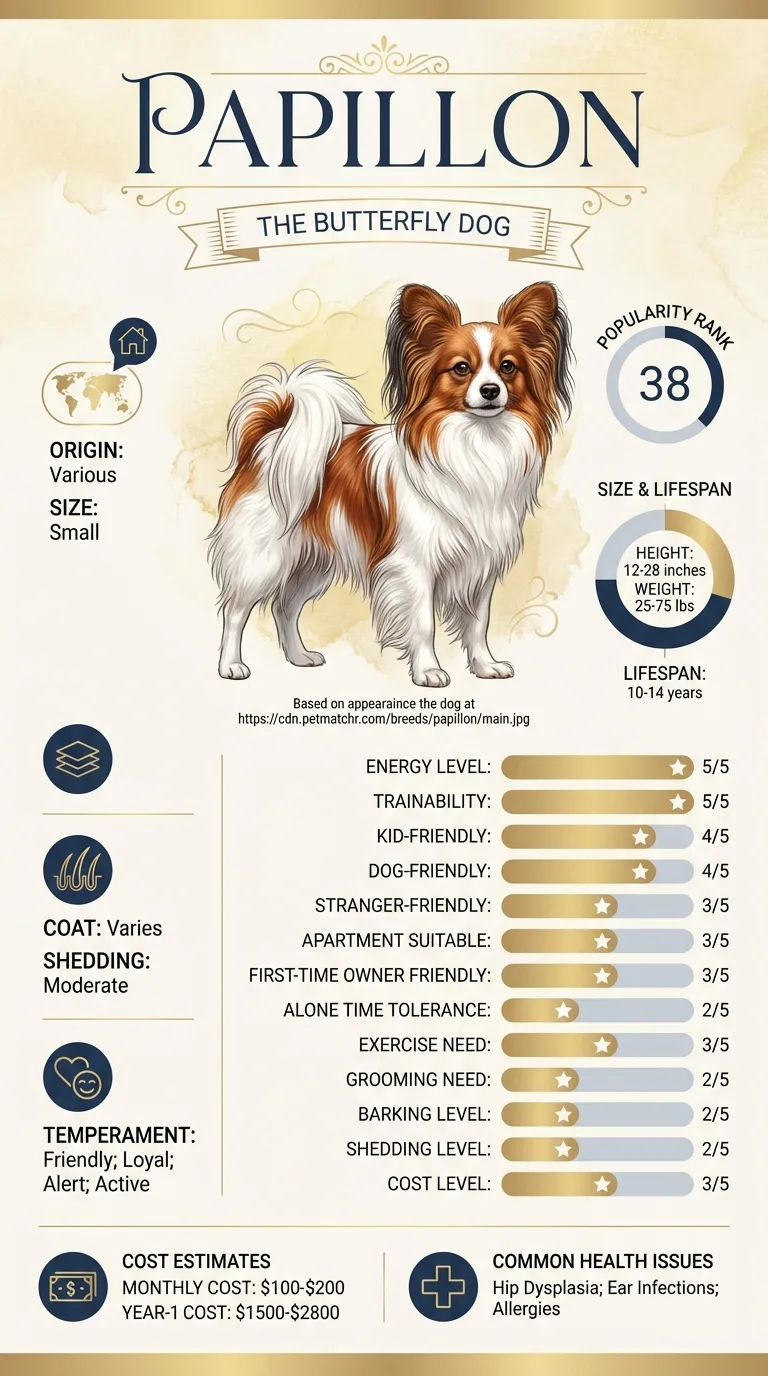
See all Papillon health problems, which breeds are prone to bone growth issues, or the full Papillon breed guide for temperament, exercise needs and ownership costs.
Height is largely settled by six to eight months and body condition by a year. Growth plates in the forearm close around the same time, which is when the fracture risk of puppyhood drops away. A repaired forearm fracture takes six to twelve weeks to heal in a toy dog, sometimes longer, with confinement throughout. An open fontanel that is going to close mostly does so within the first six months, and one that persists usually persists for life.
A yearling Papillon with four straight legs, an even trot, no history of a first-year fracture, and a documented note about its skull in the clinical file. Success also looks like an owner who never adopted large-breed growth advice, and a dog that uses a ramp to the sofa because it has never known any other way of getting up there.
An open fontanel sits on the Papillon's documented health list, and it is the one growth finding specific to this breed. In most dogs the plates of the skull fuse in the first months of life. In some toy dogs a gap at the top of the head, roughly where a human baby's soft spot is, narrows but never fully closes.
A small, persistent fontanel in an otherwise normal dog is common in toy breeds and is often of no clinical consequence at all. Many Papillons live full fourteen to sixteen year lives with one and nobody thinks about it again after the puppy check.
What it does mean practically is that a patch of brain is protected by skin and membrane rather than bone. That is worth knowing before a child carries the puppy, before rough play with a larger dog, and before any procedure where a small head is being positioned by someone who has not been told.
A large fontanel, or one that seems to be getting bigger, is a different conversation and should be assessed, since it can accompany other developmental problems.

If a Papillon puppy is going to break something, it will most likely be the radius and ulna, the paired bones of the forearm, and it will most likely happen indoors from a jump or a fall out of someone's arms.
These fractures are notorious in toy breeds for two reasons. The bones are slender, so there is little margin for a plate or a pin. And the blood supply to the lower part of the radius in a very small dog is sparse, which means these fractures heal slowly and sometimes fail to heal at all, leaving a non-union that needs further surgery.
This is the single strongest argument for the rules that sound fussy in a puppy's first year. No jumping off sofas. No being carried by a child who is standing up. No leaping from an adult's arms at the door. A dropped Papillon puppy is a genuine orthopaedic emergency, not a fright.
Growth plates in the forearm are also open until around six to eight months, and an injury through a plate can stop one bone growing while its partner continues, producing a bent limb.
If you think your Papillon has bone & growth issues, the plan is three steps: write down what you have seen and when it started, book a veterinary appointment rather than waiting for the next flare, and take video of the behaviour or symptom before you go — the thing you are worried about rarely happens in the consulting room. Screening in the parents covers patellar luxation, progressive retinal atrophy, dental disease.
What the vet visit should produce is a diagnosis and a written plan, not just reassurance: what is being ruled out, what the monitoring interval is, and which signs mean you come back sooner. Ask what the treatment costs across a year rather than per visit, because that is the number that decides whether you are managing this condition or reacting to it.
Between appointments, keep a short log — dates, what you saw, what changed. It is the single most useful thing an owner brings to a follow-up, and for bone & growth issues it is often what separates a clear pattern from a guess.
When Ewa collected her Papillon puppy, Pippa, the breeder gave her one instruction repeated three times: nobody holds this dog standing up until she is a year old. Ewa thought it excessive until her neighbour's toy-breed puppy fractured both forearm bones falling from a child's arms and needed two surgeries and eleven weeks of confinement after the first repair failed to unite. Pippa spent her first year with gates on the stairs, a pen when unsupervised, runners across the kitchen and a rule that visitors sat on the floor to meet her. She was measured at her puppy check with a small fontanel, noted in her file, which had closed by five months. She is now four, has never been lame, and still trots up the ramp to the sofa even though she could probably jump it.
Key takeaway: The whole of toy-breed growth management fits into one sentence: control the height your puppy can fall from. Diet, supplements and exercise regimes matter far less.
A small open fontanel is documented in this breed and is frequently harmless. It should be examined and recorded by your vet at the first check so you know its size, and it should not be enlarging. Ask for it to be noted in the file for any future procedure.
No, not without veterinary instruction. Adding calcium to a complete puppy food disturbs the mineral balance and can actively harm developing bone. This is one piece of large-breed folklore that does damage in every size of dog.
Most reach close to adult height by six to eight months and finish filling out by around a year. That is far faster than a giant breed, which is exactly why toy puppies do not face the slow-growth cartilage diseases those breeds do.
Free play on grass at the puppy's own pace, in short bursts, is ideal. What to avoid is repetitive forced exercise, long pavement walks, and jumping down from height. The risk in this breed is impact on fragile bone rather than overuse of joints.
Far less than in large breeds. Developmental elbow and hip disease is driven largely by body mass acting on growing cartilage, and a five to ten pound dog does not generate the loads involved. Neither appears on this breed's documented health list.
Urgent. A front-leg lameness in a toy puppy after a fall or jump should be treated as a possible fracture and seen the same day, because forearm fractures in small dogs do better with early, correct fixation than with anything improvised later.
A forearm fracture from a fall or a jump out of someone's arms. The radius and ulna of a toy puppy are slender with a marginal blood supply, and these breaks are slow and difficult to heal.
Usually not. A small persistent gap in the skull is common in toy breeds and often causes no problems at all. It should be measured, recorded and flagged before any procedure involving the head.
Surgical repair of a forearm fracture in a small dog commonly runs one to three thousand dollars, and a fracture that fails to unite can double that. It is the largest avoidable expense of a Papillon's first year.
Block access to furniture and stairs, lay non-slip runners on hard floors, and use a pen when unsupervised. The house, not the park, is where toy puppies break bones.
Yes, and start before it can. Teach a wait at the sofa edge and reward being lifted down, and provide a ramp. Papillons are exceptionally trainable and will learn the routine within a fortnight.
A one-page prep sheet for this condition: the signs, the questions to ask, what to get priced. Unlocks here.
You get: Vet visit prep sheet
No spam. One-click unsubscribe. See our privacy policy.
Preview page 1 before you decide.