Health
Is elbow dysplasia a Papillon problem?
No. It is a developmental disease of large and giant breeds driven by body mass acting on immature cartilage, and it is not on this breed's documented health list.

Quick answer
Is elbow dysplasia a Papillon problem?
No. It is a developmental disease of large and giant breeds driven by body mass acting on immature cartilage, and it is not on this breed's documented health list.
The forces that split cartilage in a growing Rottweiler's elbow simply do not exist in a puppy that will weigh nine pounds.
Owners whose Papillon is limping on a front leg and who have found large-breed orthopaedic pages, and anyone trying to work out which joint screening tests are genuinely relevant to a toy breed.
This guide is not medical advice. If your dog shows pain, sudden behavior change, or worsening symptoms, consult a licensed veterinarian.
Some links may be affiliate links. We may earn a commission at no extra cost to you. We only suggest products we believe are helpful for dog owners.
Elbow dysplasia covers a group of developmental faults in which the three bones of the elbow fail to grow in perfect proportion, leaving cartilage loaded unevenly until fragments break away. It causes front-leg lameness in dogs under a year old and leads to early arthritis. It is a disease of large, fast-growing breeds and is not part of the Papillon's picture.
Common enough in large breeds that formal screening schemes and breeding restrictions exist for them. Essentially absent in toy breeds, and not documented in Papillons. Front-leg lameness in a Papillon is a real and reasonably frequent complaint, but the diagnosis at the end of it is almost never this one.
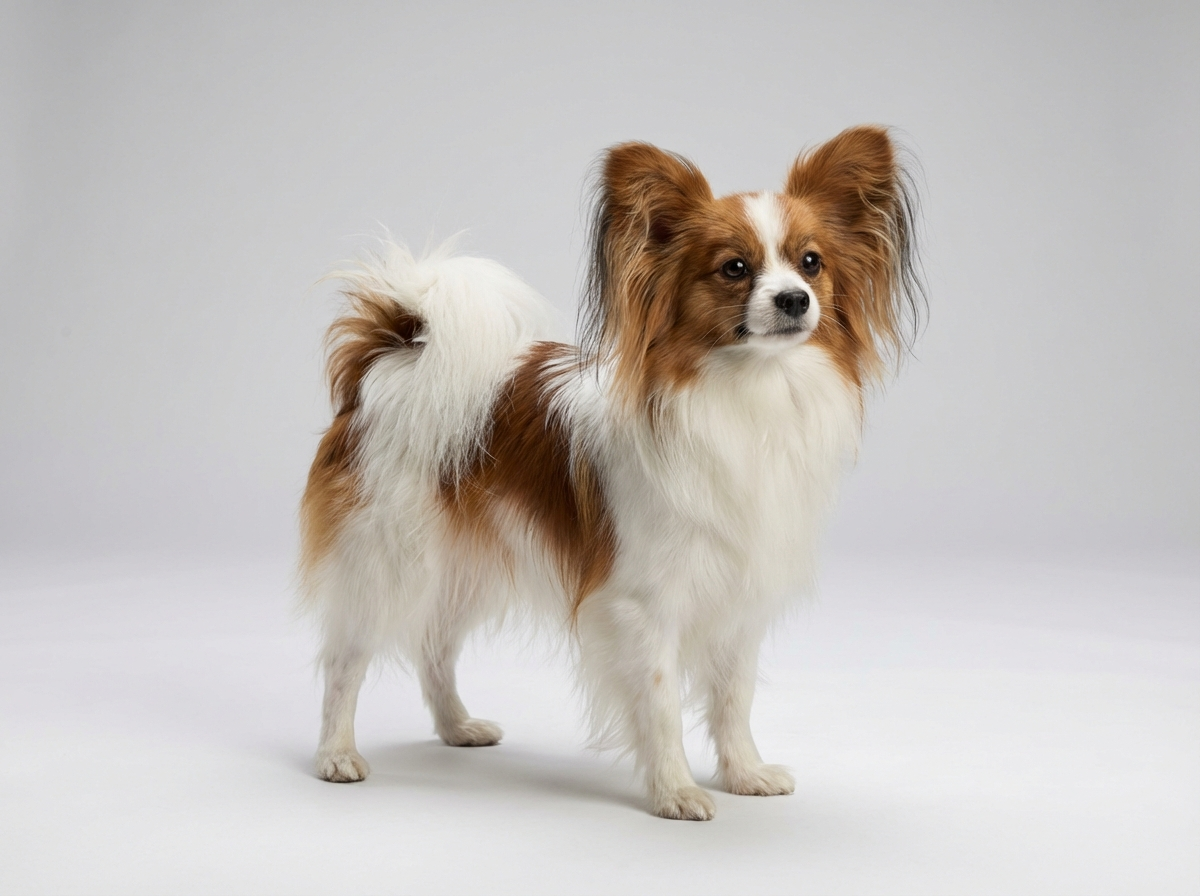
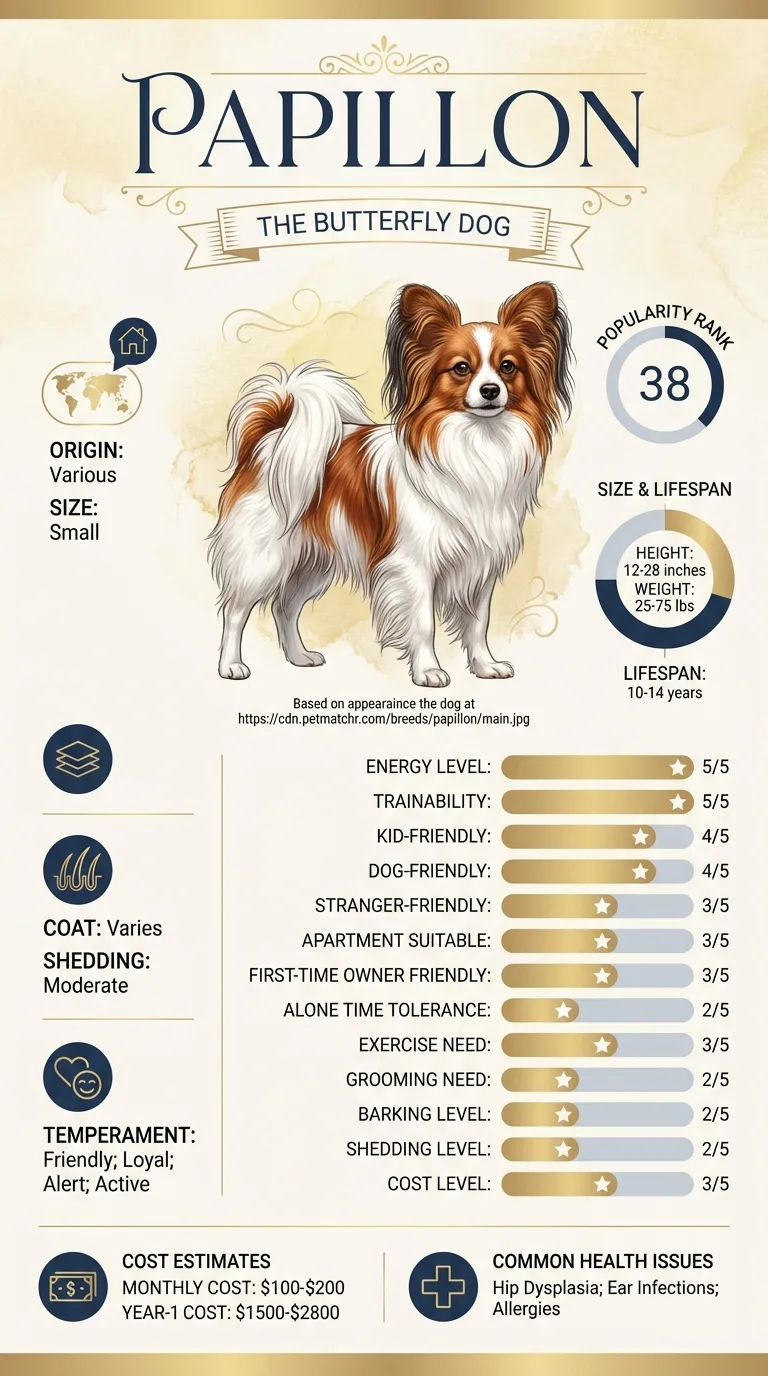
The Papillon is protected by the two things that matter most: mass and growth rate. An adult weighs five to ten pounds and stands eight to eleven inches, so the compressive load through any joint is a fraction of what a growing retriever generates. The breed also reaches close to adult size within months rather than over a long, heavy growth phase. Its documented orthopaedic problem sits in the knee instead, where the issue is a shallow groove rather than mismatched bone growth.
For large breeds the environmental levers are diet and exercise during growth. For a Papillon those levers point somewhere else entirely. What harms a toy puppy's forelimbs is height: the drop from a sofa, a bed or a person's arms onto a hard floor, which fractures slender radius and ulna bones with a poor blood supply. Slippery flooring compounds it by causing splayed, uncontrolled landings.
Seek same-day attention for a front leg your dog will not put down at all, for a limb that looks bent, swollen or is held at an odd angle, or for any lameness following a fall or a jump in a dog under a year old. Toy-breed forearm fractures heal poorly if managed late and are the reason front-leg lameness in a young Papillon is treated urgently. Book a routine appointment for a limp that has persisted more than a day or two, for stiffness after rest in an older dog, or for a leg that is being used but visibly favoured.
See all Papillon health problems, which breeds are prone to elbow dysplasia, or the full Papillon breed guide for temperament, exercise needs and ownership costs.
Investigating a front-leg lameness usually takes one appointment plus imaging, with an answer within a day or two. A soft-tissue strain settles within one to two weeks of rest. A fractured forearm in a toy dog takes six to twelve weeks to heal with confinement throughout, occasionally longer. Age-related elbow arthritis is managed indefinitely rather than resolved.
A correctly identified cause rather than a large-breed label. In practice that most often means a grass seed removed from between two toes, a torn nail trimmed, or a strained shoulder rested. Longer term, success is a Papillon that reaches adulthood without a first-year fracture, because the household controlled the height it could fall from.
Fragmented medial coronoid process is the commonest: a small piece of the ulna's inner rim cracks off and floats in the joint, grinding against cartilage. Ununited anconeal process describes a bony projection at the back of the joint that fails to fuse with the ulna during growth. Osteochondritis dissecans is a flap of cartilage on the humeral surface that separates from the bone beneath. Elbow incongruity is the underlying mismatch, where the radius and ulna have grown to slightly different lengths and the joint no longer fits.
They overlap and often occur together, and the end result is the same: a painful, arthritic elbow in a dog that is not yet a year old.
What unites them is load. Rapid growth in a heavy skeleton puts enormous compressive and shearing force through cartilage that has not yet turned to bone. That is why the condition is concentrated in Labradors, Rottweilers, German Shepherds, Bernese Mountain Dogs and Golden Retrievers, and why formal elbow scoring schemes exist for those breeds and not for toy ones.

Work from the ground up, because the further from the body you go, the more likely the answer is.
Start at the foot. A torn or overgrown nail, a cut pad, a grass seed between the toes or an interdigital infection accounts for a large share of sudden front-leg lameness and is easy to miss under coat feathering. Check every toe individually and look between the pads.
Then the forearm bones. In a young toy dog a fracture of the radius and ulna from a jump or a fall is a real and specific risk, and it is the single most important diagnosis not to miss.
Then the shoulder, where soft-tissue strain and biceps tendon problems occur in dogs of any size.
Only then the elbow, and in this breed an elbow problem is more likely to be a knock, a strain or, in an old dog, ordinary arthritis than a developmental malformation.
A limp that has lasted more than a day or two in any dog deserves examination rather than watchful waiting.
If you think your Papillon has elbow dysplasia, the plan is three steps: write down what you have seen and when it started, book a veterinary appointment rather than waiting for the next flare, and take video of the behaviour or symptom before you go — the thing you are worried about rarely happens in the consulting room. Screening in the parents covers patellar luxation, progressive retinal atrophy, dental disease.
What the vet visit should produce is a diagnosis and a written plan, not just reassurance: what is being ruled out, what the monitoring interval is, and which signs mean you come back sooner. Ask what the treatment costs across a year rather than per visit, because that is the number that decides whether you are managing this condition or reacting to it.
Between appointments, keep a short log — dates, what you saw, what changed. It is the single most useful thing an owner brings to a follow-up, and for elbow dysplasia it is often what separates a clear pattern from a guess.
Iris arrived at the clinic convinced her eight-month-old Papillon, Robin, had a joint disease. He had been limping on his right front leg for four days and she had read about elbow dysplasia the night before. The vet asked what he had been doing when it started. A walk through a hayfield, four days earlier. Robin's foot was examined before anything else. Parting the feathering between the third and fourth toes revealed a small swollen tract with a grass awn just visible at its opening. It came out with forceps under a local, and the space was flushed. He was sound within three days. Iris now runs her fingers between every pair of toes after any summer walk, and it takes her about twenty seconds per foot.
Key takeaway: In a small long-coated dog, the foot is where front-leg lameness hides. Check every toe before you start reading about joints.
It is not documented in the breed and is not a condition vets expect in toy dogs. Elbow dysplasia does not appear on the Papillon's health list, which covers patellar luxation, progressive retinal atrophy, dental disease, an open fontanel and a collapsing trachea.
Formal elbow scoring schemes exist for breeds where the condition is prevalent, and this is not one of them. Screening effort in this breed goes into eye testing for progressive retinal atrophy and into assessment of the kneecaps.
Because the disease is fundamentally about force on immature cartilage. Compressive forces through a joint scale with body mass, and a large-breed puppy grows faster and heavier than its cartilage can safely mature. A Papillon reaches adult size at five to ten pounds within months.
Check the foot carefully first, including between every pair of toes and the nails. Then have it examined the same day if the leg is not being used at all, since a forearm fracture in a toy puppy is a genuine possibility and does badly when treated late.
Yes, but usually as ordinary age-related joint degeneration or following an injury, rather than as the developmental disease. In a breed living fourteen to sixteen years, some arthritic change in various joints is expected in the final third of life.
There is no good reason to give them to a healthy toy-breed puppy on a complete diet. The growth-related joint concerns they are marketed for belong to large breeds, and adding minerals to a balanced puppy food can do harm rather than good.
No. It is a developmental disease of large and giant breeds driven by body mass acting on immature cartilage, and it is not on this breed's documented health list.
The foot. Nails, pads, the spaces between the toes and any grass seed account for a large share of sudden front-leg lameness and are hidden by coat feathering.
An examination with sedated radiographs of the limb typically runs three to six hundred dollars. Referral for advanced imaging, rarely needed in this breed, runs into the low thousands.
Control the height it can fall from. Block sofas and stairs, insist visitors and children sit on the floor to hold it, and lay non-slip runners on hard flooring.
Yes. Teaching a wait at furniture edges, calm greetings and voluntary ramp use removes most of the moments in which a small dog lands badly on a front leg.
A one-page prep sheet for this condition: the signs, the questions to ask, what to get priced. Unlocks here.
You get: Vet visit prep sheet
No spam. One-click unsubscribe. See our privacy policy.
Preview page 1 before you decide.