Costs
What's the biggest single claim risk for this breed?
Bloat surgery tends to generate the largest individual emergency claims, given the breed's large, deep-chested build.

Quick answer
What's the biggest single claim risk for this breed?
Bloat surgery tends to generate the largest individual emergency claims, given the breed's large, deep-chested build.
Reputation tells you what a breed is known for; claims data tells you what actually shows up on the invoice.
Prospective owners deciding whether pet insurance is worth the premium for this breed, and current owners trying to understand which conditions are worth budgeting an emergency fund around.
This guide is not medical advice. If your dog shows pain, sudden behavior change, or worsening symptoms, consult a licensed veterinarian.
Some links may be affiliate links. We may earn a commission at no extra cost to you. We only suggest products we believe are helpful for dog owners.
We research and check what we publish, but we do not warrant that any figure, date, price, or statement is accurate, complete, or current, and we accept no liability for any loss, cost, injury, or other harm arising from the use of this site. Use it as one reference among several. You remain responsible for your own decisions and for your dog's care - confirm anything that matters with a licensed veterinarian or another qualified professional before you act on it. Full disclaimer.
Insurance claims data for this breed track closely with its own documented health record, with orthopedic conditions like hip dysplasia, eye conditions like cataracts, thyroid disease, and emergency bloat surgery as the recurring categories generating the most frequent and highest-value claims. Understanding this pattern helps owners target prevention and budgeting rather than relying on general breed reputation alone.
Claims tied to this breed's documented conditions, orthopedic, ocular, and endocrine issues, appear frequently enough in aggregated insurance data to be considered a predictable pattern rather than a rare exception, making proactive budgeting genuinely useful for most owners.
This breed's own documented health record, hip dysplasia, cataracts, hypothyroidism, and bloat risk from a large frame, directly explains why these same categories dominate insurance claims data rather than claims being spread evenly across unrelated conditions.
How quickly a dog eats, whether it exercises heavily right after meals, and general weight management all influence bloat risk specifically, while overall preventive care consistency affects how early, and how cheaply, orthopedic and eye conditions get caught.
Any sudden, unproductive retching, a visibly distended abdomen, or restlessness and pacing after a meal should be treated as a possible bloat emergency requiring immediate veterinary care, not a wait-and-see approach, given how quickly that condition can become life-threatening.
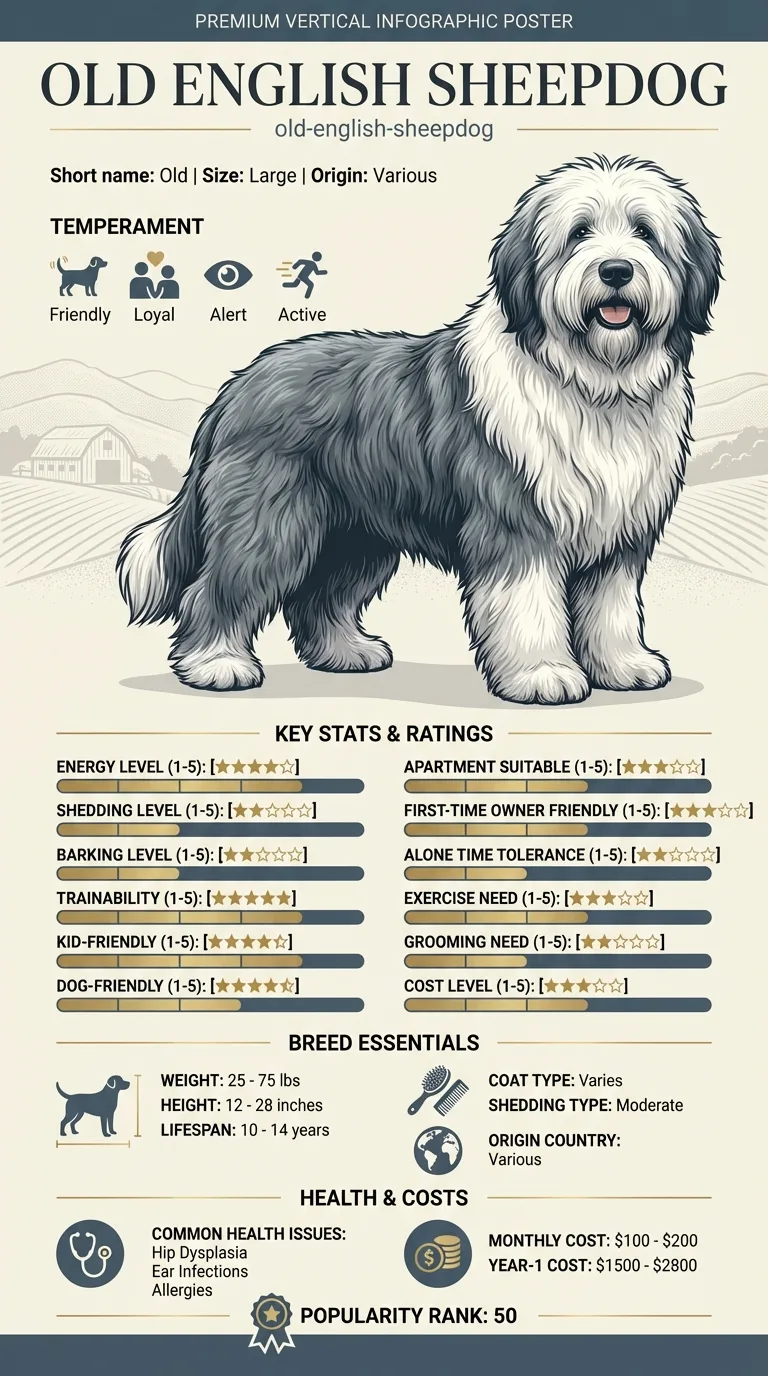
See all OLD English Sheepdog health problems, which breeds are prone to insurance claims, or the full OLD English Sheepdog breed guide for temperament, exercise needs and ownership costs.
Claims patterns tend to shift with age, orthopedic and eye claims becoming more frequent from middle age onward, while bloat risk is a lifelong concern from adulthood on given the breed's body shape. Budgeting should reflect this shifting risk profile rather than a flat assumption across all life stages.
Success looks like having either insurance or dedicated savings in place before a major claim-worthy condition arises, so a diagnosis becomes a manageable expense rather than a financial emergency layered on top of a medical one.
Orthopedic claims, driven largely by hip dysplasia and related joint issues, tend to be among the most frequent and highest-value claims filed for large breeds generally, and this breed's documented predisposition to hip dysplasia puts it squarely in that pattern. Eye conditions, particularly cataract-related claims, are the second recurring category given this breed's documented eye issues. Endocrine claims for thyroid disease are common but individually less expensive than orthopedic or emergency surgical claims. The single largest individual claims, when they occur, tend to come from bloat, or gastric dilatation-volvulus, an emergency surgical condition that can run into the thousands of dollars for a single incident and is a real risk for any large, deep-chested breed.
Claims data is most useful not as a reason to avoid the breed, but as a guide for exactly where to focus a wellness and prevention budget. Knowing that orthopedic and eye conditions dominate claims for this breed means annual eye exams and hip-conscious weight management aren't optional extras, they're targeted prevention against the categories most likely to generate a large bill. Similarly, knowing bloat generates the single largest emergency claims means learning the warning signs and having an emergency vet's contact information ready matters more for this breed than it might for a small, barrel-chested dog with essentially no bloat risk at all.

Carlos enrolled his Old English Sheepdog puppy Bristle in pet insurance at twelve weeks old, mostly out of general caution rather than any specific concern. At three years old, Bristle needed surgery for a luxating patella, a claim that came in just under two thousand dollars and was largely reimbursed. Two years later, a sudden bloat episode sent Bristle into emergency surgery overnight, a bill that topped five thousand dollars once monitoring and follow-up care were included. Because Carlos had enrolled early, both conditions were covered without any pre-existing exclusion complications, and having insurance in place meant the decision to proceed with emergency surgery didn't have to wait on finding the cash first.
Key takeaway: Enrolling before any condition was diagnosed turned two of this breed's most commonly claimed conditions from potential financial crises into manageable, mostly reimbursed bills for Carlos.
Orthopedic issues like hip dysplasia, eye conditions like cataracts, thyroid disease, and emergency bloat surgery are the recurring categories that show up most often and at the highest individual claim values.
Given the breed's documented predisposition to several conditions that can generate large individual bills, particularly orthopedic surgery and emergency bloat treatment, many owners find insurance or a dedicated emergency fund genuinely worthwhile rather than optional.
Bloat, or gastric dilatation-volvulus, tends to generate the largest individual emergency claims when it occurs, since it requires immediate surgery and intensive post-operative monitoring.
Generally no, most insurers exclude conditions diagnosed before the policy started, which is why getting coverage early, ideally as a puppy before any joint issues are diagnosed, matters for maximizing its usefulness.
Many owners of large breeds with bloat risk aim for at least a few thousand dollars in accessible emergency savings, roughly in line with what a single bloat surgery or major orthopedic procedure can cost.
Yes, given this breed's documented predisposition to cataracts, eye-related claims for exams, monitoring, and potential surgery show up as a recurring category, though usually at a lower cost per claim than orthopedic or emergency surgical procedures.
Yes, breeds with documented predispositions to costly conditions like this one's combination of joint, eye, and bloat risk typically carry higher premiums than breeds with a lower documented claims profile.
Bloat surgery tends to generate the largest individual emergency claims, given the breed's large, deep-chested build.
Coverage varies by policy, but conditions diagnosed before enrollment are typically excluded, making early enrollment more valuable.
Orthopedic surgery, cataract-related eye care, and bloat are the recurring categories worth planning for financially in this breed.
Individually, thyroid disease claims tend to be less costly than orthopedic or emergency surgical claims, though the ongoing monitoring adds up over a dog's life.
Enrolling as a puppy, before any conditions are diagnosed, generally maximizes coverage usefulness since most insurers exclude pre-existing conditions.
A one-page prep sheet for this condition: the signs, the questions to ask, what to get priced. Unlocks here.
You get: Vet visit prep sheet
No spam. One-click unsubscribe. See our privacy policy.
Preview page 1 before you decide.