Behavior
Which is the better overall choice?
It comes down to your schedule: the OES suits an owner with grooming time and moderate exercise expectations, the Vizsla suits an owner with hours of daily activity to give.

Quick answer
Which is the better overall choice?
It comes down to your schedule: the OES suits an owner with grooming time and moderate exercise expectations, the Vizsla suits an owner with hours of daily activity to give.
Old English Sheepdog or Vizsla? On paper they differ most on grooming need, and on the scales Old English Sheepdog is the heavier at 60–100 lbs. Here is how the two compare on everything that shapes an ordinary week.
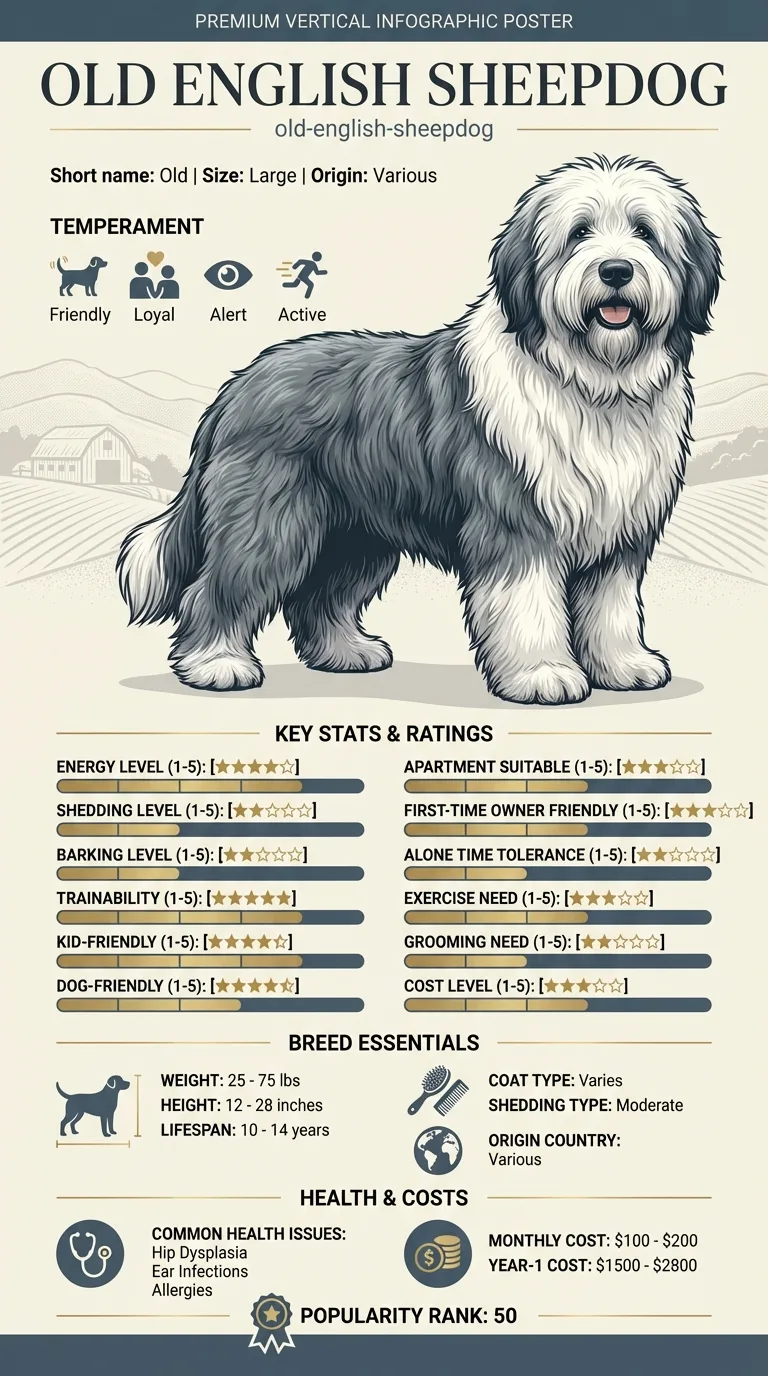
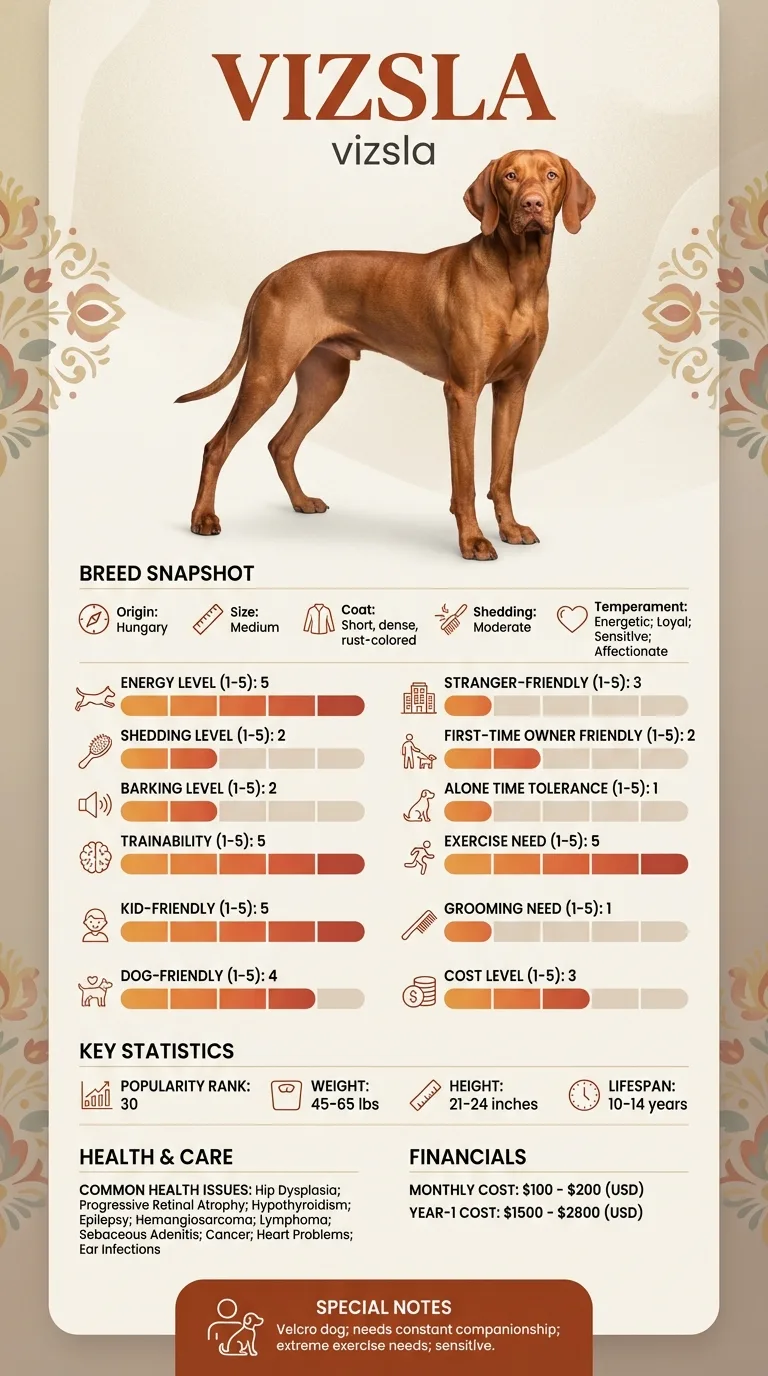
This is for someone already down to Old English Sheepdog and Vizsla and deciding between them. For this pair the decision usually turns on grooming need and exercise need, so those are covered first and in most detail. Anyone choosing from a flat has a clear answer here: Old English Sheepdog rates 2/5 against 1/5. It is written for the decision rather than the breed history.
Between Old English Sheepdog and Vizsla, grooming need is what separates them; neither is the lower-effort dog overall.
Choose Old English Sheepdog if your walking routine is modest.
Choose Vizsla if you do not want a standing grooming appointment, shedding is a problem in your house and you want a dog that picks up training quickly.
| Feature | old english sheepdog | vizsla | Winner |
|---|---|---|---|
| Size class | large | medium | Equal |
| Weight | 60–100 lbs | 45–65 lbs | Equal |
| Height | 20–24 in | 21–24 in | Equal |
| Lifespan | 10–12 years | 10–14 years | vizsla |
| Exercise need | Moderate (3/5) | Very high (5/5) | old english sheepdog |
| Grooming need | Very high (5/5) | Very low (1/5) | vizsla |
| Shedding | High (4/5) | Low (2/5) | vizsla |
| Energy level | Moderate (3/5) | Very high (5/5) | Equal |
| Barking | Moderate (3/5) | Low (2/5) | vizsla |
| Apartment suitability | Low (2/5) | Very low (1/5) | old english sheepdog |
| Good for first-time owners | Low (2/5) | Low (2/5) | Equal |
| Tolerates being alone | Low (2/5) | Very low (1/5) | old english sheepdog |
| Trainability | Moderate (3/5) | Very high (5/5) | vizsla |
| Good with kids | Very high (5/5) | Very high (5/5) | Equal |
| Good with other dogs | High (4/5) | High (4/5) | Equal |
| Friendly to strangers | High (4/5) | Moderate (3/5) | old english sheepdog |
| Cost level | High (4/5) | Moderate (3/5) | vizsla |
| Coat | Long, shaggy double coat | Short, dense, rust-colored | Equal |
| Origin | Various | Hungary | Equal |
| Typical monthly cost | $110–$240 | $100–$200 | Equal |
| Typical first-year cost | $1,700–$3,200 | $1,500–$2,800 | Equal |
An Old English Sheepdog carries 60 to 100 pounds under that shaggy double coat, standing 20 to 24 inches at the shoulder. A Vizsla is built leaner: 45 to 65 pounds, 21 to 24 inches tall — nearly the same height, noticeably lighter frame. Both land in the same general size bracket on paper, but the OES reads as a bulkier, denser dog day to day, while the Vizsla is more greyhound-shaped under its short coat.
This is where the two split hard. The OES sits at moderate exercise need (3/5) and moderate energy (3/5) — a couple of solid walks satisfy it. The Vizsla rates very high on both (5/5), and that number undersells it; Vizslas were bred to run alongside horses and hunt all day, so a fenced yard and a leash walk won't cut it. If your week doesn't include real running time, the Vizsla will find its own outlets, usually destructive ones.
The OES's coat is the whole ballgame here: very high grooming need (5/5) and high shedding (4/5) from that long, shaggy double coat, which mats fast without regular brushing and professional trims. The Vizsla is close to the opposite extreme — very low grooming (1/5) and low shedding (2/5), a wash-and-go short coat. If brushing isn't something you enjoy doing several times a week, the Vizsla is the easier animal to keep looking presentable.
Neither breed scores well for apartment life — the OES rates low (2/5), the Vizsla very low (1/5) — but for different reasons. The OES's bulk makes small spaces feel smaller. The Vizsla's issue is more about needing to move: it also rates very low (1/5) on tolerating being alone, worse than the OES's low (2/5), and is known for anxiety when left without company. Barking runs moderate for the OES (3/5) and low for the Vizsla (2/5).
Both breeds rate low (2/5) for first-time owners, so neither is a beginner's dog, but the reasons differ. The OES is only moderately trainable (3/5) and needs a handler who'll stay consistent with its grooming routine as much as its manners. The Vizsla trains at a very high level (5/5) — it's smart and eager to work with you — but that same intelligence paired with 5/5 energy means an inexperienced owner can get outpaced fast.
Both breeds are rated very high with kids (5/5) and high with other dogs (4/5), so a multi-pet household with children isn't a dealbreaker for either. The gap shows up with visitors: the OES is rated high for friendliness to strangers (4/5) while the Vizsla comes in at moderate (3/5), reflecting its more sensitive, one-family temperament versus the OES's easier, watchful sociability.
The Vizsla's lifespan edges out the OES's — 10 to 14 years against 10 to 12. Both share hip dysplasia and hypothyroidism as known risks. Beyond that they diverge: the OES carries bloat risk and a rarer respiratory condition, while the Vizsla's list runs longer and includes several cancers — hemangiosarcoma and lymphoma among them — plus epilepsy and heart problems, worth a conversation with a vet or breeder before committing.
Cost level runs high (4/5) for the OES against moderate (3/5) for the Vizsla, and the monthly figures back that up: $110–$240 for the OES versus $100–$200 for the Vizsla, with first-year costs of $1,700–$3,200 against $1,500–$2,800. Most of that OES premium is grooming — regular professional coat maintenance adds up in a way a wash-and-go Vizsla doesn't. Food costs should land closer together, since the two breeds' weights aren't far apart.
Old English Sheepdog weighs 60–100 lbs and lives 10–12 years; Vizsla weighs 45–65 lbs and lives 10–14 years. The two diverge most on grooming need, exercise need and energy level and 2 other rated axes. They are level on good with other dogs, good for first-time owners and good with kids, so those cannot decide it. In the table, a "winner" means easier for an ordinary household — not better. Size, coat and origin are recorded without a verdict. Because both breeds are scored the same way, the gaps are reliable even where the absolute numbers are rough.

The OES is heavier — 60 to 100 pounds versus the Vizsla's 45 to 65 — even though their heights are close (20–24 in vs 21–24 in). The OES's coat also makes it look bulkier than it already is.
The Vizsla, by a clear margin — it rates low (2/5) on shedding against the OES's high (4/5), and its short coat needs very little grooming (1/5) compared to the OES's very high (5/5) grooming demand.
Not really — both rate low (2/5) for first-time owners. The OES asks a lot in grooming discipline, and the Vizsla asks a lot in daily exercise and emotional attention.
Neither is a strong fit. The OES rates low (2/5) and the Vizsla very low (1/5) for apartment suitability, and the Vizsla additionally struggles being left alone (1/5).
The OES, mainly due to grooming: $110–$240 a month and $1,700–$3,200 in year one, versus $100–$200 a month and $1,500–$2,800 for the Vizsla.
Yes — both are prone to hip dysplasia and hypothyroidism. The Vizsla's overall list is longer, though, and includes several cancers the OES's list doesn't mention.
The Vizsla, decisively — very high (5/5) exercise need against the OES's moderate (3/5). A Vizsla bred for all-day fieldwork needs far more than a walk around the block.
It comes down to your schedule: the OES suits an owner with grooming time and moderate exercise expectations, the Vizsla suits an owner with hours of daily activity to give.
$110–$240 for the OES and $100–$200 for the Vizsla, with the gap mostly coming from the OES's grooming bills.
The OES rates moderate (3/5); the Vizsla rates very high (5/5) and needs real daily running, not just walks.
The Vizsla, typically 10 to 14 years against the OES's 10 to 12.
Secure checkout on Stripe. We never see your card.
7-day money-back guarantee. Instant access.
Health information here is general and is not veterinary advice. If your dog shows pain, sudden behaviour change, or worsening symptoms, consult a licensed veterinarian.
Some links on this site are affiliate links. We may earn a commission at no extra cost to you, and we only suggest products we believe are helpful for dog owners.
We research and check what we publish, but we do not warrant that any figure, date, price, or statement is accurate, complete, or current, and we accept no liability for any loss, cost, injury, or other harm arising from the use of this site. Use it as one reference among several. You remain responsible for your own decisions and for your dog's care - confirm anything that matters with a licensed veterinarian or another qualified professional before you act on it. Full disclaimer.
Match your lifestyle to the right dog.
Take quizNot sure which breed is right for you? Take our 2-minute quiz to find out.
Take the quiz