Living
Which is the better overall choice?
Depends on your grooming tolerance for shedding: the OES gives you a friendlier, more kid-oriented dog that sheds; the Poodle gives you a trainable, non-shedding dog that needs more exercise.

Quick answer
Which is the better overall choice?
Depends on your grooming tolerance for shedding: the OES gives you a friendlier, more kid-oriented dog that sheds; the Poodle gives you a trainable, non-shedding dog that needs more exercise.
Old English Sheepdog or Poodle (Standard)? On paper they differ most on shedding, and on the scales Old English Sheepdog is the heavier at 60–100 lbs. Here is how the two compare on everything that shapes an ordinary week.
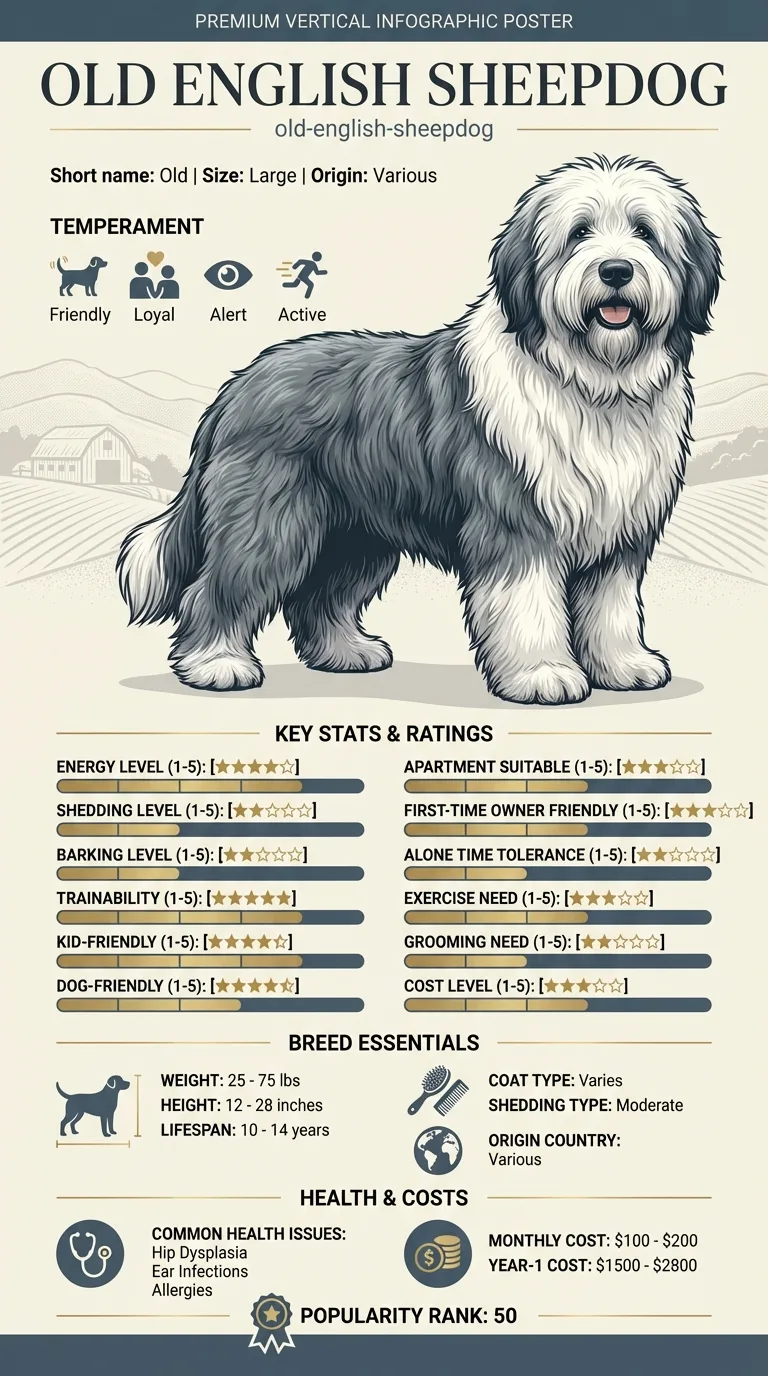
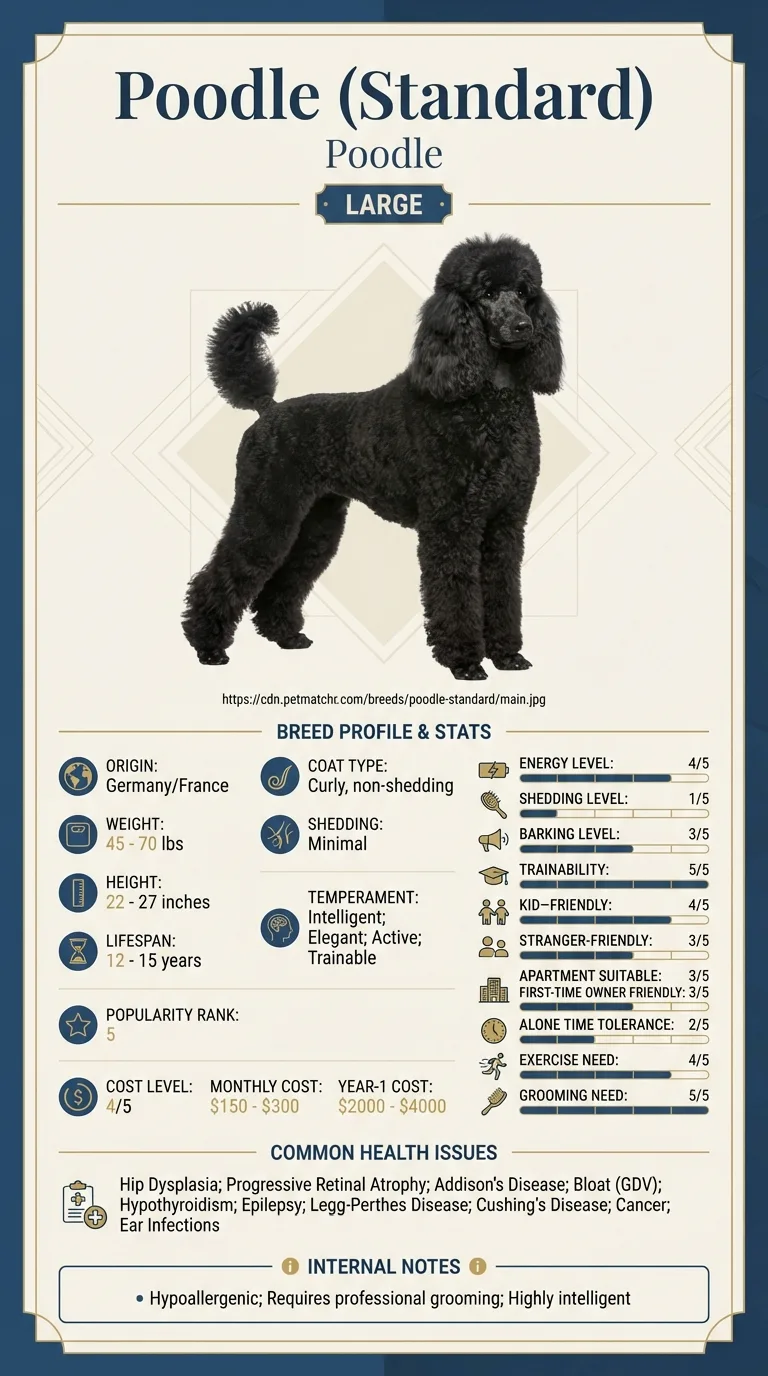
This is for someone already down to Old English Sheepdog and Poodle (Standard) and deciding between them. For this pair the decision usually turns on shedding and trainability, so those are covered first and in most detail. Anyone choosing from a flat has a clear answer here: Poodle (Standard) rates 3/5 against 2/5. It is written for the decision rather than the breed history.
Between Old English Sheepdog and Poodle (Standard), shedding is what separates them, and Poodle (Standard) is the lower-effort dog of the two to keep.
Choose Old English Sheepdog if your walking routine is modest and there are young children at home.
Choose Poodle (Standard) if you are in a flat or a smaller home, this is your first dog and shedding is a problem in your house.
| Feature | old english sheepdog | poodle standard | Winner |
|---|---|---|---|
| Size class | large | large | Equal |
| Weight | 60–100 lbs | 45–70 lbs | Equal |
| Height | 20–24 in | 22–27 in | Equal |
| Lifespan | 10–12 years | 12–15 years | poodle standard |
| Exercise need | Moderate (3/5) | High (4/5) | old english sheepdog |
| Grooming need | Very high (5/5) | Very high (5/5) | Equal |
| Shedding | High (4/5) | Very low (1/5) | poodle standard |
| Energy level | Moderate (3/5) | High (4/5) | Equal |
| Barking | Moderate (3/5) | Moderate (3/5) | Equal |
| Apartment suitability | Low (2/5) | Moderate (3/5) | poodle standard |
| Good for first-time owners | Low (2/5) | Moderate (3/5) | poodle standard |
| Tolerates being alone | Low (2/5) | Low (2/5) | Equal |
| Trainability | Moderate (3/5) | Very high (5/5) | poodle standard |
| Good with kids | Very high (5/5) | High (4/5) | old english sheepdog |
| Good with other dogs | High (4/5) | High (4/5) | Equal |
| Friendly to strangers | High (4/5) | Moderate (3/5) | old english sheepdog |
| Cost level | High (4/5) | High (4/5) | Equal |
| Coat | Long, shaggy double coat | Curly, non-shedding | Equal |
| Origin | Various | Germany/France | Equal |
| Typical monthly cost | $110–$240 | $150–$300 | Equal |
| Typical first-year cost | $1,700–$3,200 | $2,000–$4,000 | Equal |
The Old English Sheepdog is the heavier of the two, 60 to 100 pounds packed into a stocky, low frame of 20 to 24 inches. The Standard Poodle actually stands taller, 22 to 27 inches, but carries far less mass, 45 to 70 pounds. Side by side, the Poodle reads as athletic and upright where the OES reads as broad and shaggy. Both count as large dogs on paper, but they occupy space very differently in a house.
OES exercise needs sit at a moderate 3 out of 5, a couple of solid walks and some yard time cover it. The Poodle rates a 4, and that number is earned: this is a dog bred to retrieve in water for hours, and it gets restless without real output. If your idea of exercise is a lazy loop around the block, the OES will tolerate that better than the Poodle will.
Both breeds max out grooming need at 5 out of 5, so neither saves you a trip to the groomer. The difference is what happens between visits. The OES sheds at a 4 despite all that brushing, leaving hair on the couch and the coat. The Poodle's curly coat barely sheds at all, rated 1 out of 5, which is the real reason people pick a Poodle over a similarly hairy breed.
Neither dog was built for a studio apartment, but the numbers separate them a little: OES scores a 2 for apartment suitability, the Poodle a 3. Barking is a wash, both land at moderate. Neither breed handles solitude well; both are rated low, 2 out of 5, for tolerating being left alone, so a two-income household with nobody home all day should think twice about either one.
This is where the two diverge sharply. The Poodle's trainability sits at 5 out of 5, one of the most trainable breeds there is, while the OES lands at a middling 3. That gap shows up in the first-time-owner rating too: OES scores a 2, Poodle a 3. A novice owner will have an easier time shaping a Poodle's behavior than untangling an OES's stubborn streak.
With kids, the OES edges ahead, 5 versus 4, matching its reputation as a famously patient nanny-dog breed. Both score a 4 for getting along with other dogs. Strangers are where the OES pulls further ahead: a 4 rating for friendliness toward visitors against the Poodle's more reserved 3. If you want a dog that greets everyone at the door like an old friend, that leans OES.
The Poodle tends to live longer, 12 to 15 years against the OES's 10 to 12, but its health list is longer too, ten conditions including Addison's Disease, Cushing's Disease, epilepsy and cancer. The OES's shorter list of five (Hip Dysplasia, Cataracts, Hypothyroidism, Primary Ciliary Dyskinesia, Bloat) still includes Bloat, a real emergency risk in deep-chested large breeds. Hip Dysplasia and Hypothyroidism turn up on both lists.
Both land at a high 4 out of 5 for overall cost, and the dollar ranges back that up. The OES runs $110 to $240 a month and $1,700 to $3,200 in year one; the Poodle runs a bit higher, $150 to $300 a month and $2,000 to $4,000 in year one. Given the shared grooming demands, budget for a professional groomer either way, that's usually the bigger line item than food.
Old English Sheepdog weighs 60–100 lbs and lives 10–12 years; Poodle (Standard) weighs 45–70 lbs and lives 12–15 years. The two diverge most on shedding and trainability. They are level on tolerates being alone, barking and cost level, so those cannot decide it. In the table, a "winner" means easier for an ordinary household — not better. Size, coat and origin are recorded without a verdict. Because both breeds are scored the same way, the gaps are reliable even where the absolute numbers are rough.

The OES is heavier at 60-100 lbs versus the Poodle's 45-70 lbs, but the Poodle is actually taller, standing 22-27 inches to the OES's 20-24. Both are classified as large dogs.
Its shedding rating is 1 out of 5, about as low as it gets, thanks to a curly, non-shedding coat. The OES rates a 4, so if hair on furniture is a dealbreaker, the Poodle wins even though both need heavy grooming.
The Poodle is the safer bet, rated a 3 versus the OES's 2, mostly because it's far more trainable (5/5 vs 3/5). Neither is the easiest breed for a beginner, but the Poodle asks less of a new owner.
Not really, and the numbers say so, OES scores 2, Poodle scores 3. Both need daily exercise and neither tolerates being left alone well (both rated 2/5), which matters more in a small space than square footage does.
Plan on $110-$240 for the OES and $150-$300 for the Poodle. First-year costs run $1,700-$3,200 and $2,000-$4,000 respectively, with grooming as a recurring cost for both.
Yes, Hip Dysplasia and Hypothyroidism appear on both lists. Bloat is specific to the OES's list here, while the Poodle's longer ten-condition list adds Addison's Disease, Cushing's Disease, epilepsy and cancer.
The Poodle, by a wide margin, 5/5 trainability against the OES's 3/5. Poodles were bred as working retrievers and take direction readily; the OES has more of an independent streak.
Depends on your grooming tolerance for shedding: the OES gives you a friendlier, more kid-oriented dog that sheds; the Poodle gives you a trainable, non-shedding dog that needs more exercise.
The OES runs $110-$240 a month; the Poodle runs somewhat higher at $150-$300, mainly reflecting its higher activity and grooming upkeep.
The OES needs moderate exercise (3/5); the Poodle needs more, rated 4/5, reflecting its retriever background.
The Poodle typically lives longer, 12-15 years, versus 10-12 for the OES, a real difference over a dog's lifetime.
Secure checkout on Stripe. We never see your card.
7-day money-back guarantee. Instant access.
Health information here is general and is not veterinary advice. If your dog shows pain, sudden behaviour change, or worsening symptoms, consult a licensed veterinarian.
Some links on this site are affiliate links. We may earn a commission at no extra cost to you, and we only suggest products we believe are helpful for dog owners.
We research and check what we publish, but we do not warrant that any figure, date, price, or statement is accurate, complete, or current, and we accept no liability for any loss, cost, injury, or other harm arising from the use of this site. Use it as one reference among several. You remain responsible for your own decisions and for your dog's care - confirm anything that matters with a licensed veterinarian or another qualified professional before you act on it. Full disclaimer.
Match your lifestyle to the right dog.
Take quizNot sure which breed is right for you? Take our 2-minute quiz to find out.
Take the quiz