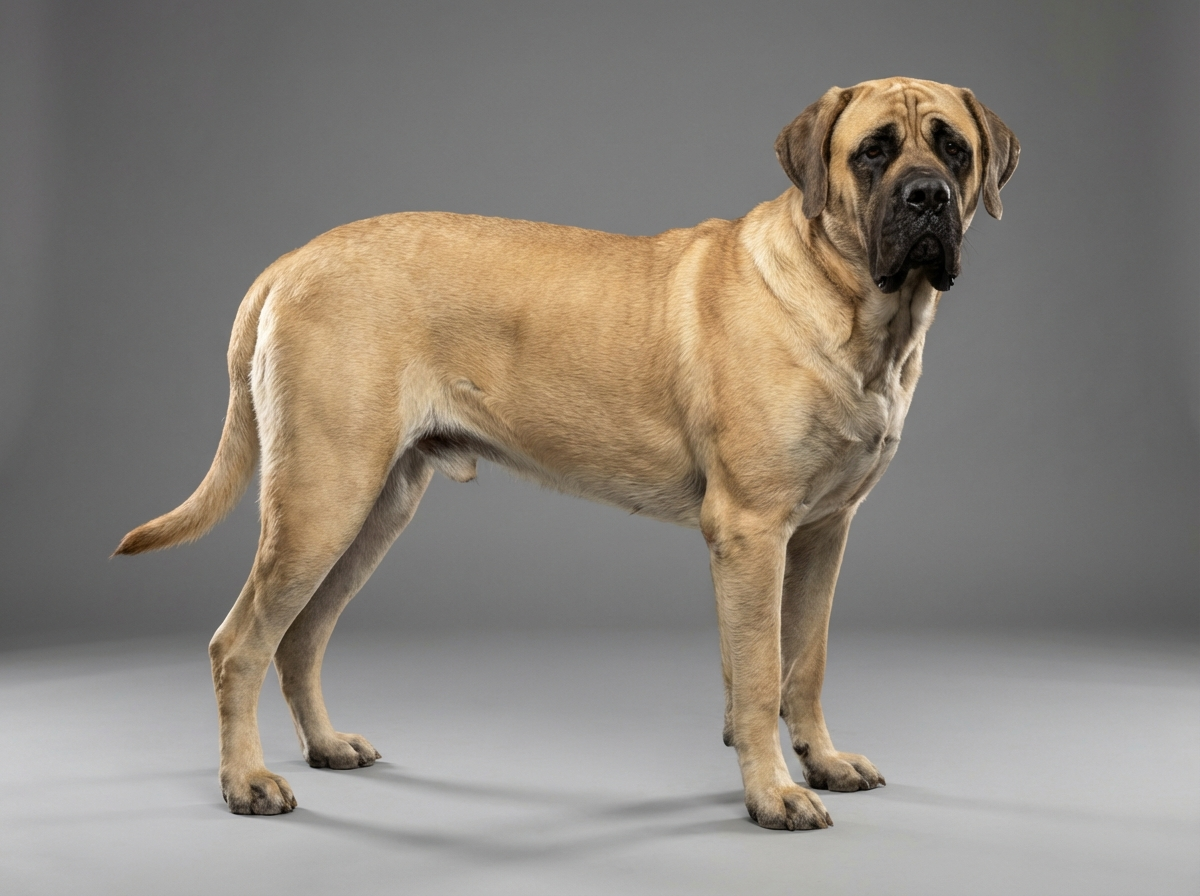
Health
Is X-SCID a common concern for Mastiff puppies?
No - it's an extremely rare condition, far more documented in certain other breeds, and should be one of the last explanations considered for a sick puppy.

Quick answer
Is X-SCID a common concern for Mastiff puppies?
No - it's an extremely rare condition, far more documented in certain other breeds, and should be one of the last explanations considered for a sick puppy.
This is one of the rarest, most severe conditions a puppy could have - which is exactly why it shouldn't be the first thing an owner assumes.
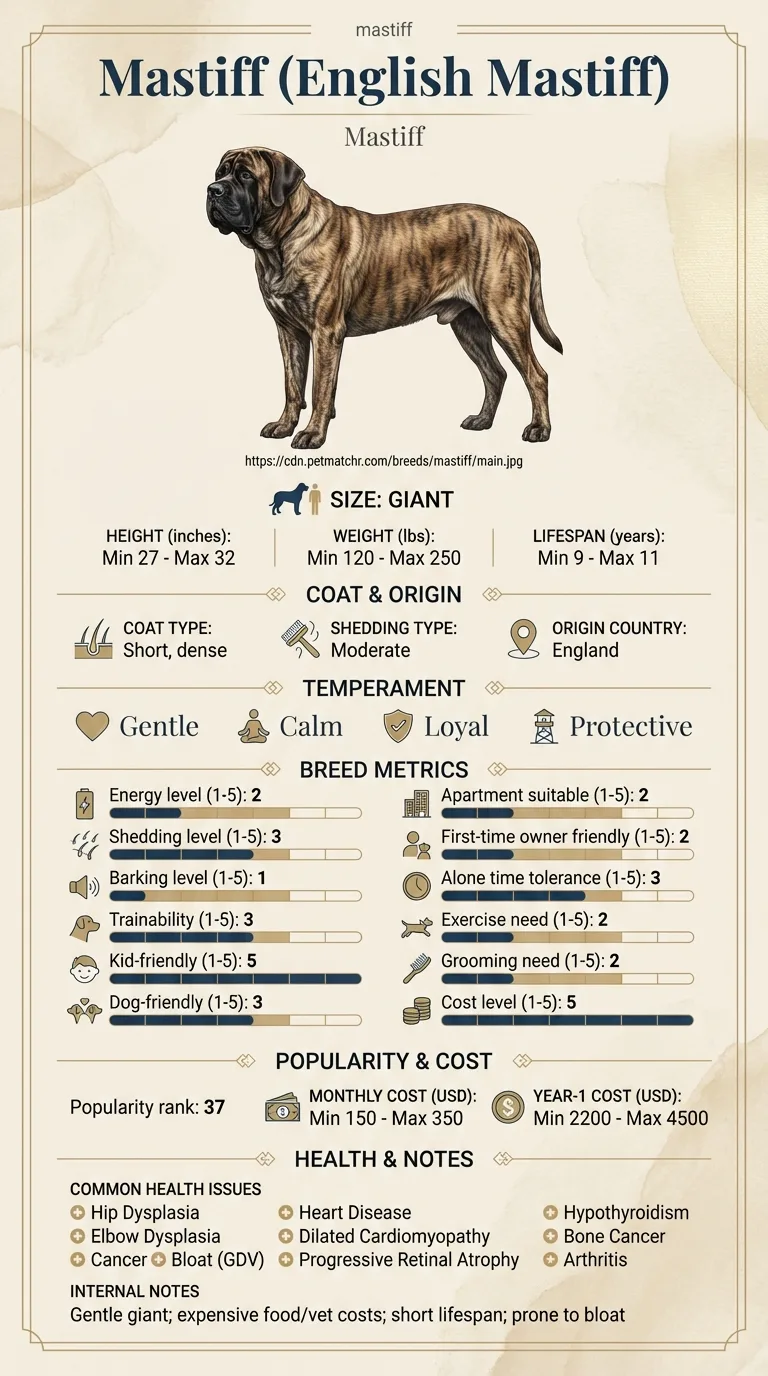
This is relevant mainly to owners of young puppies with repeated, unusually severe infections that aren't responding normally to standard treatment, and who have already worked through the far more common explanations with their vet without a clear answer.
This guide is not medical advice. If your dog shows pain, sudden behavior change, or worsening symptoms, consult a licensed veterinarian.
Some links may be affiliate links. We may earn a commission at no extra cost to you. We only suggest products we believe are helpful for dog owners.
We research and check what we publish, but we do not warrant that any figure, date, price, or statement is accurate, complete, or current, and we accept no liability for any loss, cost, injury, or other harm arising from the use of this site. Use it as one reference among several. You remain responsible for your own decisions and for your dog's care - confirm anything that matters with a licensed veterinarian or another qualified professional before you act on it. Full disclaimer.
X-linked severe combined immunodeficiency is an extremely rare inherited condition leaving affected puppies with almost no functional immune defense. It is documented far more thoroughly in certain other breeds' specific bloodlines than as an established concern in Mastiffs, and the far more common explanations for a sick puppy should always be worked through first.
This condition is extremely rare in dogs generally and is not established as a common concern specifically documented in Mastiffs. It's included here for completeness and owner awareness, not because it represents a meaningful everyday risk for most puppies in this breed.
This is a genetic mutation affecting a specific immune gene, inherited through a particular pattern that has been characterized in certain other breeds' bloodlines. It is not part of this breed's commonly documented health profile, and there's no established breed-wide predisposition the way there is for conditions like hip dysplasia or heart disease in Mastiffs.
Environment doesn't cause this genetic condition, but for an affected puppy, ordinary environmental exposure to everyday pathogens becomes dangerous because the immune system can't mount a normal defense, which is why severity in an affected puppy tends to appear very early and very seriously rather than mildly.
Talk to your vet if a puppy shows failure to thrive, repeated severe infections across multiple body systems, or poor response to standard treatment starting very young, especially if the far more common explanations have already been ruled out without an answer.
See all Mastiff health problems, which breeds are prone to x scid, or the full Mastiff breed guide for temperament, exercise needs and ownership costs.
If this rare condition is genuinely suspected, specialized diagnostic testing and specialist referral are typically needed, which can take several weeks to arrange and complete given how uncommon it is.
For the vast majority of Mastiff puppies with recurring illness, success looks like identifying and treating one of the much more common causes, and this condition never becoming relevant at all.
A young puppy that keeps getting sick has many more likely explanations than a severe inherited immunodeficiency: incomplete vaccination series, parasites, a source of ongoing environmental exposure, or a less severe but more common immune or health issue. X-SCID is characterized by an almost complete lack of certain immune cells, which typically produces a pattern far more severe and consistent than the occasional infection most sick puppies experience - think a puppy who fails to thrive, doesn't respond normally to standard treatment for infections, and shows repeated, unusually serious illness starting very early in life.
Ruling out the common causes first isn't just good practice, it's genuinely more likely to find the actual answer, since this condition is documented much more thoroughly in certain other breeds' specific bloodlines than as an established concern in Mastiffs generally.
A genetic immunodeficiency workup becomes reasonable to discuss with a vet when several of these apply together, not from any single symptom alone.

If you think your Mastiff has x-scid, the plan is three steps: write down what you have seen and when it started, book a veterinary appointment rather than waiting for the next flare, and take video of the behaviour or symptom before you go — the thing you are worried about rarely happens in the consulting room. Screening in the parents covers hip dysplasia, elbow dysplasia, cancer.
What the vet visit should produce is a diagnosis and a written plan, not just reassurance: what is being ruled out, what the monitoring interval is, and which signs mean you come back sooner. Ask what the treatment costs across a year rather than per visit, because that is the number that decides whether you are managing this condition or reacting to it.
Between appointments, keep a short log — dates, what you saw, what changed. It is the single most useful thing an owner brings to a follow-up, and for x-scid it is often what separates a clear pattern from a guess.
Julia's Mastiff puppy Peanut had two ear infections and a bout of illness within her first four months, and after reading about rare immune conditions online, Julia arrived at her vet visit already worried about something serious and genetic. Her vet worked through the standard list first: an incomplete early vaccination series due to a missed appointment, and a mild but treatable parasite load picked up from her environment. Once both were properly addressed, Peanut's pattern of illness stopped entirely, and no further workup was needed. Julia later learned that the rare immune condition she'd been worried about is not something typically documented as a specific concern in this breed, and that the pattern it produces, severe, unrelenting illness from a very early age despite treatment, looked nothing like what Peanut had actually experienced. She still thinks about how much anxiety she could have skipped by asking her vet first instead of searching online.
Key takeaway: The rarest, most severe explanation for a sick puppy is almost never the right one - working through the common causes first usually finds the real answer faster and with far less worry.
No. It's an extremely rare condition overall, and it's documented much more thoroughly in certain other specific breed bloodlines than as an established concern in Mastiffs generally. It should be one of the last explanations considered for a sick puppy.
Affected puppies typically show a pattern of severe, repeated infections starting very young, failure to thrive despite normal care, and poor response to standard infection treatment, rather than the occasional minor illness common in typical puppies.
Work through the much more common explanations first: vaccination status, parasites, environmental exposure, and other more prevalent health conditions. Most sick puppies have one of these far more likely causes rather than a rare inherited immunodeficiency.
Diagnosis typically involves specialized bloodwork assessing immune cell populations and function, usually pursued only after more common causes of repeated illness have been ruled out by a vet.
It's a severe condition with a serious prognosis, and treatment options are limited and specialized. This is exactly why ruling out far more common and more treatable explanations first matters so much before assuming the worst.
Given how rare this specific condition is in the breed, routine testing isn't standard practice. It's more relevant to discuss with a vet if a puppy is already showing the specific pattern of severe, unexplained repeated illness described above.
No - it's an extremely rare condition, far more documented in certain other breeds, and should be one of the last explanations considered for a sick puppy.
Far more common causes like incomplete vaccination, parasites, or environmental exposure explain most cases, not a rare inherited immunodeficiency.
Failure to thrive plus repeated, severe infections in multiple body systems that don't respond to standard treatment, starting very young.
It's a severe condition with limited treatment options, which is part of why ruling out more common causes first is so important.
No - routine testing isn't standard given how rare this condition is; it's more relevant only when a specific severe symptom pattern is already present.
A one-page prep sheet for this condition: the signs, the questions to ask, what to get priced. Unlocks here.
You get: Vet visit prep sheet
No spam. One-click unsubscribe. See our privacy policy.
Preview page 1 before you decide.