Behavior
Which breed needs more exercise?
The Siberian Husky, rated very high (5/5) versus the Mastiff's low (2/5).

Quick answer
Which breed needs more exercise?
The Siberian Husky, rated very high (5/5) versus the Mastiff's low (2/5).
Mastiff (English Mastiff) or Siberian Husky? On paper they differ most on exercise need, and on the scales Mastiff (English Mastiff) is the heavier at 120–250 lbs. Here is how the two compare on everything that shapes an ordinary week.
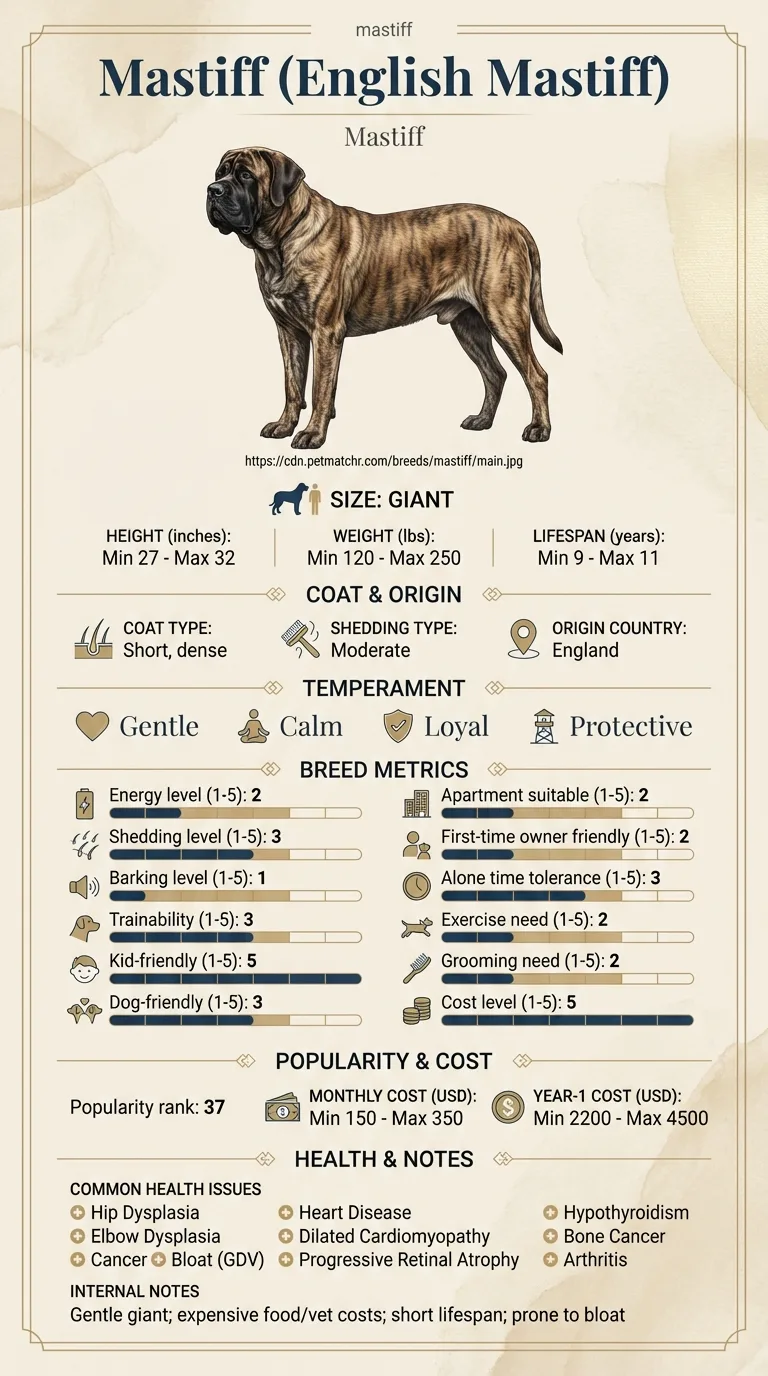
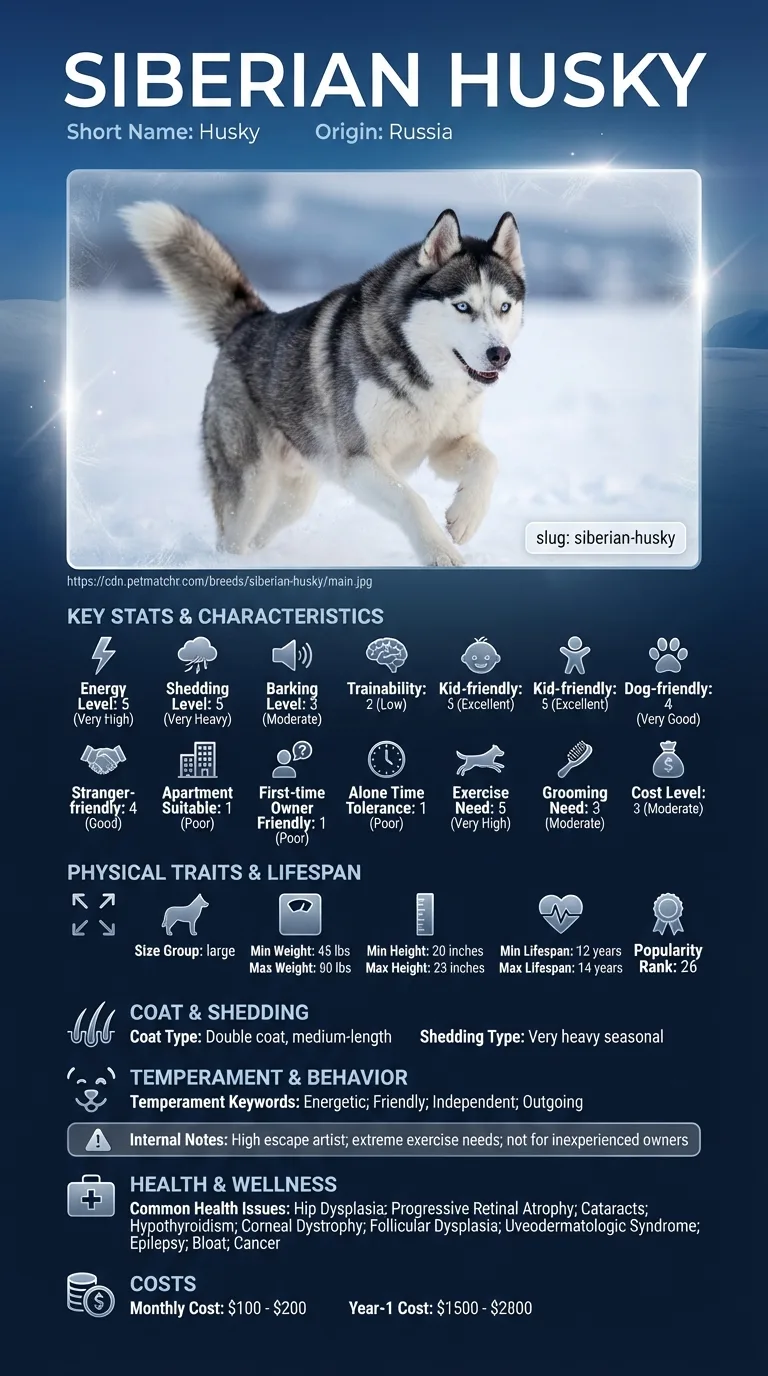
This is for someone already down to Mastiff (English Mastiff) and Siberian Husky and deciding between them. For this pair the decision usually turns on exercise need and energy level, so those are covered first and in most detail. Anyone choosing from a flat has a clear answer here: Mastiff (English Mastiff) rates 2/5 against 1/5. The focus throughout is on daily consequences rather than breed background.
Between Mastiff (English Mastiff) and Siberian Husky, exercise need is what separates them, and Mastiff (English Mastiff) is the lower-effort dog of the two to keep.
Choose Mastiff (English Mastiff) if you do not want a standing grooming appointment, shedding is a problem in your house and your walking routine is modest.
Choose Siberian Husky if you already have another dog, a smaller dog suits your car, your home or your back and you want a dog that can keep up with an active routine.
| Feature | mastiff | siberian husky | Winner |
|---|---|---|---|
| Size class | giant | large | Equal |
| Weight | 120–250 lbs | 45–60 lbs | Equal |
| Height | 27–32 in | 20–23 in | Equal |
| Lifespan | 9–11 years | 12–14 years | siberian husky |
| Exercise need | Low (2/5) | Very high (5/5) | mastiff |
| Grooming need | Low (2/5) | Moderate (3/5) | mastiff |
| Shedding | Moderate (3/5) | Very high (5/5) | mastiff |
| Energy level | Low (2/5) | Very high (5/5) | Equal |
| Barking | Very low (1/5) | Moderate (3/5) | mastiff |
| Apartment suitability | Low (2/5) | Very low (1/5) | mastiff |
| Good for first-time owners | Low (2/5) | Very low (1/5) | mastiff |
| Tolerates being alone | Moderate (3/5) | Very low (1/5) | mastiff |
| Trainability | Moderate (3/5) | Low (2/5) | mastiff |
| Good with kids | Very high (5/5) | Very high (5/5) | Equal |
| Good with other dogs | Moderate (3/5) | High (4/5) | siberian husky |
| Friendly to strangers | Moderate (3/5) | High (4/5) | siberian husky |
| Cost level | Very high (5/5) | Moderate (3/5) | siberian husky |
| Coat | Short, dense | Double coat, medium-length | Equal |
| Origin | England | Russia | Equal |
| Typical monthly cost | $150–$350 | $100–$200 | Equal |
| Typical first-year cost | $2,200–$4,500 | $1,500–$2,800 | Equal |
The Mastiff outweighs the Siberian Husky by a wide margin — up to 250 pounds against the Husky's 45-60 — despite the Husky standing a respectable 20-23 inches, not far below the Mastiff's 27-32. In other words, the Husky is a mid-size dog that looks and moves like a much lighter, leaner athlete, built for distance work pulling sleds, while the Mastiff is simple bulk, a guardian breed shaped by sheer mass rather than speed. An owner picturing 'big dog' in the abstract should note that a Husky, despite very different proportions, is still a fraction of a Mastiff's weight even at its own upper range.
These two sit at nearly opposite ends of the exercise spectrum: the Husky rates very high (5/5) for both exercise need and energy level, while the Mastiff rates low (2/5) on both. Bred to run for miles pulling sleds across snow, a Husky left under-exercised often turns to digging, howling, or fence-jumping — its very low (1/5) tolerance for being alone compounds the risk. The Mastiff, by contrast, is content with short walks and long naps, true to its calm, gentle temperament. An owner drawn to the Husky's striking looks needs to seriously reckon with hours of daily exercise; the Mastiff asks for almost none by comparison.
The Husky requires more grooming attention, rated moderate (3/5) against the Mastiff's low (2/5), but the real gap is in shedding — very high (5/5) for the Husky versus moderate (3/5) for the Mastiff. Huskies are famous for their twice-yearly 'coat blow,' releasing enormous quantities of dense double-coat undercoat over several weeks, on top of steady year-round shedding. The Mastiff's short coat sheds more predictably and needs far less brushing to manage. Anyone considering a Husky should plan for a serious de-shedding tool and tolerance for fur on every surface; the Mastiff, despite its size, is the comparatively tidy option here.
Neither breed suits an apartment well, but the Husky rates lower still — very low (1/5) versus the Mastiff's low (2/5) — and its very low (1/5) tolerance for being alone makes confinement especially risky, often triggering escape attempts or vocalizing. Barking is close, moderate (3/5) for both, though Huskies are known for distinctive howling rather than typical barking, which can be just as disruptive to neighbors. The Mastiff's calm, low-energy temperament makes it marginally more tolerable in tight quarters despite its bulk, provided there's enough floor space for it to lie down comfortably. Both genuinely need a securely fenced yard and an owner home for much of the day.
The Husky rates low (2/5) for trainability and very low (1/5) for first-time owners — the lowest score of any metric in this comparison — reflecting its famously independent, willful streak inherited from generations of working with, rather than strictly under, human direction. The Mastiff scores higher on both counts, moderate (3/5) trainability and low (2/5) for first-time owners, still a challenge given its size but more responsive to consistent handling. Neither breed is an easy first dog, but for different reasons: the Mastiff's difficulty is physical management, while the Husky's is behavioral. Experienced owners willing to out-stubborn a Husky, or out-muscle a Mastiff, will do best with either.
Both breeds score very high (5/5) with kids, a genuine tie, and the Husky edges ahead with other dogs (high 4/5 versus the Mastiff's moderate 3/5) and strangers (high 4/5 versus moderate 3/5), reflecting its outgoing, friendly pack temperament, which historically meant working alongside other dogs and tolerating many handlers. The Mastiff's protective, loyal nature makes it more watchful of unfamiliar visitors, though never at the expense of its gentleness with its own family. A household that regularly hosts other dogs or unfamiliar guests may find the Husky's universally social nature the easier fit; one that values a calmer, more discerning watchdog presence will lean Mastiff.
The Husky's 12-14 year lifespan comfortably beats the Mastiff's 9-11, consistent with the general pattern of smaller breeds outliving giants. Both carry ten-condition health lists, but the emphasis differs: the Mastiff's includes bloat, dilated cardiomyopathy, and bone cancer tied to its rapid giant-breed growth, while the Husky's leans toward eye conditions — progressive retinal atrophy, cataracts, corneal dystrophy — alongside uveodermatologic syndrome, an autoimmune condition affecting skin and eyes that's notably breed-associated. Hip dysplasia, hypothyroidism, and cancer or bloat risk appear on both lists. Regular ophthalmologic screening is a particularly worthwhile investment for Husky owners given how many eye conditions the breed carries.
The Mastiff rates very high (5/5) for cost against the Husky's moderate (3/5), and the numbers back it up clearly: $150-$350 monthly and $2,200-$4,500 in year one for the Mastiff, versus $100-$200 monthly and $1,500-$2,800 for the Husky. Food volume explains most of the gap, since a Mastiff can weigh four to five times as much as a Husky. The Husky's moderate grooming needs during non-shedding months keep its costs down, though a professional de-shed during coat-blow season adds occasional expense. Over a decade, the Mastiff remains meaningfully the more expensive breed to feed, medicate, and maintain.
Mastiff (English Mastiff) weighs 120–250 lbs and lives 9–11 years; Siberian Husky weighs 45–60 lbs and lives 12–14 years. The two diverge most on exercise need, energy level and shedding and 3 other rated axes. Almost every rated axis separates them at least slightly. The table below marks a winner only where one breed is genuinely easier for a typical owner; size and origin are facts rather than merits and stay level. Ratings come from one source applied to both breeds, so they are meaningful against each other rather than as absolute scores.

The Husky, by a clear margin — it rates low (2/5) for trainability and very low (1/5) for first-time owners, the lowest score in this comparison, due to its famously independent temperament.
No — it's rated very low (1/5) for tolerating being alone, the lowest possible score. Huskies left alone too long often dig, howl, or attempt to escape.
The Siberian Husky, rated very high (5/5) versus the Mastiff's moderate (3/5), with dramatic twice-yearly coat blows on top of regular shedding.
Yes — they rate very high (5/5) with kids, tying the Mastiff for the top score, thanks to a friendly, outgoing temperament, though their high energy means supervision during play matters.
The Siberian Husky by far, rated very high (5/5) versus the Mastiff's low (2/5). Huskies were bred to run long distances and need serious daily outlets.
The Siberian Husky, costing roughly $1,500-$2,800 in its first year compared to the Mastiff's $2,200-$4,500, driven mainly by the Mastiff's much larger food requirements.
Yes — their health list includes progressive retinal atrophy, cataracts, and corneal dystrophy, along with uveodermatologic syndrome, making regular eye screening especially worthwhile for the breed.
The Siberian Husky, rated very high (5/5) versus the Mastiff's low (2/5).
The Mastiff, rated moderate (3/5) versus the Husky's low (2/5).
The Siberian Husky, at 12-14 years versus the Mastiff's 9-11 years.
The Mastiff, rated very high (5/5) for cost versus the Husky's moderate (3/5).
Secure checkout on Stripe. We never see your card.
7-day money-back guarantee. Instant access.
Health information here is general and is not veterinary advice. If your dog shows pain, sudden behaviour change, or worsening symptoms, consult a licensed veterinarian.
Some links on this site are affiliate links. We may earn a commission at no extra cost to you, and we only suggest products we believe are helpful for dog owners.
We research and check what we publish, but we do not warrant that any figure, date, price, or statement is accurate, complete, or current, and we accept no liability for any loss, cost, injury, or other harm arising from the use of this site. Use it as one reference among several. You remain responsible for your own decisions and for your dog's care - confirm anything that matters with a licensed veterinarian or another qualified professional before you act on it. Full disclaimer.
Match your lifestyle to the right dog.
Take quizNot sure which breed is right for you? Take our 2-minute quiz to find out.
Take the quiz