Health
Is X-SCID common in Chihuahuas?
No. It is a rare condition best documented in Basset Hounds and Cardigan Welsh Corgis, not established as prevalent in this breed.

Quick answer
Is X-SCID common in Chihuahuas?
No. It is a rare condition best documented in Basset Hounds and Cardigan Welsh Corgis, not established as prevalent in this breed.
This is one of the rarest entries on any genetic panel, and for almost every owner reading about it, the honest answer is that it has nothing to do with the healthy dog already asleep on their lap.
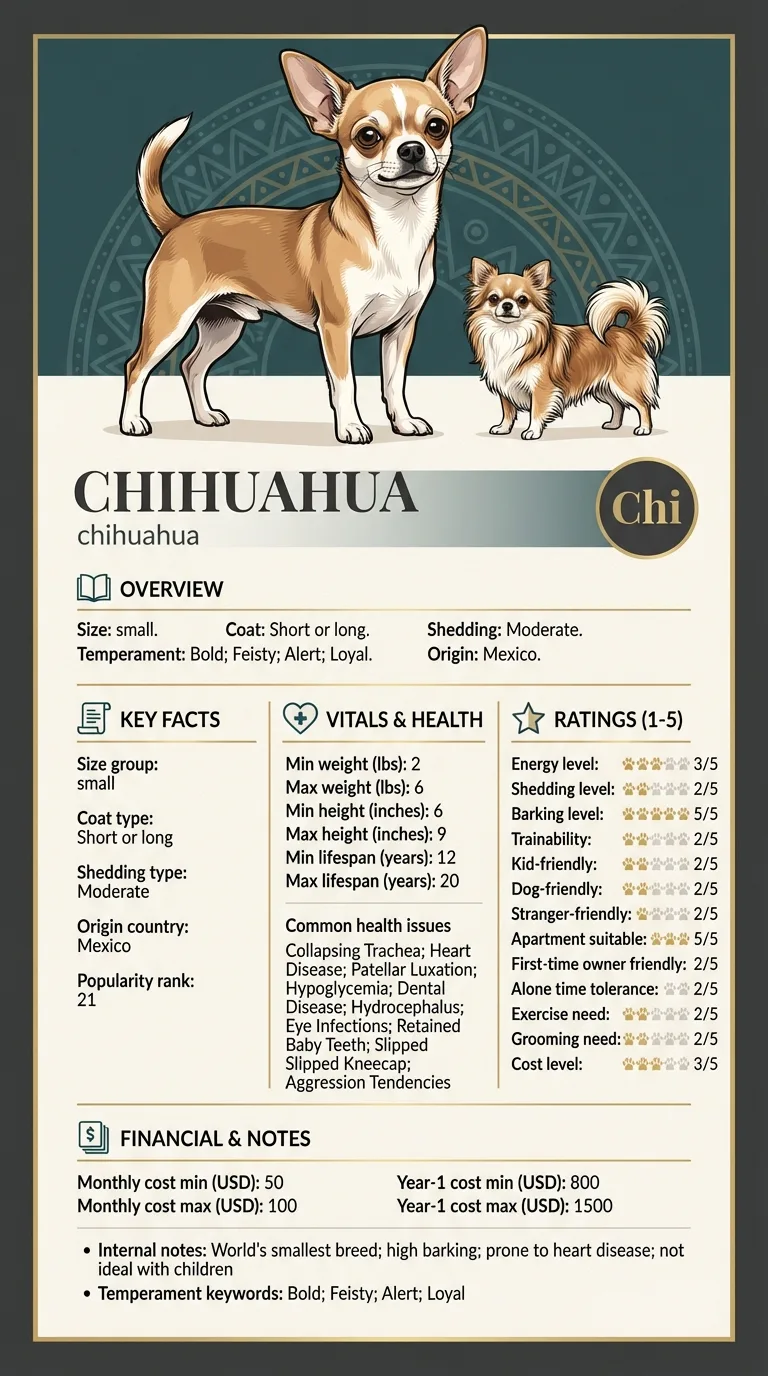
Breeders whose genetic panel unexpectedly flags a carrier parent and are unsure what that actually means for a litter, and anxious new owners who encountered the term online and want to know if their normal, healthy puppy needs testing.
This guide is not medical advice. If your dog shows pain, sudden behavior change, or worsening symptoms, consult a licensed veterinarian.
Some links may be affiliate links. We may earn a commission at no extra cost to you. We only suggest products we believe are helpful for dog owners.
We research and check what we publish, but we do not warrant that any figure, date, price, or statement is accurate, complete, or current, and we accept no liability for any loss, cost, injury, or other harm arising from the use of this site. Use it as one reference among several. You remain responsible for your own decisions and for your dog's care - confirm anything that matters with a licensed veterinarian or another qualified professional before you act on it. Full disclaimer.
X-linked severe combined immunodeficiency is an exceptionally rare inherited immune disorder, best documented in Basset Hounds and Cardigan Welsh Corgis rather than established as a meaningful risk in this breed. Affected puppies, almost always male due to the condition's X-linked inheritance, appear normal at birth but develop severe, repeated infections around weaning age as maternal antibody protection fades, a pattern usually fatal without extraordinary intervention. It is primarily a breeding-line screening topic rather than a concern for typical pet ownership.
This condition is exceptionally rare overall and is not established as a meaningfully prevalent issue in this breed's population, in contrast to its better-documented occurrence in Basset Hounds and Cardigan Welsh Corgis specifically.
This is a specific X-linked recessive gene mutation rather than a broadly documented breed predisposition in Chihuahuas. Its occasional inclusion on comprehensive genetic panels reflects general screening design across many breeds rather than confirmed, elevated breed-specific risk, distinguishing it clearly from this breed's genuinely documented health issues such as heart disease, hydrocephalus and patellar luxation.
There is no environmental trigger for the underlying genetic mutation itself. The only environmentally relevant factor is timing: an affected puppy's illness becomes apparent specifically once maternal antibody protection from nursing fades, typically around the weaning period, regardless of any care practices.
Discuss a carrier or affected result with your vet if it appears on a genetic panel for a breeding animal, so it can be factored into pairing decisions. Seek prompt veterinary attention for any very young puppy with repeated, severe infections that do not respond as expected to standard treatment, though this pattern has many more common causes that a vet would investigate first.
See all Chihuahua health problems, which breeds are prone to x scid, or the full Chihuahua breed guide for temperament, exercise needs and ownership costs.
For the overwhelming majority of owners, there is no relevant timeline since this condition does not apply to a healthy adult dog. For a breeder managing a carrier result, understanding its implications for pairing decisions is typically a single conversation with a vet or geneticist.
Success is a proportionate understanding of this condition's rarity and its narrow relevance to breeding-line management, rather than unnecessary worry about a healthy pet dog based on a panel entry that applies to a very different, much rarer situation.
X-linked severe combined immunodeficiency is caused by a mutation on the X chromosome affecting a gene essential for normal development of the immune system's T and B cells, the cells responsible for fighting infection. Because the affected gene sits on the X chromosome, the disease overwhelmingly affects males, since a male has only one X chromosome and no second copy to compensate, while females with one affected copy are typically unaffected carriers. Affected puppies are born looking entirely normal and are initially protected by antibodies passed from their mother's milk, but as that protection fades around weaning age, they become unable to mount a normal immune response and develop repeated, unusually severe infections that do not respond as expected to standard treatment, a pattern that is usually fatal in early puppyhood without extraordinary specialized intervention.
This specific condition was first characterized and remains best documented in Basset Hounds and Cardigan Welsh Corgis. It is not established as a meaningfully prevalent condition in Chihuahuas specifically, and its inclusion on some broad genetic panels reflects the panel's general multi-breed screening design rather than any documented elevated risk unique to this breed's population.
The practical relevance for almost anyone reading this is narrow and specific: it matters for breeders interpreting a genetic panel result on a breeding animal, and it matters, in theory, for a very young puppy showing a pattern of unusually severe, repeated, poorly responsive infections around weaning age, which would prompt a vet to consider a broader immune workup. It essentially does not matter for the overwhelming majority of adult, healthy Chihuahuas, whose normal history of surviving puppyhood without this pattern is itself strong practical reassurance.

This is overwhelmingly a breeding-line topic rather than an individual pet health concern.
If you think your Chi has x-scid, the plan is three steps: write down what you have seen and when it started, book a veterinary appointment rather than waiting for the next flare, and take video of the behaviour or symptom before you go — the thing you are worried about rarely happens in the consulting room. Screening in the parents covers collapsing trachea, heart disease, patellar luxation.
What the vet visit should produce is a diagnosis and a written plan, not just reassurance: what is being ruled out, what the monitoring interval is, and which signs mean you come back sooner. Ask what the treatment costs across a year rather than per visit, because that is the number that decides whether you are managing this condition or reacting to it.
Between appointments, keep a short log — dates, what you saw, what changed. It is the single most useful thing an owner brings to a follow-up, and for x-scid it is often what separates a clear pattern from a guess.
Esperanza had been breeding Chihuahuas responsibly for over a decade, running comprehensive genetic panels on every breeding dog as a matter of practice, and one of her longtime females came back with a carrier flag for the X-SCID variant, a result she had never seen in any of her lines before. Her first reaction was concern about the female's own health, since the condition's description sounded severe. A conversation with a veterinary geneticist clarified the actual situation: as a carrier, the female herself was not expected to be, and was not, showing any signs of immune dysfunction, since she had a second normal X chromosome compensating. The relevant consideration was entirely about future pairings, specifically that any sons she produced would have a chance of inheriting the affected version and being clinically affected. Esperanza adjusted her breeding plan going forward, selecting sires and tracking this specific result carefully across future litters, while continuing to breed the female herself without any change to her daily care, since the carrier status had no bearing on her own health at all.
Key takeaway: A carrier flag for a rare condition like this one is a note for a breeding spreadsheet, not a diagnosis for the dog carrying it. Understanding exactly what carrier status does and does not mean turned an alarming-sounding result into a manageable planning detail.
It is best characterized and documented in Basset Hounds and Cardigan Welsh Corgis. It is not established as a meaningful, prevalent risk specific to this breed, and its presence on some broad genetic panels reflects general multi-breed screening design rather than a known elevated risk here.
No. Affected puppies become severely and repeatedly ill around weaning age in a way that would already have been obvious and would not have been survivable without extraordinary intervention. A healthy adult dog's normal history already rules this condition out in practical terms.
It means she carries one copy of the variant on one X chromosome and is not expected to be affected herself. Because of how X-linked inheritance works, her sons have a chance of inheriting the affected version and being clinically affected, which is the specific outcome responsible pairing decisions aim to avoid.
Specialized treatments exist in veterinary and human medicine for this category of immune disorder, but they are complex, resource-intensive and not routinely available or successful in general veterinary practice, which is why prevention through informed breeding decisions is the primary practical approach.
Comprehensive multi-breed genetic panels are often designed to screen for the same broad list of known conditions across many breeds simultaneously, for efficiency and because rare cross-breed occurrence cannot always be fully ruled out, rather than being individually tailored only to conditions with confirmed high prevalence in each specific breed tested.
It is a reasonable question if you are specifically interested in comprehensive genetic screening practices, but it should not weigh heavily in your decision given how rare and breed-atypical this condition is here. A breeder's overall health testing philosophy matters more than this single rare result.
No. It is a rare condition best documented in Basset Hounds and Cardigan Welsh Corgis, not established as prevalent in this breed.
No. A normal history of surviving puppyhood without severe recurring infection already rules this condition out practically.
Mainly breeders, since it affects pairing decisions for producing puppies, particularly through a carrier female.
Around weaning age, as repeated, unusually severe infections that don't respond normally to standard treatment.
A one-page prep sheet for this condition: the signs, the questions to ask, what to get priced. Unlocks here.
You get: Vet visit prep sheet
No spam. One-click unsubscribe. See our privacy policy.
Preview page 1 before you decide.