Health
What drives Mastiff breathing difficulty most?
Heat load from a very large body with a dense coat, then excess weight restricting lung expansion, then conformation. The face is a genuine but secondary factor in this breed.

Quick answer
What drives Mastiff breathing difficulty most?
Heat load from a very large body with a dense coat, then excess weight restricting lung expansion, then conformation. The face is a genuine but secondary factor in this breed.
A Mastiff's breathing limitation is real, but its main driver is not the face. It is the two hundred pounds behind it.
Owners trying to work out whether their Mastiff's snoring and heavy breathing is normal for the breed or a problem, and anyone who has read alarming brachycephalic statistics and wants to know how much applies here.
This guide is not medical advice. If your dog shows pain, sudden behavior change, or worsening symptoms, consult a licensed veterinarian.
Some links may be affiliate links. We may earn a commission at no extra cost to you. We only suggest products we believe are helpful for dog owners.
We research and check what we publish, but we do not warrant that any figure, date, price, or statement is accurate, complete, or current, and we accept no liability for any loss, cost, injury, or other harm arising from the use of this site. Use it as one reference among several. You remain responsible for your own decisions and for your dog's care - confirm anything that matters with a licensed veterinarian or another qualified professional before you act on it. Full disclaimer.
Breathing difficulty in Mastiffs comes mainly from thermal load and body condition rather than from extreme facial conformation. A very large body with a dense coat must move a great deal of air to stay cool, and excess weight restricts lung expansion. A moderately shortened muzzle contributes in some individuals. Statistics drawn from extremely flat-faced breeds do not transfer cleanly, and applying them here misdirects owner attention.
Respiratory disease is not among the conditions documented as characteristic of Mastiffs; the breed's documented list is dominated by joint, cardiac and cancer risks. Heat-related breathing difficulty, however, affects essentially every dog of this size to some degree, and is a routine seasonal management issue rather than an occasional disease.
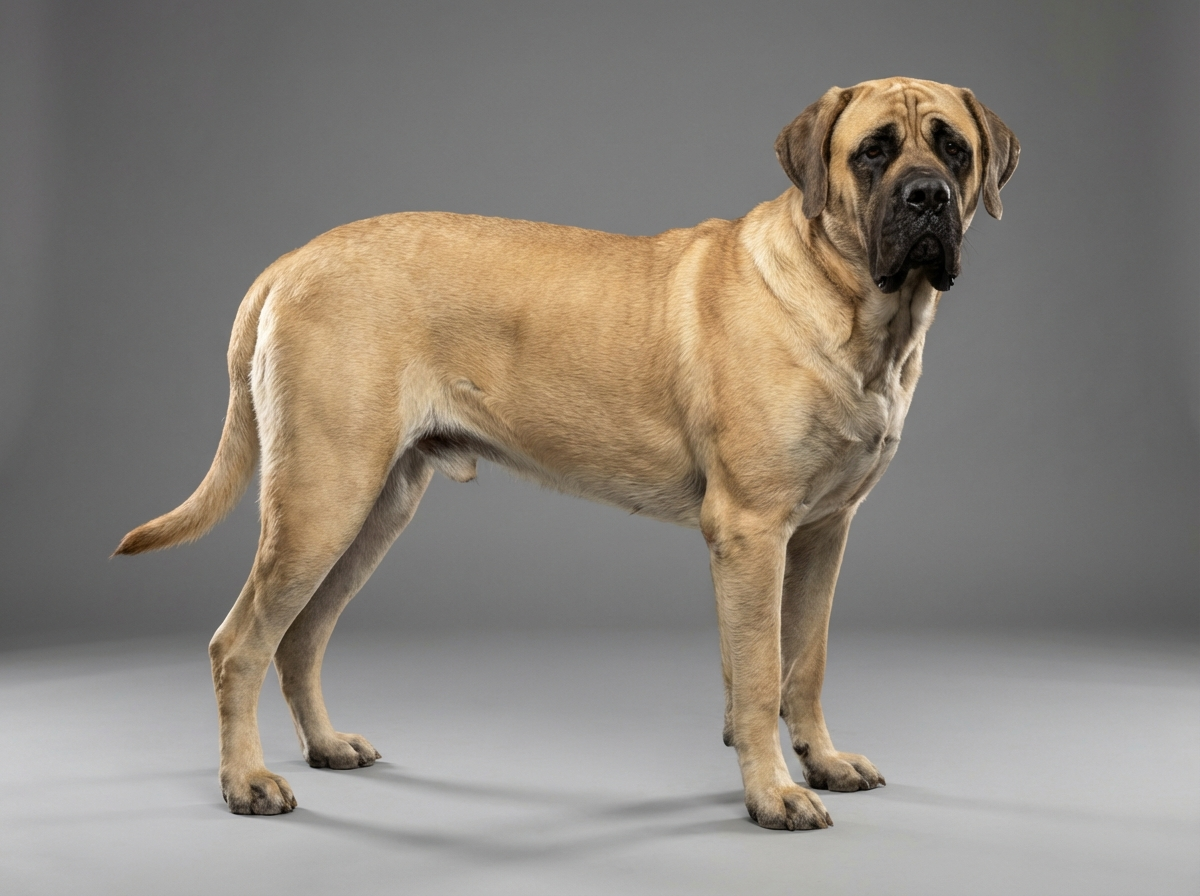
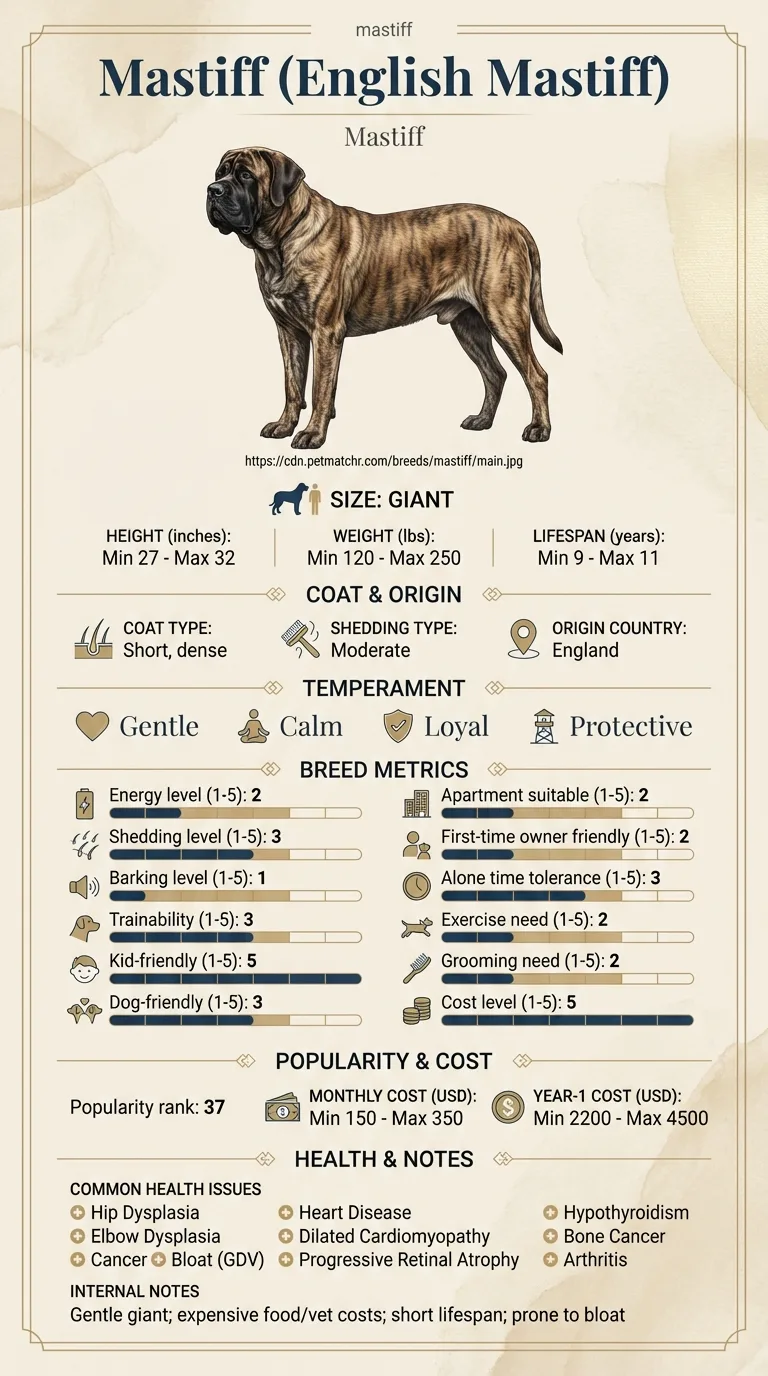
Size dominates. A Mastiff weighing 120 to 250 pounds and standing 27 to 32 inches produces heat throughout its volume but can only shed it across its surface, and panting is the mechanism. That means the respiratory system in this breed is doing thermal work continuously in warm weather, on top of its normal gas exchange. The short, dense coat insulates more than owners expect. Conformation contributes in a lesser way: this is a broad-headed breed with a shortened muzzle and generous facial and throat soft tissue, and some individuals do have narrowed nostrils or excess palate tissue. That places the Mastiff at the mild end of a spectrum whose extreme end belongs to the flat-faced breeds.
Climate and body condition set the difficulty level. A humid summer region without air conditioning removes the margin a large dog needs, since evaporative cooling stalls in moist air. Excess weight, gained over an inactive winter, arrives just in time to reduce lung capacity for the first warm spell. Walking equipment matters too, because a heavy dog leaning into a neck collar compresses its own airway. Enclosed spaces without airflow — cars, conservatories, poorly ventilated crates — are where breathing difficulty most often becomes an emergency.
Go to a clinic immediately, at any hour, for laboured breathing at rest, a dog standing with elbows held away from the body and neck extended to breathe, grey, blue or very pale gums, collapse, or a dog that will not lie down because breathing is easier upright. Treat breathing difficulty in hot weather as a potential heatstroke emergency and begin cooling with water on the belly and inner thighs while travelling. Book a routine appointment for breathing that has become noisier while awake, a new cough particularly at night, reduced tolerance for familiar walks, or gagging on the lead. Ask specifically about both airway and cardiac assessment rather than assuming which it is.
See all Mastiff health problems, which breeds are prone to respiratory disease, or the full Mastiff breed guide for temperament, exercise needs and ownership costs.
Weight-related improvement in breathing is often noticeable within eight to twelve weeks of a controlled diet, well before a target weight is reached. Seasonal management is a permanent annual cycle rather than something that resolves. Where a specific correctable obstruction is found and surgically addressed, improvement is usually apparent within a few weeks of recovery. Where the cause turns out to be cardiac, the timeline follows that condition instead.
Success is a dog that breathes quietly at rest, recovers within a few minutes of a walk, sleeps comfortably, and gets through summer without an incident that frightens anyone. It is not a silent dog; a degree of noise while asleep is normal in a heavy-headed breed. The more important measure of success is that the cause was correctly identified, because managing a cardiac problem as an airway problem, or vice versa, wastes the time in which the right intervention would have helped.
The first and largest is thermal load. Panting is not primarily about oxygen; it is the main way a dog sheds heat. A body of 120 to 250 pounds generates a great deal of heat and has proportionally little surface to lose it from, so a Mastiff has to move a lot of air to stay cool. Add a short but dense coat that insulates well, and the respiratory system is doing heavy work on any warm day before exertion enters the picture. This is why the breed's breathing difficulties cluster in hot weather rather than during exercise in the cold.
The second is body condition. Fat around the chest and abdomen physically restricts how fully the lungs can expand, and it adds tissue that has to be supplied. An overweight Mastiff has a meaningfully smaller respiratory reserve than a lean one, and this is the contributor an owner can actually change.
The third is conformation, honestly weighted. Mastiffs have a broad head with a shortened muzzle and substantial soft tissue in the face and throat, and some individuals do have genuinely narrowed nostrils or excess soft palate tissue that obstructs airflow. It is a real consideration and worth having assessed if your dog is noisy at rest. But it is a moderate feature in this breed rather than the defining one, and a Mastiff struggling to breathe in August is usually telling you about heat and weight before it is telling you about its face.
Some noise is normal in a large, heavy-headed dog. The question is what kind, when, and whether it has changed.

If you think your Mastiff has respiratory disease, the plan is three steps: write down what you have seen and when it started, book a veterinary appointment rather than waiting for the next flare, and take video of the behaviour or symptom before you go — the thing you are worried about rarely happens in the consulting room. Screening in the parents covers hip dysplasia, elbow dysplasia, cancer.
What the vet visit should produce is a diagnosis and a written plan, not just reassurance: what is being ruled out, what the monitoring interval is, and which signs mean you come back sooner. Ask what the treatment costs across a year rather than per visit, because that is the number that decides whether you are managing this condition or reacting to it.
Between appointments, keep a short log — dates, what you saw, what changed. It is the single most useful thing an owner brings to a follow-up, and for respiratory disease it is often what separates a clear pattern from a guess.
Ignatius had owned Mastiffs for twenty years and thought he knew what heavy breathing sounded like in the breed. When his dog Perdita became noisy at seven, he put it down to age and conformation. What prompted the visit was his daughter counting Perdita's breathing while she slept and getting a number that seemed high. She counted again on three separate nights and the number kept climbing. The problem was not the airway at all. An echocardiogram found chamber enlargement with fluid beginning to back up into the lungs. Perdita went onto cardiac medication and her breathing settled within a fortnight. Ignatius's reflection was that he had spent months attributing a symptom to the shape of his dog's head, when the shape of her head had not changed in seven years and her breathing had.
Key takeaway: In a breed people expect to breathe heavily, a genuine change gets absorbed into the expectation. Conformation is a constant; a symptom that appeared this year is not explained by a face the dog has always had, and the sleeping respiratory count is what separated the two.
Only loosely. Figures comparing brachycephalic to non-brachycephalic dogs are dominated by extremely flat-faced breeds, where the muzzle is shortened far more severely than in a Mastiff. This breed has a shortened muzzle but sits at the mild end of that spectrum, so treating those numbers as directly applicable overstates the risk considerably.
A degree of snoring during sleep is common in heavy-headed breeds with generous facial soft tissue, and in a dog that is otherwise comfortable it is usually not a concern. What matters is whether the dog is noisy while awake and resting, and whether the noise has increased. Both are reasons for a proper airway assessment.
Often noticeably, and it is the most reliable intervention available to an owner. Reducing fat around the chest and abdomen allows fuller lung expansion and reduces the total tissue the body has to supply. Owners of overweight giant breeds frequently report quieter, easier breathing well before the target weight is reached.
Only if an assessment finds a specific correctable obstruction, such as genuinely narrowed nostrils or an over-long soft palate causing real interference. It is not a routine procedure for this breed and should never be decided from a breed generalisation. Ask for an examination of the specific structures rather than a recommendation based on head shape.
Because panting is the primary cooling mechanism, and a giant breed has to move a great deal of air to shed the heat its body mass produces. High humidity makes this worse still, since panting cools by evaporation. Seasonal breathing difficulty in this breed is usually a heat problem rather than an airway problem.
Yes, and this is important in a breed where heart disease and dilated cardiomyopathy are documented. Fluid backing up into the lungs causes laboured breathing, a soft cough that is often worse at night, and a rising sleeping respiratory rate. Any new breathing difficulty in an adult Mastiff should include cardiac assessment rather than being assumed to be an airway issue.
Heat load from a very large body with a dense coat, then excess weight restricting lung expansion, then conformation. The face is a genuine but secondary factor in this breed.
Sleep snoring in an otherwise comfortable dog is usually unremarkable. Noise while awake and at rest, or noise that has increased over months, warrants assessment.
Laboured breathing at rest with visible effort, elbows held out, a stretched neck, or grey, blue or pale gums. Go immediately at any hour.
Substantially, and it is the most reliable thing an owner can do. Less fat around the chest and abdomen means fuller lung expansion and less tissue to supply.
Yes. Heart disease is documented in this breed and causes laboured breathing, night-time coughing and a rising sleeping respiratory rate. New breathing difficulty needs cardiac assessment.
A one-page prep sheet for this condition: the signs, the questions to ask, what to get priced. Unlocks here.
You get: Vet visit prep sheet
No spam. One-click unsubscribe. See our privacy policy.
Preview page 1 before you decide.