Health
How do I know if it is a cruciate injury?
Sudden hind limb lameness after a turn or slip, partial improvement then relapse, and sitting with the leg stuck out sideways.

Quick answer
How do I know if it is a cruciate injury?
Sudden hind limb lameness after a turn or slip, partial improvement then relapse, and sitting with the leg stuck out sideways.
Owners almost always describe the moment it happened. The moment is real, but it is the last event in a process that began long before.
Owners facing a surgical quote for a giant breed and trying to understand what the different operations do, and owners whose Mastiff has already had one knee repaired and who have just been told the other side is showing the same signs.
This guide is not medical advice. If your dog shows pain, sudden behavior change, or worsening symptoms, consult a licensed veterinarian.
Some links may be affiliate links. We may earn a commission at no extra cost to you. We only suggest products we believe are helpful for dog owners.
We research and check what we publish, but we do not warrant that any figure, date, price, or statement is accurate, complete, or current, and we accept no liability for any loss, cost, injury, or other harm arising from the use of this site. Use it as one reference among several. You remain responsible for your own decisions and for your dog's care - confirm anything that matters with a licensed veterinarian or another qualified professional before you act on it. Full disclaimer.
Cruciate ligament disease is progressive weakening of the ligament that stabilises the knee, ending in partial or complete rupture. The joint becomes unstable, the dog becomes lame, and arthritis develops quickly if the instability is not corrected. In heavy breeds it is one of the most common orthopaedic problems and one of the most common reasons for major surgery.
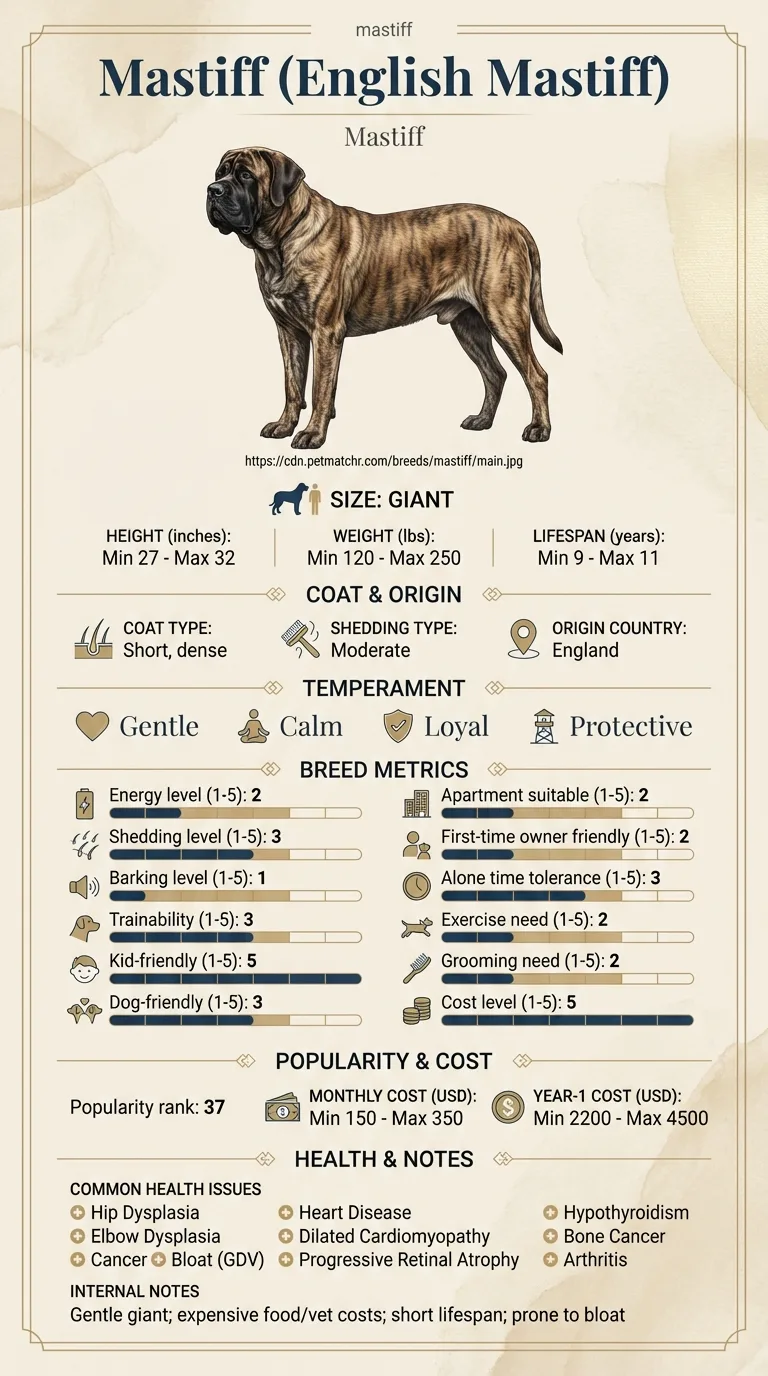
Cruciate disease is among the most frequently treated orthopaedic conditions in dogs overall, and large heavy breeds are strongly over-represented. While it is not listed by name among the English Mastiff's documented health issues, the arthritis and joint disease that are documented share the same underlying mechanics, and any breed carrying 120 to 250 pounds through a small joint is exposed to it.
Load and geometry again. The cruciate ligament is a small structure resisting a large shearing force every time the dog bears weight, and that force scales directly with body mass. A Mastiff generates several times the load of a mid-sized dog through a ligament that is not several times stronger. The angle of the top of the tibia influences how much of that force becomes forward shear, which is precisely why the corrective surgeries used in heavy dogs alter that angle rather than replacing the ligament.
The circumstances of the final tear are usually environmental. Slippery indoor flooring causes the hind limbs to splay under a heavy dog. Wet grass and mud on a turn does the same outdoors. Jumping down from a car boot loads the joint hard on landing. Beyond the moment itself, a sedentary routine with poor hind limb muscle leaves the joint less supported, and every extra pound of body weight is a permanent increase in the force the ligament resists.
Book an appointment for any hind limb lameness that has not resolved within a few days, and do not be reassured by partial improvement, which is characteristic of a partial tear. Seek same-day attention if your Mastiff cannot bear any weight on a hind limb, if the knee is hot and swollen, if there is obvious severe pain, or if the dog cannot stand at all. After surgery, contact the practice urgently if the wound opens, discharges or smells, if swelling increases sharply, if the dog suddenly becomes non-weight-bearing again, or if it will not eat, since implant complications need identifying early.
See all Mastiff health problems, which breeds are prone to cruciate ligament injuries, or the full Mastiff breed guide for temperament, exercise needs and ownership costs.
Six weeks of strict rest, then a graduated increase over the following six to twelve weeks, with rechecks and often repeat radiographs at around eight weeks. Most dogs are using the leg well by three months and back to full normal activity between three and six months. Arthritis in the operated joint continues to develop slowly regardless, and is managed thereafter.
Success is a dog that returns to comfortable, sound movement on its usual walks and does not favour the leg months later. It is not a knee that looks normal on a radiograph, because some arthritis is inevitable. A realistic further goal is delaying or avoiding the second side, which is largely achieved through weight control and consistent exercise rather than through anything the surgeon does.
The presentation is characteristic enough that many owners suspect it before the appointment, particularly the second time around.
In a small dog, conservative management of a cruciate rupture is a legitimate option and many do reasonably well without an operation. In a giant breed it generally is not. The forces passing through the joint are simply too great for scar tissue and muscle to stabilise, and an unstable knee grinds itself into severe arthritis within months while the dog transfers its weight to the other hind limb, which is precisely how the second ligament fails.
The procedures divide into two families. Techniques that place a synthetic replacement outside the joint to mimic the ligament work well in smaller dogs but are generally considered inadequate for the loads a Mastiff generates. The operations used in heavy dogs instead change the geometry of the joint itself, cutting and repositioning part of the tibia so that the slope no longer drives the bone forward when the dog bears weight. Once the mechanics are altered, the missing ligament matters much less.
Those procedures are major orthopaedic surgery. They involve cutting bone, implanting a plate, an anaesthetic in a patient that may weigh a quarter of a ton, and a recovery period measured in months. The cost reflects all of that, and for a giant breed it sits at the upper end of what is quoted for the procedure generally. Many owners face it twice.
Recovery is where owners underestimate the commitment. The first six weeks require genuinely strict confinement, lead-only toileting, no stairs, no jumping and no running, on an animal that is strong enough to ignore all of those rules if it decides to. Planning the physical space in advance, a confined ground-floor room with non-slip flooring, matters more than anything you buy.
The honest framing for a Mastiff owner is that this is one of the most likely major surgical expenses in the breed after bloat, and that the probability of needing it on the second side within a couple of years is substantial.

Hazel's Mastiff Dunn tore his right cruciate at six, turning in a wet field. He had surgery three weeks later and recovered well, and by four months he was walking his normal route. Fourteen months after that he came in lame on the left. Her surgeon had warned her this was likely, and Hazel had put money aside, but she had not expected it to be almost exactly the same story: no dramatic incident, just a turn on grass. What she did differently the second time was to start the physiotherapy referral before the surgery rather than after, and to set up the confinement room properly in advance, with rubber matting and a stair gate, so nothing had to be improvised while Dunn was groggy. The second recovery went faster than the first. Dunn is nine now, carrying arthritis in both knees, managed on a plan his vet reviews twice a year, and still doing his two short daily walks.
Key takeaway: In a heavy breed, assume the second knee is a real possibility from the day the first one goes, and prepare the money, the room and the physiotherapy referral accordingly.
The ligament itself does not repair. Some small dogs stabilise well enough with scar tissue and muscle to be comfortable, but that route is generally not considered adequate for a giant breed, where the loads are far higher and the joint deteriorates quickly if left unstable.
Because in most dogs the ligament had already been degenerating for months. The final tear happens during ordinary movement precisely because the ligament was already close to failing. This is why cruciate disease is better thought of as a slow condition with a sudden ending.
There is a substantial chance. The same underlying degeneration is usually present on both sides, and the injured dog transfers weight onto the good leg, which accelerates it. Many owners of large dogs find themselves back within one to two years.
Procedures that change the geometry of the tibia are generally preferred in heavy dogs over those that place a synthetic ligament substitute outside the joint. The specific choice belongs to the surgeon who has examined your dog and its radiographs, and it is a fair question to ask them to explain.
Expect six weeks of strict confinement and lead-only movement, followed by six to twelve weeks of gradually increasing controlled exercise, with a recheck and often repeat radiographs along the way. Most dogs are back to normal activity somewhere between three and six months.
Nothing reliably prevents cruciate degeneration, but keeping the dog lean genuinely reduces the load on the joint and is the best-supported measure. Consistent moderate exercise that maintains muscle beats the sedentary week followed by a strenuous weekend, which is a classic setup for a tear.
Geometry-altering knee surgery is a four-figure expense in most markets, and giant breed patients sit at the top of the range because of implant size, surgical time and anaesthetic requirements. Assume you may face it on both sides, and check what your insurance says about bilateral conditions before you need to know.
Sudden hind limb lameness after a turn or slip, partial improvement then relapse, and sitting with the leg stuck out sideways.
Generally yes. Forces through the joint are too high for conservative management, and an unstable knee develops severe arthritis quickly.
Substantially likely, often within one to two years, because the same degeneration is usually present on both sides.
Six weeks of strict confinement with lead-only toileting, then a graduated return over a further two to three months.
Keeping the dog lean and exercising it consistently rather than sporadically. Neither eliminates the risk but both reduce joint load.
A one-page prep sheet for this condition: the signs, the questions to ask, what to get priced. Unlocks here.
You get: Vet visit prep sheet
No spam. One-click unsubscribe. See our privacy policy.
Preview page 1 before you decide.