Health
What is OCD in a growing dog?
A layer of joint cartilage grows too thick to be nourished, the deepest part dies, and a flap separates from the bone beneath, causing pain and inflammation in the joint.

Quick answer
What is OCD in a growing dog?
A layer of joint cartilage grows too thick to be nourished, the deepest part dies, and a flap separates from the bone beneath, causing pain and inflammation in the joint.
This is a disease of growing too fast, and the growth in question happens in the first year of a dog heading for two hundred pounds.
Owners of a Mastiff puppy or young adult with a limp that will not settle, and owners planning the first year of a giant-breed puppy who want to know how feeding affects joint development.
This guide is not medical advice. If your dog shows pain, sudden behavior change, or worsening symptoms, consult a licensed veterinarian.
Some links may be affiliate links. We may earn a commission at no extra cost to you. We only suggest products we believe are helpful for dog owners.
We research and check what we publish, but we do not warrant that any figure, date, price, or statement is accurate, complete, or current, and we accept no liability for any loss, cost, injury, or other harm arising from the use of this site. Use it as one reference among several. You remain responsible for your own decisions and for your dog's care - confirm anything that matters with a licensed veterinarian or another qualified professional before you act on it. Full disclaimer.
Osteochondritis dissecans occurs when joint cartilage in a fast-growing puppy becomes too thick to be nourished, so its deepest layer dies and a flap lifts away from the bone underneath. The loose flap causes pain and inflammation and can break free into the joint. It affects the shoulder most often, appears between roughly four and ten months, and is strongly linked to growth rate in large and giant breeds.
Abnormal cartilage development causing joint discomfort is a recognised concern in Mastiffs, and OCD is one of the standard differentials for lameness in any rapidly growing giant-breed puppy. It sits alongside hip dysplasia and elbow dysplasia, both explicitly documented for this breed, as part of a cluster of growth-related orthopaedic problems.
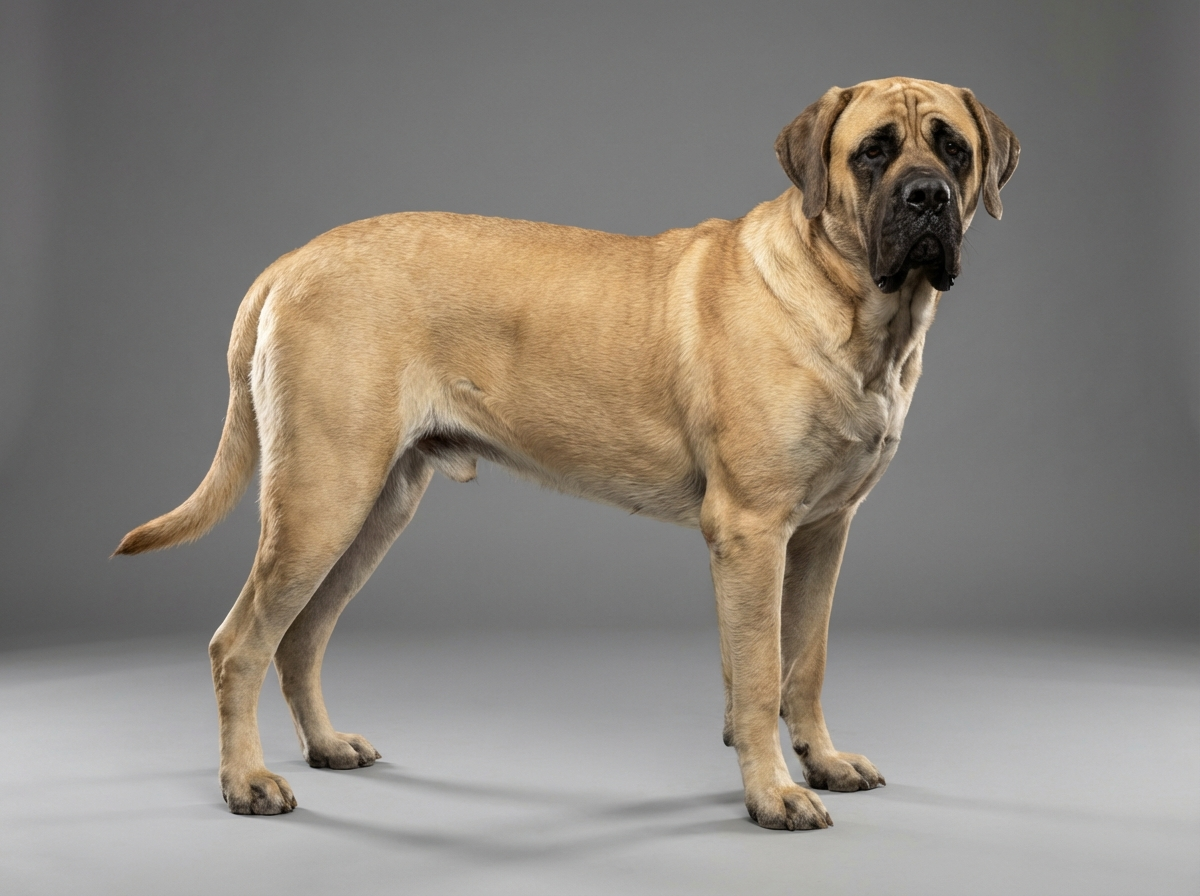
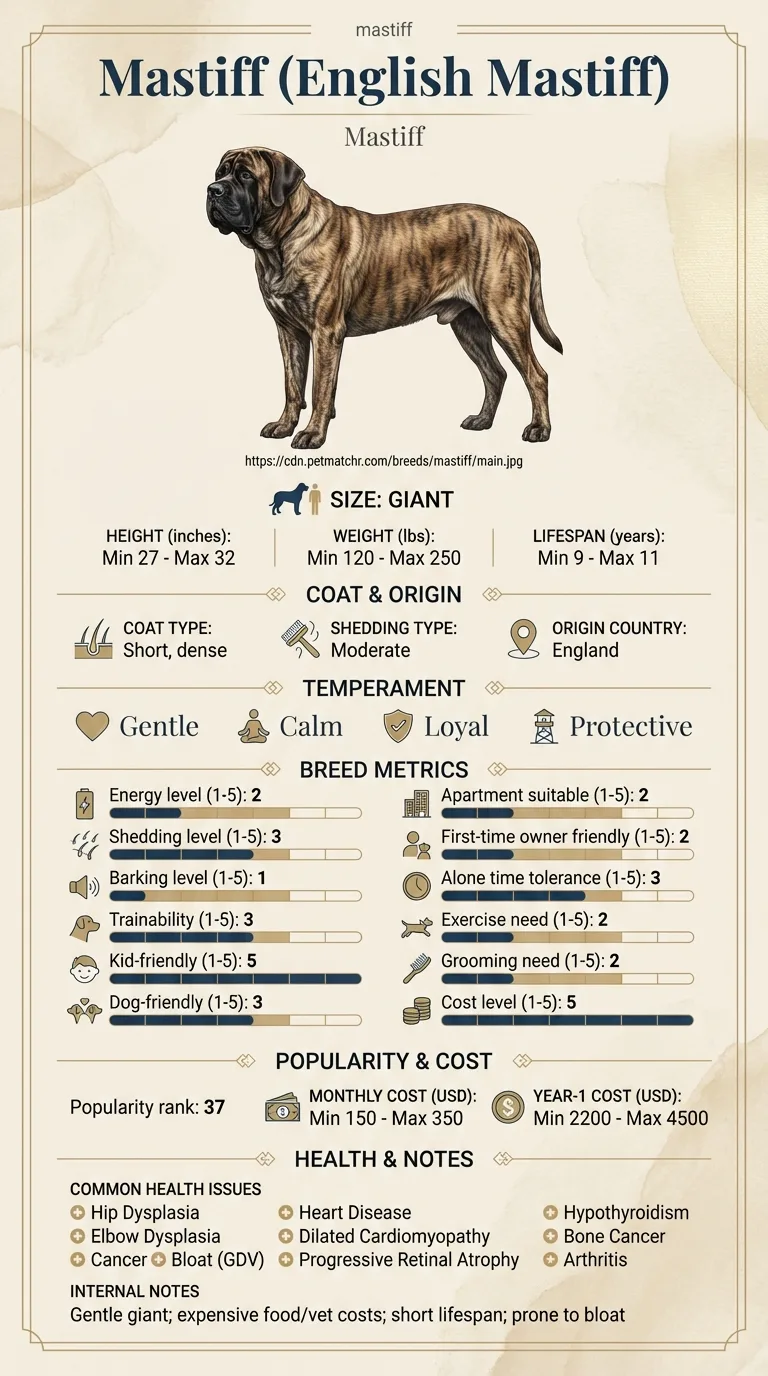
The Mastiff has one of the most demanding growth trajectories of any dog. A puppy that will reach 120 to 250 pounds and stand 27 to 32 inches at the shoulder must build that entire skeleton within roughly twelve to eighteen months, and joint cartilage is under continuous load throughout. That is precisely the setting in which cartilage can be laid down faster than it is converted. The breed's documented hip and elbow dysplasia reflect the same underlying pressure, and a susceptibility to abnormal cartilage development is recognised here.
Growth-stage nutrition is the dominant modifiable factor. Feeding a giant-breed puppy generously, or using a food not formulated for large-breed growth, accelerates development in the wrong way. Adding calcium to a complete food is actively harmful and is a mistake owners make with good intentions. Activity matters next: forced exercise, long walks on hard surfaces, stairs and jumping down from vehicles all load joints heavily during the vulnerable window. Slippery flooring adds abnormal loading angles to an already stressed joint.
Book an appointment for any limp in a growing giant-breed puppy that lasts more than a couple of days, for lameness that is worse after rest, or for a young dog that has become reluctant on walks it used to enjoy. Reluctance without an obvious limp matters here, because bilateral disease often presents that way. Seek same-day care if your puppy will not bear weight on a limb at all, if a joint is hot or visibly swollen, if there is obvious pain on handling, or if lameness began after a fall. Ask specifically about radiographs of the shoulder and elbow rather than accepting a period of rest without imaging if lameness persists.
See all Mastiff health problems, which breeds are prone to osteochondritis dissecans ocd, or the full Mastiff breed guide for temperament, exercise needs and ownership costs.
Diagnosis usually takes one to three weeks including imaging. Conservative management is trialled over four to eight weeks of genuinely restricted activity, which requires more discipline than most households expect. Where surgery is performed, arthroscopic removal typically involves a recovery of six to eight weeks with controlled activity, and improvement is often apparent within the first month. Skeletal growth completes over twelve to eighteen months, after which the risk of new lesions passes.
Success is a sound dog with a comfortable joint who goes on to a normal, active adult life, accepting that some arthritic change in the affected joint is likely over the years. It is not an undamaged joint. The broader success, for owners still in the growth phase, is a puppy that never develops the problem at all, which is genuinely achievable through controlled feeding, a lean body condition and sensible activity limits during the first year.
Cartilage on a joint surface is nourished by diffusion from the joint fluid and from the bone below. It has no blood vessels of its own. That works well when the layer is thin, and fails when it is not.
In a rapidly growing large-breed puppy, the conversion of cartilage to bone can fall behind the rate at which cartilage is being laid down. The layer thickens, the deepest cells become too far from any nutrient source, and they die. A fissure forms at that dead layer, and the cartilage above it lifts away from the bone as a flap.
Once loose, the flap moves with the joint. It causes pain directly, provokes inflammation in the joint lining, and can break free entirely to float in the joint. Whether it heals or worsens depends largely on its size and on whether the joint keeps being loaded hard.
The shoulder is the most frequently affected joint, followed by the elbow, the stifle and the hock. Shoulder involvement produces a front-limb lameness that owners often mislocate, because a dog offloading a sore shoulder nods its head as it walks and the movement can look like it is coming from anywhere.
Signs typically appear between about four and ten months, which in a Mastiff coincides with the period of most rapid weight gain. Lameness is often worse after rest and after exercise, and may affect both sides, which confuses the picture further because a dog lame on both front legs may just look stiff or reluctant rather than obviously limping.
This is one of the few skeletal conditions where owner decisions during the first year genuinely shift the odds, which makes the practical guidance worth taking seriously.

If you think your Mastiff has osteochondritis dissecans (ocd), the plan is three steps: write down what you have seen and when it started, book a veterinary appointment rather than waiting for the next flare, and take video of the behaviour or symptom before you go — the thing you are worried about rarely happens in the consulting room. Screening in the parents covers hip dysplasia, elbow dysplasia, cancer.
What the vet visit should produce is a diagnosis and a written plan, not just reassurance: what is being ruled out, what the monitoring interval is, and which signs mean you come back sooner. Ask what the treatment costs across a year rather than per visit, because that is the number that decides whether you are managing this condition or reacting to it.
Between appointments, keep a short log — dates, what you saw, what changed. It is the single most useful thing an owner brings to a follow-up, and for osteochondritis dissecans (ocd) it is often what separates a clear pattern from a guess.
Kester was proud of how fast his Mastiff puppy, Wilhelmina, was growing. She was well ahead of her littermates at five months and he fed her generously, on the reasoning that a giant breed needed it. She began favouring her right front leg at six months, worst first thing in the morning and again after their afternoon walk. His vet took radiographs of both shoulders and found a lesion on the right, with a smaller one developing on the left. Wilhelmina had arthroscopic surgery on the right shoulder. The larger change, though, was to her feeding. Her vet set a target growth curve and Kester moved to weighed portions of a giant-breed puppy food, which felt to him like underfeeding her. She was lean for the rest of her growth. The left shoulder settled without surgery. She finished growing at 168 pounds and has been sound since, with an annual check on both shoulders.
Key takeaway: Growing fast is not the same as growing well. Kester's generous feeding was well intentioned and was part of the mechanism, and the change that protected the second shoulder was a scale in the kitchen rather than anything that happened in an operating theatre.
Abnormal cartilage development causing joint discomfort is a recognised concern in this breed, and OCD as a category is strongly associated with rapidly growing large and giant breeds generally. The Mastiff's growth curve, from a few pounds to well over a hundred inside a year, places it firmly in the at-risk group alongside its documented hip and elbow dysplasia.
Radiographs of the affected joint are the starting point and often show the defect, particularly in the shoulder. Elbow lesions can be harder to see, and CT or arthroscopy is sometimes needed for a clear answer. Arthroscopy has the advantage of allowing the flap to be removed during the same procedure.
No. Small lesions in some joints can heal with strict rest and controlled activity over a period of weeks. Larger flaps, and those causing persistent lameness, are usually better removed, because a loose flap continuing to move within the joint drives ongoing damage. Your vet or surgeon will base this on the size and site.
Some degree of arthritic change in the affected joint is likely over time, even after successful surgery, because the joint surface has been damaged. Arthritis is already documented in this breed. What treatment and weight control achieve is slowing that process, not preventing it entirely, and a great deal can be gained by starting early.
Yes, and bilateral disease is not unusual. It also makes the lameness much harder to see, because a dog sore on both sides does not limp so much as move stiffly, shorten its stride, or become reluctant to walk. A young giant-breed dog that has become reluctant on walks deserves a proper examination.
Not entirely, since there is a genetic component and cases occur in well-managed puppies. But growth rate is a real and modifiable factor, and controlled feeding with sensible activity limits during the first year meaningfully reduces the risk. This is one of the areas where owner decisions genuinely matter.
A layer of joint cartilage grows too thick to be nourished, the deepest part dies, and a flap separates from the bone beneath, causing pain and inflammation in the joint.
Usually between about four and ten months, which in a Mastiff is the period of fastest weight gain. Lameness is often worse after rest and after exercise.
The shoulder most commonly, then elbow, stifle and hock. Shoulder lameness is frequently mislocated by owners because the head nods as the dog walks.
Feeding for maximum growth loads immature cartilage sooner. Use a giant-breed puppy food, measure portions, keep the puppy lean, and never add calcium supplements.
No. Small lesions can heal with strict rest. Larger flaps causing persistent lameness are usually removed, often arthroscopically, to stop ongoing joint damage.
A one-page prep sheet for this condition: the signs, the questions to ask, what to get priced. Unlocks here.
You get: Vet visit prep sheet
No spam. One-click unsubscribe. See our privacy policy.
Preview page 1 before you decide.