Living
What is the hardest practical part of a Mastiff cardiac diagnosis?
Moving the dog. A ramp, non-slip flooring and a support harness with a rear handle, all practised while your dog is still well, solve most of it.

Quick answer
What is the hardest practical part of a Mastiff cardiac diagnosis?
Moving the dog. A ramp, non-slip flooring and a support harness with a rear handle, all practised while your dog is still well, solve most of it.
Nobody warns you that the hardest part of a giant-breed cardiac diagnosis is moving the dog.
Owners past the diagnostic stage who now have to build the daily routine — often while managing arthritis or hip problems in the same dog, and while working out what all of this is going to cost.
This guide is not medical advice. If your dog shows pain, sudden behavior change, or worsening symptoms, consult a licensed veterinarian.
Some links may be affiliate links. We may earn a commission at no extra cost to you. We only suggest products we believe are helpful for dog owners.
We research and check what we publish, but we do not warrant that any figure, date, price, or statement is accurate, complete, or current, and we accept no liability for any loss, cost, injury, or other harm arising from the use of this site. Use it as one reference among several. You remain responsible for your own decisions and for your dog's care - confirm anything that matters with a licensed veterinarian or another qualified professional before you act on it. Full disclaimer.
Once a Mastiff has a confirmed cardiac problem, the work shifts from diagnosis to daily management. That means a medication routine sustained for years, a home and vehicle set up for a very heavy dog with less stamina, seasonal planning around heat, and a household that knows what deterioration looks like. The medicine is your vet's job; the infrastructure is yours.
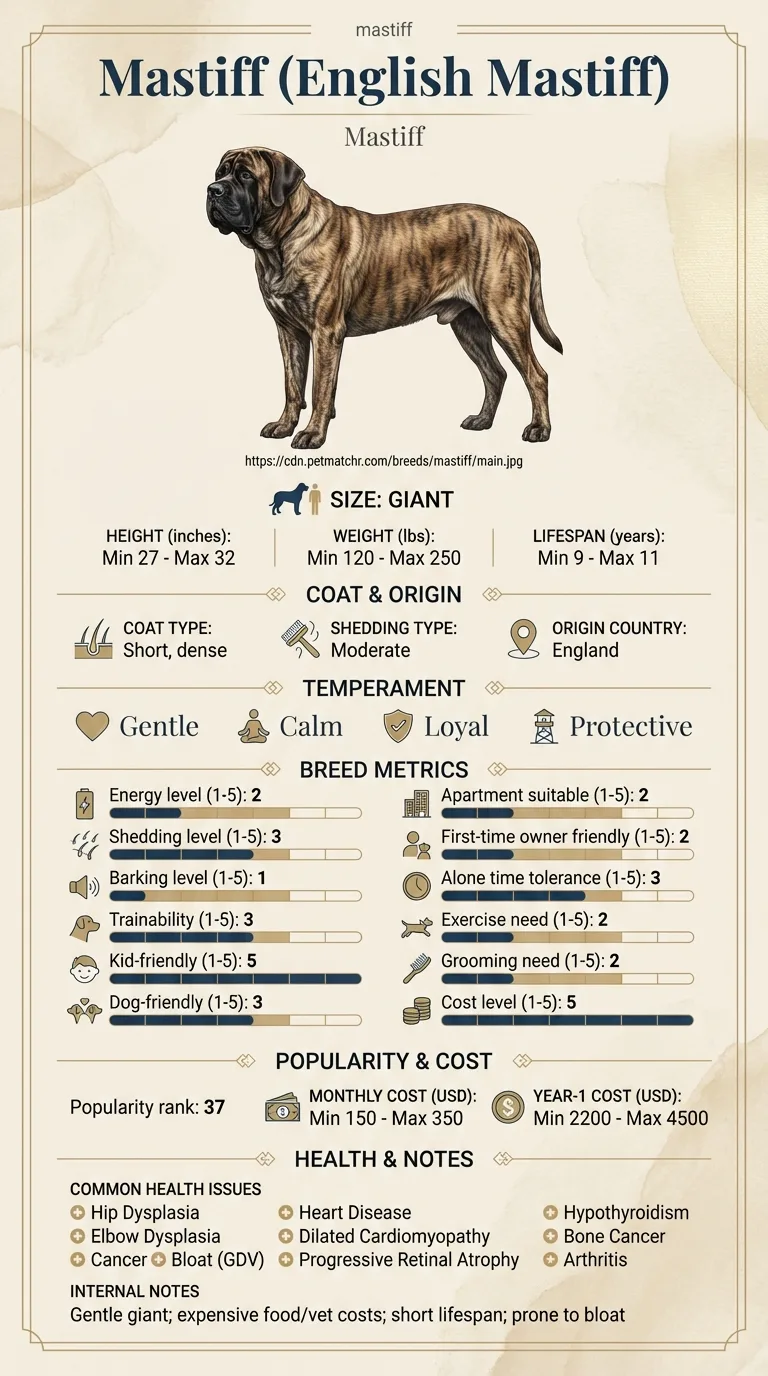
Heart disease appears on the Mastiff's documented health issue list, and giant breeds are widely recognised as carrying elevated cardiac risk. Many Mastiff owners will eventually manage some form of it, most often in the second half of a life that runs only nine to eleven years.
Everything about managing a cardiac Mastiff is complicated by scale. At 120 to 250 pounds the dog cannot be lifted, medication doses are large and expensive, and the same body mass that makes the heart's job hard also makes cooling inefficient thanks to a short, dense coat and low surface area. The breed's calm, low-energy temperament is a double-edged asset here: it makes rest easy to enforce, but it also hides declining capacity because a Mastiff resting more looks entirely normal.
Household setup does more work than most owners expect. Hard floors, stairs, a high tailgate and a bed on an upper storey each turn ordinary movement into exertion for a dog whose reserve has shrunk. Climate is the other major factor: a home without meaningful cooling turns every summer week into a sustained challenge. Routine matters too, since a household with no fixed medication schedule accumulates missed doses that look, clinically, like the disease progressing faster than it is.
Go immediately, at any hour, if your Mastiff is breathing with visible effort while resting, refuses to lie down and keeps standing or sitting up to breathe, has grey, blue or very pale gums, collapses, or seems suddenly disoriented. A distended abdomen with retching in this bloat-prone breed is also an emergency and should never be assumed to be cardiac. Call within a day or two for a persistent new cough, a sleeping breathing rate that has stayed elevated for several days, a sudden refusal of food, or unexplained weight loss alongside a swelling belly.
See all Mastiff health problems, which breeds are prone to heart problems, or the full Mastiff breed guide for temperament, exercise needs and ownership costs.
Expect two to four weeks to settle into the medication routine and get the household adjustments in place. After that, life runs in recheck intervals of three to six months, with the plan adjusted at most of them. Stable periods of many months are common and normal. Decline, when it comes, is often stepwise rather than gradual: a good plateau, then a bad fortnight, then a new plateau at a slightly lower level.
Success is a dog who sleeps comfortably, eats well, still wants the short walk, and gets to the vet without a struggle. It is measured in stable months rather than in improvement, because most cardiac disease in this breed is managed rather than reversed. Given that a Mastiff's whole life spans nine to eleven years, buying two good years with a routine you can sustain is a genuinely large result, not a consolation prize.
Cardiac management fails on adherence far more often than on drug choice. In a household with a Mastiff, the practical obstacles are specific.
This is where the giant-breed reality bites. A Labrador with reduced stamina can be picked up and carried. A Mastiff standing 27 to 32 inches at the shoulder and weighing anywhere from 120 to 250 pounds cannot, and pretending otherwise gets owners injured.
Plan for it before you need it. A sturdy ramp for the car, kept in the car rather than the garage, means a trip to the vet does not depend on your back. Practise the ramp while your dog is still well; a dog who has never seen one will not learn it on a bad day. Inside the house, move the bed to the ground floor if it is not already, and put non-slip runners on any hard flooring the dog crosses regularly, because a heavy dog who slips and cannot get up is a two-person problem.
A support harness with a handle over the hips is worth owning. Used correctly it lets you take some weight during a stand-up rather than lifting a dog you cannot lift. Ask your vet or a physiotherapist to show you the technique, since a harness used wrongly puts strain on a chest that is already working hard.
Think about the exit route. If your Mastiff needed emergency care tonight, how would the dog get from the sofa to the car, and who else is home? Owners who have answered that question in advance make far better decisions at two in the morning.

If you think your Mastiff has heart problems, the plan is three steps: write down what you have seen and when it started, book a veterinary appointment rather than waiting for the next flare, and take video of the behaviour or symptom before you go — the thing you are worried about rarely happens in the consulting room. Screening in the parents covers hip dysplasia, elbow dysplasia, cancer.
What the vet visit should produce is a diagnosis and a written plan, not just reassurance: what is being ruled out, what the monitoring interval is, and which signs mean you come back sooner. Ask what the treatment costs across a year rather than per visit, because that is the number that decides whether you are managing this condition or reacting to it.
Between appointments, keep a short log — dates, what you saw, what changed. It is the single most useful thing an owner brings to a follow-up, and for heart problems it is often what separates a clear pattern from a guess.
When her Mastiff Fennick was diagnosed at seven, Priya's cardiologist mentioned almost in passing that she should sort out car access before she needed it. Fennick was still jumping into the estate car easily and the advice felt premature, but she bought a ramp anyway and spent three weeks feeding him dinner at the top of it until using it was unremarkable. Fourteen months later Fennick had a bad night and needed to be seen urgently. He weighed 190 pounds and Priya was on her own. He walked up the ramp without hesitating. The episode turned out to be a medication adjustment rather than a crisis, and he had another good year afterwards. Priya says the ramp was the single most useful thing she did, and the thing she nearly did not bother with.
Key takeaway: The equipment for a large cardiac dog has to be bought and practised while the dog is still well. A Mastiff who has never seen a ramp will not learn one on the night it matters, and no owner can carry two hundred pounds to a car.
Medication cost scales with body weight, so a Mastiff sits at the expensive end of every cardiac drug. Add rechecks with imaging every three to six months. Realistically this lands as a significant addition to the 150 to 350 dollars a month that routine Mastiff ownership already runs, and it continues for life.
Usually yes, and usually should. The instruction is normally shorter, slower, cooler and more frequent rather than none at all. Mastiffs have naturally low exercise needs, so a cardiac limit often looks close to what the dog wanted anyway. Ask your cardiologist for a concrete boundary rather than a vague one.
It deserves real respect. This breed already cools inefficiently because of its mass and short, dense coat, and a compromised circulation makes that worse. Plan the hot months around dawn and dusk walks, air conditioning or fans, cool floor surfaces, and constant water. Never leave the dog in a parked car, even briefly.
Do not change it on your own. Diet in cardiac patients is a genuine veterinary conversation involving sodium, calories and sometimes specific formulations, and getting it wrong is easy. There is also a bloat consideration in this breed that makes abrupt diet changes and large single meals inadvisable regardless.
The reliable home markers are a rising sleeping breathing rate, a belly that looks fuller while the dog is losing condition elsewhere, reluctance on walks that used to be easy, and restlessness at night from difficulty settling. Any of these justify a call rather than waiting for the next scheduled recheck.
Honestly and early. Write down three or four things your dog visibly enjoys while things are stable, and revisit that list monthly. It is much easier to judge decline against a written baseline than against a memory, and it makes a difficult conversation with your vet clearer when it comes.
Moving the dog. A ramp, non-slip flooring and a support harness with a rear handle, all practised while your dog is still well, solve most of it.
Anchor doses to existing habits, use a weekly pill organiser, set a reorder reminder at one week remaining, and name a backup person.
Rarely. Most cardiac plans allow shorter, slower, cooler walks. Ask for a specific limit rather than accepting general advice to take it easy.
Poor heat dissipation from high body mass plus a compromised circulation. Shift activity to dawn and dusk, keep the house cool, and never use a parked car.
Only with your vet. Cardiac diets involve sodium and calorie targets, and abrupt food changes carry separate bloat risk in this breed.
A one-page prep sheet for this condition: the signs, the questions to ask, what to get priced. Unlocks here.
You get: Vet visit prep sheet
No spam. One-click unsubscribe. See our privacy policy.
Preview page 1 before you decide.