Health
When is von Willebrand's disease usually discovered?
Often during a routine surgery like spay or neuter, when bleeding lasts longer than expected.

Quick answer
When is von Willebrand's disease usually discovered?
Often during a routine surgery like spay or neuter, when bleeding lasts longer than expected.
A dog with this condition can look completely normal its entire life until the first time it undergoes a procedure or injury that tests its ability to clot, which is exactly why pre-surgical screening matters more than watching for obvious daily symptoms.
Owners preparing for a puppy's spay or neuter who want to understand pre-surgical bleeding risk, and owners navigating an unexpectedly prolonged bleeding episode after a minor injury or procedure.
This guide is not medical advice. If your dog shows pain, sudden behavior change, or worsening symptoms, consult a licensed veterinarian.
Some links may be affiliate links. We may earn a commission at no extra cost to you. We only suggest products we believe are helpful for dog owners.
We research and check what we publish, but we do not warrant that any figure, date, price, or statement is accurate, complete, or current, and we accept no liability for any loss, cost, injury, or other harm arising from the use of this site. Use it as one reference among several. You remain responsible for your own decisions and for your dog's care - confirm anything that matters with a licensed veterinarian or another qualified professional before you act on it. Full disclaimer.
Von Willebrand's disease is an inherited bleeding disorder caused by a deficiency in von Willebrand factor, a protein essential to normal blood clotting. Most affected dogs, including Labradors, have the milder Type 1 form and show no daily symptoms, with the condition often first discovered when a routine surgery leads to unexpectedly prolonged bleeding rather than through any prior obvious sign.
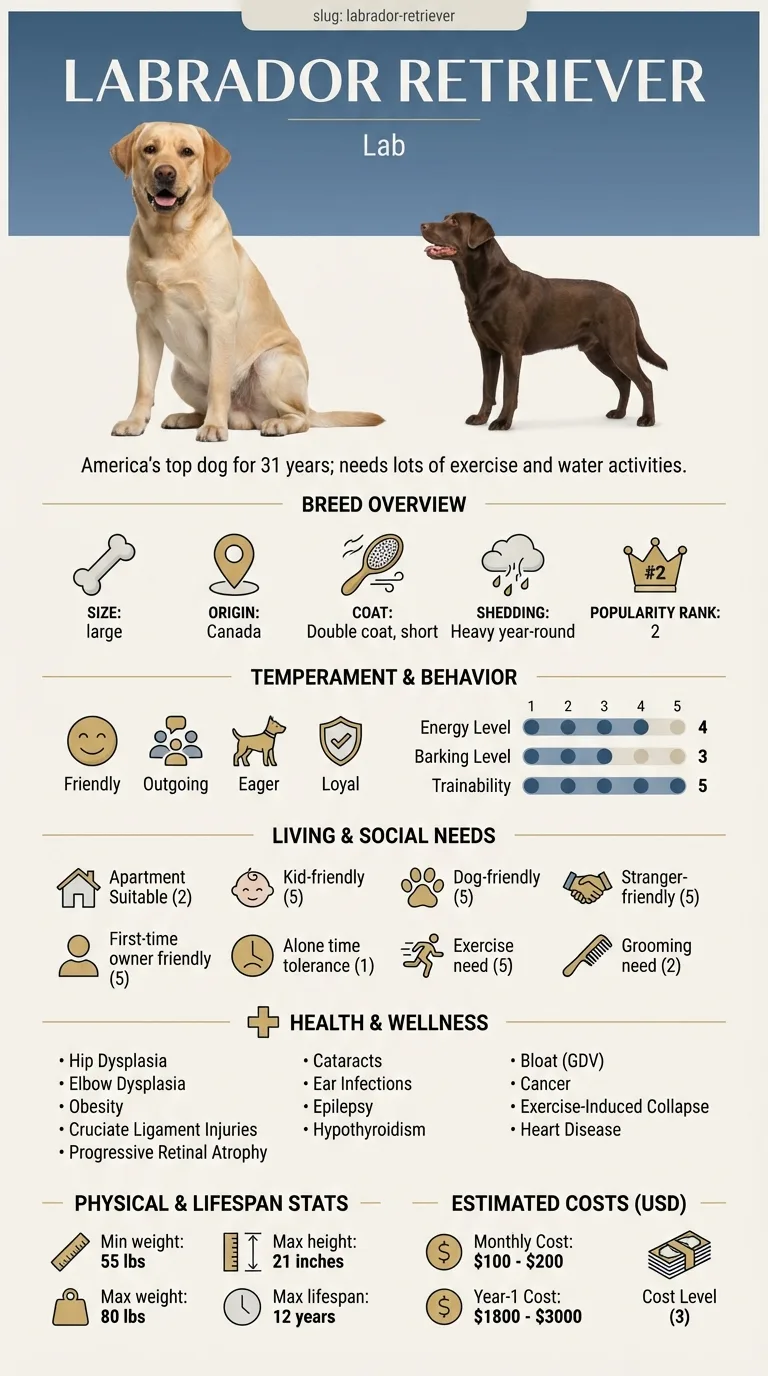
Von Willebrand's disease is documented across many breeds including Labrador Retrievers, though it's less breed-defining in Labs than in certain other breeds where it's discussed more prominently, making individual genetic testing more informative than assuming risk based on breed alone.
Von Willebrand's disease has a documented genetic basis that can appear across many breeds including Labrador Retrievers, though it's not considered as strongly breed-defining here as in some other specific breeds. Its inherited nature means an individual dog's specific lineage matters more for actual risk than general breed statistics alone.
There's no environmental trigger for the underlying genetic clotting deficiency itself — it's present from birth regardless of diet, exercise, or general care. Environmental relevance comes into play only through the specific events (surgery, trauma) that test clotting capacity and reveal the underlying condition.
Mention any prolonged bleeding from minor injuries or a family history of bleeding issues before your dog's next surgery, and seek prompt veterinary care for bleeding that doesn't stop within a reasonable time after any injury or procedure — this can become a genuine emergency if blood loss is significant.
See all Labrador Retriever health problems, which breeds are prone to von willebrands disease, or the full Labrador Retriever breed guide for temperament, exercise needs and ownership costs.
Testing is typically a single blood draw with results available within a few days to a week. Once diagnosed, management is a lifelong awareness item factored into any future medical or surgical planning, rather than an ongoing daily treatment.
Success means a known diagnosis factored proactively into future surgical and medical planning, avoiding an unexpected bleeding scare — most affected dogs, especially with the common milder Type 1 form, live completely normal lives with this awareness in place.
Von Willebrand's disease is caused by a deficiency or dysfunction of von Willebrand factor, a protein that helps platelets stick together and adhere to injured blood vessel walls during the initial phase of clot formation. Without enough functional von Willebrand factor, that first step of clotting is impaired, which means even a minor cut, a nail trim gone slightly too short, or a routine surgical incision can bleed longer and more heavily than expected.
Severity varies across three recognized types, with Type 1 being the mildest and most common form across affected breeds, often causing only mild to moderate bleeding tendencies rather than dramatic hemorrhage. Many affected dogs go their entire lives without a spontaneous bleeding episode, since normal daily activity rarely tests clotting capacity the way surgery, significant trauma, or a deep laceration does.
Diagnosis involves a specific blood test measuring von Willebrand factor levels, and because it's an inherited condition, genetic testing is also available for identifying carrier and affected status in breeding programs, similar in concept to how other inherited conditions in this breed are screened for before pairing decisions are made.

Since daily symptoms are often absent or subtle, these specific signs and history details are what actually prompt testing before a surgical bleeding scare happens.
When her Lab puppy, Daisy, was spayed at six months old, owner Fatima was alarmed when the vet clinic called partway through recovery to say Daisy was bleeding more than typical from the incision site. Bloodwork afterward confirmed von Willebrand's disease, Type 1. Daisy recovered fully with extra monitoring and supportive care, and Fatima now makes sure every new vet or groomer she sees knows about the diagnosis before any procedure. Daisy has had no further bleeding issues in the years since, since minor daily activities rarely test her clotting capacity the way surgery did.
Key takeaway: An unexpectedly prolonged bleeding episode after a routine procedure is often the very first sign of this condition, precisely because it rarely shows up any other way in daily life.
It's an inherited bleeding disorder caused by a deficiency or dysfunction of von Willebrand factor, a protein essential to the first step of normal blood clotting, which can lead to prolonged bleeding after injury or surgery.
A specific blood test measuring von Willebrand factor levels is the standard diagnostic tool, sometimes combined with genetic testing to identify carrier or affected status, particularly relevant for breeding decisions.
It's a reasonable precaution, especially if there's any known family history of bleeding issues, since many cases are first discovered when a routine procedure leads to unexpectedly prolonged bleeding rather than through any prior daily symptom.
Most affected dogs have Type 1, the mildest and most common form, causing mild to moderate bleeding tendencies rather than dramatic spontaneous hemorrhage, and many go their entire lives without a serious bleeding episode outside of surgery or significant trauma.
There's no cure, since it's a genetic condition, but it can be managed — surgeries can be planned with precautions like special clotting support medication, and bleeding episodes are treated as they arise rather than prevented outright.
A blood test for von Willebrand factor levels typically costs $50–$100, a relatively low-cost precaution especially valuable before a planned surgery.
For most affected dogs with the milder Type 1 form, it's manageable and not typically life-threatening, though uncontrolled bleeding during major surgery or significant trauma can become a serious emergency without proper precautions in place.
Often during a routine surgery like spay or neuter, when bleeding lasts longer than expected.
Typically $50–$100 for a blood test measuring von Willebrand factor levels.
Most cases are the mildest form, Type 1, causing manageable rather than dramatic bleeding tendencies.
No, but it can be managed with surgical precautions and treatment of bleeding episodes as they arise.
It's a reasonable precaution, especially with any known family history of bleeding issues.
A one-page prep sheet for this condition: the signs, the questions to ask, what to get priced. Unlocks here.
You get: Vet visit prep sheet
No spam. One-click unsubscribe. See our privacy policy.
Preview page 1 before you decide.