Health
What's the classic sign of a luxating patella?
A brief skip or hop mid-stride where the dog picks up a back leg for a step or two before walking normally again.

Quick answer
What's the classic sign of a luxating patella?
A brief skip or hop mid-stride where the dog picks up a back leg for a step or two before walking normally again.
A dog with a luxating patella often looks completely normal between episodes, which is exactly what makes this condition so easy for owners to dismiss as a quirky running style rather than a joint issue.
Owners who've noticed an intermittent hop or skip in their Lab's gait during play but see the dog otherwise acting totally fine, unsure whether it's worth mentioning at the next checkup.
This guide is not medical advice. If your dog shows pain, sudden behavior change, or worsening symptoms, consult a licensed veterinarian.
Some links may be affiliate links. We may earn a commission at no extra cost to you. We only suggest products we believe are helpful for dog owners.
We research and check what we publish, but we do not warrant that any figure, date, price, or statement is accurate, complete, or current, and we accept no liability for any loss, cost, injury, or other harm arising from the use of this site. Use it as one reference among several. You remain responsible for your own decisions and for your dog's care - confirm anything that matters with a licensed veterinarian or another qualified professional before you act on it. Full disclaimer.
A luxating patella is a kneecap that slides out of its normal groove, most visibly recognized by owners as an intermittent skip or hop mid-stride that resolves within a step or two as the kneecap slides back into place. While discussed most often in small breeds, it does occur in Labradors, and its intermittent, self-correcting nature in lower grades is exactly why it's so easy for owners to overlook early on.
Luxating patellas are diagnosed less frequently in large breeds like Labradors than in small breeds where the condition is much more classically associated, but it's a well-recognized possibility in this breed, particularly when other conformational orthopedic factors are present.
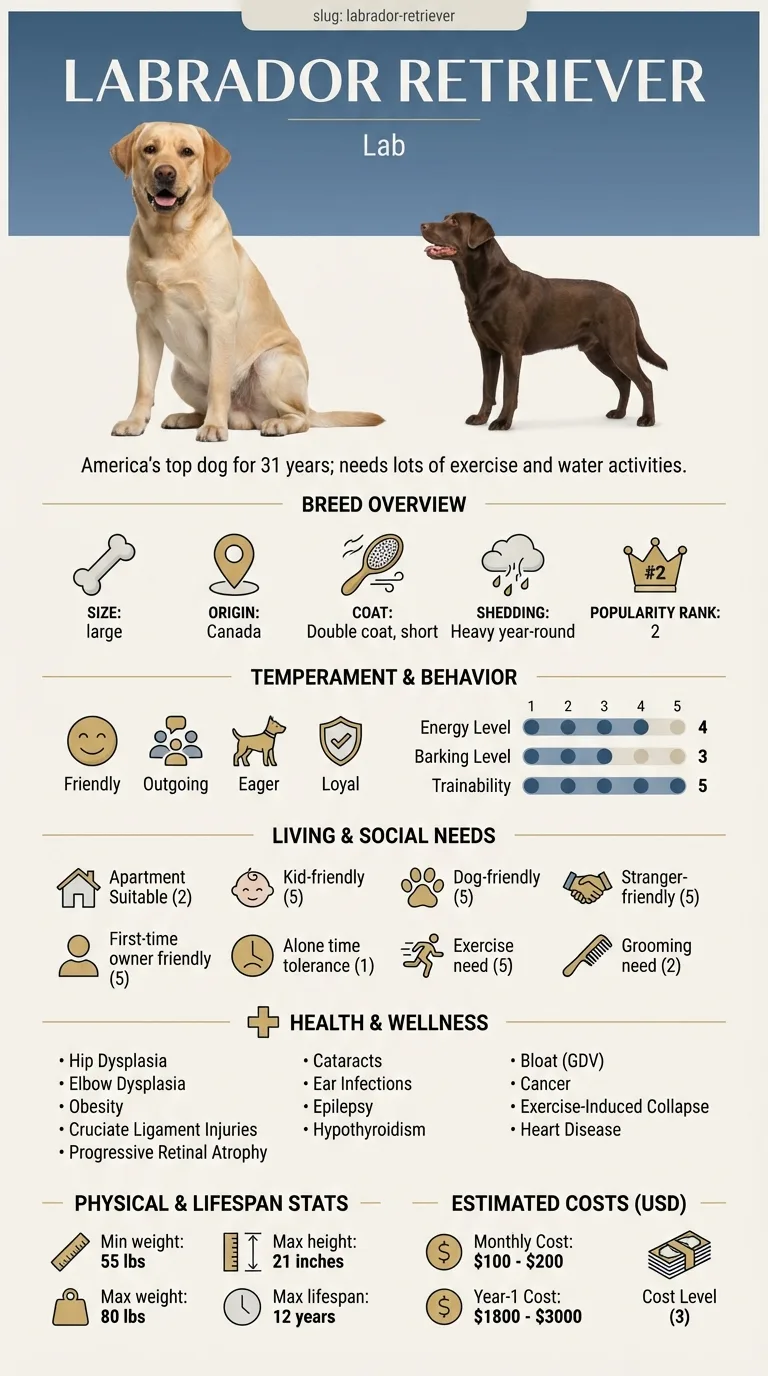
Labradors are a large, athletic breed at 55 to 80 pounds with an exercise need rated near the top of the scale, which means real mechanical stress on the knees through years of jumping and hard directional changes during retrieving and play, potentially compounding an underlying mild conformational tendency toward instability.
Excess body weight adds direct strain to an already unstable joint, and repeated high-impact jumping, especially onto hard surfaces, accelerates wear on the groove the kneecap is supposed to track within, making this partly an environmental and lifestyle-influenced condition on top of any underlying conformation.
Mention any observed skip-step gait at a routine visit even if it seems minor, and schedule a dedicated visit if the skipping becomes more frequent, the leg seems to stay 'stuck' out of place longer than a step or two, or your dog starts showing consistent lameness rather than an intermittent hitch.
See all Labrador Retriever health problems, which breeds are prone to luxating patellas, or the full Labrador Retriever breed guide for temperament, exercise needs and ownership costs.
Lower-grade cases are typically just monitored at each routine vet visit with no immediate treatment timeline at all. If surgery becomes necessary, recovery typically involves six to eight weeks of restricted activity followed by a gradual return to normal exercise.
Success for a low-grade case means stable, infrequent episodes that don't progress and don't require intervention. For a surgical case, success means a knee that tracks normally with no more skipping, restoring full comfortable use of the leg.
A luxating patella means the kneecap slides out of its normal groove at the front of the knee, usually toward the inside of the leg in most affected dogs. When it slips out, the leg often can't bear weight properly for a step or two — the classic 'skip' where the dog picks up the leg briefly mid-stride — and then the kneecap slides back into place on its own, and the dog resumes walking completely normally, as if nothing happened.
This in-and-out pattern is exactly why the condition is so often missed or downplayed early on — it doesn't look like a consistent limp, it looks like an occasional hitch that resolves itself within a step or two. Over time, in more affected dogs, the kneecap may luxate more frequently or stay out longer before sliding back, and repeated luxation gradually wears the groove it's supposed to sit in, worsening the underlying mechanical problem.
While luxating patellas are talked about most in small breeds, it does occur in large breeds like Labradors too, sometimes linked to other conformational factors like how the leg is aligned, and it's graded on a scale from I (occasional, self-correcting) to IV (permanently displaced) that determines whether monitoring or surgery is the right path.

For many dogs, especially lower grades, this isn't a condition that upends daily life — it's one that calls for a few consistent, low-effort habits.
Owner Beth had noticed her Lab, Scooter, occasionally do a quick hop-skip while running in the yard since he was about a year old, but he never seemed bothered by it and she didn't think to mention it at his annual exams. At age three, during a routine checkup, she happened to mention it almost as an aside, and her vet examined his knees closely, finding a grade II luxating patella that hadn't been apparent during the brief in-clinic gait check at previous visits. Given it hadn't progressed and Scooter showed no pain, her vet recommended monitoring and weight management rather than surgery. Two years later, the frequency hasn't increased, and Scooter remains active with no further intervention needed so far.
Key takeaway: An intermittent skip that seems too minor to mention is exactly the kind of detail worth bringing up at a vet visit — it's often the only clue of a condition that a brief in-clinic exam alone might not catch.
It typically looks like a brief 'skip' or hop mid-stride, where the dog picks up a back leg for a step or two before walking normally again, as the kneecap slides out of its groove and then back in on its own.
Lower grades often cause minimal discomfort and may not bother the dog much day to day, while higher grades with more frequent or permanent displacement are more consistently uncomfortable and more likely to need surgical correction.
No — lower-grade cases, especially those that self-correct quickly and don't progress, are often simply monitored. Higher grades, or any case causing consistent lameness, are more likely to be recommended for surgical correction.
It's graded I through IV based on frequency and severity — grade I luxates occasionally and self-corrects, while grade IV is permanently displaced and doesn't return to normal position on its own.
Yes — keeping a lean body weight reduces mechanical strain on the knee and is one of the more effective non-surgical steps an owner can take regardless of grade.
Surgical correction typically runs $1,500–$3,000 per knee, depending on the specific procedure needed and whether both knees are affected.
It can in some dogs, since repeated luxation gradually wears the groove the kneecap sits in, potentially increasing frequency or severity over time — which is why tracking any change in frequency matters for deciding when surgery becomes worthwhile.
A brief skip or hop mid-stride where the dog picks up a back leg for a step or two before walking normally again.
No — many lower-grade cases are simply monitored, with surgery reserved for higher grades or progressively worsening cases.
Typically $1,500–$3,000 per knee depending on the procedure and severity.
Yes — a lean body weight reduces strain on the joint and is one of the more effective non-surgical management steps.
It can, since the skip is often intermittent and the dog may walk completely normally during the exam itself, which is why mentioning it even if you don't see it happen at the visit matters.
A one-page prep sheet for this condition: the signs, the questions to ask, what to get priced. Unlocks here.
You get: Vet visit prep sheet
No spam. One-click unsubscribe. See our privacy policy.
Preview page 1 before you decide.

