Health
What does a hip dysplasia gait look like?
A bunny-hop when running, swaying hips when walking, or noticeable difficulty rising after rest are the classic patterns.

Quick answer
What does a hip dysplasia gait look like?
A bunny-hop when running, swaying hips when walking, or noticeable difficulty rising after rest are the classic patterns.
A young Akita that bunny-hops when it runs, or an older one that struggles to rise from the floor, may be dealing with a hip joint that never quite fit together the way it should have.
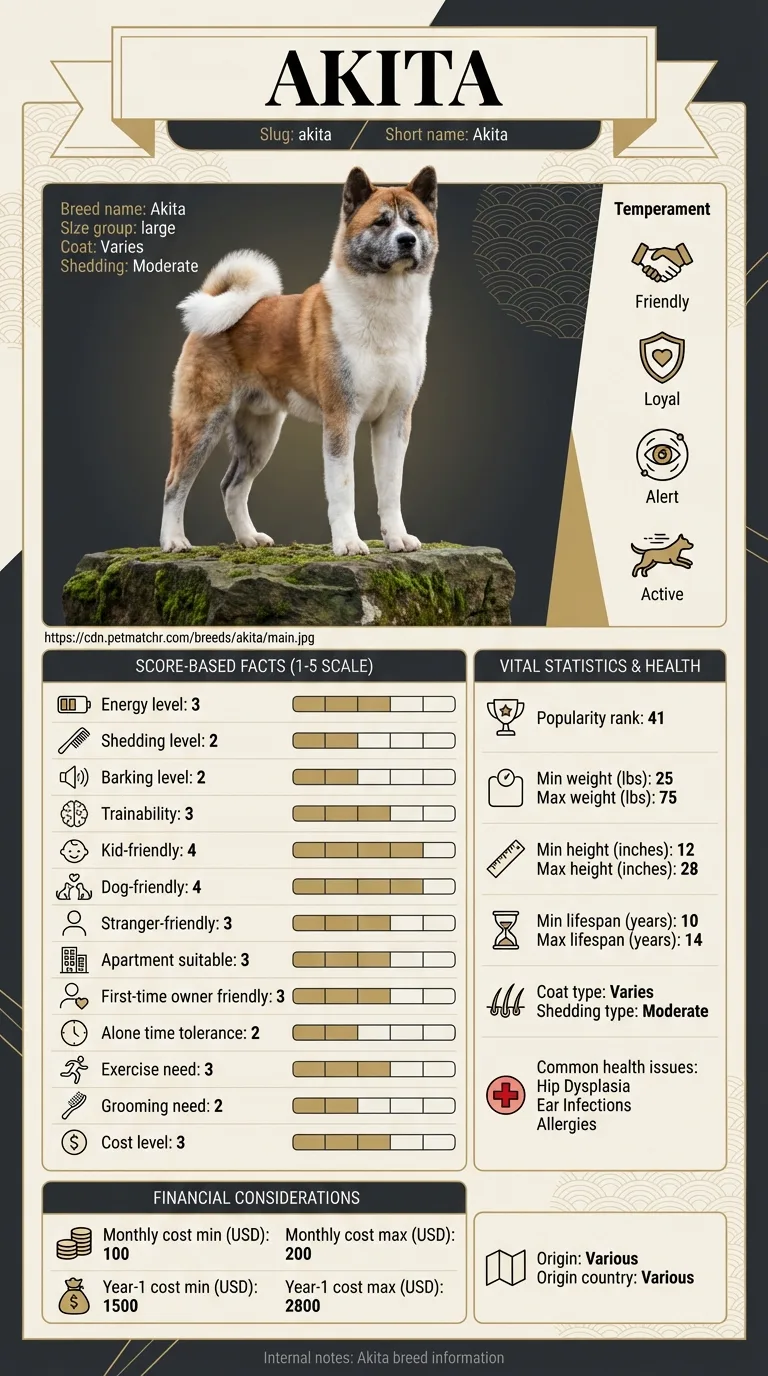
Owners of Akitas at both ends of the age spectrum see this — young dogs with looseness and pain from poor joint conformation, and older dogs dealing with the arthritis that follows years of abnormal joint wear.
This guide is not medical advice. If your dog shows pain, sudden behavior change, or worsening symptoms, consult a licensed veterinarian.
Some links may be affiliate links. We may earn a commission at no extra cost to you. We only suggest products we believe are helpful for dog owners.
We research and check what we publish, but we do not warrant that any figure, date, price, or statement is accurate, complete, or current, and we accept no liability for any loss, cost, injury, or other harm arising from the use of this site. Use it as one reference among several. You remain responsible for your own decisions and for your dog's care - confirm anything that matters with a licensed veterinarian or another qualified professional before you act on it. Full disclaimer.
Check this first
A dog that suddenly can't bear weight on a rear leg, or that cries out sharply when a hip is manipulated, should be seen promptly — this could indicate a luxated hip, a fracture, or a severe arthritic flare rather than routine dysplasia symptoms. Sudden total hind-end collapse also warrants urgent evaluation to rule out a spinal or neurologic cause on top of the hip.
More typically, hip dysplasia presents gradually: a bunny-hop gait when running, difficulty rising after rest, reluctance to climb stairs or jump into a car, or a swaying rear-end walk. These are appropriate for a scheduled vet visit rather than an emergency one, though earlier evaluation generally leads to better long-term management.
The key distinction is whether the change is sudden and severe or a slow pattern building over weeks to months. Chronic stiffness that's stable day to day can wait for a routine appointment; a sudden inability to use a leg at all should not.
If any of these apply, call your vet or an emergency clinic now. The rest of this page is for the cases that are not an emergency.
Hip dysplasia is a malformation of the hip joint that keeps the ball and socket from fitting together snugly, leading to looseness, abnormal wear, and eventually arthritis. It's specifically named among the Akita's documented common health issues, and the breed's substantial size adds real mechanical consequence to a joint that's already prone to forming imperfectly.
Hip dysplasia is one of the most frequently diagnosed orthopedic conditions in large-breed dogs, and it's specifically flagged as a common issue for the Akita, which is part of why hip screening is standard practice among responsible breeders of this breed.
At up to 130 pounds, an Akita's hips bear substantially more load than a small dog's, and this breed carries a documented predisposition to hip joint malformation. When the ball and socket don't fit precisely, that extra body weight accelerates the abnormal wear and the resulting arthritis considerably faster than it would in a lighter dog with the same joint conformation.
Excess weight, rapid puppy growth, and high-impact exercise before the hips mature all add mechanical stress on top of the underlying joint conformation. A lean body condition and appropriately paced exercise throughout life meaningfully slow the progression of symptoms even when the joint itself isn't perfectly formed.
Schedule an exam for a bunny-hopping gait, difficulty rising, or reluctance to climb stairs or jump, especially in a dog under two. Seek same-day care for sudden inability to bear weight on a rear leg or sharp pain when the hip is touched.
Hip dysplasia can be managed well or managed poorly, and the difference often comes down to a handful of everyday choices.
See all Akita health problems, which breeds are prone to hip dysplasia, or the full Akita breed guide for temperament, exercise needs and ownership costs.
With consistent weight control and activity modification, many dogs show improved comfort within four to eight weeks. Surgical cases typically need two to three months of structured recovery before returning to a full, comfortable range of activity.
Success looks like a dog that rises, walks, and plays without obvious discomfort day to day, even if some long-term exercise moderation, weight management, or joint support remains part of ongoing care.
Ingrid noticed her Akita puppy Sora ran with an odd bunny-hop gait, using both back legs together instead of alternating, from around six months old in Spokane. A vet exam and hip X-rays confirmed moderate hip dysplasia in both hips. Rather than jump straight to surgery, Ingrid's vet recommended weight management, a joint-support diet, and a structured low-impact exercise routine built around swimming and leash walks. Sora's gait improved noticeably by her first birthday, and while she still tires a bit faster on long hikes than other Akitas her age, she's active, comfortable, and hasn't needed surgical intervention.
Key takeaway: A young dog's odd running gait is worth investigating early — many Akitas with hip dysplasia do well long-term with consistent, non-surgical management.
Yes — it's specifically listed among the Akita's commonly documented health issues, largely because the breed's size puts real mechanical demand on a joint that's prone to developing imperfectly in many large breeds.
Signs can appear as early as four to twelve months in puppies with significant joint laxity, though many dogs don't show obvious symptoms until arthritis develops later in life.
Yes — hip X-rays, sometimes evaluated through programs like OFA or PennHIP, can identify joint laxity in young dogs before clinical symptoms develop, which is why responsible breeders screen breeding stock.
Options range from weight management, physical therapy, and joint supplements for milder cases, to surgical options like a femoral head osteotomy or total hip replacement for more severe cases.
Conservative management runs a few hundred dollars a year in supplements and rehab; surgical options like total hip replacement can run $3,500 to $7,000 or more per hip at a specialty practice.
Not necessarily — many dogs with mild to moderate hip dysplasia are managed successfully for years with weight control, exercise modification, and medical management, reserving surgery for dogs with significant pain or dysfunction.
It's not typically fatal on its own, but unmanaged chronic pain and reduced mobility significantly affect quality of life, which is why proactive management matters even in mild cases.
A bunny-hop when running, swaying hips when walking, or noticeable difficulty rising after rest are the classic patterns.
The underlying joint looseness doesn't necessarily worsen, but secondary arthritis typically builds up over time without management.
Total hip replacement commonly runs $3,500 to $7,000 per hip; less invasive options cost less but suit different severity levels.
Controlled, low-impact exercise like swimming or leash walks builds supportive muscle around the joint; high-impact activity like jumping should be limited.
If you're planning to breed, yes, screening is standard practice; for a pet-only dog, discuss timing with your vet based on any early gait changes.
A one-page prep sheet for this condition: the signs, the questions to ask, what to get priced. Unlocks here.
You get: Vet visit prep sheet
No spam. One-click unsubscribe. See our privacy policy.
Preview page 1 before you decide.