Behavior
Can Labradors overheat even though they're water dogs?
Yes — their dense double coat and high drive to keep playing make overheating a real risk despite their reputation as a water-loving breed.

Quick answer
Can Labradors overheat even though they're water dogs?
Yes — their dense double coat and high drive to keep playing make overheating a real risk despite their reputation as a water-loving breed.
A Lab happily retrieving on a warm afternoon can go from fine to dangerously overheated faster than most owners expect, precisely because the dog won't tell you to stop.
Owners in warm climates who exercise their Lab at midday out of convenience, and new owners who assume a 'water dog' can't possibly struggle with heat.
This guide is not medical advice. If your dog shows pain, sudden behavior change, or worsening symptoms, consult a licensed veterinarian.
Some links may be affiliate links. We may earn a commission at no extra cost to you. We only suggest products we believe are helpful for dog owners.
We research and check what we publish, but we do not warrant that any figure, date, price, or statement is accurate, complete, or current, and we accept no liability for any loss, cost, injury, or other harm arising from the use of this site. Use it as one reference among several. You remain responsible for your own decisions and for your dog's care - confirm anything that matters with a licensed veterinarian or another qualified professional before you act on it. Full disclaimer.
Labrador Retrievers are more heat sensitive than their water-dog reputation suggests. Their dense double coat traps body heat on land, their muscular build generates significant metabolic heat during exercise, and their high drive means they rarely stop playing on their own even as they're becoming uncomfortably hot — making heat management largely an owner's responsibility rather than something the dog manages instinctively.
Heat-related discomfort is common across the breed given its coat type and drive level, though full heatstroke remains a less frequent but serious outcome when precautions are ignored. Most heat sensitivity in Labs shows up as reduced tolerance for exercise on hot days rather than acute emergencies, as long as owners adjust accordingly.
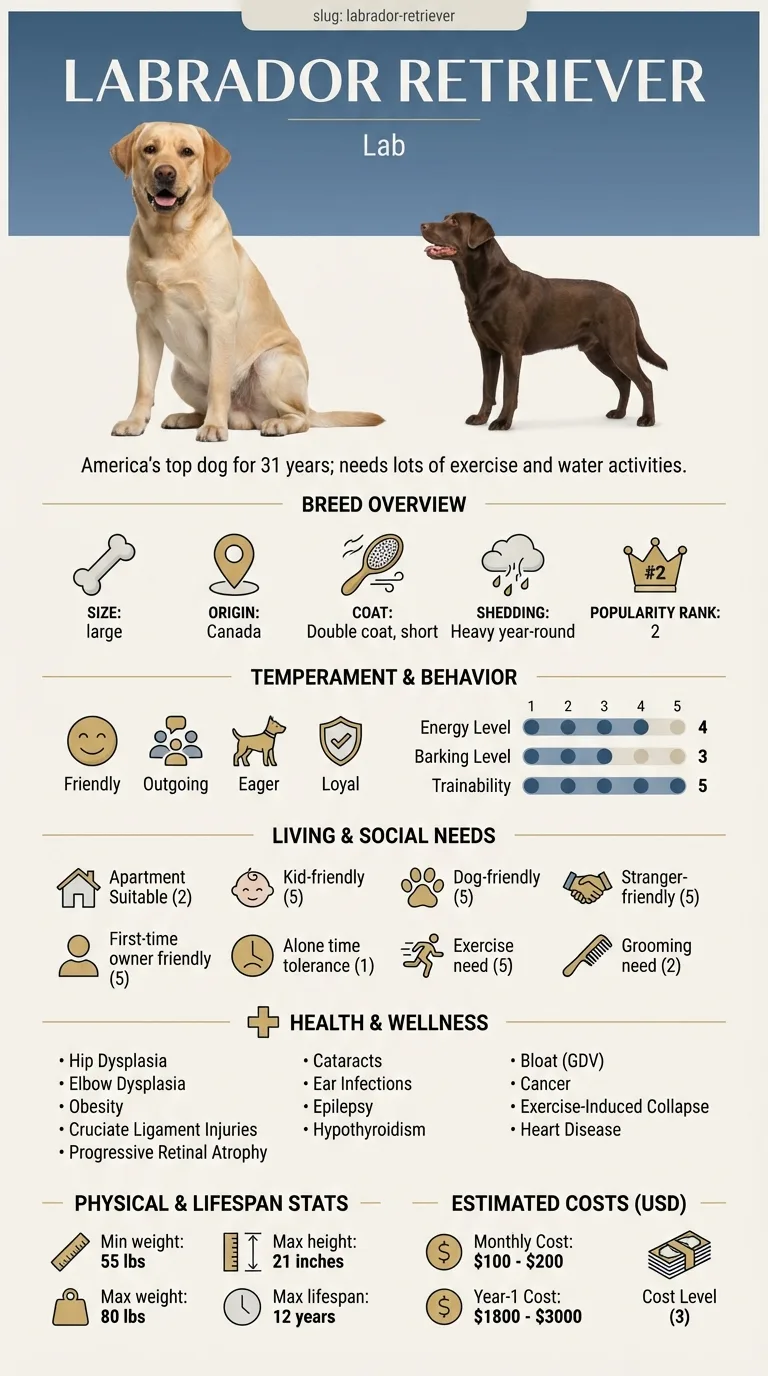
A Labrador's dense double coat, rated as a heavy year-round shedding coat, insulates effectively in cold water but traps heat on land more than owners expect from a short-haired breed. At 55 to 80 pounds of muscle with an exercise need rated near the top of the scale, Labs generate substantial metabolic heat during play, and their famously eager, trainable temperament means they'll keep working for a thrown ball well past the point a lower-drive dog would stop.
Warm, humid climates and midday sun are the clearest environmental triggers, since humidity specifically reduces how effectively a dog's panting can cool the body. Paved surfaces, unshaded yards, and parked cars add radiant heat on top of ambient temperature, compounding the risk during the hottest parts of the day.
Seek emergency veterinary care immediately if your Lab shows heavy uncontrolled panting alongside bright red or purple gums, vomiting, stumbling, disorientation, or collapse — these are signs of heatstroke, a true emergency where minutes matter, not a wait-and-see situation.
See all Labrador Retriever health problems, which breeds are prone to heat sensitivity, or the full Labrador Retriever breed guide for temperament, exercise needs and ownership costs.
Heat sensitivity isn't something that resolves — it's a permanent breed trait tied to coat and body type that needs to be managed every warm season for the dog's entire life, adjusted as your dog ages or if health conditions change.
Success looks like a summer routine that keeps your Lab active and satisfied without a single overheating scare — shifted exercise timing, built-in water breaks, and an owner who's learned to read early warning signs before they escalate.
A Labrador's coat looks short and simple, but it's actually a double coat — a dense, insulating undercoat beneath the visible outer layer. That undercoat is excellent at keeping a dog warm swimming in cold water, which is exactly what it evolved for, but it also traps body heat on land during warm weather far more than a true single-coated breed's fur would.
Combine that with the breed's build — 55 to 80 pounds of mostly muscle — and you get an animal that generates a lot of metabolic heat during exercise and has a harder time shedding it than a leaner, thinner-coated dog would. Add a heavy exercise drive rated near the top of the scale for the breed, plus a temperament built to keep working for the reward of a thrown ball, and the dog you're managing simply won't slow down on its own the way a lower-drive breed might.
This combination — insulating coat, high body mass, high drive, minimal self-imposed limits — is why heat management for a Lab is genuinely more of an owner responsibility than it might be for many other breeds.

None of this requires special equipment — it's mostly about timing and attentiveness during the months when heat risk is highest.
If you think your Lab has heat sensitivity, the plan is three steps: write down what you have seen and when it started, book a veterinary appointment rather than waiting for the next flare, and take video of the behaviour or symptom before you go — the thing you are worried about rarely happens in the consulting room. Screening in the parents covers hip dysplasia, elbow dysplasia, obesity.
What the vet visit should produce is a diagnosis and a written plan, not just reassurance: what is being ruled out, what the monitoring interval is, and which signs mean you come back sooner. Ask what the treatment costs across a year rather than per visit, because that is the number that decides whether you are managing this condition or reacting to it.
Between appointments, keep a short log — dates, what you saw, what changed. It is the single most useful thing an owner brings to a follow-up, and for heat sensitivity it is often what separates a clear pattern from a guess.
Jen used to take her Lab, Bear, to the park every day after lunch, rain or shine, because that fit her schedule. One July afternoon Bear kept dropping the ball and lying down mid-fetch instead of bringing it back, which she initially read as him just being tired. By the time she noticed his gums looked unusually bright red, he was stumbling on the walk back to the car. An emergency vet visit confirmed mild heat exhaustion, caught early enough to resolve with cooling and IV fluids overnight. Jen now exercises Bear at 7am and after 7pm from May through September, and she's learned that 'still fetching' isn't the same as 'doing fine' in the heat.
Key takeaway: A Lab's eagerness to keep playing is not a reliable signal that it's safe to keep going — visible signs like gum color and unsteadiness matter more than whether the dog is still willing to fetch.
Yes. Their dense double coat traps heat on land even though it helps insulate them in cold water, and their high drive means they'll keep playing well past the point they should stop, which is a combination that increases overheating risk more than owners expect.
There's no single universal number, since humidity and a dog's fitness level matter as much as raw temperature, but many vets suggest caution above roughly 80°F, and real caution once humidity is added on top of heat.
Most vets advise against it. The double coat provides some insulation against heat and protects skin from sunburn; shaving can actually increase heat absorption and remove a protective barrier rather than helping.
Heavy panting that doesn't ease with rest, bright red gums, thick drooling, unsteadiness, or reluctance to keep moving are all early signs. These can progress quickly, so it's worth stopping activity and cooling your dog down as soon as you notice them.
Yes — extra body fat acts as insulation that makes it harder for a dog to dissipate heat, and it adds cardiovascular strain during exercise, compounding an already heat-prone breed's risk.
Generally yes, and most Labs love it, but supervise closely in hot weather since an overheated, exhausted dog can still struggle in water. It's a good cooling tool, not a substitute for rest.
Yes — older dogs, especially those with any heart or respiratory issue, regulate temperature less efficiently and should get shorter, cooler-hour exercise sessions than a younger, healthier dog might tolerate.
Yes — their dense double coat and high drive to keep playing make overheating a real risk despite their reputation as a water-loving breed.
It's better to shift exercise to early morning or evening once temperatures climb, rather than exercising during peak heat.
No — most vets advise against shaving a double coat, since it can remove a protective barrier against both heat and sunburn.
Heavy panting that doesn't ease with a rest break is one of the clearest early signs to watch for.
Yes — extra body fat insulates heat in and adds cardiovascular strain, making an overweight Lab more heat sensitive than a lean one.
A one-page prep sheet for this condition: the signs, the questions to ask, what to get priced. Unlocks here.
You get: Vet visit prep sheet
No spam. One-click unsubscribe. See our privacy policy.
Preview page 1 before you decide.
