Behavior
Is barking a natural Labrador trait?
No, this breed wasn't bred for vocal alert behavior; excessive barking usually points to an underlying cause like boredom or separation distress rather than breed nature.

Quick answer
Is barking a natural Labrador trait?
No, this breed wasn't bred for vocal alert behavior; excessive barking usually points to an underlying cause like boredom or separation distress rather than breed nature.
A Labrador that barks constantly is rarely just "being a Lab," it's more often a sign of boredom, under-exercise, or genuine distress at being left alone, and each of those has a real fix.
Owners of under-exercised, under-stimulated Labradors, and owners whose dogs struggle noticeably when left alone, are the ones most likely to deal with genuinely excessive barking in this breed.
This guide is not medical advice. If your dog shows pain, sudden behavior change, or worsening symptoms, consult a licensed veterinarian.
Some links may be affiliate links. We may earn a commission at no extra cost to you. We only suggest products we believe are helpful for dog owners.
We research and check what we publish, but we do not warrant that any figure, date, price, or statement is accurate, complete, or current, and we accept no liability for any loss, cost, injury, or other harm arising from the use of this site. Use it as one reference among several. You remain responsible for your own decisions and for your dog's care - confirm anything that matters with a licensed veterinarian or another qualified professional before you act on it. Full disclaimer.
Excessive barking in Labrador Retrievers usually isn't a breed temperament trait, since this breed was developed for quiet retrieving work rather than vocal alert behavior. It's most often a signal of an underlying cause: insufficient exercise given this breed's high documented energy needs, genuine separation-related distress given its notably low alone-time tolerance, or simple attention-seeking that's been inadvertently reinforced.
Genuinely common as a complaint among Labrador owners, largely because this breed's combination of high exercise needs and low alone-time tolerance creates real conditions for excessive barking when either need goes unmet, rather than reflecting an inherently vocal breed temperament.
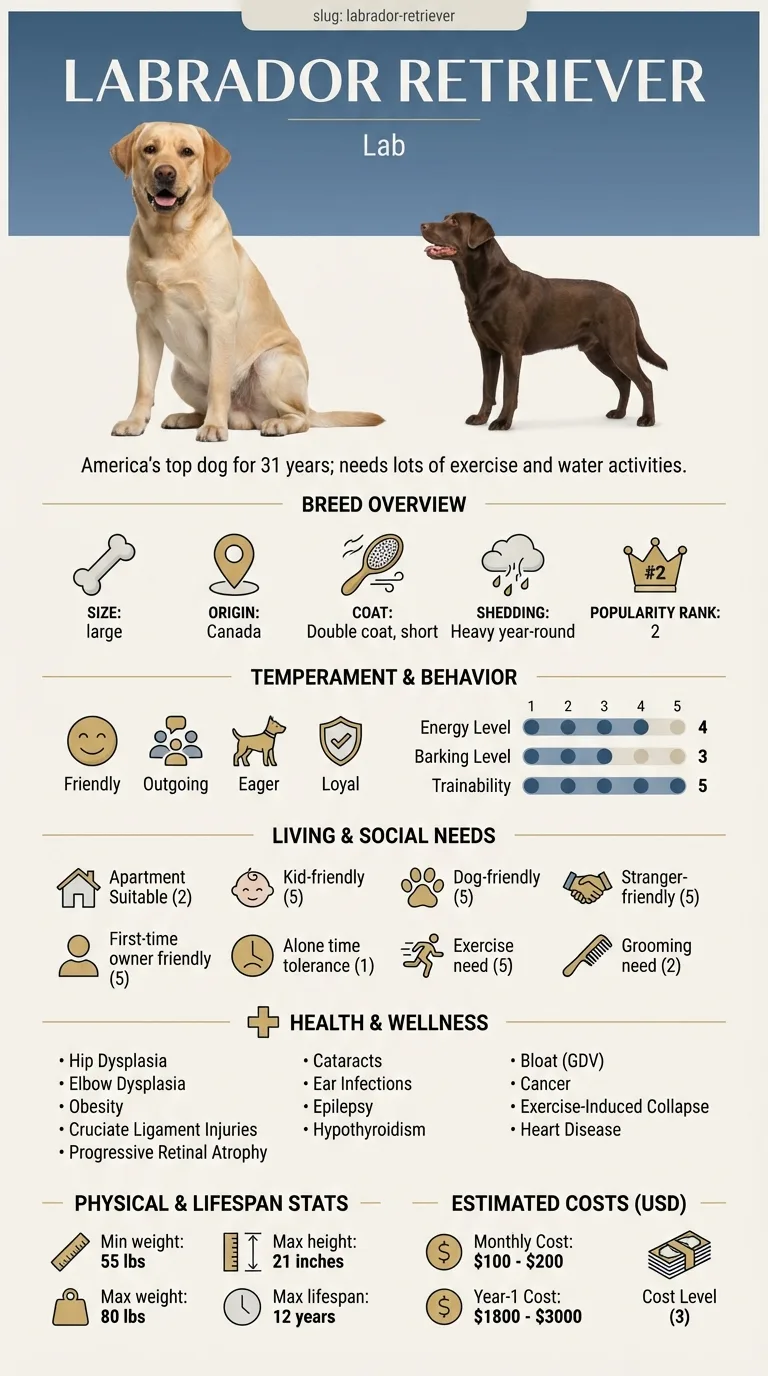
Labrador Retrievers are documented with very low alone-time tolerance and very high exercise needs, a combination that creates genuine conditions for excessive barking when either is unmet. Their equally well-documented high sociability also means barking for attention is easily, if unintentionally, reinforced by engaged owners.
A household with long work hours and no plan for exercise or enrichment during the day, limited daily physical activity relative to this breed's needs, and inadvertent reinforcement of attention-seeking barking are the main environmental factors driving excessive vocalization.
A trainer is genuinely useful here, especially one experienced with this breed's specific combination of high energy and low alone-time tolerance, to build a structured plan addressing exercise, enrichment, and gradual alone-time conditioning together.
Consider a vet visit if barking is a sudden, new change in an otherwise well-adjusted dog, since pain or a medical issue can sometimes present as increased vocalization. Persistent barking alongside pacing, destruction, or signs of distress when left alone deserves an evaluation for genuine separation anxiety.
See all Labrador Retriever health problems, which breeds are prone to excessive barking, or the full Labrador Retriever breed guide for temperament, exercise needs and ownership costs.
Barking driven by simple under-exercise often improves within one to two weeks of consistently meeting this breed's activity needs. Separation-related barking takes longer, often four to eight weeks or more of gradual, structured alone-time training to see meaningful, lasting improvement.
Success looks like barking dropping to occasional, situational vocalization, greeting excitement or an unusual noise, rather than a dog that never makes a sound, since some barking is a normal part of canine communication for any breed.
This breed's documented temperament centers on being friendly, outgoing, eager, and loyal, traits suited to a working retriever that needed to stay quiet in a duck blind, not bark at every passerby. Labradors also score at the very bottom of the scale for alone-time tolerance among documented breed traits, meaning this breed struggles more than most with being left by itself. When you put a genuinely high-energy, high-exercise-need dog with very low alone-time tolerance into a low-stimulation or frequently-alone situation, excessive barking is a predictable communication of real discomfort, not a breed quirk to simply train away without addressing the cause.
Different barking patterns point toward different underlying drivers, and treating them the same rarely works:

Ziggy, a two-year-old Labrador left alone for eight-hour workdays with a single short morning walk, had developed a habit of barking almost constantly by mid-morning, prompting complaints from his owner's apartment neighbors. Rather than trying to punish the behavior, his owner added a vigorous forty-minute run before work and hired a midday dog walker for a second walk plus a puzzle feeder for enrichment during the day. Within two weeks, the neighbor complaints stopped entirely. Ziggy's owner realized the barking had never been about defiance, it had been a high-energy, highly social dog with genuinely unmet needs finding the only outlet available to him.
Key takeaway: Excessive barking in a Labrador is usually a solvable symptom of unmet exercise or social needs rather than a fixed breed trait, and addressing the actual cause tends to work far better than trying to suppress the barking directly.
No, this breed's documented temperament is friendly and eager rather than alert-barking or guarding, and its historical role as a quiet working retriever didn't select for vocal behavior. Excessive barking usually points to an underlying cause rather than breed nature.
This breed is documented as having very low tolerance for being alone compared to other breeds, so barking that escalates while you're gone often reflects genuine separation-related distress rather than simple misbehavior.
Often significantly, yes. Given this breed's high documented exercise need, pent-up energy from insufficient physical and mental stimulation is one of the most common, fixable drivers of excessive barking.
It's common but not ideal, and it usually reflects excitement or under-socialization rather than guarding instinct, since this breed is documented as highly friendly toward strangers rather than naturally wary.
Avoid rewarding it with attention, even negative attention like scolding, and instead reward quiet behavior deliberately, redirecting your dog to a calm alternative before it starts barking for attention.
Punishment alone rarely addresses the underlying cause and can increase anxiety-driven barking specifically, making it worse; identifying and addressing the actual trigger works better long-term.
If barking is tied to clear separation distress, involves pacing, destruction, or self-injury attempts, or hasn't improved despite addressing exercise and attention needs, a trainer or behaviorist experienced with anxiety-driven behavior is worth involving.
No, this breed wasn't bred for vocal alert behavior; excessive barking usually points to an underlying cause like boredom or separation distress rather than breed nature.
Insufficient exercise relative to this breed's high documented energy needs is one of the most common and most fixable drivers.
Yes, Labradors are documented as having notably low alone-time tolerance compared to many other breeds, which directly connects to separation-related barking.
Yes, especially given how highly trainable this breed is; teaching and rewarding quiet behavior, combined with addressing the root cause, is generally effective.
If barking stems from under-exercise or long alone periods, a midday walk or additional enrichment can meaningfully reduce it, and many owners find it a worthwhile cost.
Behaviour changes often start with pain. The prep sheet for this page covers what to rule out, and what to ask.
You get: Vet visit prep sheet
No spam. One-click unsubscribe. See our privacy policy.
Preview page 1 before you decide.