Behavior
Do Akitas bark a lot?
No — they're documented as an unusually quiet breed, more prone to watchful behavior than routine barking.

Quick answer
Do Akitas bark a lot?
No — they're documented as an unusually quiet breed, more prone to watchful behavior than routine barking.
Most Akita owners will tell you their dog barks less than almost any other breed they've owned, which is exactly why a sudden pattern of excessive barking in this breed deserves real attention rather than dismissal as typical dog behavior.
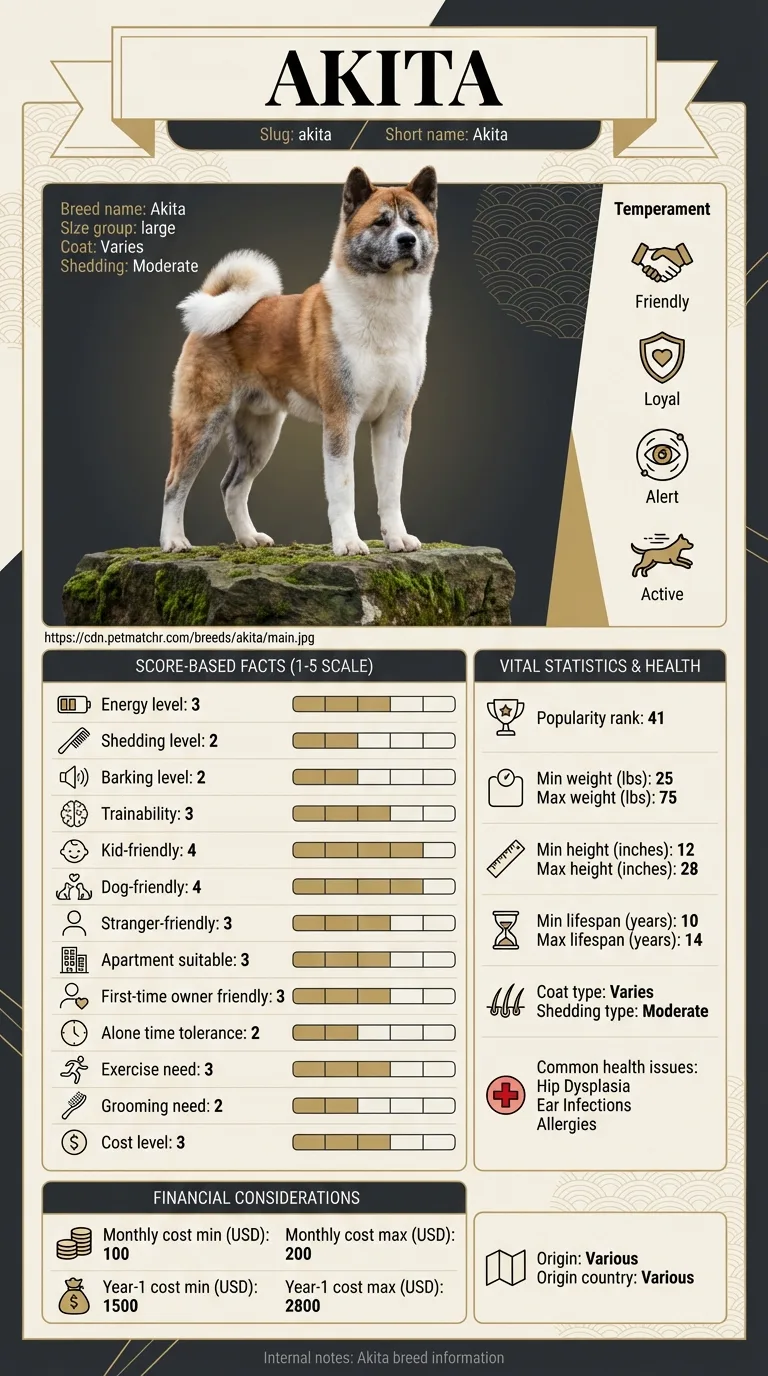
Owners who've noticed a new or increasing pattern of barking in an otherwise typically quiet Akita are the audience for this, since the presentation itself is somewhat unusual for the breed.
This guide is not medical advice. If your dog shows pain, sudden behavior change, or worsening symptoms, consult a licensed veterinarian.
Some links may be affiliate links. We may earn a commission at no extra cost to you. We only suggest products we believe are helpful for dog owners.
We research and check what we publish, but we do not warrant that any figure, date, price, or statement is accurate, complete, or current, and we accept no liability for any loss, cost, injury, or other harm arising from the use of this site. Use it as one reference among several. You remain responsible for your own decisions and for your dog's care - confirm anything that matters with a licensed veterinarian or another qualified professional before you act on it. Full disclaimer.
The Akita is documented as an unusually quiet breed by temperament, more inclined toward watchful alertness or distinctive 'talking' vocalizations than routine barking. When excessive barking does appear in this breed, it's a meaningful signal worth investigating for a specific cause — territorial triggers, anxiety, boredom, or a medical issue — rather than dismissing it as ordinary dog behavior.
Excessive barking is a relatively unusual presentation for this breed given its documented low baseline barking tendency, which is precisely why a real, sustained change deserves closer attention than it might in a breed with naturally higher baseline vocalization.
The Akita's temperament profile includes a notably low barking tendency, historically connected to its use as a quiet, watchful guardian rather than a breed selected for vocal alerting. This baseline quietness means that when excessive barking does emerge, it's more likely to reflect a genuine, specific underlying issue than simple breed-typical behavior.
Territorial triggers (unfamiliar people or animals near the home), insufficient mental stimulation, and situations that provoke anxiety, such as being left alone, are the main environmental factors that can drive atypical barking in this breed. Addressing the specific environmental trigger tends to be more effective than generic barking-suppression approaches.
A trainer experienced with guardian-type breed temperaments is particularly valuable for this breed, since generic barking-reduction techniques may not address the specific territorial or anxiety-driven triggers behind an Akita's atypical barking.
Schedule a vet visit for any new or significantly increased barking pattern, particularly in an older dog, to rule out pain or cognitive changes. Seek prompt care if barking is accompanied by other signs of acute distress or physical illness.
See all Akita health problems, which breeds are prone to excessive barking, or the full Akita breed guide for temperament, exercise needs and ownership costs.
Once the underlying trigger is identified, behavioral improvement often begins within a few weeks of consistent intervention, though anxiety-related barking may take longer to resolve fully depending on severity.
Success is a return to this breed's typical low-barking baseline, achieved by identifying and addressing whatever specific trigger — medical, environmental, or behavioral — was driving the atypical increase.
Because barking is atypical for this breed, certain assumptions can lead owners to miss what's actually going on.
Barking isn't typically an emergency on its own, but if it's accompanied by other signs of acute distress — disorientation, pacing, apparent pain, or a sudden behavior change alongside physical symptoms like vomiting or labored breathing — the underlying cause of those combined symptoms may need prompt veterinary attention.
Gradually increasing barking without other acute symptoms is not an emergency and is worth investigating through a combination of a vet visit (to rule out pain or cognitive changes, especially in an older dog) and, if medically clear, a behavioral assessment.
Given how unusual excessive barking is for this breed's typical temperament, a real, sustained change is worth treating as a meaningful signal rather than routine behavior, even without other acute symptoms present.

Trevor's Akita, Ghost, had always been remarkably quiet, so when Ghost started barking frequently at seemingly nothing while home alone in Missoula, Trevor knew something had changed. A vet visit ruled out any medical cause, and a consultation with a trainer familiar with guardian breeds pointed to separation-related anxiety as the likely driver. Trevor worked on a gradual desensitization plan for alone time, along with more structured mental enrichment throughout the day. Ghost's barking decreased significantly within a few weeks, returning close to his previously quiet baseline.
Key takeaway: Because barking is so atypical for this breed's temperament, a real change is a meaningful signal worth investigating specifically rather than assuming it's just normal dog behavior.
Yes — this breed is documented as having a low tendency toward barking, often described as more likely to growl, 'talk,' or watch quietly than to bark routinely, distinct from many other breeds' baseline vocal tendencies.
Given how atypical routine barking is for this breed, a real increase usually points to a specific cause — a territorial trigger, anxiety, boredom, or in some cases a medical issue — rather than just general dog behavior.
Yes — pain or discomfort from an orthopedic issue, dental problem, or other medical condition can increase vocalization in any dog, and this is worth ruling out with a vet exam, especially in a breed not typically prone to barking.
Yes — territorial barking is typically directed at a specific perceived intrusion (someone at the door, a passerby) and tends to be more controlled, while anxiety-driven barking is often more persistent and connected to a broader emotional state like distress at being left alone.
Identifying the specific trigger, addressing any underlying anxiety or boredom, and working with a trainer experienced in guardian-type breed temperaments tends to be more effective than generic barking-suppression techniques.
Yes — cognitive dysfunction syndrome in older dogs can cause increased vocalization, confusion, and altered sleep patterns, and this is worth discussing with your vet if your senior dog's barking pattern changes.
Some alert barking at genuine perceived intrusions is consistent with this breed's historical guarding temperament and isn't necessarily concerning on its own; it's a marked increase or persistent, hard-to-interrupt barking that's worth investigating.
No — they're documented as an unusually quiet breed, more prone to watchful behavior than routine barking.
It usually signals a specific trigger — territorial concern, anxiety, boredom, or a medical issue.
Yes, especially in an older dog, to rule out pain or cognitive changes first.
Not usually — addressing the underlying trigger is more effective than suppression alone.
Yes — insufficient mental engagement can occasionally show up as increased vocalization.
Behaviour changes often start with pain. The prep sheet for this page covers what to rule out, and what to ask.
You get: Vet visit prep sheet
No spam. One-click unsubscribe. See our privacy policy.
Preview page 1 before you decide.