Living
Which is smaller?
The Shiba Inu, at 17-23 lbs and 13-16 inches versus the GSP's 45-70 lbs and 21-25 inches.

Quick answer
Which is smaller?
The Shiba Inu, at 17-23 lbs and 13-16 inches versus the GSP's 45-70 lbs and 21-25 inches.
German Shorthaired Pointer or Shiba Inu? On paper they differ most on apartment suitability, and on the scales German Shorthaired Pointer is the heavier at 45–70 lbs. Here is how the two compare on everything that shapes an ordinary week.
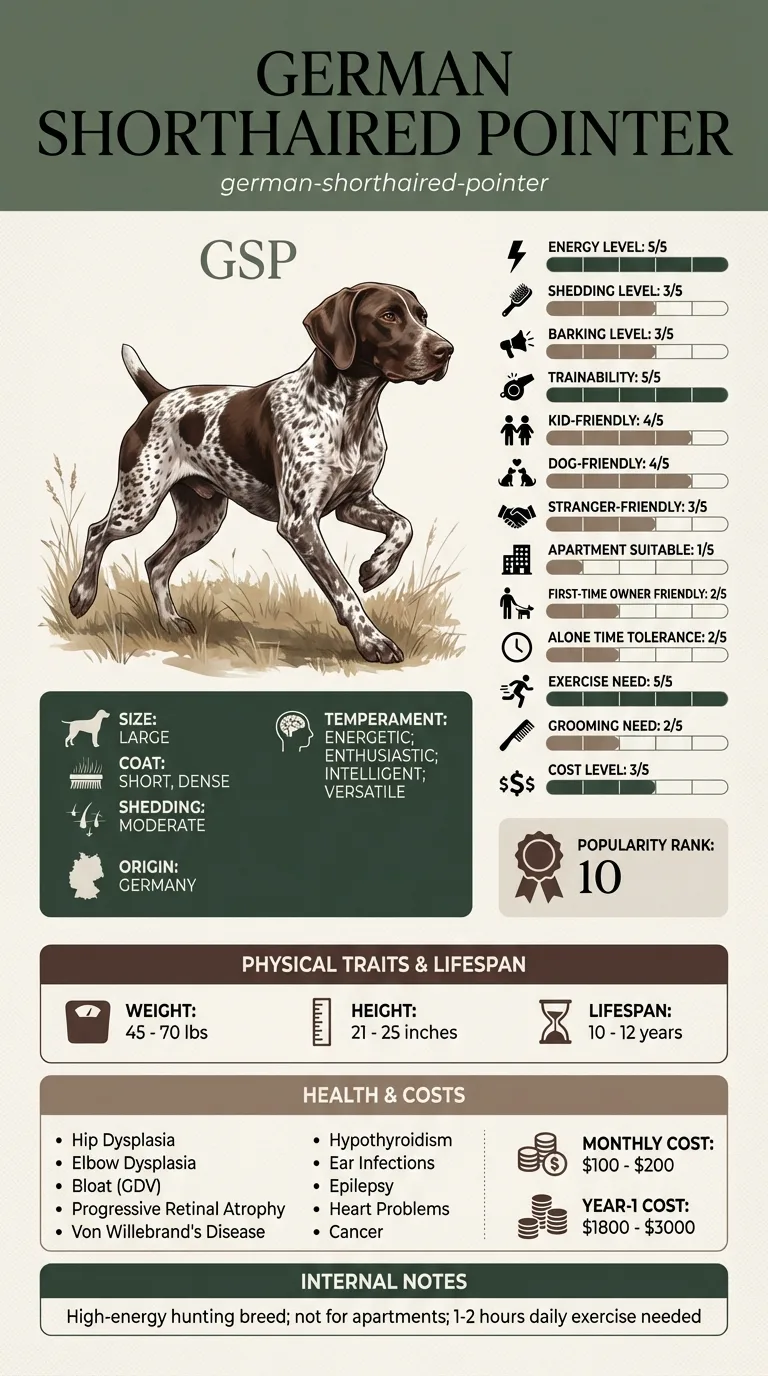
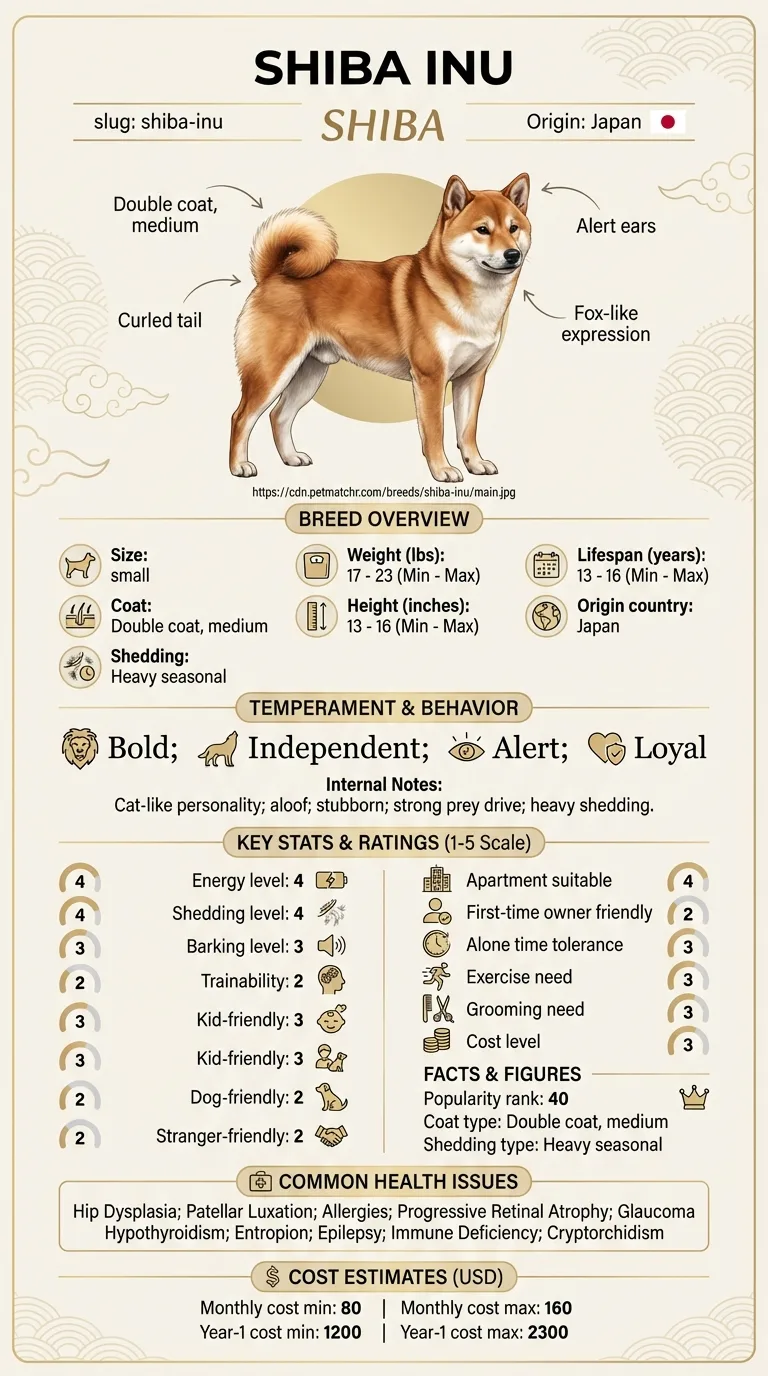
This is for someone already down to German Shorthaired Pointer and Shiba Inu and deciding between them. For this pair the decision usually turns on apartment suitability and trainability, so those are covered first and in most detail. Anyone choosing from a flat has a clear answer here: Shiba Inu rates 4/5 against 1/5. The focus throughout is on daily consequences rather than breed background.
Between German Shorthaired Pointer and Shiba Inu, apartment suitability is what separates them, and Shiba Inu is the lower-effort dog of the two to keep.
Choose German Shorthaired Pointer if you do not want a standing grooming appointment, shedding is a problem in your house and there are young children at home.
Choose Shiba Inu if you are in a flat or a smaller home, your walking routine is modest and the dog will be alone during the working day.
| Feature | german shorthaired pointer | shiba inu | Winner |
|---|---|---|---|
| Size class | large | small | Equal |
| Weight | 45–70 lbs | 17–23 lbs | Equal |
| Height | 21–25 in | 13–16 in | Equal |
| Lifespan | 10–12 years | 13–16 years | shiba inu |
| Exercise need | Very high (5/5) | Moderate (3/5) | shiba inu |
| Grooming need | Low (2/5) | Moderate (3/5) | german shorthaired pointer |
| Shedding | Moderate (3/5) | High (4/5) | german shorthaired pointer |
| Energy level | Very high (5/5) | High (4/5) | Equal |
| Barking | Moderate (3/5) | Moderate (3/5) | Equal |
| Apartment suitability | Very low (1/5) | High (4/5) | shiba inu |
| Good for first-time owners | Low (2/5) | Low (2/5) | Equal |
| Tolerates being alone | Low (2/5) | Moderate (3/5) | shiba inu |
| Trainability | Very high (5/5) | Low (2/5) | german shorthaired pointer |
| Good with kids | High (4/5) | Moderate (3/5) | german shorthaired pointer |
| Good with other dogs | High (4/5) | Low (2/5) | german shorthaired pointer |
| Friendly to strangers | Moderate (3/5) | Low (2/5) | german shorthaired pointer |
| Cost level | Moderate (3/5) | Moderate (3/5) | Equal |
| Coat | Short, dense | Double coat, medium | Equal |
| Origin | Germany | Japan | Equal |
| Typical monthly cost | $100–$200 | $80–$160 | Equal |
| Typical first-year cost | $1,800–$3,000 | $1,200–$2,300 | Equal |
A Shiba Inu tops out around 23 lbs — barely a third of a German Shorthaired Pointer's 45-70 lb range — and stands 13-16 inches versus the GSP's 21-25 inches. Both breeds carry a size-class label that undersells the visual gap: a Shiba next to a GSP looks closer to a fox standing beside a deer. The Shiba's compact, fox-like frame under a medium double coat contrasts sharply with the GSP's lean, short-coated athletic build, and prospective owners comparing photos online often underestimate just how much daily handling and crate space that size gap ends up requiring in practice.
Exercise need actually splits these two more than their size suggests: very high (5/5) for the GSP against just moderate (3/5) for the Shiba. That's a two-point gap, one of the largest on this chart, and it reflects genuinely different jobs the breeds were built for — all-day field hunting versus small-game hunting in dense terrain that rewards agility over distance. A Shiba owner who gives thirty solid minutes a day is usually covered; a GSP owner attempting the same routine will have a restless dog by evening.
Shedding is the Shiba's Achilles heel despite its low-maintenance reputation: it rates high (4/5) for shedding, driven by seasonal coat blows from that double coat, compared to the GSP's moderate (3/5). Grooming effort itself stays close — moderate (3/5) for the Shiba against low (2/5) for the GSP — so the difference is really about volume of loose hair rather than time spent brushing. Anyone who's heard 'Shiba season' described online is hearing about this exact gap in the numbers.
Here the Shiba pulls well ahead: high (4/5) apartment suitability against the GSP's very low (1/5), and both breeds share a moderate (3/5) barking score, so noise isn't the deciding factor the way space is. The Shiba also edges out the GSP on tolerating time alone — moderate (3/5) versus low (2/5) — though independent is one of the four words used to describe its temperament, and that independence can look like aloofness rather than easy contentment when left solo.
This is the widest trainability gap in the whole comparison: very high (5/5) for the GSP against low (2/5) for the Shiba, a three-point spread. The Shiba's bold, independent temperament traits aren't code words for a lack of intelligence — they mean the dog frequently decides a command isn't worth following, a trait Shiba owners often describe with dark humor. Both breeds rate low (2/5) for first-time owners, but for different reasons: the GSP needs an owner ready to match its physical drive, while the Shiba needs one ready to out-stubborn a genuinely willful dog.
The GSP wins across the board here — good with kids at high (4/5) versus the Shiba's moderate (3/5), good with other dogs at high (4/5) versus the Shiba's low (2/5), and friendlier to strangers at moderate (3/5) versus the Shiba's low (2/5). None of these are close calls. The Shiba's loyal streak tends to concentrate around its immediate household rather than extend outward, which is consistent with lower marks on every social measure in this table.
The Shiba lives longer — 13-16 years against the GSP's 10-12 — despite carrying an equally long list of ten commonly flagged conditions, including glaucoma, entropion, immune deficiency and cryptorchidism alongside hip dysplasia and PRA, which both breeds share. The GSP's distinct risks run toward bloat (GDV), von Willebrand's disease and cancer. Longevity and health-list length don't always move together, and this pair is a clear example: similar volume of named concerns, but a meaningfully different lifespan outcome.
Both breeds sit at moderate (3/5) for overall cost, and monthly spending lands close — $100-$200 for the GSP, $80-$160 for the Shiba. The first-year gap is larger: $1,800-$3,000 for a GSP puppy against $1,200-$2,300 for a Shiba, a difference driven mostly by the bigger dog's higher food volume and larger-size gear rather than anything specific to either breed's health needs.
German Shorthaired Pointer weighs 45–70 lbs and lives 10–12 years; Shiba Inu weighs 17–23 lbs and lives 13–16 years. The two diverge most on apartment suitability, trainability and exercise need and 1 other rated axes. They are level on barking, cost level and good for first-time owners, so those cannot decide it. The table below marks a winner only where one breed is genuinely easier for a typical owner; size and origin are facts rather than merits and stay level. Ratings come from one source applied to both breeds, so they are meaningful against each other rather than as absolute scores.

The GSP by a wide margin — it rates very high (5/5) for trainability against the Shiba's low (2/5), largely because the Shiba's independent streak makes it far more willing to ignore commands.
The German Shorthaired Pointer, rated very high (5/5) versus the Shiba Inu's moderate (3/5) — a two-point gap that reflects the GSP's all-day field-hunting background.
Not especially — it rates low (2/5) for compatibility with other dogs, well below the GSP's high (4/5).
The Shiba Inu, typically 13-16 years compared to the GSP's 10-12 years.
The Shiba Inu, rated high (4/5) versus the GSP's moderate (3/5), due to heavy seasonal coat-blowing.
Both rate low (2/5) for first-time owners, but for opposite reasons — the GSP demands more physical exercise than most beginners can provide, while the Shiba demands more patience for its independent, sometimes stubborn nature.
The GSP, at moderate (3/5), compared to the Shiba's low (2/5) — Shibas tend toward reserved, one-household loyalty rather than open friendliness.
The Shiba Inu, at 17-23 lbs and 13-16 inches versus the GSP's 45-70 lbs and 21-25 inches.
The Shiba Inu, rated high (4/5) versus the GSP's very low (1/5).
The German Shorthaired Pointer, rated very high (5/5) versus the Shiba's low (2/5).
The Shiba Inu, at $1,200-$2,300 versus the GSP's $1,800-$3,000.
Secure checkout on Stripe. We never see your card.
7-day money-back guarantee. Instant access.
Health information here is general and is not veterinary advice. If your dog shows pain, sudden behaviour change, or worsening symptoms, consult a licensed veterinarian.
Some links on this site are affiliate links. We may earn a commission at no extra cost to you, and we only suggest products we believe are helpful for dog owners.
We research and check what we publish, but we do not warrant that any figure, date, price, or statement is accurate, complete, or current, and we accept no liability for any loss, cost, injury, or other harm arising from the use of this site. Use it as one reference among several. You remain responsible for your own decisions and for your dog's care - confirm anything that matters with a licensed veterinarian or another qualified professional before you act on it. Full disclaimer.
Match your lifestyle to the right dog.
Take quizNot sure which breed is right for you? Take our 2-minute quiz to find out.
Take the quiz