Health
How many distinct eye conditions are documented in this breed?
At least three are specifically documented: cataracts, progressive retinal atrophy, and collie eye anomaly.

Quick answer
How many distinct eye conditions are documented in this breed?
At least three are specifically documented: cataracts, progressive retinal atrophy, and collie eye anomaly.
Understanding that your Aussie's eye risk isn't one condition but several distinct ones is the first step to knowing what an eye specialist is actually screening for at each visit.
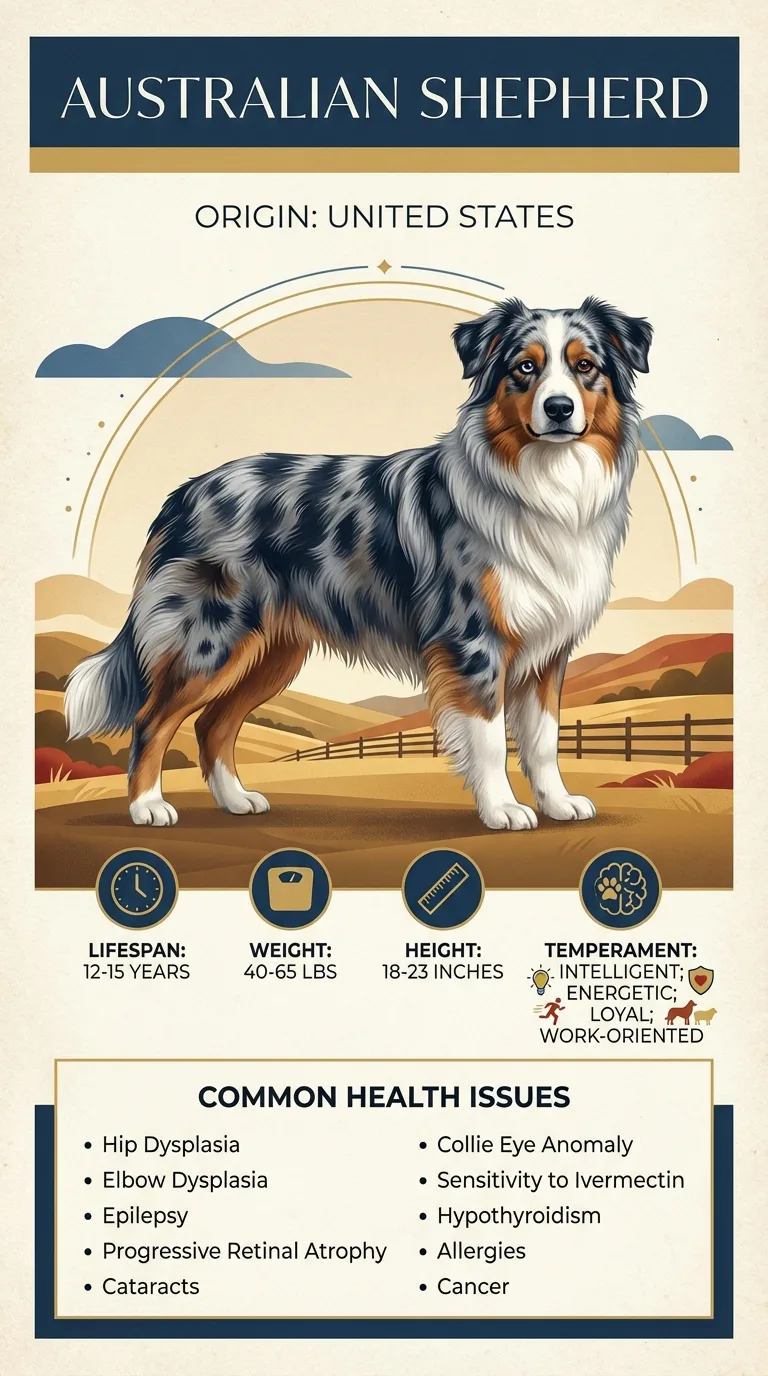
Owners and breeders trying to make sense of genetic eye testing panels are the ones who benefit most from a clear overview, since the individual condition names and abbreviations can be confusing without context.
This guide is not medical advice. If your dog shows pain, sudden behavior change, or worsening symptoms, consult a licensed veterinarian.
Some links may be affiliate links. We may earn a commission at no extra cost to you. We only suggest products we believe are helpful for dog owners.
We research and check what we publish, but we do not warrant that any figure, date, price, or statement is accurate, complete, or current, and we accept no liability for any loss, cost, injury, or other harm arising from the use of this site. Use it as one reference among several. You remain responsible for your own decisions and for your dog's care - confirm anything that matters with a licensed veterinarian or another qualified professional before you act on it. Full disclaimer.
Australian Shepherds carry documented risk across several distinct eye conditions, including cataracts, progressive retinal atrophy, and collie eye anomaly, each with its own mechanism, timeline, and screening approach. Understanding them as separate conditions rather than one general category is key to knowing what a vet or ophthalmologist is actually checking for at each life stage.
This breed's documented health profile specifically lists multiple eye conditions, making eye health an area of genuine, ongoing attention for owners and breeders rather than an occasional afterthought.
This breed's documented predisposition to cataracts, progressive retinal atrophy, and collie eye anomaly reflects a broader inherited pattern of eye-tissue vulnerability, with each specific condition following its own genetic pathway and developmental timeline.
Most of these conditions are primarily genetic rather than environmentally driven, though age plays a role in when cataracts typically appear, and general eye health maintenance can support overall comfort regardless of underlying genetic risk.
Talk to your vet about establishing a baseline eye exam early in your dog's life and continuing periodic checks. Any sudden vision change, eye redness, or apparent pain warrants prompt evaluation rather than waiting for the next scheduled visit.
See all Australian Shepherd health problems, which breeds are prone to eye disorders, or the full Australian Shepherd breed guide for temperament, exercise needs and ownership costs.
Full eye health screening unfolds over a dog's lifetime rather than at a single visit, starting with early puppy screening and continuing through annual adult exams.
Success means having a clear, tracked picture of your dog's eye health over time, catching any condition early enough to manage it well, rather than assuming a single clean exam rules out future risk.
Each of these conditions has its own timeline, mechanism, and screening approach, which is why breeders and owners are encouraged to understand them individually rather than as one general category.
Collie eye anomaly is present from birth and is typically screened for in puppies as young as six to eight weeks old, since it doesn't develop later in life. Progressive retinal atrophy, by contrast, usually isn't detectable until later, often through a specialized electroretinogram test or genetic screening for known mutations. Cataracts can appear at almost any age depending on whether they're inherited or age-related.
Because these conditions develop on different timelines, a single early puppy exam won't catch everything, and ongoing periodic eye exams throughout a dog's life are what actually provide a complete picture. This layered approach is standard practice among vets and breeders familiar with this breed's eye health profile.

If you think your Aussie has eye disorders, the plan is three steps: write down what you have seen and when it started, book a veterinary appointment rather than waiting for the next flare, and take video of the behaviour or symptom before you go — the thing you are worried about rarely happens in the consulting room. Screening in the parents covers hip dysplasia, elbow dysplasia, epilepsy.
What the vet visit should produce is a diagnosis and a written plan, not just reassurance: what is being ruled out, what the monitoring interval is, and which signs mean you come back sooner. Ask what the treatment costs across a year rather than per visit, because that is the number that decides whether you are managing this condition or reacting to it.
Between appointments, keep a short log — dates, what you saw, what changed. It is the single most useful thing an owner brings to a follow-up, and for eye disorders it is often what separates a clear pattern from a guess.
When Yvette was considering breeding her Aussie, Sadie, she scheduled a full ophthalmologist exam rather than relying on Sadie's seemingly normal vision alone. The exam found early, very mild signs consistent with collie eye anomaly that hadn't affected Sadie's day-to-day vision at all but were significant enough for the specialist to recommend against breeding her. Yvette was grateful she'd tested before breeding rather than after, since the condition would have gone completely unnoticed without a formal screening exam.
Key takeaway: A dog can look and act completely normal while still carrying a documented eye condition, which is exactly why formal screening, not casual observation, is the only reliable way to know the full picture.
Cataracts, progressive retinal atrophy, and collie eye anomaly are all specifically documented, each affecting a different part of the eye through a different mechanism and timeline.
Yes, collie eye anomaly is typically screened for as early as six to eight weeks old since it's present from birth, though other conditions like progressive retinal atrophy usually aren't detectable until later.
No, it's a progressive, currently untreatable degeneration of the retina, though affected dogs typically adapt well to gradual vision loss over time.
It ranges from very mild cases that don't meaningfully affect vision to more significant cases that can impact sight, which is why early screening and grading by a vet ophthalmologist matters.
Yes, given the range of documented eye conditions in this breed, a certified eye exam is a standard and important part of responsible breeding health screening.
Annual eye checks as part of a routine wellness exam are reasonable for most dogs, with more frequent monitoring if any condition has already been identified.
At least three are specifically documented: cataracts, progressive retinal atrophy, and collie eye anomaly.
As early as six to eight weeks old for collie eye anomaly, since it's present from birth.
They can't be prevented outright since they're largely genetic, but early screening allows for informed breeding decisions and timely management.
A basic annual eye check is relatively affordable, though a full ophthalmologist exam with specialized testing costs more.
No, documented risk doesn't mean every dog is affected, but the range of conditions makes regular screening a worthwhile precaution for this breed.
A one-page prep sheet for this condition: the signs, the questions to ask, what to get priced. Unlocks here.
You get: Vet visit prep sheet
No spam. One-click unsubscribe. See our privacy policy.
Preview page 1 before you decide.