Health
What is a normal sleeping breathing rate?
Under thirty breaths a minute for a healthy dog, and usually well under. Take a baseline while your dog is well so you can spot a rise.

Quick answer
What is a normal sleeping breathing rate?
Under thirty breaths a minute for a healthy dog, and usually well under. Take a baseline while your dog is well so you can spot a rise.
Most canine heart disease is silent for years before it is obvious, and the years it is silent are the years treatment does the most good.
Owners of dogs from about seven onwards, and anyone who has been told at a routine appointment that their dog has a murmur and left the consulting room unsure whether that was serious.
This guide is not medical advice. If your dog shows pain, sudden behavior change, or worsening symptoms, consult a licensed veterinarian.
Some links may be affiliate links. We may earn a commission at no extra cost to you. We only suggest products we believe are helpful for dog owners.
We research and check what we publish, but we do not warrant that any figure, date, price, or statement is accurate, complete, or current, and we accept no liability for any loss, cost, injury, or other harm arising from the use of this site. Use it as one reference among several. You remain responsible for your own decisions and for your dog's care - confirm anything that matters with a licensed veterinarian or another qualified professional before you act on it. Full disclaimer.
Cardiac disease in this breed is a category rather than a single named condition, and the German Shorthaired Pointer's documented health list records heart problems without further specification. The practical implication is a monitoring approach: regular listening from middle age, imaging when something is heard, and a home measurement that catches deterioration early.
Heart problems appear on the German Shorthaired Pointer's documented health list, which makes them a realistic senior concern rather than an unusual one. Most acquired canine heart disease develops in the second half of life, so in a breed living ten to twelve years the relevant window opens around age six or seven.
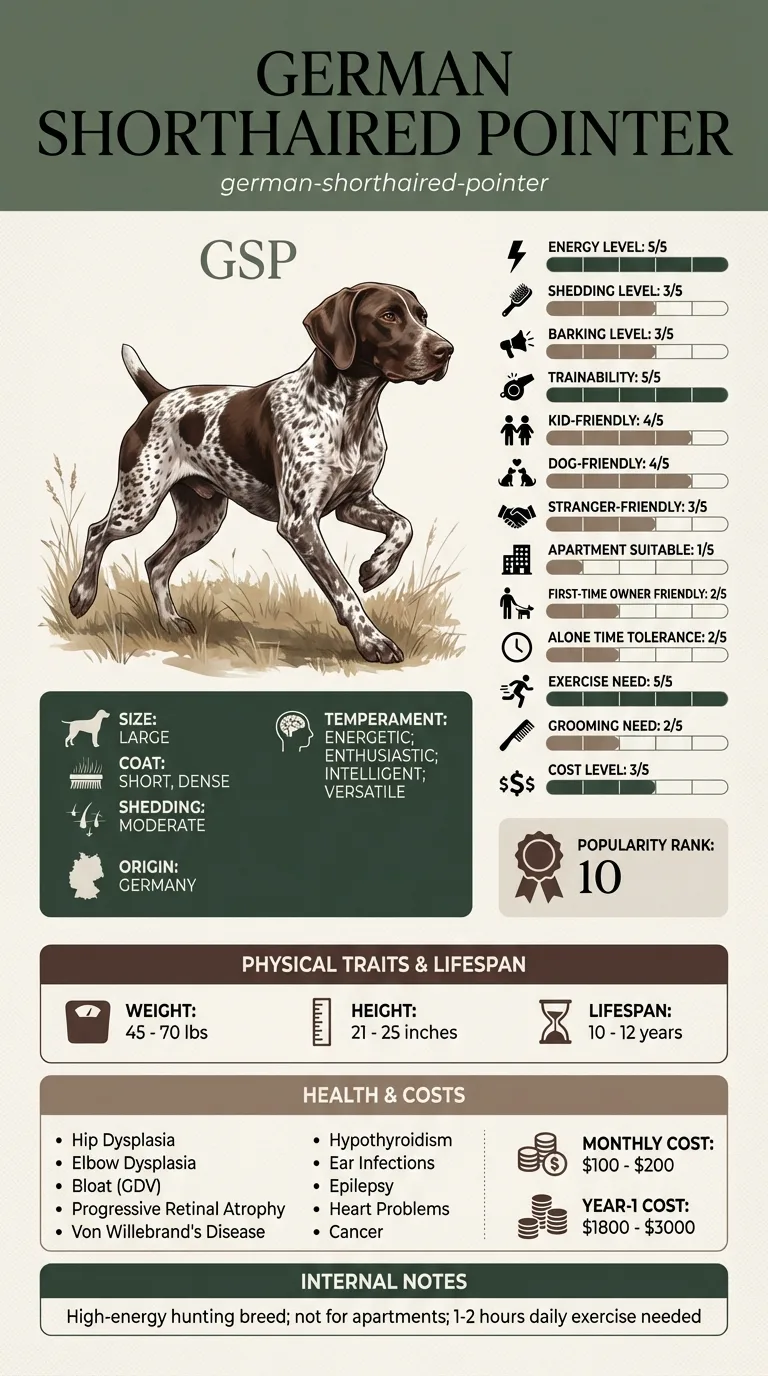
The German Shorthaired Pointer's documented health issues include heart problems alongside hip and elbow dysplasia, bloat, progressive retinal atrophy, von Willebrand's disease, hypothyroidism, ear infections, epilepsy and cancer. No single cardiac diagnosis is named for the breed, which is why the approach is screening rather than testing for one thing. What the breed does contribute is a masking effect: a dog rated five out of five for energy and exercise need has so much cardiac reserve that early disease produces no visible limitation at all.
Little in a dog's environment causes heart disease, but several things determine when it is noticed. An owner who works the dog and tracks its capacity spots a decline earlier than one who walks it around a block. Weight gained during an off-season increases cardiac workload directly. And a busy consulting room with an excited, panting dog produces a far less useful examination than a quiet one with a settled dog, which is worth requesting for a senior check.
Book an appointment if the sleeping breathing rate has risen above thirty, or has climbed noticeably from your dog's own baseline over a fortnight; also for a new cough, particularly at night, for stamina that has dropped and not recovered, or for a murmur you have been told about but never had explained. Go to an emergency clinic immediately for laboured breathing at rest, gums that are pale, grey or blue, a dog that will not lie down or that stands with its neck extended, collapse or fainting, or a rapidly swelling abdomen. Fluid accumulating in the lungs is a genuine emergency and it can develop over hours.
See all German Shorthaired Pointer health problems, which breeds are prone to cardiac disease, or the full German Shorthaired Pointer breed guide for temperament, exercise needs and ownership costs.
Screening is a habit rather than an event: an annual thorough listen, becoming a deliberate senior review from about eight, with monthly breathing counts at home in between. If disease is found, expect an ultrasound within a few weeks and then rechecks every six to twelve months. Where medication is started, improvement in breathing rate and comfort is often visible within days.
A dog whose heart disease, if it develops, is found before it produces symptoms, and whose owner has a baseline number to compare against. Success is a stable senior dog on a settled treatment plan, exercising at a level a vet has set, with an owner who will notice a change in the second week rather than the second month.
A cardiac assessment is not just a stethoscope on the chest. Understanding the steps helps you ask better questions and know when something has been skipped.
There is one measurement an owner can take at home that veterinary cardiologists genuinely rely on, and it costs nothing.
Count your dog's breaths while it is asleep, not merely resting, in a comfortable room. One breath is one rise and fall of the chest. Count for thirty seconds and double it. A healthy dog, of any size, almost always sits below thirty breaths per minute asleep, and most sit comfortably in the teens or low twenties.
The value of this number is that it rises before a dog looks ill. When the left side of the heart starts failing, fluid accumulates in the lungs, and the body's first response is to breathe faster rather than to breathe with obvious effort. A dog whose sleeping rate has climbed from eighteen to thirty over a fortnight is telling you something a week or two before it starts coughing or refusing walks.
For a German Shorthaired Pointer this is unusually valuable, because the breed's other early sign, reduced exercise tolerance, is so easily attributed to age or a hard season. A number written in a notebook is not open to that kind of interpretation. Take a baseline while your dog is well, ideally around age seven, and repeat it monthly.

Ash's owner started counting his sleeping breaths after a vet mentioned it at his seventh birthday check. He sat consistently at seventeen or eighteen a minute, and she wrote the number in a notebook on the first of each month, feeling slightly foolish about it. At ten, over about three weeks, the number went from eighteen to twenty-four, then twenty-nine. Nothing else had changed. He was eating, still walking, still cheerful. She rang the practice mostly because the trend bothered her. He had a murmur that had not been present the previous year, and the ultrasound showed early changes with fluid just beginning to back up. Treatment started that week. Within four days his sleeping rate was back to nineteen. He lived another two years, monitored on the same monthly count.
Key takeaway: She had no symptom to report. What she had was a trend in a notebook, and in heart disease that arrives before the cough, before the tiredness, and before the dog looks unwell.
A thorough listen at every annual visit throughout life, and a deliberate senior focus from around seven or eight, in a breed living ten to twelve years. If anything is heard, your vet will advise how often to recheck and whether imaging is warranted.
A grade two is a soft murmur, and grade alone does not tell you how serious the underlying problem is. Loudness reflects turbulence, not heart function. The useful next question is what your vet thinks is causing it and whether an ultrasound is recommended, not simply what the number was.
A rising sleeping breathing rate, a soft cough that is worse at night or after lying down, reduced stamina that does not recover with rest, a swelling abdomen, restlessness at night, and fainting. In this breed the stamina change is the one most often explained away.
Considerably more. It shows chamber sizes, valve function and how well the muscle is contracting, which is what determines treatment. Listening tells you something is worth looking at; imaging tells you what it is and whether medication should start.
Usually yes, at a level your vet sets, and gentle regular exercise is generally better than none. What is unwise is letting a high-drive gundog choose its own workload, since a GSP will run itself into trouble long before it volunteers to stop.
Heart problems sit on the breed's documented health list, so a family history is worth asking about when buying a puppy. Ask specifically what cardiac screening the parents had and who performed it, rather than accepting a general statement that the line is healthy.
Under thirty breaths a minute for a healthy dog, and usually well under. Take a baseline while your dog is well so you can spot a rise.
No. Some are incidental and some signal significant disease, and loudness does not reliably distinguish them. Imaging is what settles it.
Listening is part of a routine exam. A specialist ultrasound is a meaningful one-off cost, and repeat scans are usually annual once a problem is found.
Mostly not at all until your vet advises otherwise. Keep the dog lean, keep exercise regular and moderate, and start counting sleeping breaths.
A one-page prep sheet for this condition: the signs, the questions to ask, what to get priced. Unlocks here.
You get: Vet visit prep sheet
No spam. One-click unsubscribe. See our privacy policy.
See a sample page before you decide.
Early access list
The free prep sheet covers the same-day warning signs, a symptom log and the questions to ask. We are considering a fuller kit that adds a cost worksheet for the usual tests and treatments (US price ranges with their sources) and a plain-English guide to ways of covering the bill. It is not built yet; this list tells us whether it is worth building.
One email, no spam, unsubscribe anytime. Information only, not veterinary advice.