Health
Is BOAS a German Shorthaired Pointer problem?
No. It is a condition of short-muzzled breeds, and the GSP is a long-muzzled sporting dog with open nostrils and normal airway anatomy.

Quick answer
Is BOAS a German Shorthaired Pointer problem?
No. It is a condition of short-muzzled breeds, and the GSP is a long-muzzled sporting dog with open nostrils and normal airway anatomy.
If your GSP is struggling in the heat, the answer is not in its nose. It is in the fact that dogs cannot sweat, and this one has an engine built for work its cooling system cannot always keep up with.
Owners who have searched a symptom, heat distress after exercise, and landed on the wrong condition. Also anyone comparing breeds and trying to work out whether a GSP will cope with a hot climate.
This guide is not medical advice. If your dog shows pain, sudden behavior change, or worsening symptoms, consult a licensed veterinarian.
Some links may be affiliate links. We may earn a commission at no extra cost to you. We only suggest products we believe are helpful for dog owners.
We research and check what we publish, but we do not warrant that any figure, date, price, or statement is accurate, complete, or current, and we accept no liability for any loss, cost, injury, or other harm arising from the use of this site. Use it as one reference among several. You remain responsible for your own decisions and for your dog's care - confirm anything that matters with a licensed veterinarian or another qualified professional before you act on it. Full disclaimer.
Brachycephalic obstructive airway syndrome is caused by a shortened skull crowding normal soft tissue into too small a space. The German Shorthaired Pointer has a long, functional muzzle and does not have this condition. What GSP owners actually encounter, and often mislabel, is heat distress in a very high-output dog whose cooling depends entirely on evaporation.
Brachycephalic airway syndrome is effectively absent in the breed and does not appear on its documented health list. Heat distress, by contrast, is a routine concern for anyone who works a German Shorthaired Pointer in summer, and it is the reason most owners arrive at this topic in the first place.
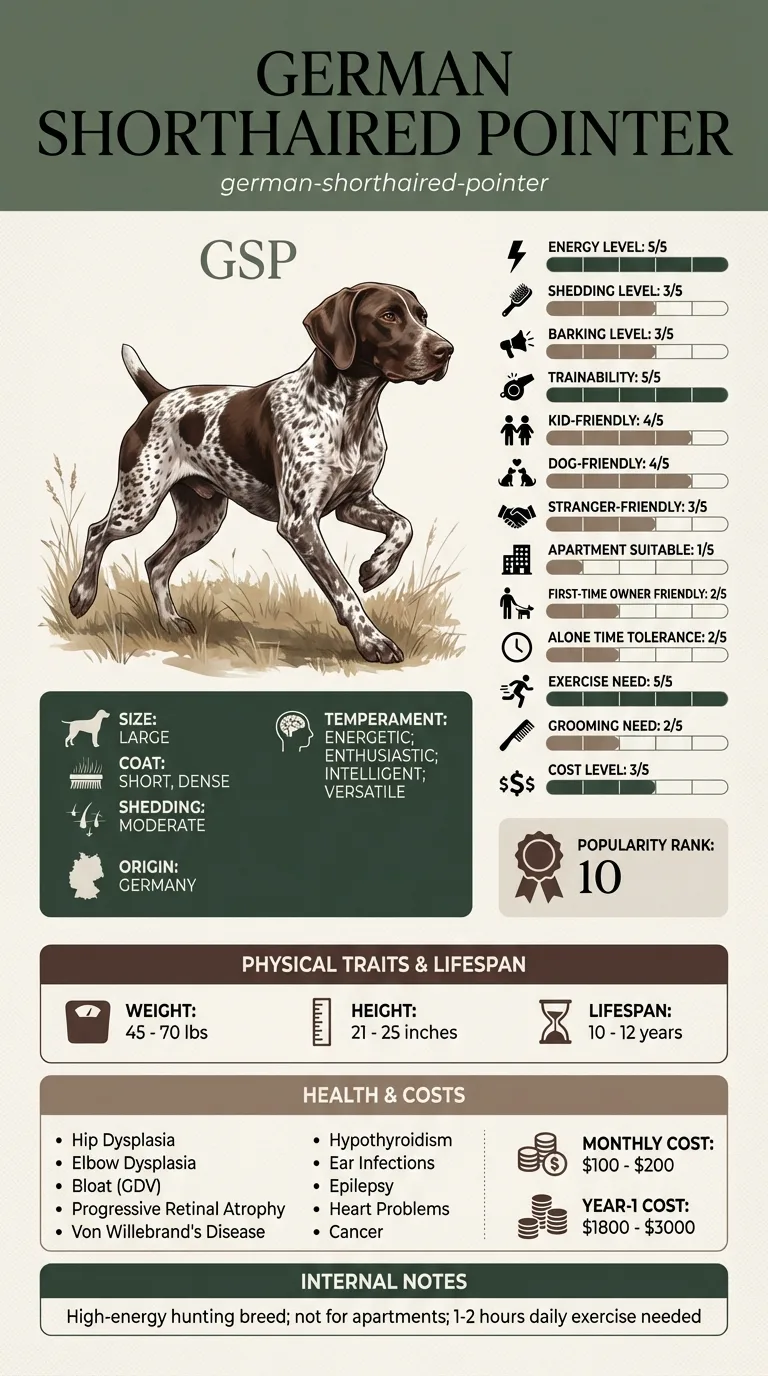
The German Shorthaired Pointer's anatomy protects it from airway syndrome and does nothing to protect it from heat load. This is a 45 to 70 pound dog rated five out of five for both energy and exercise need, capable of galloping for an hour or two, and heat production scales with muscular work. The long muzzle and folded nasal chamber give it a large evaporative surface and a real advantage over flat-faced breeds, but that advantage is a bigger cooling system, not an unlimited one. Temperament removes the safety margin: an enthusiastic dog does not self-regulate.
Ambient temperature is only half the picture. Humidity determines whether evaporation works at all, so a warm muggy morning is more dangerous than a hot dry one. Open stubble with no shade, no water on the route, dark vehicles, and the tendency to work the middle of the day because that is when people are free all raise risk. Body condition matters too, since a heavier dog produces more heat and sheds it less efficiently.
Book an appointment for any noisy breathing, new snoring, gagging or voice change in a German Shorthaired Pointer, because this breed has no anatomical excuse for those and they warrant investigation. Treat it as an emergency and go straight to a clinic, cooling the dog with water on the way, for frantic distressed panting that will not settle, bright red or brick-coloured gums, staggering, vomiting or diarrhoea after exertion in heat, collapse, or a body that feels abnormally hot to the touch. Heatstroke damages organs quickly and a dog that seems to recover on the drive can still deteriorate hours later.
See all German Shorthaired Pointer health problems, which breeds are prone to brachycephalic airway syndrome boas, or the full German Shorthaired Pointer breed guide for temperament, exercise needs and ownership costs.
There is nothing to treat or resolve here, so the timeline is seasonal rather than clinical. Expect to spend one summer working out your own dog's real limits, using recovery time as the measure, and to arrive at a warm-weather routine you repeat every year. Fitness improves heat tolerance somewhat, but far less than owners hope.
An owner who has stopped worrying about a condition their dog cannot get, and started managing the one it can. In practice that is a summer of early starts, water carried, enforced breaks, and a dog whose panting settles quickly after work, with no heat incidents on the record.
In a brachycephalic breed the bones of the face have been shortened dramatically, but the tongue, soft palate and other soft tissues have not shrunk to match. The result is too much tissue packed into too little space: nostrils narrowed to slits, a soft palate that overhangs the entrance to the windpipe, an oversized tongue, and, over years of fighting for air, a voice box that begins to collapse inward.
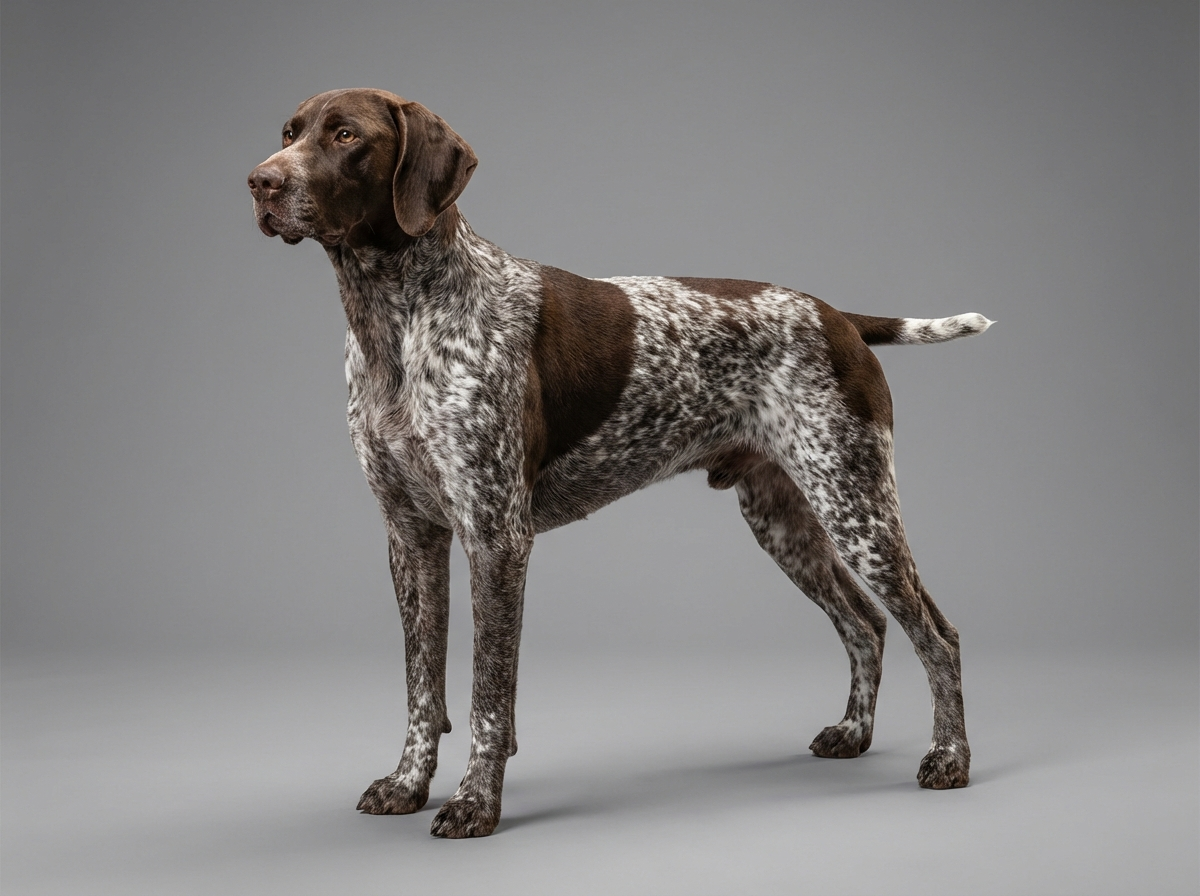
Every part of that is a consequence of the shortened skull. The German Shorthaired Pointer's skull is not shortened. It is a long-muzzled, mesocephalic breed developed in Germany as a versatile gundog, with wide, open nostrils and a nasal chamber built to process scent at a gallop. Structurally it is close to the opposite of a brachycephalic dog, and no reputable source lists BOAS among the breed's health problems. The documented list is hip and elbow dysplasia, bloat, progressive retinal atrophy, von Willebrand's disease, hypothyroidism, ear infections, epilepsy, heart problems and cancer.
That is worth stating clearly, because a GSP with genuine noisy breathing has a different problem, and searching for the brachycephalic explanation will take an owner further from the answer rather than closer to it.
Dogs do not sweat meaningfully. Almost all cooling happens through the respiratory tract, which is why muzzle length matters so much and why a GSP has an advantage that it can still be pushed past.

If you think your German Shorthaired Pointer has BOAS, the plan is three steps: write down what you have seen and when it started, book a veterinary appointment rather than waiting for the next flare, and take video of the sign before you go — the thing you are worried about rarely happens in the consulting room.
What the visit should produce is a diagnosis and a written plan: what is being ruled out, how often it is monitored, and which signs mean you come back sooner. Ask what the treatment costs across a year rather than per visit, because that is the number that decides whether you are managing BOAS or reacting to it.
Between appointments keep a short log — dates, what you saw, what changed. For BOAS in German Shorthaired Pointers it is usually what separates a clear pattern from a guess.
Alder's owner spent a July evening convinced her dog had an airway problem. He had come back from a twenty-minute run panting so hard he could not settle for half an hour, and an internet search had led her through brachycephalic airway syndrome to a long list of surgical procedures. Her vet took one look at Alder's long, open-nostrilled muzzle and explained that he had none of the anatomy that causes the syndrome. The examination was normal. What the history showed was a run at four in the afternoon, in humid weather, on open ground, with no water carried. The plan required no medicine. Runs moved to before seven in the morning, water went in the car, and she began timing his recovery. By August he was settling within ten minutes of stopping. She kept the routine permanently, and now uses recovery time as her gauge of whether the day is workable.
Key takeaway: The symptom was real and the diagnosis she found was not. In a long-muzzled breed, heat distress is far more likely than any airway malformation, and the fix is a change to the timetable rather than to the dog.
No. The breed is long-muzzled with open nostrils and normal soft tissue proportions, which is the opposite of the brachycephalic build that causes airway syndrome. Breathing problems in this breed have other explanations and should be investigated on their own terms.
Because dogs cool by evaporation from the airway, and there is a limit to how much heat that can move. A dog rated at the top of the scale for exercise need, running hard, generates heat faster than any cooling system can shed it once the ambient temperature climbs. That is a workload problem, not an anatomy problem.
Mild snoring in a relaxed sleeping dog is usually nothing. Snoring that is new, that is getting worse, or that comes with noisy breathing while awake deserves a veterinary look, because in a long-muzzled breed it can point at a nasal obstruction or a voice box problem rather than at normal anatomy.
Yes, widely. What changes is scheduling rather than suitability. Exercise moves to dawn and dusk, water and shade become non-negotiable, and midday work in summer stops. Owners who plan around the heat manage this breed successfully in genuinely hot places.
Potentially yes. A dog with brachycephalic ancestry can inherit a shortened muzzle regardless of the other parent. If your dog is a cross with a visibly shortened face, it should be assessed on its own anatomy rather than on the pointer half of its heritage.
Less than people assume. The German Shorthaired Pointer's short, dense coat provides some protection from direct sun and does not trap heat the way a heavy double coat can, but coat length is a minor factor compared with panting capacity, humidity and workload.
No. It is a condition of short-muzzled breeds, and the GSP is a long-muzzled sporting dog with open nostrils and normal airway anatomy.
Panting is how it dumps heat, and a dog working at this intensity produces a great deal. Heavy panting that does not settle within about fifteen minutes of stopping is worth taking seriously.
There is no single number, because humidity matters as much as temperature. Judge by the dog's recovery rather than the thermometer, and start earlier in the day when in doubt.
Yes. Because the GSP has no anatomical reason to breathe noisily, new noise is a signal rather than a breed trait and should be examined.
A one-page prep sheet for this condition: the signs, the questions to ask, what to get priced. Unlocks here.
You get: Vet visit prep sheet
No spam. One-click unsubscribe. See our privacy policy.
Preview page 1 before you decide.