Health
What is the biggest growth mistake GSP owners make?
Overfeeding a growing puppy and raising it too heavy. Lean, steady growth protects joints better than any supplement.

Quick answer
What is the biggest growth mistake GSP owners make?
Overfeeding a growing puppy and raising it too heavy. Lean, steady growth protects joints better than any supplement.
The first year is the only part of your dog's life where what you put in the bowl can permanently change its joints. Most owners find that out afterwards.
New owners of a puppy between three and twelve months, especially those with a lively pup who seems capable of far more exercise than the guidelines allow, and those worried by a sudden unexplained limp in an otherwise healthy youngster.
This guide is not medical advice. If your dog shows pain, sudden behavior change, or worsening symptoms, consult a licensed veterinarian.
Some links may be affiliate links. We may earn a commission at no extra cost to you. We only suggest products we believe are helpful for dog owners.
Growth problems are the conditions that arise while a puppy's skeleton is still being built. In German Shorthaired Pointers they cluster between about four and twelve months and range from painful but self-limiting bone inflammation to joint changes that persist for life. Nutrition, body weight and exercise choices during that window all influence the outcome.
Both hip dysplasia and elbow dysplasia appear on the German Shorthaired Pointer's documented health list, so developmental joint problems are a genuine breed concern rather than a rarity. Panosteitis is common in fast-growing large-breed youngsters generally. Most growth-period lameness in this breed resolves, but the proportion that does not is the reason each episode is worth investigating.
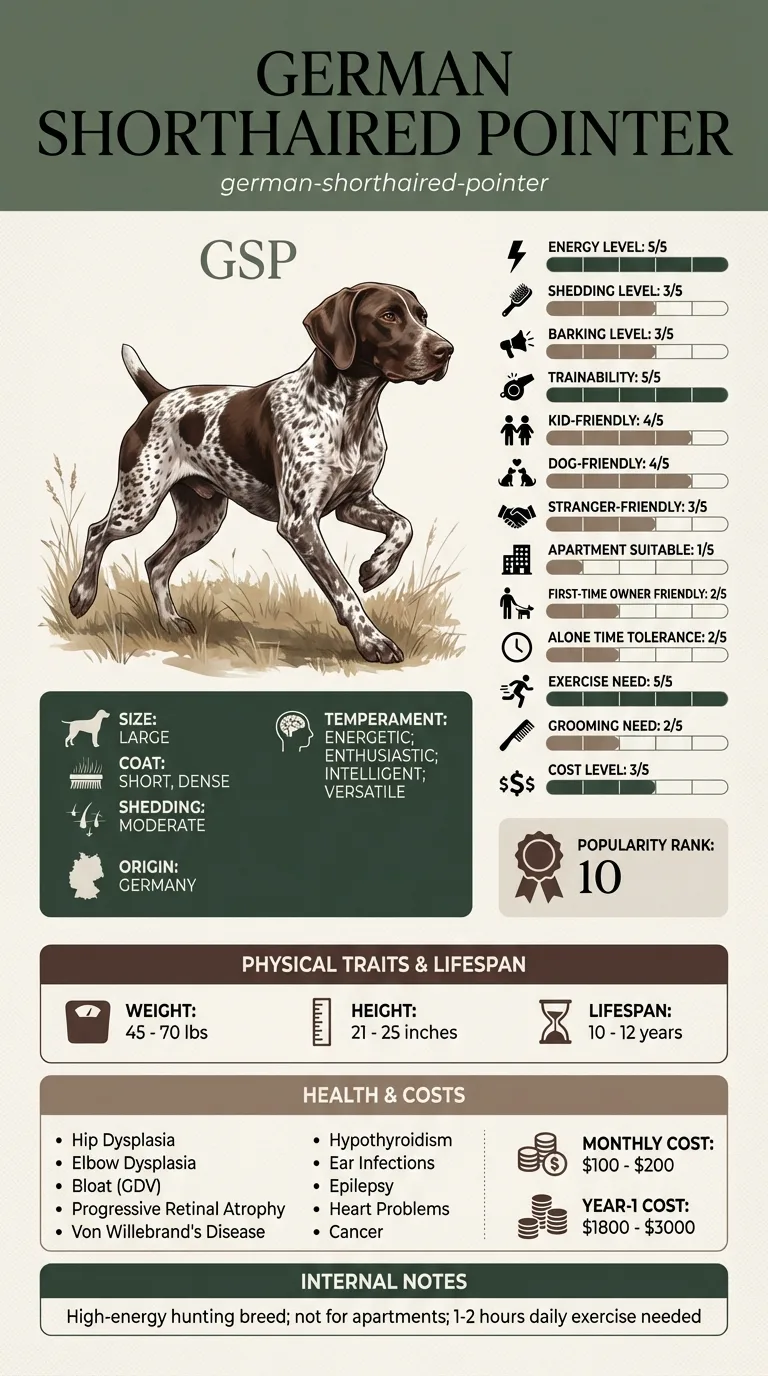
The German Shorthaired Pointer builds a 45 to 70 pound athletic frame in roughly twelve months, which is a demanding schedule for cartilage and bone. Hip and elbow dysplasia both feature in the breed's documented health issues, meaning some dogs start with joints that have less tolerance for error. The temperament compounds the risk in an unusual way: a breed rated five out of five for energy will demand and appear to enjoy far more exercise than its growing skeleton should be doing, and puppies give no useful feedback about damage they are accumulating.
Almost all of the modifiable risk sits with the owner's routine. Free feeding, generous portions and a chubby puppy, supplements added out of good intentions, high tailgates a pup jumps down from daily, slippery kitchen floors, and structured endurance exercise begun too early are the recurring themes. A busy household that lets a bored puppy run itself ragged on hard ground is doing more harm than one that tires the same puppy with scentwork indoors.
Book an appointment for any lameness in a growing puppy that lasts more than a day or two, and for any lameness that recurs, even if it moves between legs. A vet needs to separate self-limiting bone pain from a joint problem that will not resolve on its own, and that separation usually needs radiographs. Go urgently for a puppy that will not bear weight on a limb at all, has an obviously swollen or hot joint, is running a fever and is reluctant to move, or has become lame immediately after a fall. Sudden non-weight-bearing lameness in a young dog can mean a fracture through a growth plate, which is time-critical.
See all German Shorthaired Pointer health problems, which breeds are prone to bone growth issues, or the full German Shorthaired Pointer breed guide for temperament, exercise needs and ownership costs.
Panosteitis episodes typically last one to three weeks each and recur intermittently until the dog is around eighteen months old, then stop. Osteochondrosis and elbow problems are diagnosed during the growth period and, if surgery is needed, followed by two to three months of controlled rehabilitation. The consequences of hip and elbow dysplasia unfold over years rather than months.
A yearling that is lean, well-muscled, sound at trot, and has never been asked to do sustained forced exercise. Success is measured a decade later, in a nine-year-old that still moves well, and it is largely determined by decisions made before the dog's first birthday.
Most are self-limiting and resolve as the dog matures. A few leave permanent joint change, and telling them apart is what a vet visit is for rather than a wait-and-see at home.
The most powerful lever an owner has over a GSP's adult joints is the food bowl during the first year, and it works in the opposite direction to most people's instincts.
A growing skeleton lays down cartilage at the ends of the bones and converts it to bone as the dog matures. If the puppy grows very fast, or carries excess weight while it does, that conversion happens under load it was not designed for. Cartilage that should have become bone stays thick and poorly supported, and joints that are already only just fitting together, in a breed where hip and elbow dysplasia are both documented, are pushed further out of tolerance.
The practical consequences are simple and slightly counterintuitive. A large-breed puppy should be raised lean, not plump. It should grow steadily rather than as fast as it possibly can, since maximum growth rate is not the same as best outcome. And calcium supplementation on top of a complete puppy food is not helpful; a growing dog cannot regulate excess calcium well, and extra can actively interfere with normal bone development. If your pup is on a complete large-breed puppy diet, adding supplements is a way to cause harm rather than prevent it.

Pike was a big, confident pup whose owners were proud of how well he was doing. At six months he weighed more than his littermates and had a soft, rounded look they read as condition. They fed the amount printed on the bag and topped it with a calcium supplement recommended by a friend with a different breed. At seven months he became lame on a front leg. It was the elbow, and radiographs showed early developmental change. The vet's assessment was blunt: the genetics were not in Pike's control, but the weight and the supplement had not helped, and both were changeable that afternoon. They stopped the supplement, weighed his food, and brought him down to a lean condition over three months. His exercise moved to free play and scentwork with no road work until fourteen months. He needed one elbow procedure and has been sound since. He is now five and hunts full days.
Key takeaway: The feeding guide on the bag is a starting estimate, not an instruction, and a well-covered large-breed puppy is not a well-raised one. Growth is the only window in a GSP's life where the bowl outranks almost everything else.
Far less forced exercise than the pup will demand. Free play on soft ground where the puppy sets its own pace and stops when tired is very different from a structured run alongside a bike or a long forced march. Ask your vet for a schedule tied to your dog's age rather than its energy.
That shifting pattern is the signature of panosteitis, which is common in fast-growing large-breed youngsters. It still needs veterinary confirmation, because elbow and shoulder problems can also produce intermittent front-leg lameness with a very different prognosis.
Yes, a complete diet formulated for large-breed growth is the sensible default, because the calcium and energy balance is designed for exactly this situation. Feed to a lean body condition rather than to the bag's suggested amount, which is a starting point rather than a prescription.
Minimise both while the growth plates are open. Repeated jumping down onto hard ground is the classic mechanism for growth plate and joint injury, and a young pointer will happily do it a hundred times without ever showing you that it hurt.
Broadly between about ten and fourteen months in a dog this size, though it varies. Until then the ends of the long bones contain soft growth zones that hard impact can damage. Your vet can advise when your individual dog is ready for sustained running work.
It is the single most effective preventive measure that exists for hip and elbow dysplasia, both of which are documented in this breed. Ask to see the hip and elbow scores for both parents and check what the numbers mean rather than accepting that they were tested.
Overfeeding a growing puppy and raising it too heavy. Lean, steady growth protects joints better than any supplement.
No, not on top of a complete puppy diet. Excess calcium interferes with normal bone development in a growing large-breed dog.
Scentwork, training games and chewing. Mental work exhausts a young pointer far more efficiently than distance, and costs the joints nothing.
Panosteitis costs little beyond exams and pain relief. Surgery for a cartilage flap or an elbow problem is a significant one-off cost, which is an argument for insuring from day one.
A one-page prep sheet for this condition: the signs, the questions to ask, what to get priced. Unlocks here.
You get: Vet visit prep sheet
No spam. One-click unsubscribe. See our privacy policy.
Preview page 1 before you decide.