Health
What is the earliest sign of elbow dysplasia?
Intermittent front-leg lameness in a dog between five and twelve months, worse after exercise and better after rest. It is subtle and it is not a growth phase.

Quick answer
What is the earliest sign of elbow dysplasia?
Intermittent front-leg lameness in a dog between five and twelve months, worse after exercise and better after rest. It is subtle and it is not a growth phase.
A young pointer that is subtly lame on a front leg after exercise is not being dramatic and is not going through a growth phase. In this breed that is the elbow until someone proves otherwise.
Owners of dogs between five and twelve months with an intermittent front-leg lameness, owners choosing a puppy and trying to read elbow scores, and owners of adults now dealing with the arthritis that follows.
This guide is not medical advice. If your dog shows pain, sudden behavior change, or worsening symptoms, consult a licensed veterinarian.
Some links may be affiliate links. We may earn a commission at no extra cost to you. We only suggest products we believe are helpful for dog owners.
Elbow dysplasia is a group of developmental faults in how the three bones of the elbow fit together. Any of them causes uneven loading, cartilage damage and, over years, arthritis. It is documented among the German Shorthaired Pointer's typical health issues and usually declares itself as a subtle front-leg lameness in a growing dog.
Elbow dysplasia appears explicitly on the German Shorthaired Pointer's documented health list, making it one of the breed's recognised orthopaedic problems alongside hip dysplasia. Prevalence differs markedly between breeding lines, which is why parental screening scores are the single most informative thing a puppy buyer can look at.
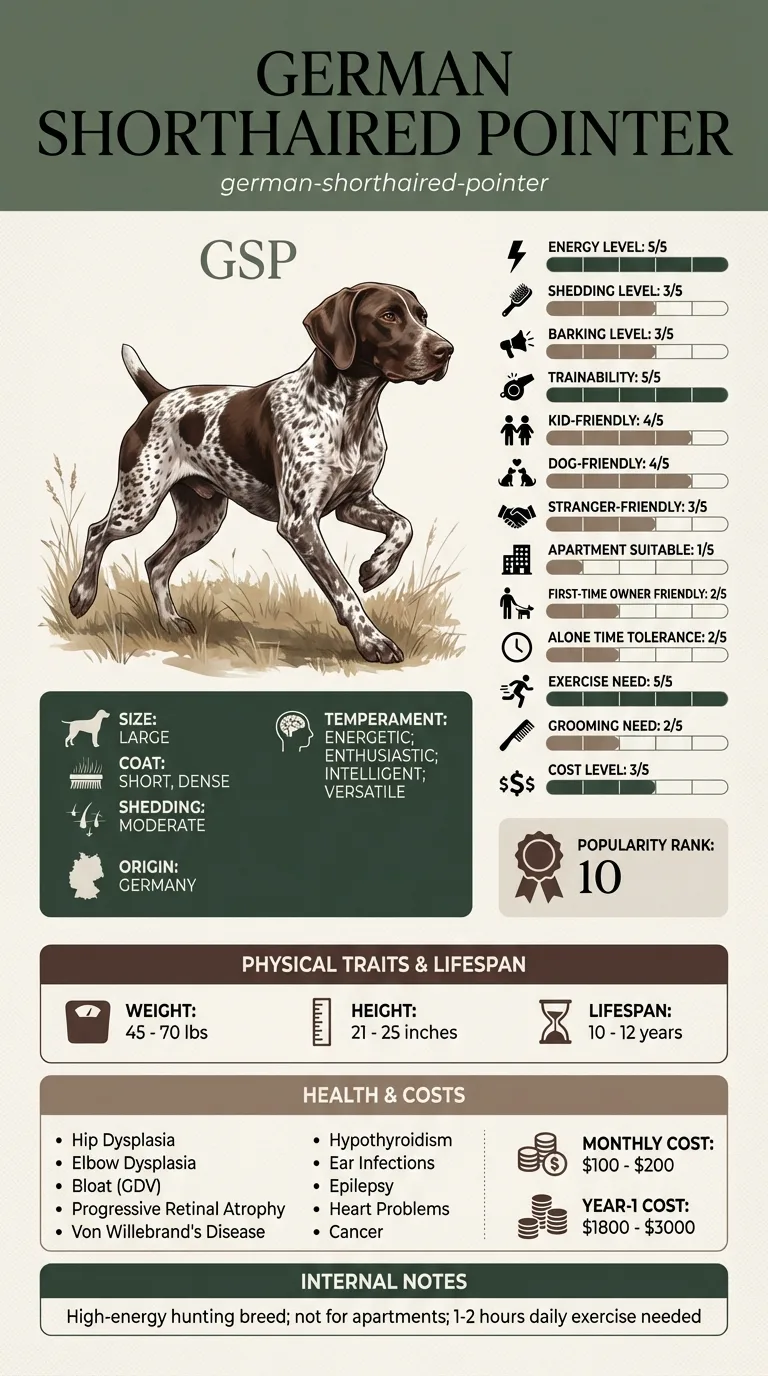
Elbow dysplasia is inherited, and it is documented in the German Shorthaired Pointer specifically. The breed's build and drive determine how it plays out. A dog reaching 45 to 70 pounds and 21 to 25 inches in about a year is building a complex joint fast, and any small mismatch in the growth rates of the radius and ulna translates into an incongruent elbow. Then a breed rated five out of five for both energy and exercise need puts that joint through more repetitions in a decade than almost any other breed of similar size would.
The first year is where owners have leverage. Overfeeding, a heavy puppy, mineral supplements added to a complete diet, structured forced exercise before the growth plates close, and daily jumps down from a tailgate all increase the load on a joint that is still forming. Later, ground conditions and body weight determine how fast the resulting arthritis progresses, and inconsistent exercise patterns are harder on the joint than steady work.
Book an appointment for any front-leg lameness in a growing dog that lasts more than a day or two or that keeps returning after exercise, and ask specifically for the elbow to be assessed. In an adult, book for stiffness on rising, a shortened front stride, or muscle loss over one shoulder. Go urgently for a dog that will not bear any weight on a front leg, for a joint that is hot and visibly swollen, for a dog with a fever that is reluctant to move, or for lameness that begins immediately after a fall. Sudden non-weight-bearing lameness in a young dog can mean a fracture through a growth plate and needs same-day assessment.
See all German Shorthaired Pointer health problems, which breeds are prone to elbow dysplasia, or the full German Shorthaired Pointer breed guide for temperament, exercise needs and ownership costs.
Diagnosis usually takes one to three weeks including radiographs and, often, a specialist opinion with advanced imaging. Keyhole surgery is followed by six to twelve weeks of controlled rehabilitation, with return to full work at three to four months. Arthritis develops progressively over years regardless, so expect this to become a lifelong management commitment rather than a fixed problem.
A dog that is sound at trot, has even muscle over both shoulders, holds a lean weight, and works productively on a consistent exercise routine with a defined ceiling. Success is not an elbow that looks normal on a radiograph at eight; it is a dog that is comfortable and still doing its job.
Elbow dysplasia is not a single lesion, which is why the diagnosis, treatment and outlook vary so much between dogs. A surgeon will want to know which of these your dog has.
Elbow dysplasia in a German Shorthaired Pointer almost always announces itself between about five and twelve months, and it almost always announces itself quietly.
The classic history is a puppy that is slightly stiff or short-strided on a front leg after a long play session or a big day out, and normal again by the following morning. Nothing is dramatic. The puppy is not crying, is eating, and is desperate to keep going. Because the lameness resolves with rest, and because everybody knows that growing puppies have odd episodes, the first few incidents are attributed to a knock, a strain or a growth phase.
The breed makes this worse in a specific way. A German Shorthaired Pointer at six months has enormous drive and no judgement, and it will keep running on a painful elbow all day. The lameness an owner sees is what is left over after the dog has masked everything it can.
The reason this matters is that intervention has a window. Removing a loose fragment or addressing incongruity while the dog is still growing can meaningfully change how much arthritis develops over the following decade. The same surgery on a three-year-old with an established arthritic joint achieves considerably less. The dog that limps at seven months and is investigated at seven months has options that the same dog does not have at eighteen.

If you think your GSP has elbow dysplasia, the plan is three steps: write down what you have seen and when it started, book a veterinary appointment rather than waiting for the next flare, and take video of the behaviour or symptom before you go — the thing you are worried about rarely happens in the consulting room. Screening in the parents covers hip dysplasia, elbow dysplasia, bloat (gdv).
What the vet visit should produce is a diagnosis and a written plan, not just reassurance: what is being ruled out, what the monitoring interval is, and which signs mean you come back sooner. Ask what the treatment costs across a year rather than per visit, because that is the number that decides whether you are managing this condition or reacting to it.
Between appointments, keep a short log — dates, what you saw, what changed. It is the single most useful thing an owner brings to a follow-up, and for elbow dysplasia it is often what separates a clear pattern from a guess.
Birch was slightly off on his left front after big days, and right again by the next morning. His owner mentioned it twice and was told, reasonably, to rest him and see. It kept coming back. What changed the conversation was a video. She filmed him trotting up the yard on concrete and watched it back at half speed, and the head nod was unmistakable. She brought the clip to the appointment. Radiographs showed changes in both elbows, worse on the left. Keyhole surgery found and removed a fragmented coronoid process on that side, and the right was managed conservatively. He had ten weeks of rehabilitation, came back into work at four months, and has hunted every season since on a strictly lean weight. He is six now, with mild arthritis on both sides that is managed and has never stopped him.
Key takeaway: The intermittent limp was real and the rest-and-see advice was reasonable, but the video was what made it undeniable. Thirty seconds of slowed footage is the cheapest diagnostic tool a puppy owner has.
It is listed among the breed's documented health issues, alongside hip dysplasia, which places it firmly on the list of things a GSP owner should know about. Prevalence varies considerably between lines, which is exactly why screening of breeding stock matters.
Screening schemes grade elbows from zero, meaning no visible arthritic change, up to three, meaning severe change, and a dog is given the score of its worse elbow. Ask for both parents' actual scores rather than an assurance that they were screened, and prefer zeros.
Most affected dogs show something between five and twelve months, though mild cases can go unnoticed until arthritis produces stiffness in middle age. Any front-leg lameness in a growing large-breed puppy deserves radiographs rather than rest and hope.
No. Some dogs are managed with weight control, controlled exercise and pain relief. Surgery, usually keyhole, is more likely to be recommended for a loose fragment or a cartilage flap and is most valuable when done relatively early.
Almost certainly some, and it is important to hear that plainly. Elbow dysplasia leads to joint degeneration over years even in well-managed dogs. The purpose of treatment is to slow it and to keep the dog comfortable and working, not to prevent it entirely.
Many affected dogs work productively for years on a lean weight, consistent conditioning and appropriate pain management. What tends not to work is a dog left to choose its own workload, since a GSP will not moderate for a sore joint.
Intermittent front-leg lameness in a dog between five and twelve months, worse after exercise and better after rest. It is subtle and it is not a growth phase.
For the actual elbow scores of both parents, not just confirmation that they were screened. Zero on both elbows is what you want to see.
Radiographs and a specialist assessment are moderate; keyhole surgery is a significant one-off cost, often on both sides. Lifelong management adds a recurring line.
Enormously, and it is free. Keeping a GSP at the lean end of its 45 to 70 pound range reduces load on the joint every step of its life.
A one-page prep sheet for this condition: the signs, the questions to ask, what to get priced. Unlocks here.
You get: Vet visit prep sheet
No spam. One-click unsubscribe. See our privacy policy.
Preview page 1 before you decide.